
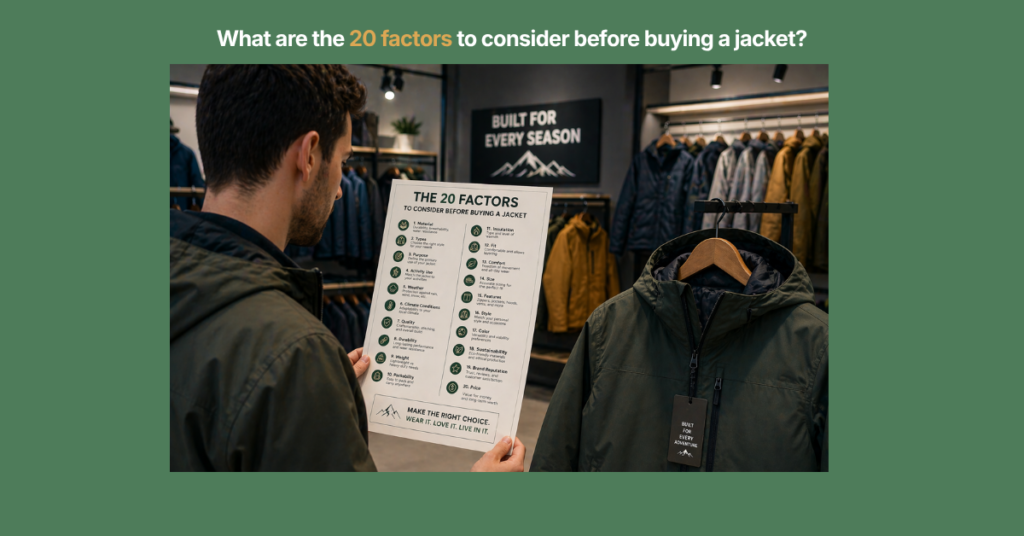
What are the 20 factors to consider before buying a jacket?
Summary Answer:
Considering 20 specific jacket buying factors provides a structured framework to align outerwear purchases with local climates, daily commute demands, and long-term utility. Evaluating isolated attributes like material durability, thermal insulation, and anatomical fit prevents purchasing errors by matching garment construction directly to your specific environmental and physical requirements.
The 20 Factors Covered in This Guide:
- Jacket Material
- Jacket Types
- Jacket Purpose
- Jacket Activity Use
- Jacket Weather
- Jacket Climate Conditions
- Jacket Quality
- Jacket Durability
- Jacket Weight
- Jacket Packability
- Jacket Insulation
- Jacket Fit
- Jacket Comfort
- Jacket Size
- Jacket Features
- Jacket Style
- Jacket Color
- Jacket Sustainability
- Jacket Brand Reputation
- Jacket Price
Why Does Jacket Material Matter Before Buying?
Jacket material refers to the outer face fabric and inner lining construction that dictates the garment’s overall abrasion resistance, breathability, and water repellency. High-denier nylon face fabric resists physical abrasion, extending the overall lifespan of the garment in harsh transit environments.
What Jacket Types Should You Know Before Buying?
Jacket types categorize outerwear based on structural design and intended thermal profiles, ranging from lightweight windbreakers to heavy expedition parkas. Specific jacket typologies dictate anatomical coverage, optimizing thermal protection for their specifically intended environments.
Why Does Jacket Purpose Matter When Choosing a Jacket?
Jacket purpose defines the primary functional intent of the garment, establishing whether it is engineered for high-output alpine sports or static urban commuting. Defining a clear functional purpose restricts feature bloat, preventing the purchase of unnecessary technical hardware.
How Does Jacket Activity Use Affect Jacket Selection?
Jacket activity use measures the physical intensity, metabolic output, and kinetic movement requirements expected from the wearer during operation. High-output activity profiles require active-stretch paneling, eliminating physical restriction during dynamic movement.
Why Do Jacket Weather Conditions Matter Before Buying?
Jacket weather refers to the specific atmospheric conditions—such as wind, rain, or snow—the garment is engineered to withstand and deflect. Weather-specific membrane integration blocks external moisture, keeping the wearer’s underlying base layers completely dry.
How Do Jacket Climate Conditions Affect Jacket Selection?
Jacket climate conditions categorize the macro-environmental temperature ranges and seasonal humidity levels of your specific geographic region. Regional climate mapping aligns baseline insulation volume with seasonal averages, preventing dangerous core temperature drops.
Climate & Structural Requirement Matrix:
| Climate Profile | Average Temp Range | Recommended Insulation | Ideal Face Fabric / Membrane |
|---|---|---|---|
| Mild & Wet | 40°F to 60°F | Lightweight Synthetic | Unlined / 2.5-Layer Waterproof |
| Cold & Dry | 15°F to 40°F | High Fill-Power Down | Tightly Woven Nylon / Windproof |
| Freezing & Wet | -10°F to 30°F | Heavyweight Synthetic | 3-Layer Membrane / Seam-Sealed |
| Extreme Alpine | Below -10°F | Expedition-Grade Down | Reinforced Ripstop / Heavy Denier |
Why should I consider jacket quality before buying?
Jacket quality evaluates the manufacturing precision, stitching density, and hardware grade utilized throughout the garment’s construction. Premium molded-tooth hardware ensures smooth mechanical operation, reducing the likelihood of catastrophic zipper failure.
How Does Jacket Durability Affect Your choice?
Jacket durability measures a garment’s physical capacity to withstand repeated friction, structural tension, and environmental degradation over time. Reinforced ripstop weaving localizes fabric tension, preventing minor surface punctures from becoming catastrophic tears.
Is Jacket Weight the Most Important Factor to Consider Before Buying?
Jacket weight calculates the total physical mass of the garment, which directly impacts physical fatigue and layering compatibility. Low-density synthetic fabrics reduce overall garment mass, minimizing metabolic fatigue during extended periods of wear.
Does Jacket Packability Matter When You Are Buying?
Jacket packability evaluates the degree to which a garment can be safely compressed for storage or travel without damaging internal insulating structures. Highly compressible down clusters reduce the garment’s spatial footprint, allowing for efficient integration into small travel packs.
Is Jacket Insulation Important to Consider Before Buying?
Jacket insulation refers to the internal material—either natural down clusters or synthetic fibers—designed to trap dead air space and retain body heat. High fill-power down creates a robust thermal barrier, sustaining core body temperature in sub-zero environments. (For deeper density metrics, review our TorivaWear hub on Understanding Down Fill Power).
Is Jacket Fit the Most Important When Buying a Jacket?
Jacket fit describes the spatial relationship between the garment’s anatomical cut and the wearer’s physical body dimensions. Articulated structural patterning allows for natural kinetic movement, eliminating fabric tension across the back and shoulders.
Why Jacket Comfort Should Drive Your Buying Decision?
Jacket comfort encompasses the tactile sensation, thermal equilibrium, and freedom from dermal friction experienced by the wearer. Soft-touch tricot linings reduce skin friction, maintaining sensory ease during prolonged periods of daily wear.
How Should You Choose Jacket Size Before Buying?
Jacket size standardizes the garment’s dimensional measurements, ensuring adequate internal volume for varied body types and layering systems. Proper volumetric sizing provides sufficient internal space, preventing the compression of essential mid-layer garments.
Are Jacket Features Important When Choosing a Jacket?
Jacket features include specific functional structural additions—such as cinch cords, drop-tail hems, and specialized pockets—designed to enhance localized utility. Multi-point adjustable hoods stabilize peripheral vision, ensuring safe physical navigation during high-wind events.
Why Does Jacket Style Matter When Choosing a Jacket?
Jacket style denotes the aesthetic silhouette and visual lineage of the garment, determining its appropriateness for professional, casual, or tactical settings. Minimalist architectural lines streamline the visual profile, ensuring seamless integration into formal urban dress codes.
How Does Jacket Color Influence Your Decision When Buying a Jacket?
Jacket color determines the garment’s visual hue, which directly impacts thermal absorption, stain visibility, and low-light physical safety. High-visibility chromatic dyes reflect external light sources, maximizing wearer safety in low-light transit conditions.
Why Jacket Sustainability Is Essential When Buying a Jacket?
Jacket sustainability evaluates the environmental impact of the garment’s supply chain, material sourcing transparency, and end-of-life recyclability. Responsibly sourced down certifications mandate ethical animal treatment, eliminating cruelty from the manufacturing process.
How Does Jacket Brand Reputation Influence Your Buying Decisions?
Jacket brand reputation reflects the manufacturer’s historical track record for quality control, warranty fulfillment, and material innovation. Comprehensive lifetime manufacturer warranties guarantee structural repair, protecting the consumer’s initial financial investment.
Is Jacket Price a Factor to Consider Before Buying a Jacket?
Jacket price quantifies the upfront financial cost of the garment relative to its material components, manufacturing complexity, and brand markup. Calculating cost-per-wear amortizes the initial purchase price, revealing the true long-term financial value of a durable garment.
Cost-Per-Wear (CPW) Financial ROI Analysis:
| Garment Tier | Upfront Purchase Price | Estimated Lifespan (Wears) | Calculated Cost-Per-Wear | Financial ROI Assessment |
|---|---|---|---|---|
| Fast-Fashion Trend | $90 | 60 | $1.50 | Negative / Rapid Replacement Required |
| Mid-Tier Commuter | $180 | 300 | $0.60 | Moderate / Good Everyday Utility |
| Premium Technical | $400 | 800+ | $0.50 | High / Maximum Long-Term Yield |
Conclusion: A summary of practical jacket evaluation
In conclusion, purchasing the correct outerwear requires a systematic evaluation of environmental factors, material durability, anatomical fit, and hardware utility. Matching insulation to local weather, prioritizing durable hardware like YKK zippers, and calculating Cost-Per-Wear are the core tenets of a smart outerwear investment. Ultimately, evaluating outerwear through a structured framework of practical utility significantly increases the likelihood of a successful, long-term wardrobe investment.
The 20-point jacket buying checklist for your next purchase
Use this final 20-point checklist to systematically verify that a chosen jacket matches your specific climate, daily routine, and personal comfort requirements.