
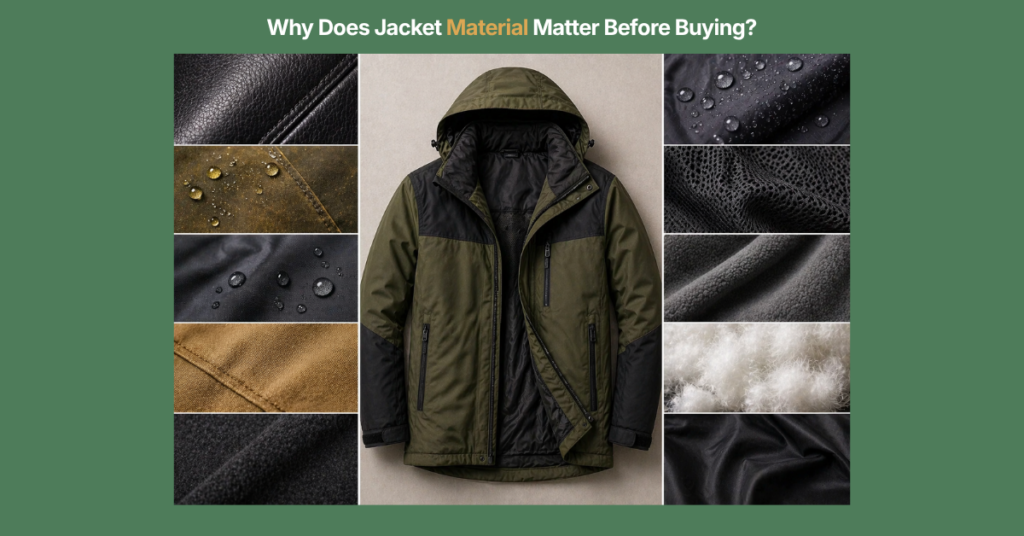
Why Does Jacket Material Matter Before Buying?
Jacket material matters before buying because the specific textile engineering—not the brand logo—dictates a garment’s ability to manage internal vapor pressure, block external precipitation, and trap dead air space in real-world environments. Purchasing outerwear based on visual trends rather than reading the fabric composition tag frequently leads to catastrophic thermal failure—either severe overheating or dangerous freezing—in the field. This guide breaks down how to evaluate exterior membranes, compare insulation types, and assess fabric durability so you can purchase outerwear engineered for your exact climate.
Why evaluating jacket material prevents expensive buying mistakes
Evaluating jacket material prevents expensive buying mistakes by shifting your purchasing criteria away from brand aesthetics and toward objective textile performance data.
Rule: Always check the material composition tag before the price tag.
Reason: A premium designer brand using a non-breathable Polyurethane (PU) coated fabric will functionally underperform a budget brand utilizing a micro-porous expanded polytetrafluoroethylene (ePTFE) membrane.
Example: You will experience the physical discomfort of sweating profusely inside a $400 raincoat because the PU jacket material acts as a solid plastic vapor barrier, trapping metabolic heat instead of venting it.
How to match waterproof jacket fabrics to your local weather conditions
Matching waterproof jacket fabrics to your local weather conditions requires decoding textile descriptions to ensure the membrane technology aligns precisely with your regional precipitation volume.
- DWR-treated fabrics: Durable Water Repellent (DWR) chemically alters surface tension, allowing light drizzle to bead up and roll off. However, it provides zero barrier against sustained rain. This textile is best reserved for short city commutes.
- 2-layer coated fabrics: These garments utilize liquid Polyurethane (PU) coatings applied directly to the inner face of the exterior fabric. They perform best for moderate, everyday rain where extreme physical exertion is not a factor.
- 3-layer micro-porous membranes: Materials like ePTFE (such as GORE-TEX) are mandatory jacket materials for heavy downpours and high-output activities. They physically block external liquid water droplets while maintaining pores large enough to vent internal vapor.
Weather & Fabric Decision Matrix
| Precipitation Type | Required Fabric Technology | Breathability Need |
|---|---|---|
| Light Drizzle / Mist | DWR-treated fabrics | High |
| Moderate, Everyday Rain | 2-layer PU coated fabrics | Low to Moderate |
| Heavy Downpour / Snow | 3-layer micro-porous (ePTFE) | High (for physical exertion) |
Compare natural versus synthetic jacket insulation before making a purchase
Comparing natural versus synthetic jacket insulation before making a purchase prevents dangerous heat loss in wet climates by aligning the fill material’s physical structure with your environmental reality.
If you live in a wet, freezing climate (like the Pacific Northwest), Do choose continuous filament synthetic jacket insulation.
Result: The synthetic material structurally resists collapsing and retains its thermal heat-trapping ability even if heavy rain breaches the outer shell.
Natural down offers a mathematically superior warmth-to-weight ratio for dry, sub-zero conditions, but completely loses its insulating loft when wet. (For a complete breakdown of fill powers and synthetic equivalents, consult our TorivaWear Down vs. Synthetic Insulation Guide).
Insulation Material Comparison Table
| Material Type | Warmth-to-Weight Ratio | Wet Performance | Ideal Buyer Profile |
|---|---|---|---|
| Synthetic Fill | Moderate | Excellent (retains loft) | Wet climate residents, active hikers |
| Natural Down | Superior | Poor (loses loft instantly) | Dry climate residents, extreme cold exposure |
Assess jacket material durability to ensure long-term everyday performance
Assessing jacket material durability ensures long-term everyday performance by matching the face fabric’s thickness and weave structure to your expected level of daily physical abrasion.
The Denier (D) rating acts as the objective measurement of a textile’s yarn thickness. High-denier nylon, typically ranging from 40D to 70D, combined with a Ripstop weave is critical for resisting abrasion from harsh hiking environments or the friction of carrying heavy backpacks. Conversely, softer, low-denier polyester materials falling between 15D and 20D are perfectly adequate for driving, urban commuting, and casual wear where abrasion risks are minimal.
For a deeper understanding of how yarn weight dictates garment lifespan, review our technical guide to Outerwear Denier Ratings.
Avoid common jacket fabric buying mistakes that compromise weather protection
Consumers frequently compromise weather protection by falling for common jacket fabric buying mistakes, specifically confusing marketing buzzwords with certified technical specifications.
Mistake: Buying “water-resistant” jacket materials for a heavy monsoon or sustained rain climate.
Fix: Only purchase materials explicitly labeled “waterproof” that feature fully taped seams to prevent water ingress through stitching holes.
Mistake: Ignoring breathability metrics in a winter sports coat.
Fix: Ensure the fabric has a high Moisture Vapor Transmission Rate (MVTR) so internal sweat vapor can escape before it condenses and freezes against your base layers.
The ultimate jacket material checklist to verify before checkout
Use this pre-purchase jacket material checklist to systematically verify that the technical specifications of your chosen garment align perfectly with your environmental and physical demands.
Commit to the right jacket material to guarantee long-term weather protection
In conclusion, committing to the right jacket material guarantees long-term weather protection by ensuring your garment is scientifically engineered to mitigate the specific meteorological threats of your local climate.
Rule: Always let the environment dictate your fabric choice.
Reason: The most expensive designer coat in the world will still fail if its material properties aren’t engineered for your local climate reality.
Example: Trust your fabric research, complete your purchase based on the data, and stay perfectly comfortable in the exact weather you planned for.
Ultimately, reading the fabric composition tag is the single most powerful tool a consumer has to guarantee outerwear performance.
Conclusion
By systematically applying the principles of material science to your outerwear purchases, you eliminate the guesswork from staying warm and dry. Rather than relying on aesthetic brand prestige, you now have a concrete, data-driven framework to evaluate ePTFE membranes, insulation performance, and Denier ratings for your specific environment. Ultimately, reading the fabric composition tag is the single most powerful tool a consumer has to guarantee outerwear performance.