
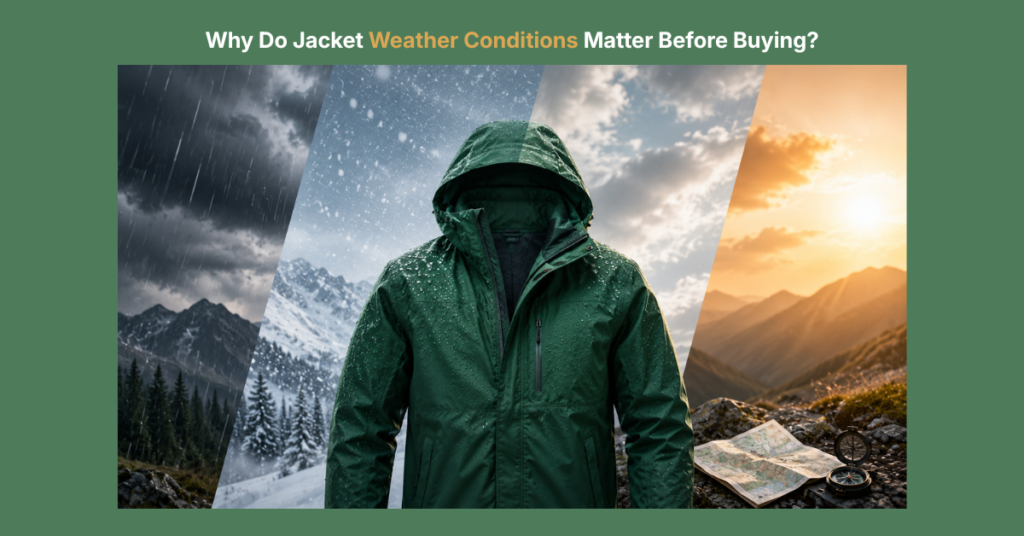
Why Do Jacket Weather Conditions Matter Before Buying?
Jacket weather conditions matter before buying because matching a garment’s specific textile engineering to the exact meteorological realities of your environment is the only way to ensure thermal equilibrium and physical protection. Purchasing outerwear based on brand marketing rather than environmental diagnostics inevitably leads to catastrophic thermal failure. You will face either freezing from inadequate insulation or overheating from non-breathable barriers. This guide provides a rigorous diagnostic framework to assess your local climate’s temperature baselines, precipitation volume, and convective wind exposure before evaluating brands.
Outerwear is functional equipment, operating as a localized architectural structure designed to manage the thermodynamic transfer of heat between the human body and the atmosphere. Selecting the wrong textile architecture for your specific atmospheric exposure guarantees physical discomfort and mechanical breakdown. A heavy, impermeable waterproof membrane aggressively suffocates the wearer in dry, high-output heat by trapping metabolic moisture. Conversely, an uncoated nylon windbreaker accelerates hypothermia during freezing rain by failing to block external hydrostatic pressure. We approach garment selection strictly through the lens of applied meteorology. You must evaluate the sky first, mapping the exact environmental threats. Only then do you select the technical fabric engineered to defeat those specific parameters.
Why analyzing jacket weather conditions prevents catastrophic gear failure
Analyzing jacket weather conditions prevents catastrophic gear failure by shifting the purchasing decision entirely from brand aesthetics to objective meteorological reality.
Rule: Always define your primary meteorological environment before looking at garment specifications.
Reason: The highest hydrostatic head rating in the world is useless dead weight if your primary weather consists of dry, sub-zero cold where precipitation is completely frozen. Heavy rain shells utilize solid ePTFE (expanded polytetrafluoroethylene) membranes engineered specifically to block liquid water under immense kinetic pressure. In a dry, deeply frozen environment, that dense barrier provides no structural advantage. Instead, it simply traps evaporated sweat against your base layer, accelerating convective heat loss without providing the necessary thermal insulation to maintain your core temperature.
Example: Detail the physical reality of freezing in a $500 premium rain shell during a dry blizzard because the jacket weather conditions were misjudged, and the garment possessed zero thermal insulation. Imagine standing on an exposed ridge facing a dry, minus-ten-degree blizzard. Because the atmospheric data was ignored, you are wearing an expensive, top-tier technical rain shell. You begin freezing rapidly. That shell possesses absolute water resistance but zero thermal insulation. It blocks the wind, but the ambient cold penetrates the thin denier face fabric instantly through conductive heat loss. Your body burns through its caloric reserves trying to heat an uninsulated void. A high-priced garment completely failed because its structural defense mechanism was designed for a forty-degree torrential downpour, not a sub-zero dry freeze.
To understand how different shell technologies handle these specific environments, review our complete breakdown of Technical Outerwear Defenses at TorivaWear.
How to assess your local jacket weather conditions before evaluating brands
Assessing your local jacket weather conditions requires a precise diagnostic evaluation of baseline temperature ranges, precipitation frequency, and convective wind exposure. Accurate data collection prevents the application of incorrect textile defenses.
- Baseline Temperature Range: Determine if you need deep-freeze thermal equilibrium or mild, transitional heat retention. Sub-zero climates require maximizing trapped “dead air space” through high-loft insulation architectures. You need materials that expand significantly to hold radiant body heat within a dense matrix of fibers. Mild climates require modular, easily removable layers that allow for rapid mechanical venting to prevent overheating. Applying expedition-weight, high-CLO insulation to a fifty-degree day forces the body into hyperthermia, rapidly overwhelming the Moisture Vapor Transmission Rate (MVTR) of the exterior shell.
- Precipitation Frequency and Volume: Differentiate between light, intermittent drizzle and sustained torrential downpours. Heavy rain requires a micro-porous membrane rated to a minimum of 20,000mm hydrostatic head. This specific rating ensures the fabric withstands both the kinetic energy of driving rain and the localized physical pressure generated by backpack straps pressing against wet fabric. Intermittent drizzle requires only a basic Durable Water Repellent (DWR) chemical coating applied to a tight nylon weave, prioritizing high breathability over absolute liquid impermeability.
- Convective Wind Exposure: Evaluate if your local environment suffers from high wind chill. Convective heat loss rapidly strips trapped body heat if the outer fabric is not strictly windproof. A garment rated at 0 CFM (Cubic Feet per Minute) completely blocks all air permeability. Wearing highly air-permeable fleece in a thirty-mile-per-hour gale renders the thermal insulation mathematically useless, as the wind violently forces cold air through the thermal matrix, instantly resetting your internal microclimate to the freezing ambient temperature.
Weather Exposure Evaluation Matrix
| Temperature Range | Precipitation Type | Environmental Category | Required Textile Architecture |
|---|---|---|---|
| Sub-Zero (< 20°F) | Dry / Frozen | Arctic / Continental Winter | High Fill-Power Down, High CFM Face Fabric |
| Cold (20°F – 40°F) | Heavy Rain / Sleet | Maritime Winter | Synthetic Insulation, ePTFE Hardshell |
| Mild (40°F – 60°F) | Intermittent Rain | Temperate Transitional | Uninsulated Softshell, Modular Base Layers |
| Warm (> 60°F) | Torrential Rain | Tropical Monsoon | Unlined 2.5-Layer Shell, High Mechanical Venting |
Compare outerwear categories to match your specific jacket weather conditions
Comparing outerwear categories to match your specific jacket weather conditions ensures that the structural defense mechanisms of the garment align perfectly with external environmental threats.
If your primary jacket weather conditions involve heavy, freezing rain, Do choose a fully seam-taped hardshell integrated with continuous-filament synthetic insulation.
Result: You maintain total thermal equilibrium and dryness because synthetic fill retains its structural loft even when the exterior environment is soaking wet. Synthetic fibers are manufactured from hydrophobic plastics. They do not collapse under heavy moisture accumulation, preserving the critical dead air space required to trap metabolic heat while the exterior ePTFE membrane deflects external hydrostatic pressure.
Contrast this exact functional requirement against dry, extreme cold. Dry, extreme cold conditions demand a focus on high Fill Power down to maximize warmth-to-weight ratio without the need for heavy waterproof membranes. Goose down plumules provide the highest known CLO value per ounce of any material. Covering down with a thick 20,000mm waterproof hardshell in an entirely dry environment adds unnecessary physical weight, drastically reduces the garment’s overall breathability, and traps internal condensation. The primary external threat is absolute temperature, not liquid water.
Condition-to-Garment Match Table
| Defined Weather Condition | Required Technical Defense | Ideal Jacket Silhouette |
|---|---|---|
| Freezing Rain / High Wind | 100% Waterproofing + Wet-Weather Loft | Synthetic Insulated Parka |
| Dry Sub-Zero Cold | Maximum Thermal Trapping + Wind Resistance | High-Loft Down Baffle Jacket |
| High Output / Light Snow | High MVTR Breathability + Dynamic Stretch | Grid-Fleece Lined Softshell |
| Sustained Monsoon Rain | 20k+ Hydrostatic Head + Mechanical Venting | 3-Layer Uninsulated Alpine Shell |
Avoid common jacket weather mistakes that ruin environmental protection
Consumers frequently compromise their environmental protection by making jacket weather mistakes, primarily by selecting highly specialized technical fabrics that fundamentally oppose their local climate. Purchasing a highly engineered garment for the wrong atmospheric pattern guarantees mechanical failure and physical exposure.
Mistake: Buying a highly breathable, water-resistant softshell for monsoon-level weather conditions. Softshells prioritize air permeability and structural stretch over absolute waterproofing. Under sustained hydrostatic pressure, liquid water inevitably forces its way through the woven face fabric, leading to rapid heat loss.
Fix: Upgrade to a 3-layer ePTFE micro-porous membrane engineered specifically for sustained heavy rain and hydrostatic pressure.
Mistake: Prioritizing heavy down fill for wet, humid coastal winters. Goose down relies on delicate micro-filaments to trap insulating air. When exposed to high environmental humidity and penetrating wet precipitation, the down clusters clump together, entirely losing their structural loft and insulating capacity.
Fix: Switch to synthetic insulation to ensure the coat retains structural heat-trapping capabilities even when high environmental humidity and moisture breach the shell.
The ultimate jacket weather condition checklist to verify before checkout
Use this pre-purchase jacket weather condition checklist to systematically verify that your chosen outerwear provides the exact meteorological defenses your environment demands.
- [ ] Does this jacket’s primary defense mechanism match my most frequent weather problem?
- [ ] Is the internal insulation type suited for my local humidity and precipitation levels?
- [ ] Have I avoided paying for extreme weather features (like 30,000mm waterproofing) my local climate doesn’t require?