
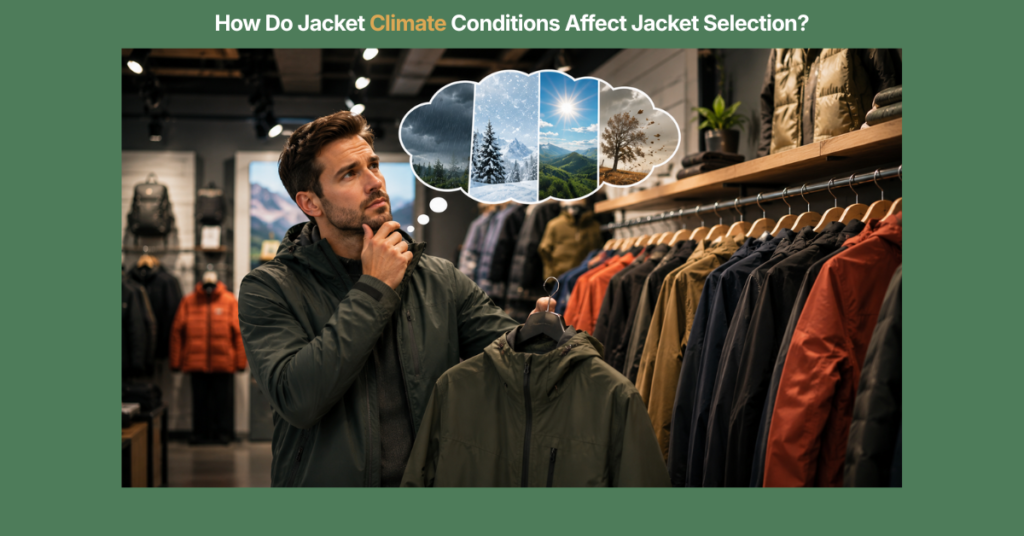
How Do Jacket Climate Conditions Affect Jacket Selection?
Jacket climate conditions dictate jacket selection because regional meteorological baselines—such as temperature ranges and precipitation states—determine the exact textile engineering required to prevent critical thermal failure. Ignoring regional climate data in favor of brand aesthetics leads to severe physical discomfort and wasted financial investments. Purchasing a specialized garment engineered for an environment you do not inhabit destroys any viable cost-per-wear metric and exposes the body to dangerous environmental stressors. This guide provides a clinical framework for assessing regional climate conditions, matching outerwear technologies to specific environments, and avoiding high-stakes purchasing mistakes.
Garment engineering operates entirely on the laws of physics and thermodynamics, completely independent of consumer fashion trends. An advanced barrier design fails instantly if its structural parameters cannot process the metabolic heat you generate within a specific humidity index. Understanding these localized variables forces a definitive shift from subjective aesthetic shopping to objective meteorological matching. By establishing a rigid diagnostic protocol, you mathematically map textile specifications directly to atmospheric realities. To build a complete functional wardrobe system, integrate this framework with targeted insights found in articles covering Understanding Hydrostatic Head Ratings and Synthetic vs. Natural Insulation Performance.
Why analyzing jacket climate conditions dictates your ultimate jacket selection
Analyzing jacket climate conditions dictates your ultimate jacket selection by prioritizing regional atmospheric realities over brand names to prevent total gear failure. Selecting an exterior shell without defining the exact environmental variables it must counteract bypasses the fundamental purpose of technical apparel. Formulating a protective strategy requires baseline data.
Rule: Always establish comprehensive regional climate baselines before reviewing a single piece of apparel to guarantee your technical defense mechanism matches the meteorological threat.
Reason: Advanced fabric technologies become useless dead weight if they do not match local atmospheric realities. A high-denier face fabric paired with a low-permeability solid membrane acts as a vapor trap if the ambient temperature exceeds the jacket’s intended operational threshold, inducing mass internal condensation and causing rapid conductive heat loss from the inside out.
Example: Consider the catastrophic failure of an uninsulated alpine shell utilized in a dry, sub-zero blizzard. The wearer possesses an absolute barrier against liquid moisture, but without the necessary trapped dead air space to mitigate rapid caloric transfer, their core temperature plummets. The expensive outer layer becomes entirely ineffective because the wearer solved for the wrong atmospheric equation.
How to assess your local jacket climate conditions before evaluating brands
Assessing your local jacket climate conditions requires a systematic evaluation of your baseline temperature range, precipitation frequency, and convective wind exposure before evaluating specific brands. Proper diagnosis isolates the exact environmental stressors your garment must defeat, filtering out irrelevant apparel categories.
- Baseline Temperature Range: Evaluate average winter lows to determine necessary thermal insulation. Record the historical meteorological data for your primary geographical zone, focusing explicitly on absolute minimums rather than broad seasonal averages. Identifying that your local environment consistently drops below the -10°C threshold dictates a mandatory shift from lightweight fleece mid-layers to high-loft structural baffles to halt lethal caloric expenditure.
- Precipitation Frequency and State: Define your specific moisture type by categorizing historical weather patterns into sustained liquid rain versus frozen snowfall. Liquid moisture demands a continuous, unbroken hydrophobic barrier evaluated through rigorous static column pressure tests. Frozen precipitation primarily requires defense against structural melting upon contact with escaping body heat, which alters the specific surface tension requirements of your exterior durable water repellent (DWR) chemical coating.
- Convective Wind Exposure: Factor in local wind speeds and their direct impact on stripping trapped body heat. Moving atmospheric air accelerates thermal energy transfer exponentially across the garment’s surface area. Convective heat loss occurs immediately when high-velocity wind penetrates porous fabrics to displace the millimeter-thin boundary layer of warm, stagnant air resting directly against your skin, necessitating a specialized micro-porous membrane to arrest this aggressive thermal drain.
Meteorological Decision Matrix
| Temperature Range | Primary Precipitation State | Required Structural Defense Mechanism |
|---|---|---|
| Sub-Zero (< 0°C) | Dry / Frozen Snow | High-loft insulation; rapid vapor transmission; moderate hydrostatic head. |
| Cold (0°C to 5°C) | Mixed / Sleet | Synthetic insulation; fully sealed structural seams; high hydrostatic head. |
| Mild (5°C to 15°C) | Sustained Liquid Rain | Uninsulated 3-layer hardshell; extreme hydrostatic head; active mechanical venting. |
Compare outerwear technologies to match your specific jacket climate conditions
Comparing outerwear technologies allows you to match advanced textiles—such as micro-porous membranes and synthetic fills—directly to your specific jacket climate conditions to maintain core thermal equilibrium. Understanding the chemical and physical mechanics of these textiles isolates high-performance materials from inadequate substitutes. A micro-porous membrane, specifically constructed from expanded polytetrafluoroethylene (ePTFE), functions as a highly selective barrier. This architecture contains billions of microscopic voids per square inch. These pores are meticulously sized to be substantially smaller than a liquid water droplet, yet physically larger than individual water vapor molecules. This precise structural engineering permits internal metabolic sweat to evacuate outward via a sustained Moisture Vapor Transmission Rate (MVTR) while simultaneously blocking pressurized exterior rain from penetrating inward.
If: The user’s primary climate conditions involve heavy, wet coastal rain.
Do: Select a fully seam-taped hardshell paired with high-loft synthetic insulation.
Result: Core thermal equilibrium is safely maintained even when the exterior is saturated.
Outerwear Technology Comparison Table
| Defined Climate Condition | Required Technical Defense | Ideal Jacket Material |
|---|---|---|
| High Wind / Dry Cold | Arresting rapid convective heat loss while trapping stagnant dead air. | Windproof ePTFE membrane integrated with baffled natural down insulation. |
| Sustained Heavy Rain / Mild Temp | Absolute liquid water blockade coupled with continuous active vapor transmission. | 3-Layer micro-porous ePTFE shell rated at >20,000mm Hydrostatic Head. |
| High Humidity / Moderate Cold | Maintaining internal insulation loft within highly saturated ambient environments. | Continuous filament synthetic insulation beneath a high-MVTR face fabric. |
Avoid jacket selection mistakes that ignore core climate conditions
Consumers frequently compromise their physical safety by making jacket selection mistakes that ignore core climate conditions in favor of marketing hype. Relying on aesthetic preferences rather than analyzing factual weather data yields systemic wardrobe failures. Operating via empirical, data-driven parameters actively removes emotion from the procurement cycle.
The Rain Mistake: Buying an expedition-grade, low-breathability parka for a mild but rainy climate. Consumers routinely equate heavy visual bulk with superior elemental protection. In mild temperatures, thick insulation trapped beneath a non-permeable outer shell generates massive internal condensation, mimicking the effects of external rain penetration.
Fix: Re-route the budget to a 3-layer micro-porous shell engineered for sustained rain. Employing a dedicated, uninsulated rain shell over a modular, lightweight thermal mid-layer guarantees absolute protection from wet environments without risking dangerous hypothermia via internal sweat accumulation.
The Insulation Mistake: Selecting unprotected natural down fill for highly humid conditions. Natural down relies entirely on the static, uncompressed structure of its plumules to trap metabolic heat. When exposed to continuous ambient liquid moisture or extreme relative humidity, these organic plumules collapse completely, instantly stripping the garment of its baseline thermal resistance.
Fix: Switch to synthetic clusters that retain structural loft when wet. Synthetic insulation utilizes highly engineered polyester fibers mathematically designed to refuse water absorption. This ensures the continuous creation of vital dead air space regardless of the external atmospheric moisture index.
To ensure your technical fabrics maintain their defensive properties against these specific mistakes, review our comprehensive guide on DWR Maintenance.
The ultimate jacket climate condition checklist to verify before checkout
Use this jacket climate condition checklist to run a rapid, foolproof quality check on your shopping cart before finalizing any outerwear investment. Diagnostic verification eliminates the margin of error at the point of sale, ensuring total alignment between regional meteorology and garment specifications.
- Does the outer fabric layer match my area’s exact rainfall state?
- Is the insulation type suited to my local humidity baselines?
- Does the garment provide an adequate defense against my region’s convective wind exposure?
Commit to your defined jacket climate conditions to guarantee field performance
Committing to your defined jacket climate conditions guarantees field performance by anchoring your purchase entirely in localized environmental data. Securing optimal technical apparel demands total reliance on empirical weather variables rather than subjective brand narratives.
Rule: Always let the sky above you dictate the gear you purchase.
Reason: The most expensive designer coat on the market will fail completely if its textile engineering is fighting the wrong weather system.
Example: Define your local climate parameters, select the exact fabric barrier engineered to defeat them, and maximize your long-term gear investment.