
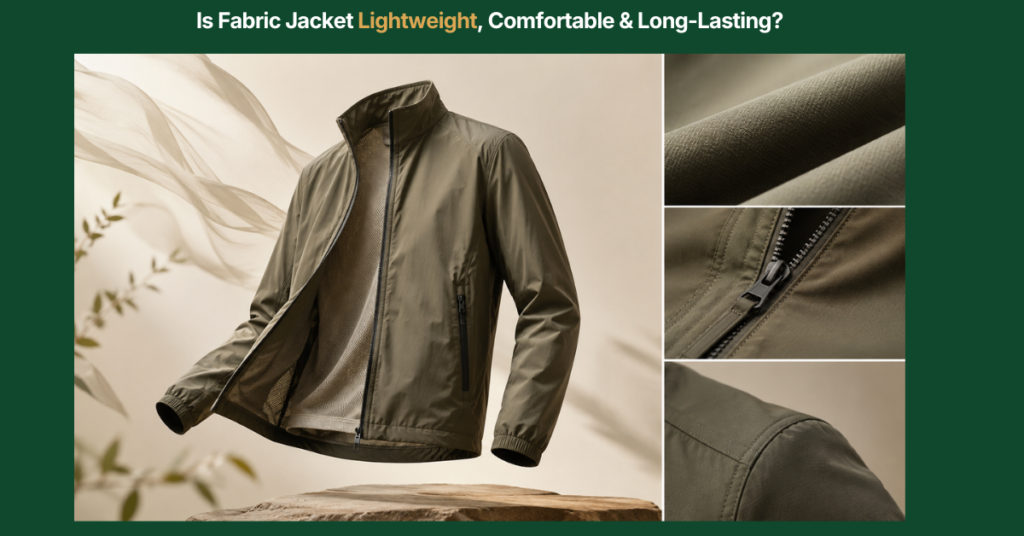
Is Fabric Jacket Lightweight, Comfortable & Long-Lasting?
Fabric jacket properties dictate daily mobility and comfort because the specific textile weave and fiber blend directly determine the garment’s physical weight, structural breathability, and long-term durability against abrasion. Purchasing woven outerwear based on the visual assumption that “all fabric is lightweight” frequently results in buying garments that become uncomfortably heavy and restrictive once exposed to the elements.
Shoppers routinely prioritize aesthetic colorways or brand heritage over the actual mathematical properties of the garment’s construction, leading to immediate performance failures in unpredictable environments. This visual bias ignores the physical reality of textile physics. A standard cotton twill coat visually resembles a high-performance synthetic layer on a retail hanger, yet under physical stress, environmental moisture, and repetitive kinetic movement, the structural differences become glaringly apparent.
Water saturation multiplies the physical mass of natural fibers, poorly mapped seams restrict shoulder extension, and unreinforced yarns snap under friction. This guide provides a rigorous diagnostic framework for assessing textile outerwear GSM, comparing fabric materials for durability and lightness, and avoiding high-stakes garment care mistakes. You will learn to evaluate apparel not as fashion pieces, but as engineered equipment designed to perform a specific physical task based entirely on material science.
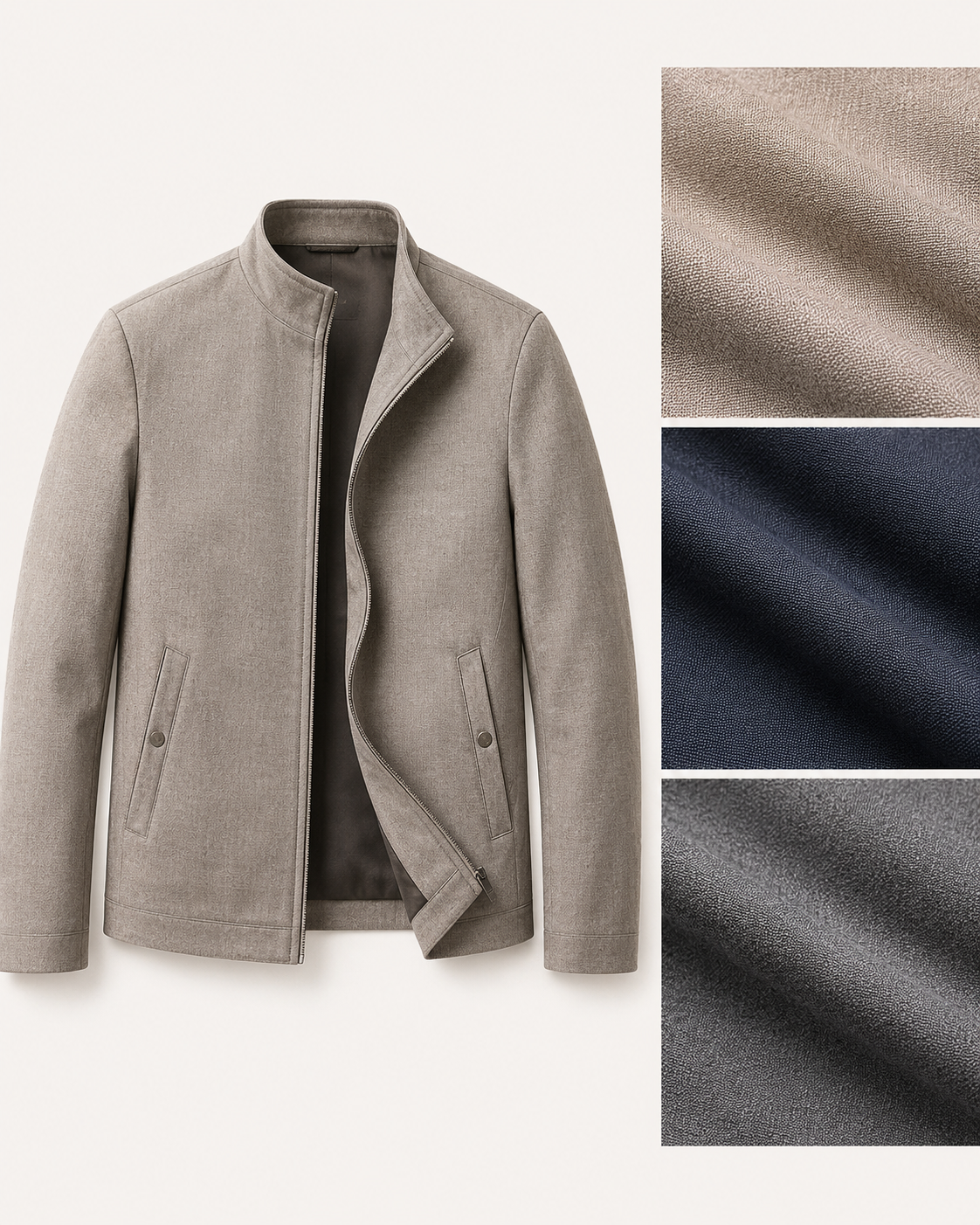
Why analyzing fabric jacket properties dictates your daily mobility and comfort
Analyzing fabric jacket properties dictates your daily mobility and comfort by explicitly revealing how the underlying thread count and material blend affect the garment’s physical weight. Evaluating the specific thread count and material blend before assuming a coat is naturally lightweight prevents severe mobility penalties during active use. Precision in fabric selection eliminates the physical trade-offs traditionally associated with woven materials, establishing a precise baseline for how the garment will behave under biomechanical stress. High-density weaves stack tightly together, trapping dead air for insulation but simultaneously adding substantial physical mass to the garment that the wearer must continually support.
While unlined cotton is highly breathable, it lacks the abrasion resistance of synthetic blends, directly impacting its lifespan. The hydrophilic nature of natural cellulose fibers ensures that standard cotton actively absorbs ambient humidity, human perspiration, and environmental precipitation, fundamentally altering its physical state and behavior. Because natural staple fibers are relatively short and weak, they rely on mass and thickness to survive friction, meaning a heavy-duty natural jacket carries an inherent, unavoidable weight penalty from the moment it is constructed.
A buyer purchasing a 100% cotton canvas jacket for hiking quickly discovers the fabric becomes uncomfortably heavy and restrictive once it absorbs environmental moisture. The absorbed water violently fills the microscopic spaces between the woven threads through capillary action. This saturation swells the actual fibers, effectively locking the weave into a rigid, inflexible structure that actively fights against the wearer’s kinetic movement. Every physical action then requires additional caloric expenditure just to force the saturated fabric to bend at the elbow or shoulder joints, rapidly accelerating wearer fatigue.
How to assess textile outerwear for weight, breathability, and lifespan
Assessing textile outerwear for weight, breathability, and lifespan requires a systematic physical evaluation of fabric density, fiber composition, and the underlying weave structure. Relying on marketing adjectives guarantees structural failure in the field; you must instead extract empirical data directly from the garment’s manufacturing tags and geometric construction. To fully comprehend how to measure these performance metrics, reading our specialized resource on understanding fabric GSM provides the mandatory foundational context required for technical apparel analysis. Follow this strict diagnostic protocol to isolate the exact performance capabilities of any woven layer.
Fabric Density (Weight)
Verify the material’s Grams per Square Meter (GSM) to determine if the garment serves as a lightweight windbreaker or a heavy chore coat. Lower values, typically hovering around 100 to 150 GSM, indicate a garment engineered for high-output aerobic activity where rapid moisture vapor transmission is mandatory. Higher values, exceeding 350 GSM, designate structural canvas fabrics intentionally designed to stop penetrating winds, resist heavy blunt trauma, and survive extreme industrial environments.
Fiber Composition (Comfort)
Check for Elastane or Spandex blends that provide Mechanical Stretch and superior mobility. The introduction of highly elastic synthetic polymers into a static cotton or nylon base transforms the structural dynamic of the apparel. A mere two to three percent inclusion of these elastomers allows the fabric to physically expand under kinetic load and immediately snap back to its original geometric shape, completely preventing the permanent bagging and sagging that destroys the fit of standard jackets over time.
Weave Structure (Longevity)
Identify a Ripstop Grid or tightly woven twills that mathematically prevent micro-tears from spreading. The ripstop weaving technique inserts thicker, high-tensile reinforcement yarns at regular intervals in a geometric crosshatch pattern across the primary fabric base. When an exterior sharp object punctures the base fabric, the resulting tear travels only millimeters before violently halting against the reinforced grid square, isolating the physical damage and preserving the overall structural integrity of the coat.
Decision Matrix: Base Mobility and Durability Capabilities
| Weave Type | Base Mobility Rating | Durability Capability | Ideal Application Profile |
|---|---|---|---|
| Standard Twill | Moderate (Relies entirely on fiber blend) | High (Diagonal ribbing naturally resists surface wear) | Urban commuting, light outdoor labor, general temperature regulation |
| Heavy Canvas | Low (Rigid initial structure, requires extensive mechanical break-in) | Extreme (Maximum abrasion resistance against harsh surfaces) | Heavy carpentry, dense brush navigation, industrial fabrication |
| Ripstop Grid | High (Lightweight base fabric allows maximum dynamic flex) | High (Tear containment geometry prevents catastrophic failure) | Alpine hiking, tactical deployment, high-kinetic output operations |
Compare fabric jacket materials to find your perfect balance of durability and lightness
Comparing fabric jacket materials allows you to find your perfect balance of durability and lightness by deliberately contrasting the structural limitations of natural brushed cotton against the extreme resilience of synthetic nylon blends. Material science dictates long-term performance, meaning you cannot bypass the physical laws governing textile friction, moisture retention, and tensile strength.
If the user requires a highly durable, tear-resistant layer for outdoor work that won’t weigh them down, they must reject standard 100% natural canvases. Natural fibers simply require substantial physical thickness, and therefore excessive mass, to achieve high durability thresholds.
Do select a jacket made from a Nylon-Cotton (NyCo) blend with a ripstop weave. This precise engineering amalgamation combines the soft, quiet drape and vapor-absorbing comfort of natural cotton with the extraordinarily high tensile strength of synthetic nylon filaments, creating an optimized hybrid textile.
Resulting directly from this specific material selection, the garment effortlessly withstands physical abrasion while remaining light enough for all-day, high-output movement. The synthetic filaments handle the external friction and maintain the structural skeleton of the coat, while the natural fibers internally regulate the microclimate by absorbing trace amounts of vapor before it condenses against the skin.
Fabric Comparison Matrix: Weight vs. Lifespan
| Fabric Category | Weight Profile | Expected Lifespan Rating | Structural Characteristics |
|---|---|---|---|
| 100% Cotton (Canvas/Duck) | Heavy (300+ GSM) | Moderate to High (Rapidly degrades from retained moisture) |
High mass, excellent wind blocking, highly susceptible to kinetic fatigue when wet. |
| Synthetic Blend (NyCo) | Medium (150-250 GSM) | Extremely High (Synthetic structural reinforcement) |
High tensile strength, faster evaporation rates, optimally balanced thermal regulation. |
| Technical Canvas (Cordura Nylon) | Medium-Heavy (250+ GSM) | Maximum (Military-grade abrasion resistance) |
Engineered polymer structure, supreme friction endurance, rigid drape profile. |
Avoid woven jacket mistakes that accelerate wear and tear
Consumers frequently accelerate wear and tear by committing woven jacket mistakes, specifically deploying light, casual fabrics in high-abrasion environments or utilizing improper laundering techniques. Financial investments in technical apparel vanish rapidly when users ignore the explicit physical limitations of their chosen garments. To master the maintenance of these complex material blends and prevent microscopic structural collapse, consult our detailed documentation on how to wash technical woven outerwear. Poor maintenance protocols systematically dismantle the microscopic structures of the fabric long before external abrasion takes its toll.
The Abrasion Mistake
The Technical Fix
The Shrinkage Mistake
The Technical Fix
To safely extend the lifespan of your woven outerwear, review our complete technical guide on Proper Textile Laundering Protocols.
The ultimate fabric jacket evaluation checklist to verify before checkout
Use this ultimate fabric jacket evaluation checklist to perform a rapid, foolproof physical audit of a garment’s weight profile, mechanical stretch, and seam construction before finalizing checkout. Diagnostic verification completely prevents buyer’s remorse and guarantees that the selected apparel operates within the specific biomechanical parameters required by the user. You must systematically test the physical boundaries of the garment before removing the retail tags. Inspect the stitch count per inch to verify manufacturing density. Stretch the fabric across the bias to measure the recovery speed of the elastane chains. Weigh the garment in your hands to estimate the caloric cost of wearing the piece over a twelve-hour shift.
Diagnostic Verification Checklist
These strictly defined queries serve as an absolute empirical filter. If the targeted garment fails to provide immediate, affirmative answers to these specific structural parameters, it lacks the technical engineering required to survive rigorous daily deployment and will fail in the field.
Commit to the right fabric jacket construction for guaranteed daily performance
In conclusion, committing to the right fabric jacket construction guarantees daily performance by perfectly aligning the textile’s physical properties with your specific lifestyle requirements. Precision in evaluation removes all guesswork from the purchasing process.
- Always match the specific weave and fiber composition of the coat directly to your daily physical output.
- Expecting an ultra-lightweight fashion textile to survive rugged outdoor use will result in immediate garment failure and wasted money.
- Select a properly blended synthetic-canvas coat, follow the correct care instructions, and secure a highly comfortable garment that endures for years.