
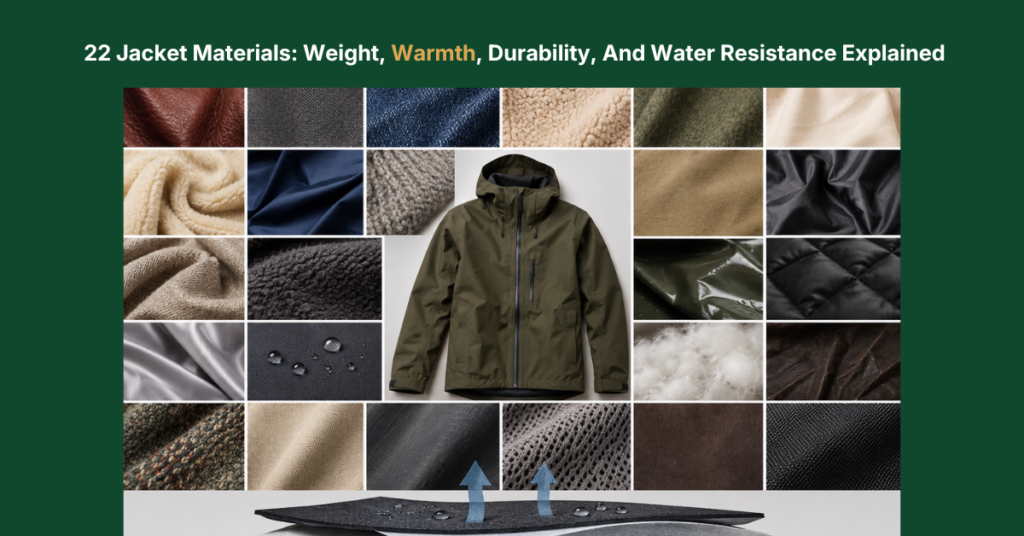
22 Jacket Materials: Weight, Warmth, Durability, And Water Resistance Explained
Jacket materials completely define outerwear performance, as a garment’s specific textile composition mathematically determines its exact weight, thermal warmth, structural durability, and absolute water resistance in the field. Purchasing outerwear based purely on aesthetic design while ignoring the raw textile data frequently results in catastrophic thermal failure and rapid garment destruction. A jacket is primarily an environmental isolation chamber. Its physical construction materials act as the only barrier between human biology and atmospheric extraction of body heat.
This guide provides a rigorous diagnostic framework for assessing the 22 core outerwear fabrics, comparing technical textiles for durability, and avoiding high-stakes material mistakes. Fabric science operates on strict physical laws. Synthetic polymers react to temperature and moisture in predictable, measurable ways. Natural insulations loft and compress according to exact structural geometry. Evaluating a jacket requires looking past the brand tag and analyzing the structural engineering of the garment. We analyze denier thread counts, microscopic pore structures, and specific chemical coatings to determine exact field utility.
Why understanding jacket materials dictates your overall weather protection
Understanding jacket materials dictates your overall weather protection by shifting the purchasing focus from superficial design to raw textile physics and environmental defense mechanics. Outerwear functions strictly as an engineering solution to atmospheric threats. The face fabric stops wind convection. The insulation layer arrests conductive heat loss. The internal membrane repels liquid precipitation while managing biological vapor.
Graphic 1: The Three-Layer Environmental Defense System
Diagram Explanation: This diagram illustrates the sequential engineering of modern outerwear. External elements (rain, wind) strike the rugged Face Fabric first. Any moisture that passes through is halted by the micro-porous Membrane. Finally, the internal Insulation Layer traps biological heat to prevent thermal drain.
Rule: Always evaluate the raw textile data—specifically weight, warmth, and structural durability—before considering the garment’s visual design or silhouette.
Reason: An inherently water-absorbent fabric cannot be magically transformed into a functional rain shell, regardless of how much it costs, how well it is tailored, or what chemical spray is applied to its surface. Structural physics supersedes chemical surface treatments. If a textile’s baseline composition attracts moisture, it fundamentally fails as a barrier against precipitation.
Example: Consider a buyer facing a winter storm in a heavy, water-logged cotton canvas coat. Because cotton is hydrophilic, it actively absorbs incoming water. The water replaces the insulating air within the fabric matrix. Water conducts heat away from the human body 25 times faster than air. The buyer freezes not because the coat lacks thickness, but because the base jacket materials were fundamentally mismatched for precipitation, resulting in rapid thermal drain.
How to assess the 22 core outerwear fabrics for weight and warmth
Assessing the 22 core outerwear fabrics for weight and warmth requires a systematic physical evaluation of thermal insulation loft, fabric GSM density, and absolute hydrostatic resistance. You must measure the textile’s capacity to trap stagnant air against its physical mass. Advanced outerwear engineering balances these metrics to provide maximum protection with minimal metabolic penalty to the wearer. For a deeper analysis of insulation types, consult our guide on Down vs. Synthetic Insulation: A Technical Breakdown.
Graphic 2: Membrane Breathability Mechanics
Diagram Explanation: Technical membranes like ePTFE function via micro-porous structures. The microscopic pores are vastly smaller than liquid rain droplets (blocking external moisture), yet large enough to allow biological water vapor (sweat) to exhaust outward, maintaining the internal microclimate.
Decision Matrix: Environmental Conditions vs. Ideal Fabric Metrics
| Primary Weather Condition | Ideal Fabric Weight (GSM) | Ideal Warmth Class / Insulation | Target Hydrostatic Head |
|---|---|---|---|
| High-Output Alpine / Dry Cold | Ultralight (20 – 40 GSM) | Active Synthetic (PrimaLoft® Gold) | < 1,000mm (Highly Breathable) |
| Extreme Static Cold / Dry | Light-Medium (40 – 70 GSM) | High-Loft Goose Down (800+ Fill) | 1,000mm – 5,000mm (Snow Shedding) |
| Torrential Rain / Moderate Temp | Medium (80 – 150 GSM) | Uninsulated (Layering Shell) | > 20,000mm (ePTFE Membrane) |
| High-Abrasion Workwear / Mixed | Heavy (200 – 400 GSM) | Dense Fleece (PET) or Flannel | 5,000mm (Waxed or PU Coated) |
Compare technical garment textiles to balance durability and water resistance
Comparing technical garment textiles allows you to balance severe structural durability with absolute water resistance, ensuring the face fabric survives high-abrasion environments without breaching the waterproof membrane. Face fabrics take the physical abuse; membranes stop the moisture. You must pair a high-denier thread count on the exterior with an impermeable chemical barrier on the interior.
If: The user requires extreme abrasion resistance for backcountry tree-skiing while maintaining absolute water resistance under heavy snow load.
Do: Select a 3-layer hardshell utilizing a high-denier Cordura® Nylon face fabric bonded securely to an ePTFE membrane like Gore-Tex®.
Result: The garment explicitly blocks 100% of incoming moisture without tearing or puncturing when scraped against sharp branches, jagged rocks, or ski edges.
Evaluating the full spectrum of 22 core materials requires understanding their distinct roles. Linings manage next-to-skin moisture. Insulations trap heat. Membranes block weather. Face fabrics provide the structural skeleton.
To choose the right protection layer, read our guide on the difference between a rain jacket, a softshell jacket, and a hardshell jacket.
Technical Textile Comparison Matrix
| Material Type / Textile Role | Durability Score (1-10) | Water Resistance Rating | Primary Functional Application |
|---|---|---|---|
| 1. Cordura® Nylon (Face) | 10/10 | Low (Requires Membrane) | Extreme abrasion resistance; workwear. |
| 2. Kevlar Blends (Reinforcement) | 10/10 | None | Slash and puncture resistance. |
| 3. Cotton Canvas (Face) | 8/10 | None (Hydrophilic) | Dry heavy labor; sparks resistance. |
| 4. Waxed Cotton (Face) | 8/10 | Moderate (Weather Resistant) | Heritage weather protection. |
| 5. Ripstop Nylon (Face) | 6/10 | Low (DWR dependent) | Lightweight tear resistance. |
| 6. Polyester (Face/Lining) | 6/10 | Low (Hydrophobic fibers) | UV resistance; quick drying. |
| 7. Merino Wool (Lining/Mid) | 4/10 | Low (Retains warmth wet) | Biological temperature regulation. |
| 8. Fleece (PET) (Mid-layer) | 5/10 | None | Static air trapping; breathable. |
| 9. Spandex/Elastane (Blend) | 4/10 | None | Dynamic mobility; stretch. |
| 10. Softshell (Nylon/Spandex) | 7/10 | Moderate (Blocks snow/light rain) | High-output aerobic protection. |
| 11. Hardshell (3-Layer ePTFE) | 8/10 | Absolute (>28,000mm) | Severe weather isolation. |
| 12. ePTFE Membrane (Gore-Tex®) | 2/10 (Internal only) | Absolute | Micro-porous liquid barrier. |
| 13. Polyurethane (PU) Coating | 4/10 (Degrades over time) | High (Non-breathable) | Total waterproof sealing. |
| 14. Goose Down (Insulation) | 3/10 (Fragile clusters) | None (Collapses wet) | Maximum warmth-to-weight ratio. |
| 15. PrimaLoft® (Insulation) | 5/10 (Resists compression) | Moderate (Retains loft wet) | Wet-weather thermal retention. |
| 16. Hydrophobic Down (Insulation) | 3/10 | Moderate (Repels humidity) | Damp-climate natural insulation. |
| 17. Microfiber (Face/Lining) | 4/10 | Low | Wind resistance; soft hand-feel. |
| 18. Neoprene (Specialty) | 7/10 | Absolute | Aquatic thermal retention. |
| 19. Tri-blend (Poly/Cotton/Rayon) | 5/10 | None | Lifestyle comfort; casual drape. |
| 20. Taffeta (Lining) | 4/10 | None | Frictionless interior layering. |
| 21. Mesh (Lining) | 3/10 | None | Internal vapor ventilation. |
| 22. Silnylon (Face) | 5/10 | High | Ultralight emergency weather shedding. |
Avoid jacket material mistakes that lead to total thermal failure
Consumers frequently suffer severe physical discomfort by committing jacket material mistakes, specifically ignoring how certain synthetic fabrics chemically react to biological sweat and external rain. Fabric performance is a two-way street. It must repel the external atmosphere while aggressively exhausting the internal microclimate generated by human metabolism. Failing to match the textile’s vapor transmission rate to your output leads to systemic failure.
Graphic 3: Moisture Collapse in Insulation
Diagram Explanation: When exposed to humidity or direct precipitation, standard untreated goose down absorbs the water, causing its microscopic filaments to clump and collapse. This eliminates the dead air space required for insulation. Synthetics and hydrophobic down maintain their structural scaffolding even when saturated.
To thoroughly grasp how textiles manage internal moisture, review our technical breakdown on Managing Outerwear Breathability.
The ultimate jacket materials evaluation checklist to verify before checkout
Use this ultimate jacket materials evaluation checklist to perform a rapid, foolproof physical audit of a garment’s denier ratings, chemical suitability, and warmth-to-weight balance before finalizing checkout. Do not rely on marketing claims. Verify the mathematical parameters of the textile engineering. Every garment has specific thresholds for failure. By auditing the materials, you determine exactly where those thresholds lie before exposing yourself to environmental risk.
Analyze the garment against these strict diagnostic criteria:
- [ ] Does the primary face fabric have a high enough denier rating to survive my specific environment?
- [ ] Is the insulation material chemically suited to handle the humidity levels of my local climate?
- [ ] Have I accurately balanced the physical weight of this material against the thermal warmth it promises to deliver?