
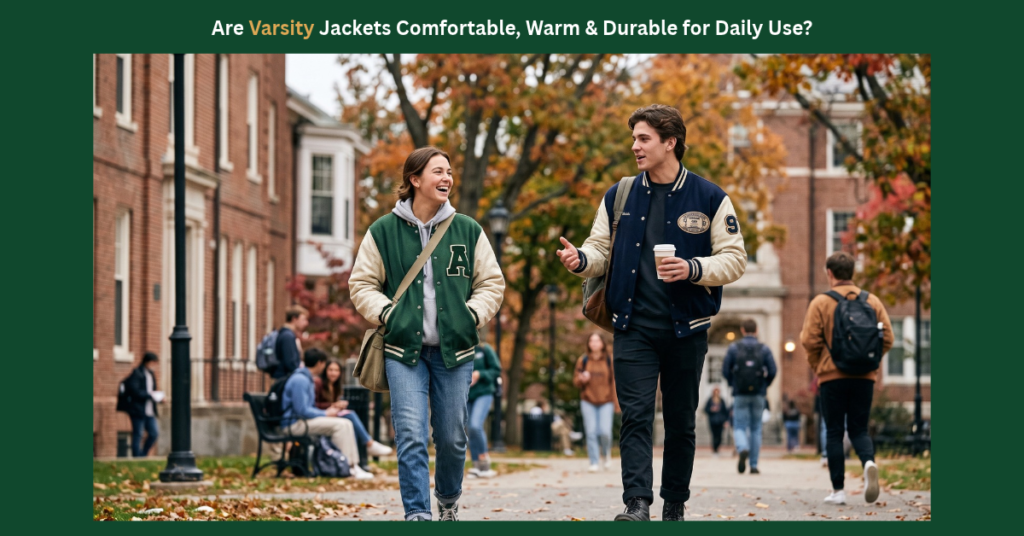
Are Varsity Jackets Comfortable, Warm, and Durable for Daily Use?
A varsity jacket generally offers substantial warmth and high physical durability for daily use, but its initial comfort and long-term lifespan depend heavily on breaking in the rigid leather and strictly avoiding heavy rain.
The heritage look can make the jacket seem simple, yet the traditional build combines materials that behave very differently: dense Melton wool at the body, cowhide or steerhide at the sleeves, ribbed knit trims, snap hardware, decorative chenille, and often a satin or quilted lining. That mix creates warmth and toughness, but it also creates maintenance obligations.
This guide evaluates the structural mechanics of a varsity jacket to validate its break-in comfort, explain its thermal heat-trapping capabilities, and map its exact durability and maintenance boundaries.
How the Melton Wool and Leather Construction Defines the Varsity Blueprint
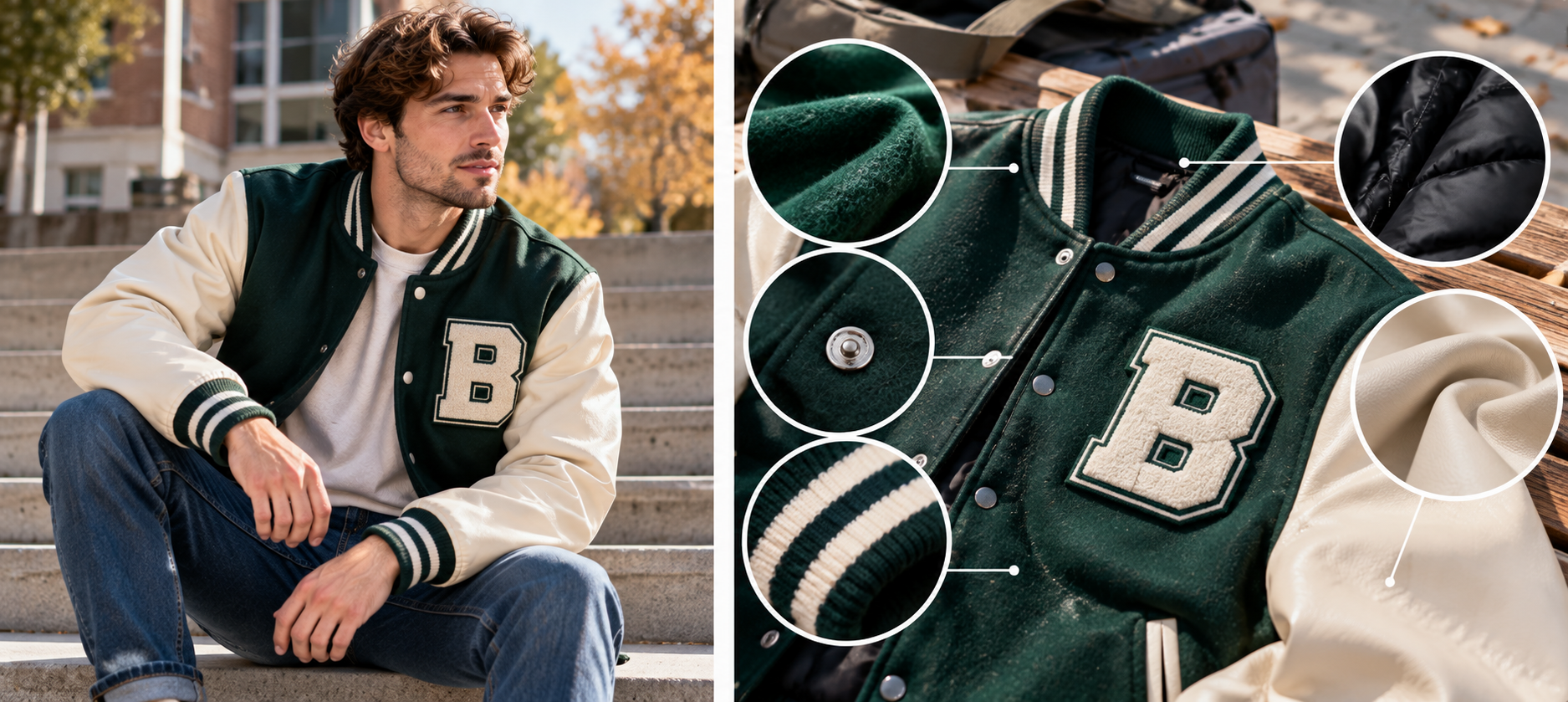
Traditional varsity jacket materials typically combine a dense Melton wool torso with full-grain leather sleeves, creating a garment that prioritizes structural toughness over lightweight mobility.
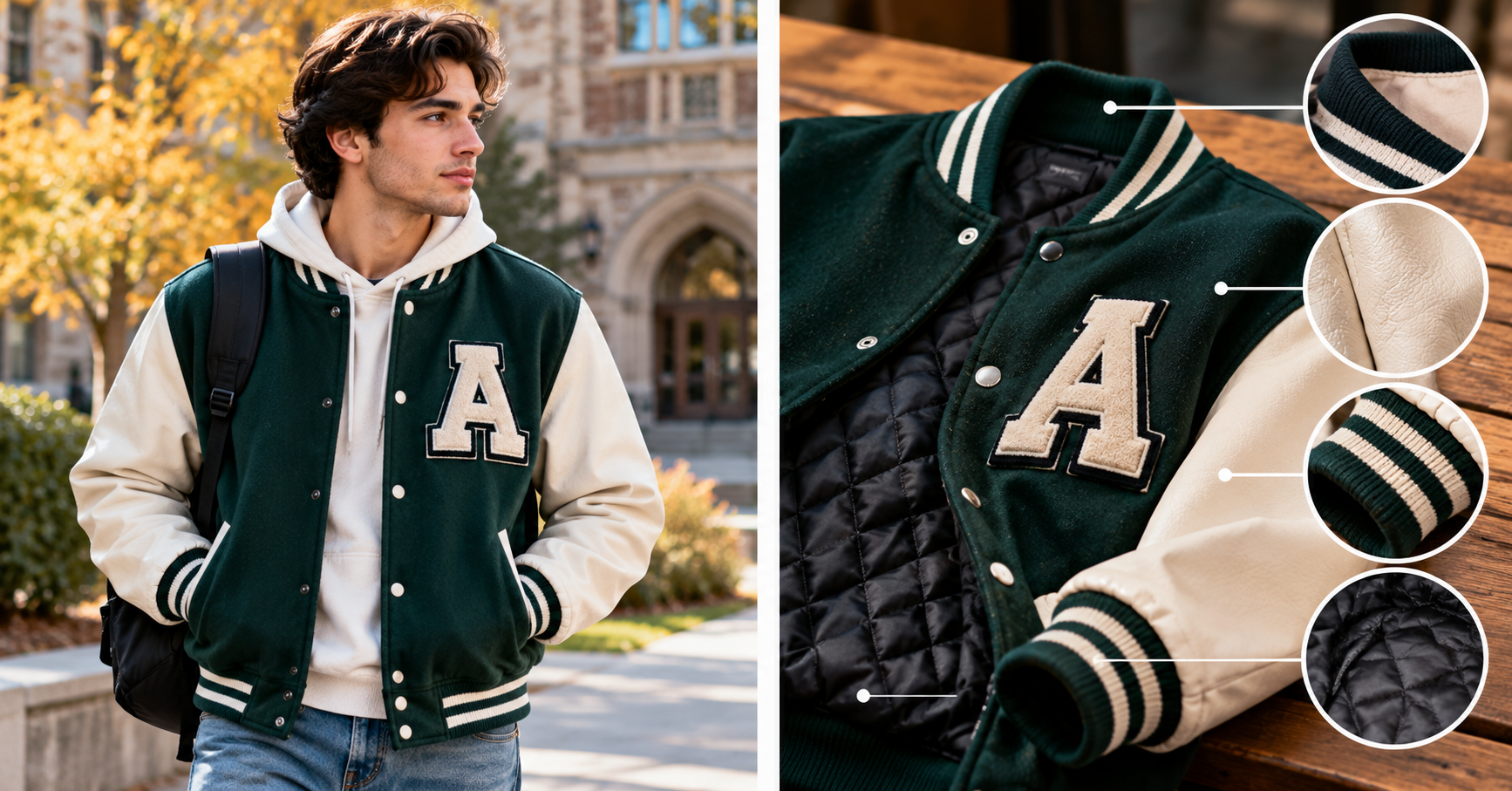
The heavy-duty insulating properties of fulled Melton wool torso panels
Melton is a thick, densely fulled wool fabric historically used for structured outerwear. The Smithsonian’s American Woolen Co. textile record describes Melton as a thick, densely fulled fabric with a closely cut nap used for overcoats and jackets.[2]
That dense cloth structure complements wool’s fibre-level insulation. Woolmark explains that wool’s natural three-dimensional crimp traps pockets of still air, helping insulate the wearer while also managing moisture and temperature.[3]
How cowhide leather sleeves provide localized abrasion resistance
The classic letterman pattern is commonly described as a wool-bodied jacket with leather sleeves, banded trim, and a chenille letter. That construction places leather on the arms, where daily contact and flexing are frequent.[1]
Leather’s performance in those high-contact areas depends on its internal fibre structure and mechanical properties. Peer-reviewed leather research measures characteristics such as stiffness, toughness, tensile strength, and grain behaviour rather than treating all cowhide as equally durable.[4]
Why elasticized ribbed knit cuffs and waistbands are engineered for draft exclusion
Traditional letterman jackets use banded or ribbed trim at the wrists, collar, and waist. These close-fitting knitted edges are part of the established varsity-jacket construction.[1]
The draft-control effect is mechanical: elastic trim reduces the open area around the wrists and hem compared with a loose straight edge. The article treats that as a construction principle, not as a measured thermal rating.
Does the Varsity Jacket Provide Immediate Comfort or Require a Break-In?
A traditional varsity jacket generally requires a dedicated break-in period before achieving optimal comfort, as the rigid leather sleeves and thick wool must soften and mold to the wearer’s body.
Why rigid cowhide leather sleeves can restrict initial arm mobility
Heavy leather can vary substantially in stiffness depending on hide structure, tannage, thickness, and finishing. Leather-science research shows that stiffness and other mechanical properties are measurable features of the material rather than fixed characteristics of every leather jacket.[4]
That supports the possibility of a firm initial feel, but it does not support a universal 30-to-60-day break-in schedule. Comfort depends on the specific leather, garment fit, frequency of wear, and the amount of repeated flexing.
How body heat, friction, and movement help the leather conform to the wearer’s shape
Repeated flexing changes how leather behaves under load. Peer-reviewed testing of bovine leathers documents elastic recovery, delayed recovery, and permanent set under stretching and repeated loading, showing that leather can retain some deformation as it is worked.[5]
The evidence supports gradual mechanical adaptation through use, but it does not isolate body heat as a universal break-in mechanism or establish a fixed timeline. Excessive heat or deliberate soaking should not be used as shortcuts because poor moisture and heat control can damage leather.[7][8]
The role of quilted interior linings in separating coarse outer materials from the wearer
A lining creates a separate interior surface between the wearer and the outer wool or leather. University of Nebraska–Lincoln Extension identifies wearer comfort, garment shape, added body, and concealed construction as core functions of jacket and coat linings.[6]
A quilted lining can also add thickness and trapped air, but the amount of extra warmth depends on the lining material and batting. The article therefore treats lining as a comfort and construction feature rather than assigning it a universal insulation value.
| Wear Stage | Expected Comfort | Material Behavior |
|---|---|---|
| Initial Wears | Firm to restrictive | Heavy leather can feel stiff at elbows and shoulders; thick wool adds bulk. |
| Repeated Wear | Improving mobility | Leather begins conforming at flex points as the jacket is worn; the pace varies by hide, finish, fit, and use. |
| Established Break-In | More natural movement | The leather is typically more compliant and creased to the wearer’s movement pattern; there is no universal calendar. |
How the Traditional Material Blend Traps Body Heat in Cold Weather
The dense combination of Melton wool and heavy leather typically provides substantial thermal retention in cold weather, though the jacket’s design features specific vulnerabilities to wind drafts.
How the dense structure of Melton wool retains heat and resists moderate wind
Wool fibres are naturally crimped, and Woolmark explains that this three-dimensional structure traps pockets of still air that insulate against cold conditions.[3]
Melton adds a dense, heavily fulled fabric structure to that fibre-level mechanism. The Smithsonian describes Melton as a thick, densely fulled outerwear cloth, which supports its use where more substantial fabric coverage is desired.[2]
The thermal vulnerability of snap-button closures compared with continuous front closures
Traditional letterman jackets commonly use snap-button fronts, while the MA-1 bomber is classically built around a front zipper. These are documented construction differences between the two jacket families.[1][9]
A line of snaps can leave small spaces between fastening points, while a zipper closes along a more continuous line. The available educational sources do not establish a universal measured heat-loss difference, so the article treats this as a structural vulnerability rather than a quantified warmth penalty.
Why the cropped waist design requires strategic layering for severe cold
Varsity jackets are usually cut around the waist rather than extending over the hips and thighs. That short silhouette improves mobility but gives the lower torso less coverage than a parka or long coat.
For severe cold, a longer mid-layer or outer shell can reduce exposed gaps around the waist. The varsity jacket should not be treated as a substitute for extended, weather-sealed winter outerwear.
What Are the Exact Weather and Wear Boundaries for Daily Use?
A varsity jacket offers substantial physical resistance to everyday friction, but untreated wool-and-leather constructions have strict moisture and maintenance limits.
High physical resistance against daily friction, scuffs, and urban wear
Melton’s dense fulled construction gives the wool body a substantial outerwear structure, while leather strength depends on properties such as toughness, stiffness, tensile performance, and grain quality.[2][4]
That does not make every varsity jacket equally abrasion-resistant. Leather quality, wool blend, seam construction, patch attachment, pocket edges, and knit trim all affect where wear appears first.
The moisture failure point: why prolonged heavy rain is a poor match for wool and leather
Wool can manage substantial moisture vapour while continuing to regulate temperature, but it is not waterproof. Leather creates a separate care issue: the Canadian Conservation Institute identifies moisture, environmental fluctuation, desiccation, oxidation, and hydrolysis as important pathways of leather deterioration.[3][7]
If you need to clean a wool-and-leather varsity jacket, the mixed-material construction requires care suited to both wool and leather. Iowa State University Extension advises allowing wet leather to air-dry away from direct heat and recommends professional leather cleaning for stains and deeper care.[8]
How brittleness and chemical deterioration threaten neglected leather over time
The consumer phrase “dry rot” can hide several different deterioration mechanisms. The Canadian Conservation Institute describes desiccation, oxidation, hydrolysis, and red rot among the conditions that can weaken leather.[7]
There is no evidence-safe universal countdown for sleeve failure or a single conditioning interval for every leather. Material type, tanning method, finish, storage environment, moisture exposure, and cleaning history all change the care requirement, so specialist guidance is safer than a fixed schedule.[7][8]
| Action | Recommendation | Reason |
|---|---|---|
| Heavy Rain Exposure | Avoid prolonged exposure | Melton wool can hold moisture, while leather care sources advise against prolonged wetness and poor drying. |
| Machine Washing | Avoid unless the care label explicitly allows it | A wool-and-leather garment combines materials with different cleaning requirements. |
| Professional Cleaning | Use a cleaner experienced with leather-trimmed garments | Leather jackets can require material-specific cleaning and conditioning methods. |
| Leather Conditioning | Follow the leather type and maker guidance; condition when needed | There is no evidence-safe universal 6–12 month interval for every sleeve leather and finish. |
Varsity vs. Bomber Jackets: Which Transitional Layer Performs Better?
Comparing varsity and bomber jackets highlights a choice between substantial natural-material structure that requires care and lighter flight-jacket construction with better resistance to light weather.
| Feature | Varsity Jacket (Wool/Leather) | Nylon Bomber Jacket |
|---|---|---|
| Weight | Usually substantial because of wool, leather, and trim | Usually lighter in nylon flight-jacket construction |
| Warmth | Moderate to high depending on wool weight and lining | Varies widely with lining and insulation |
| Weather Resistance | Limited in prolonged rain unless specially treated | Can be water-resistant in flight-nylon designs |
| Physical Wear | Leather sleeves and dense wool can tolerate substantial daily wear | Durable nylon is lighter but performance depends on fabric weight and construction |
| Break-In | Leather can begin stiff and soften with wear | Nylon typically does not require a leather-style break-in |
Compare the heavy structural drape of wool and leather with lightweight nylon flight jackets
The traditional varsity pattern combines a wool body, leather sleeves, banded trim, and a cropped silhouette. Melton itself is a thick, densely fulled outerwear fabric, so the natural-material construction is typically more substantial than a lightweight nylon shell.[1][2]
The MA-1 bomber follows a different material strategy: informational references describe a high-quality nylon shell with polyester interlining, developed as a lighter flight jacket than earlier leather designs.[9][10]
Compare long-term material character and maintenance between the two styles
Leather can develop permanent set and changed flex behaviour as it is repeatedly loaded and worn, while wool-and-leather varsity jackets also require moisture and cleaning decisions that account for two natural materials.[5][7][8]
A nylon bomber does not require leather-style conditioning, but its lifespan still depends on fabric weight, seams, hardware, abrasion, and care. The evidence therefore supports a maintenance-heavy natural-material system versus a lighter synthetic system, not a universal claim that one style always lasts longer.[9]
Final Verdict: When Is a Varsity Jacket the Smartest Daily Outerwear?
A varsity jacket is a highly effective investment for dry, transitional climates and high-contact urban environments, provided the wearer is willing to maintain its natural materials.
Ideal scenarios for dry, transitional climates and everyday urban wear
The varsity jacket works best when its strengths align with the environment: cool, mostly dry weather; regular daily wear; and situations where a structured wool-and-leather shell is more useful than an ultralight layer.
Melton wool contributes a dense outerwear structure, wool fibre crimp contributes insulation, leather supplies a mechanically substantial sleeve material, ribbed trim narrows garment openings, and lining improves interior comfort.[1][2][3][4][6]
When to bypass the varsity style for waterproof shells or high-loft parkas
Heavy precipitation and prolonged exposure to severe cold push the varsity jacket beyond its strongest use case. In those conditions, a waterproof shell or longer insulated coat provides environmental protection that a traditional wool-and-leather varsity design does not.
The final decision is straightforward: choose the varsity jacket for substantial everyday structure, moderate cold, and dry-weather durability; choose purpose-built winter or rain outerwear when sealing, length, and sustained moisture protection matter more.
Sources
- Wikipedia. Letterman (sports) — traditional letter-jacket construction and materials. View source.
- Smithsonian National Museum of American History. American Woolen Co. Melton fabric samples — Melton described as thick, densely fulled wool used for overcoats and jackets. View source.
- The Woolmark Company. Wool Is Naturally Breathable — wool crimp, trapped air, insulation, moisture and temperature management. View source.
- Journal of the American Leather Chemists Association. Characterization of Mechanical Properties of Leather with Airborne Ultrasonics — stiffness, toughness and tensile properties. View source.
- Journal of the American Leather Chemists Association. Elasticity and Setting of Stretched Leather — elastic recovery, permanent set and cyclic loading. View source.
- University of Nebraska–Lincoln Extension. Lining a Jacket or Coat — lining for wearer comfort, garment shape and body. View source.
- Canadian Conservation Institute. Caring for Leather, Skin and Fur — water damage, desiccation, oxidation, hydrolysis and leather deterioration. View source.
- Iowa State University Extension and Outreach. Leather Care Tips — drying wet leather away from heat and using professional leather cleaners. View source.
- Wikipedia. MA-1 Bomber Jacket — lightweight nylon shell, polyester interlining and flight-jacket construction. View source.
- Wikipedia. Flight Jacket — transition from leather to lighter nylon flight-jacket construction and water resistance. View source.
Source policy: Evidence citations on this page now use informational or learning-oriented sources only: museum records, university extension material, government conservation guidance, a peer-reviewed leather-science journal, Woolmark technical education, and informational reference pages. Retail product pages are not used as evidence.