
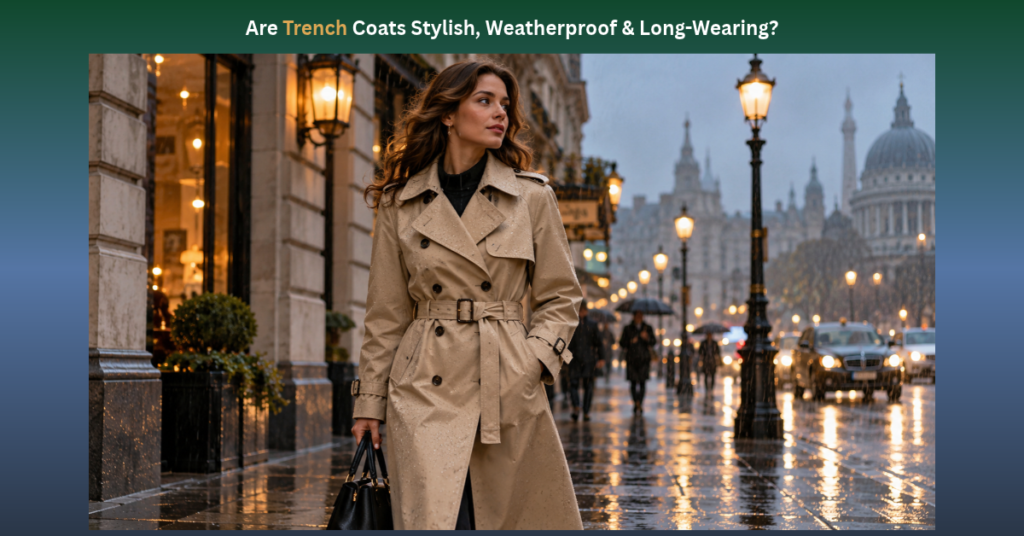
Are Trench Coats Stylish, Weatherproof, and Long-Wearing?
A heritage trench coat delivers refined style versatility, effective wind deflection, and long service potential, but its weather protection is designed for shedding rain rather than providing technical storm waterproofing or sub-zero warmth.
Buyers can expect an authentic trench coat to behave like a complete all-weather shield because of its military history and dense fabric. Its strengths are narrower: it offers tailored versatility, wind control, short-duration rain shedding, repairable hardware, and a shape that works across formal and casual clothing.
This guide evaluates the structural engineering of traditional trench coats to validate their stylistic versatility, explain their rain-shedding mechanics, audit their physical durability, and map their exact environmental boundaries.
How Military Engineering and Gabardine Define the Trench Coat Blueprint
The trench coat grew from military demand for a breathable officer’s coat that could shed weather without relying on the heavy rubberized construction used in earlier rainwear.
The rise of gabardine as a breathable alternative to rubberized rainwear
The V&A dates Thomas Burberry’s gabardine to 1879, while Smithsonian history describes it as a breathable, weather-resistant twill made by proofing fibres or yarns rather than sealing the finished cloth beneath a continuous rubber layer.[1][2][3]
That difference mattered because early rubberized Macintosh-style coats blocked rain but also trapped heat and perspiration. Gabardine approached wet-weather protection through dense textile structure and surface repellency instead of a fully impermeable rubber sandwich.[2][3]
How First World War use shaped length and military hardware
The trench coat form was refined during the First World War around movement, exposure, and officer equipment. Smithsonian history describes a belted, double-breasted coat cut around knee length so it stayed clear of mud while still covering much of the body.[2]
The V&A identifies the gun flap, storm shield, D-rings, epaulettes, throat latch, and adjustable cuffs as functional features carried into the trench coat’s modern identity. The Tielocken predecessor was patented in 1912, while the later Trench-Warm added military hardware and a removable liner.[1]
What separates a heritage trench from a trench-inspired fashion coat
A heritage trench is defined less by its label than by a group of construction choices: dense gabardine or comparable rainwear cloth, a double-breasted front, storm layers, adjustable cuffs, a waist belt, and substantial tailoring.
Fashion versions may keep the silhouette while changing fibre content, fabric mass, hardware, lining, or water-repellent treatment. They can still be useful coats, but their rain-shedding behavior and structural feel should not be assumed to match dense cotton gabardine.
How Double-Breasted Tailoring Creates Cross-Generational Style
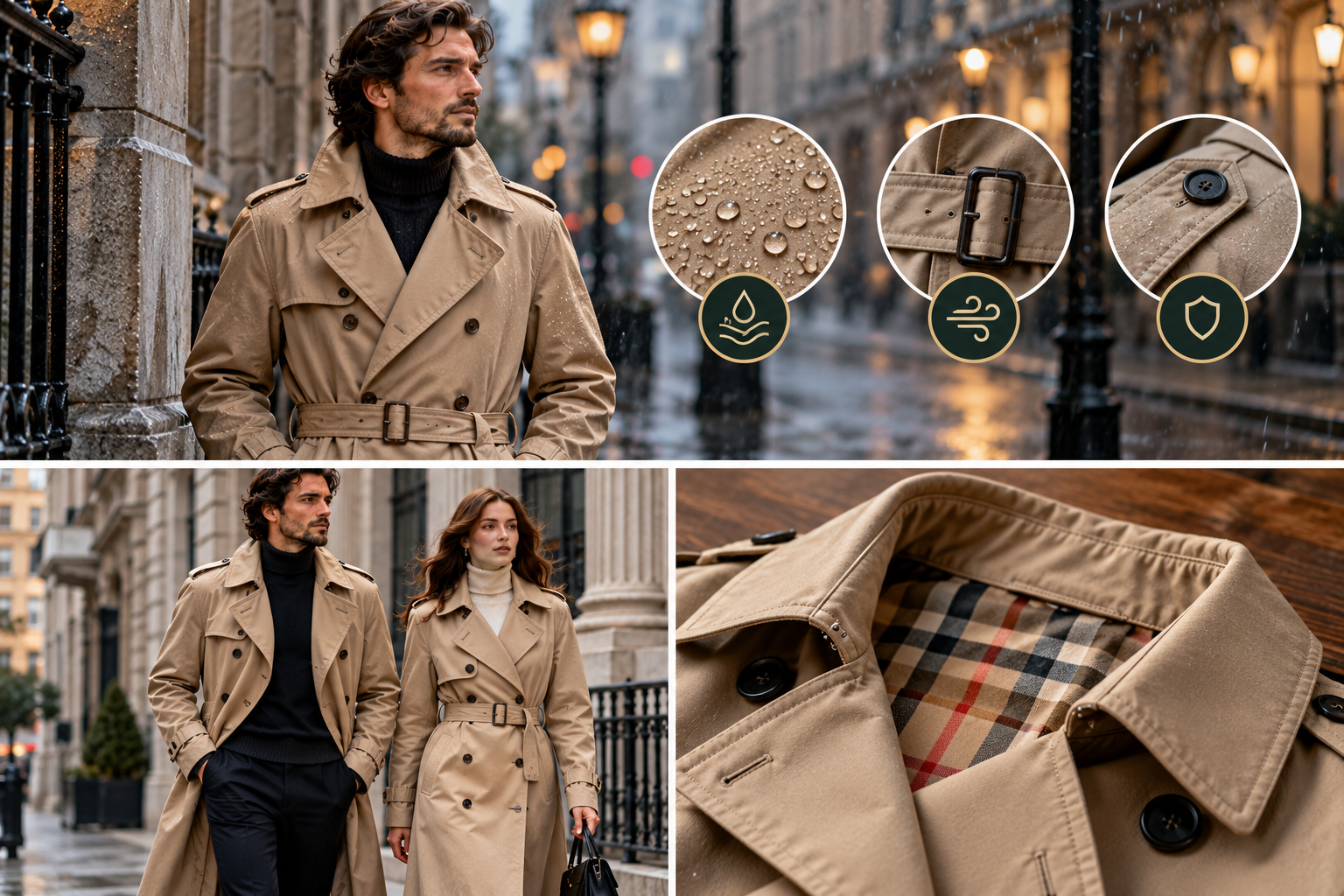
The trench coat’s style comes from structured double-breasted tailoring, adjustable waist shaping, and a silhouette that can move between business clothing and casual layers.
How lapels and epaulettes shape the upper-body frame
Wide lapels and shoulder epaulettes create strong horizontal and diagonal lines across the upper torso. That geometry gives the coat a defined frame even when the clothing underneath is soft or informal.
Those elements mainly affect shape and proportion. Weather performance comes from cloth density, overlap, closure, surface treatment, and how completely the coat seals around the body.
How the belt and raglan sleeve adjust fit over different layers
A raglan sleeve runs from the neckline toward the underarm instead of ending at a conventional shoulder seam. Garment-fit research shows that raglan pattern geometry can change shoulder comfort and ease, which is useful where arm movement matters.[4][5]
On a trench coat, that extra shoulder room helps the outer layer sit over a suit jacket or knitwear. The belt then controls excess torso fabric, allowing a loose protective shell to become more defined without changing the coat’s basic cut.
Why heritage neutrals remain easy to combine
Khaki, stone, tan, navy, and related muted colors work with a wide range of shirts, tailoring, denim, knitwear, and footwear because they sit outside highly saturated seasonal palettes.
Color does not make a coat durable, but restrained military-derived shades are less tied to one styling cycle. The V&A’s historical trench material shows the design adapting across decades while keeping its recognizable structure.[1]
How Tightly Woven Fabrics and Storm Architecture Deflect Rain and Wind
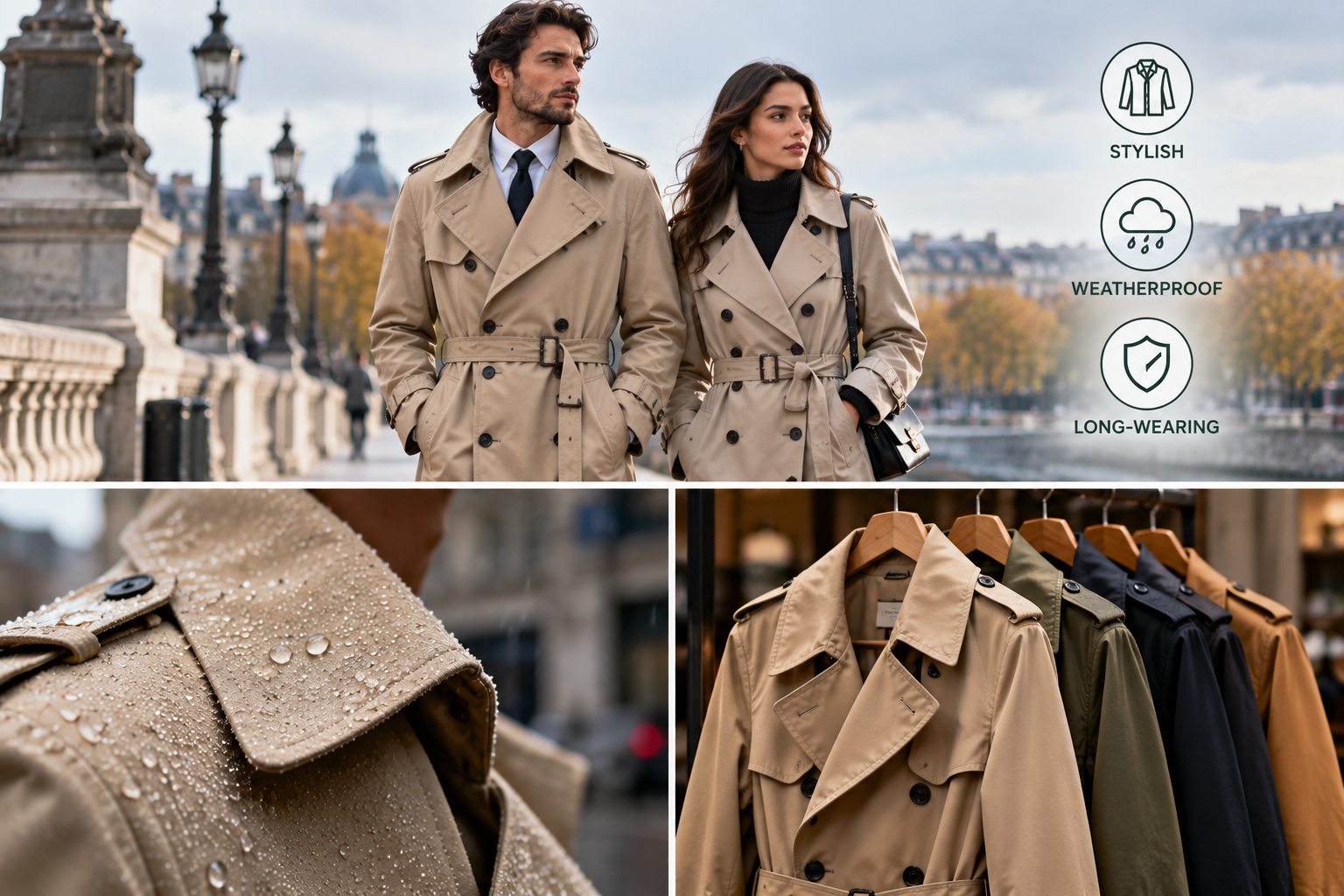
A trench coat deflects rain and wind through two linked mechanisms: dense water-repellent twill and overlapping fabric features that guide runoff away from the body.
How dense twill and DWR encourage water to bead rather than spread
Water repellency and waterproofing are different properties. Textile-finishing research describes DWR as a surface treatment that reduces wetting, making droplets more likely to bead and roll away instead of spreading into the textile.[6][7]
Fabric structure matters as well. A dense weave narrows the physical pathways available to wind and liquid water, while surface treatment reduces how readily droplets wet individual fibres. Exact thread-count thresholds are not used because weave geometry, yarn size, fibre, finish, and test method all affect performance.
How the gun flap and back rain shield manage runoff
The gun flap and rear storm shield add overlapping layers over parts of the upper torso. The V&A describes the gun flap as a weather shield that supports runoff and the storm shield as a floating panel that lets rainwater move off the upper back.[1]
These panels are not waterproof membranes. They redirect surface water and add coverage over exposed areas, reducing how much rain reaches the underlying coat body and some seam zones.
How the throat latch and cuff straps close wind entry points
Wind can enter through the neck, sleeves, and front openings even when the fabric itself resists airflow. The V&A identifies the throat latch and adjustable cuffs as protective hardware for wet and windy conditions.[1]
Fastening the collar, narrowing the cuffs, and using the double-breasted overlap reduces open pathways around the body. The belt can also stabilize loose fabric in wind, though it does not form a waterproof seal.
| Component | Physical Design | Engineering Function |
|---|---|---|
| Gun flap / storm flap | Overlapping chest panel | Adds a second fabric layer and helps direct rain away from the coat body |
| Rain shield / back yoke | Floating panel across the upper back | Creates an overlapping runoff layer over the shoulders and upper back |
| Throat latch | Tab and fastening point around the collar | Closes the neck opening to reduce wind and driven-rain entry |
| Epaulettes | Buttoned shoulder straps | Military-origin hardware used for insignia or gear and retained as a structural detail |
| Cuff straps | Adjustable wrist tabs or buckled straps | Reduce the sleeve opening and limit wind or rain entering at the wrist |
| Belt with D-rings | Waist belt with attached metal rings on heritage designs | Adjusts torso shape; D-rings originated as equipment attachment points |
What Are the Exact Weather and Thermal Boundaries of a Trench Coat?
A cotton gabardine trench coat handles wind and moderate showers well, but it is not a fully waterproof storm coat and offers little standalone insulation in freezing conditions.
Water-resistant vs. waterproof: why stitched seams matter
A water-repellent woven shell can delay wetting, but traditional stitching creates needle holes. Research on waterproof seams notes that those holes need seam tape, bonding, welding, or similar sealing methods when true waterproofness is required.[8]
Traditional trench tailoring does not rely on full thermoplastic seam taping. During prolonged rain, water can eventually move through fabric, openings, and stitched construction even if the face cloth initially beads droplets.
Why unlined gabardine is a wind layer rather than deep insulation
Cold protection depends heavily on trapped air and total clothing insulation. Reviews of cold-weather clothing show that textile structure, layer thickness, trapped air, fit, and wind all influence thermal resistance.[9]
A traditional cotton trench is thin compared with a lofted puffer or heavily insulated coat. Its dense shell can reduce convective cooling from wind, but the fabric contains little loft for retaining large volumes of warm air.
How removable warmers extend seasonal use
The V&A records a removable fleece liner in the wartime Burberry Trench-Warm, showing that extra insulation was treated as a separate layer rather than an inherent property of the gabardine shell.[1]
A wool, camelhair, fleece, or quilted warmer increases the amount of trapped air inside the clothing system. It can extend the coat into colder weather, but temperature limits still depend on liner thickness, wind, activity, fit, and the wearer’s other layers.
| Environmental Condition | Traditional Trench Capability | Structural Reason |
|---|---|---|
| High wind / drafts | Good when collar, cuffs, and front are closed | Dense twill, front overlap, throat closure, and cuff adjustment reduce direct airflow |
| Light to moderate showers | Good short-duration protection | Tight fabric plus water-repellent finishing encourages surface beading and runoff |
| Sustained heavy downpour | Limited | Water-repellent cloth is not the same as a seam-sealed waterproof membrane; needle holes and prolonged wetting create entry paths |
| Freezing or sub-zero cold, standalone | Poor | Traditional unlined cotton gabardine has little loft; insulation must come from added layers or a removable warmer |
What Determines the Long-Term Lifespan of a Trench Coat?
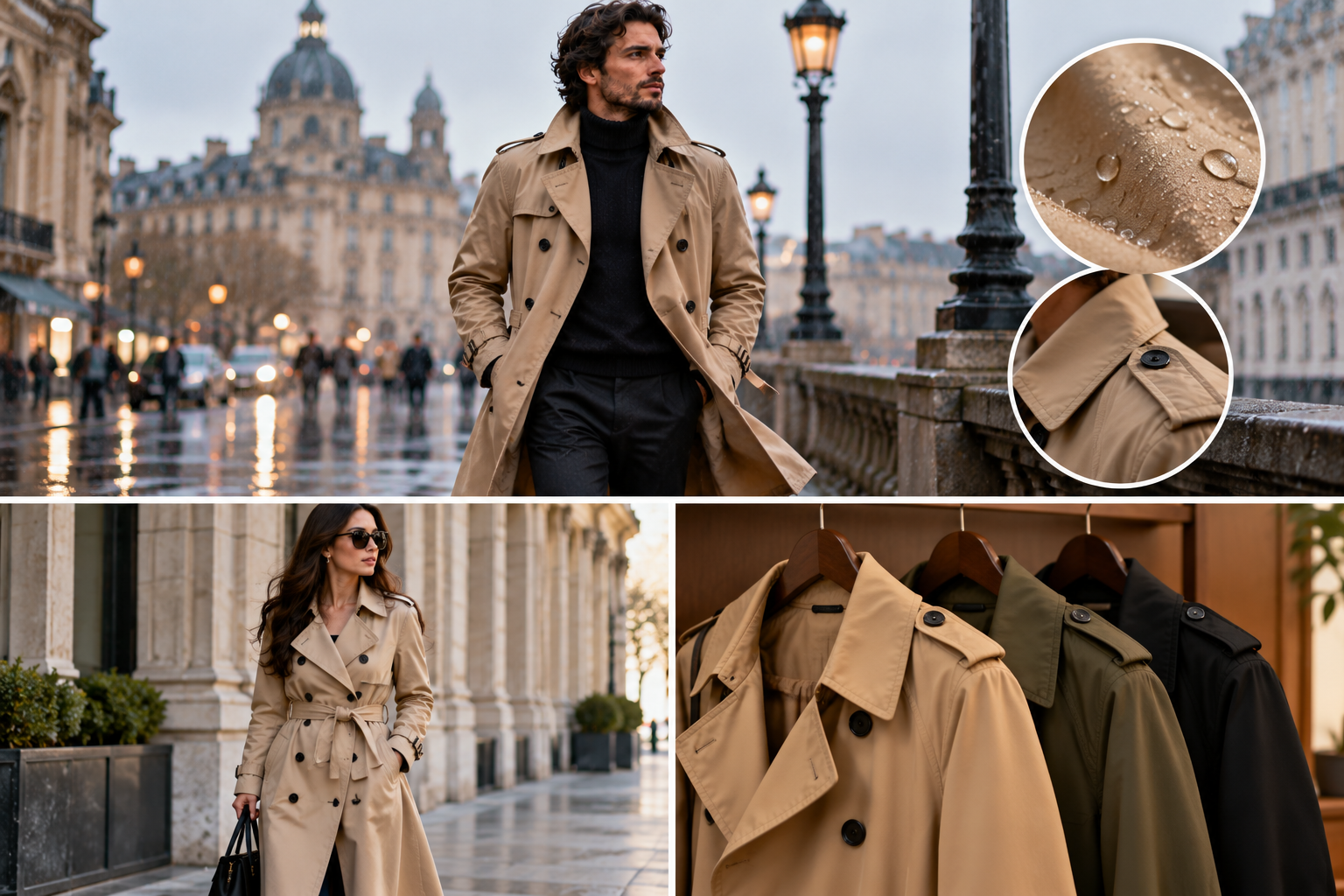
The long service life of a quality trench coat depends on durable woven cloth, sound seams, repairable hardware, and maintenance that preserves the shell and its water-repellent performance.
How dense gabardine construction resists everyday surface wear
Fabric durability depends on fibre properties, yarn twist, weave, density, and finishing rather than on one “authentic” yarn-count rule. Textile wear research shows that abrasion resistance changes with yarn mobility, linear density, twist balance, fabric set, and weave structure.[10][11]
Gabardine’s twill structure can support good wear performance, but no universal tensile-strength figure is assigned to two-ply cotton because one number cannot describe every finished trench fabric.
Auditing buckles, cuff edges, buttons, and other friction points
A trench coat combines textile and hardware components that age at different rates. Belt buckles rub against desks and bags, cuff edges contact surfaces, and front buttons repeatedly load the same thread attachment points.
Those local failures are often repairable before the shell is worn out. Reinforcing loose buttons, worn cuff binding, damaged belt hardware, or opening seams early can extend usable life without replacing the whole garment.
How cleaning and abrasion change water repellency
DWR performance is not permanent. Research reviews show that water-repellent finishes can lose effectiveness through abrasion, contamination, laundering, or dry cleaning, with the result depending on the chemistry used.[6][7][12]
Care-label instructions are more useful than a fixed reproofing schedule. Surface repellency should be restored when beading has clearly declined, using a treatment compatible with the garment’s fibre, finish, lining, and care requirements.
| Component | Durability Profile | Common Wear Mode | Preventive Care |
|---|---|---|---|
| Gabardine shell | Potentially long-lived with sound construction | Edge abrasion, staining, seam wear, finish loss | Brush or spot-clean when suitable and follow the garment care label |
| Leather-trimmed buckles | Wear-sensitive hardware | Scuffing, cracking, coating or leather deterioration | Keep dry when possible and repair or replace worn hardware |
| Water-repellent finish | Performance declines with use and care | Abrasion, contamination, laundering, or dry cleaning can reduce repellency depending on finish chemistry | Restore repellency when needed and in line with care guidance |
| Buttons and thread shanks | Repairable stress points | Thread loosening or breakage under repeated fastening load | Reinforce loose attachments before loss |
Trench Coat vs. Mac Coat and Technical Hardshell: Which Performs Best?
Choosing between a traditional trench coat, a minimalist Mac coat, and a technical hardshell means balancing tailored formality, airflow, garment weight, and the severity of expected rainfall.
| Performance Metric | Heritage Trench Coat | Macintosh / Mac Coat | Technical Rain Hardshell |
|---|---|---|---|
| Primary rain strategy | Dense woven cloth + water-repellent finish + overlapping hardware | Bonded or coated rain-barrier tradition with simpler styling | Waterproof-breathable membrane or coating plus sealed construction |
| Style / formality | High; military-tailored and belt-adjustable | Clean, minimal, often single-breasted | Technical and performance-oriented |
| Liquid-water barrier | Water-resistant rather than fully waterproof by default | Depends on bonded/coated construction | Designed for high resistance to liquid-water penetration |
| Air / vapor exchange | Woven cloth can permit direct air permeability; finish and lining affect it | Barrier construction can reduce direct airflow | Membrane systems block liquid water while transferring water vapor to varying degrees |
| Wind control | Strong when double-breasted front, collar, cuffs, and belt are closed | Depends on fabric and front closure | Strong with wind-resistant membrane construction |
Compare trench overlap and adjustability with the simpler Mac coat
The trench uses a double-breasted front, belt, storm layers, cuff adjustment, and collar hardware to manage shape and exposure. A Macintosh-derived raincoat follows a simpler rain-barrier tradition built around rubberized or bonded cloth.[2][3]
The two designs prioritize different things: the trench favors adjustable tailoring and military-derived hardware, while the Mac tradition favors a cleaner raincoat form with fewer external components.
Compare woven gabardine with membrane-backed technical hardshells
Technical hardshells use waterproof-breathable membranes or coatings engineered to resist liquid-water pressure while allowing water vapor to move outward. Reviews of waterproof-breathable layers treat hydrostatic resistance and vapor transmission as separate performance variables.[13][14]
Gabardine uses a different mechanism. Dense woven cloth plus water repellency can provide direct air permeability and useful shower resistance, but it does not offer the sealed liquid-water barrier of a membrane shell with protected seams. Breathability in both systems changes with fabric structure, finish, lining, humidity, temperature, and garment ventilation.[6][13][14]
Final Verdict: When Is a Trench Coat the Right Outerwear Investment?
A traditional trench coat is a sound outerwear choice for cool transitional weather and urban rain when tailored style, wind control, and long-term repairability matter more than extreme-weather protection.
Ideal scenarios for transitional climates and professional layering
The trench coat is strongest during spring and autumn commutes, business travel, and urban walking where the wearer needs a polished outer layer that can cut wind and shed intermittent rain.
Its adjustable belt, raglan sleeve, double-breasted front, collar hardware, and storm panels make it useful across different layers without turning it into a bulky insulated coat.
When to choose a technical shell or insulated winter coat instead
Sustained heavy rain favors a seam-sealed waterproof hardshell because its barrier system is designed around water pressure and sealed construction. Freezing conditions with low activity favor a heavily insulated coat or parka because those garments hold much more insulating air.[8][9][13]
The trench coat has a specific role: formal versatility, wind control, shower resistance, and repairable heritage construction. It should not be treated as a substitute for storm waterproofing or deep-winter insulation.
Sources
- Victoria and Albert Museum. The Burberry Trench: Crafting an Icon — history, Tielocken, Trench-Warm and hardware. View source.
- Smithsonian Magazine. The Classy Rise of the Trench Coat — gabardine, Macintosh rainwear and First World War development. View source.
- Victoria and Albert Museum. A Very Brief History of Staying Dry — rubberized Macintosh cloth and gabardine. View source.
- International Journal of Clothing Science and Technology / ScienceDirect. Research on the fit raglan sleeve based on armhole depth and body-sleeve connection. View source.
- Sensors / MDPI. The Effect of Sleeve Pattern and Fit on E-Textile EMG Electrode Performance. View source.
- Environment International / ScienceDirect. Properties, performance and associated hazards of durable water repellent chemistry. View source.
- Waterproof and Water Repellent Textiles and Clothing / ScienceDirect. Performance evaluation and testing of water-repellent textiles. View source.
- Materials Science. Usage of Fusible Sewing Threads to Improve the Waterproof Property of Seam. View source.
- Building and Environment / ScienceDirect. Quantitative characterization of clothing cold-protective capability — systematic review. View source.
- ScienceDirect Topics. Wear of Materials — abrasion resistance of cotton, wool and woven structures. View source.
- Procedia Engineering / ScienceDirect. Research Regarding the Physical-Mechanical Properties of Knits for Garments — Abrasion Resistance. View source.
- ScienceDirect Topics. Repellent finishes and care durability. View source.
- Advances in Colloid and Interface Science / ScienceDirect. Waterproof breathable layers — waterproofness, hydrostatic pressure and vapor transfer. View source.
- Materials / MDPI. Review of Waterproof Breathable Membranes. View source.
- The Metropolitan Museum of Art. Burberry trench coat, 1970s — museum collection record. View source.
Source policy: Evidence citations use museums, peer-reviewed textile and clothing research, academic reviews, and technical textile references. No retail product or trench-coat sales page is used as evidence. Unsupported universal thread counts, fixed hydrostatic ratings, exact tensile-strength claims, fixed garment lifespans, and fixed DWR reproofing intervals were removed or softened.