
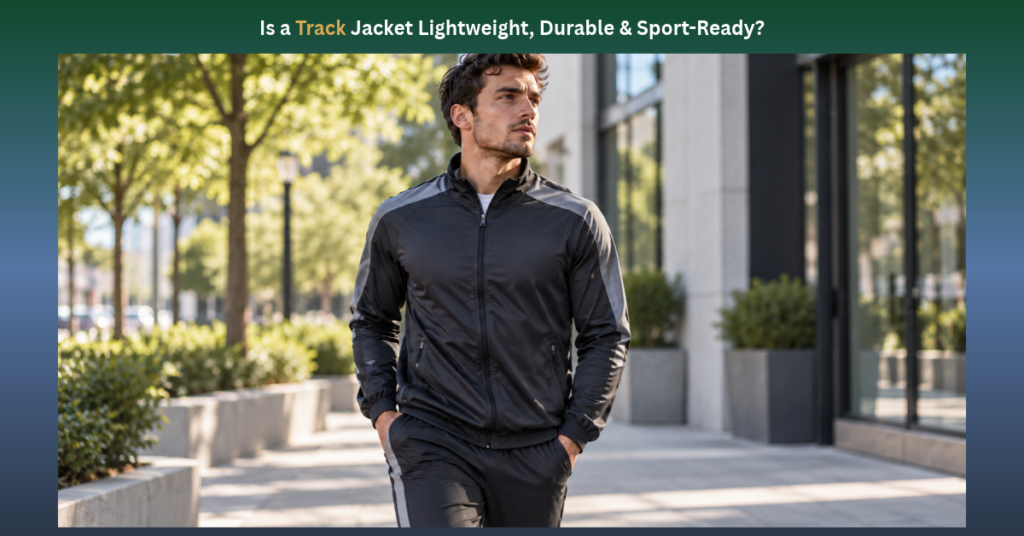
Is a Track Jacket Lightweight, Durable, and Sport-Ready?
A technical track jacket provides effective lightweight mobility and active thermoregulation for sports, but its porous knit structure limits its protection against sharp snags and severe weather.
Buyers can confuse vintage lifestyle tracksuits with sport-focused warm-up layers because both share a similar silhouette. The useful distinction is mechanical: fabric structure, moisture transport, air permeability, stretch, fit, and surface durability determine whether a track jacket can handle active use.
This guide evaluates the structural mechanics of track jackets to validate their lightweight mobility, explain their heat-management capabilities, audit their physical durability, and map their exact weather boundaries.
How Polyester Tricot Knit Defines the Track Jacket Blueprint
The foundational performance of a track jacket relies on double-faced polyester tricot, a specialized warp-knit that creates a smooth exterior and a lightly brushed, heat-trapping interior.
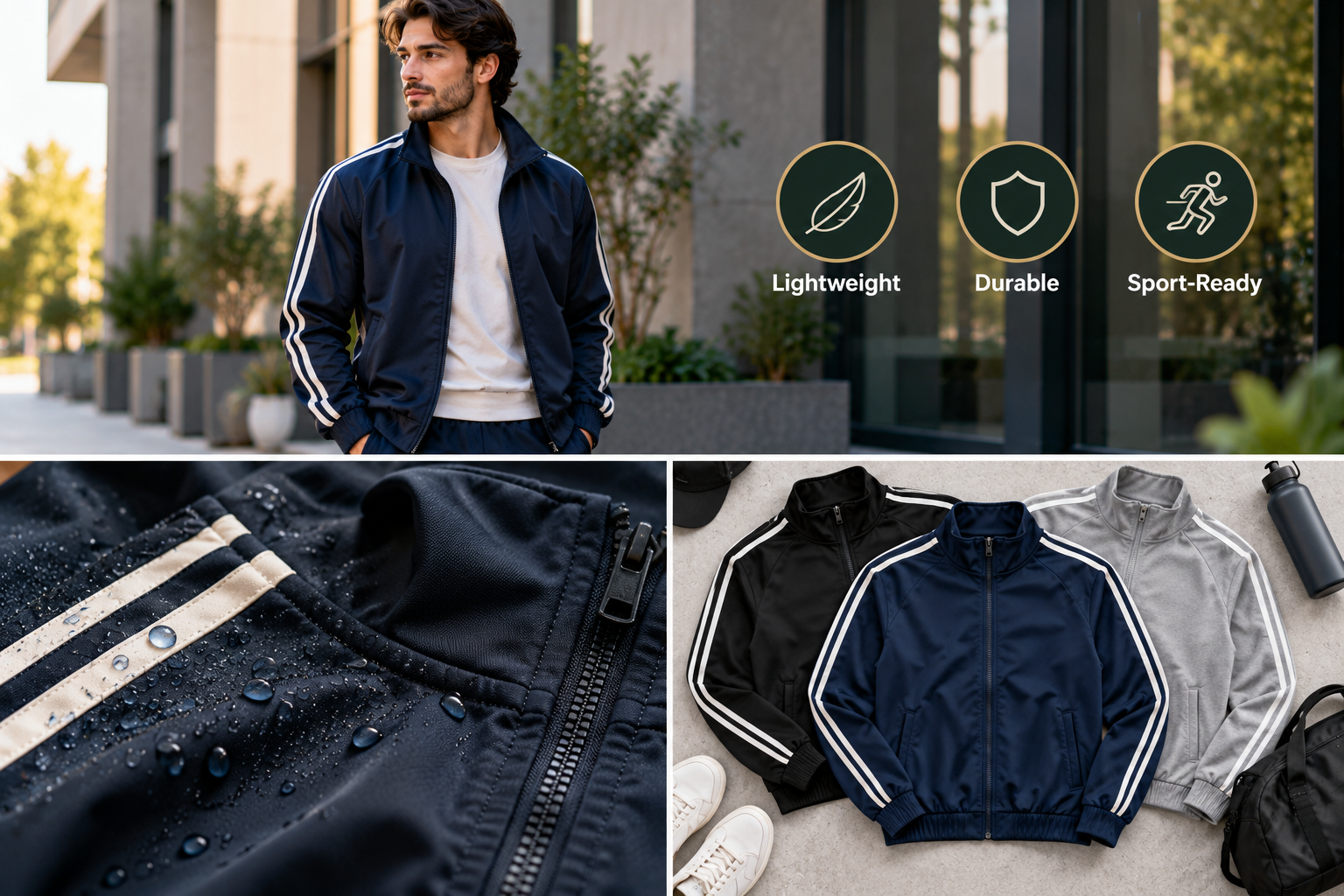
The structure of polyester tricot: a stable warp-knit face and soft inner surface
Tricot belongs to the warp-knit family. Warp knitting feeds yarns along the length of the fabric and intermeshes loops across many needles at once; textile references describe warp knits as flatter, more run-resistant, and less elastic than many weft knits.[1]
Tricot commonly shows fine vertical wales on the face and crosswise ribs on the reverse. Brushing or finishing the inner surface can add softness and raise more fibre from the back, but not every track jacket uses the same finishing process.[1]
Why a warm-up layer works before and after activity
A track jacket can reduce the abrupt shift from active heat production to cooler ambient air by adding a light clothing layer before exercise and during recovery. The exact effect depends on fabric thickness, air permeability, fit, wind, and how much heat the athlete is producing.[2][3]
The brief’s historical claim that early track jackets were engineered to a specific muscle-cooling specification is not presented as fact because no authoritative historical source was supplied or verified for that detail.
How technical polyester differs from cotton-rich lifestyle blends
Polyester absorbs little moisture inside the fibre compared with cotton, while capillary channels between filaments and yarns can move liquid across the fabric when the construction is designed for wicking.[4][5]
Cotton-rich blends can feel comfortable at low output, but cotton takes up more water and can retain more sweat mass during exercise. That changes garment weight, drying behavior, and the post-exercise feel of the layer.[5][6]
Does the Unlined Knit Structure Deliver Effective Lightweight Mobility?
An unlined knit track jacket minimizes physical restriction by pairing mid-weight synthetic fabrics with ergonomic seam placement to support athletic movement.
How fabric mass affects coverage without creating unnecessary drag
Fabric GSM measures mass per unit area, but no universal 180–250 GSM standard defines a sport-ready track jacket. Comfort depends on mass together with thickness, porosity, yarn type, knit structure, fit, and finishing.[7]
Removing a separate heavy lining keeps the garment simpler and reduces added bulk. A lightweight feel still depends on the finished jacket, including zipper, pockets, rib trim, collar, and any brushed or laminated layers.
The ergonomic role of raglan sleeves during arm swing
A raglan sleeve runs from the neckline toward the underarm instead of ending at a conventional shoulder seam. Pattern research shows that raglan geometry affects shoulder ease and fit, making sleeve design relevant when the arm must move through a large range.[8][9]
For sprinting arm swing, warm-up drills, and overhead movement, useful freedom comes from sufficient pattern ease and fabric compliance rather than from the sleeve name alone.
How ribbed elastane cuffs and hems stabilize the garment
Elastic rib structures at the wrists and hem can hold the jacket closer to the body without rigid closures. That limits loose fabric movement during running or drills and helps maintain the intended fit.
The amount of recovery depends on yarn content, knit construction, use, and laundering, so no fixed stretch-recovery percentage is assigned to every polyester tricot jacket.
What Makes a Track Jacket Authentically Sport-Ready?
A track jacket functions as a sport-ready layer by managing sweat, airflow, and trapped body heat during athletic warm-ups and training.
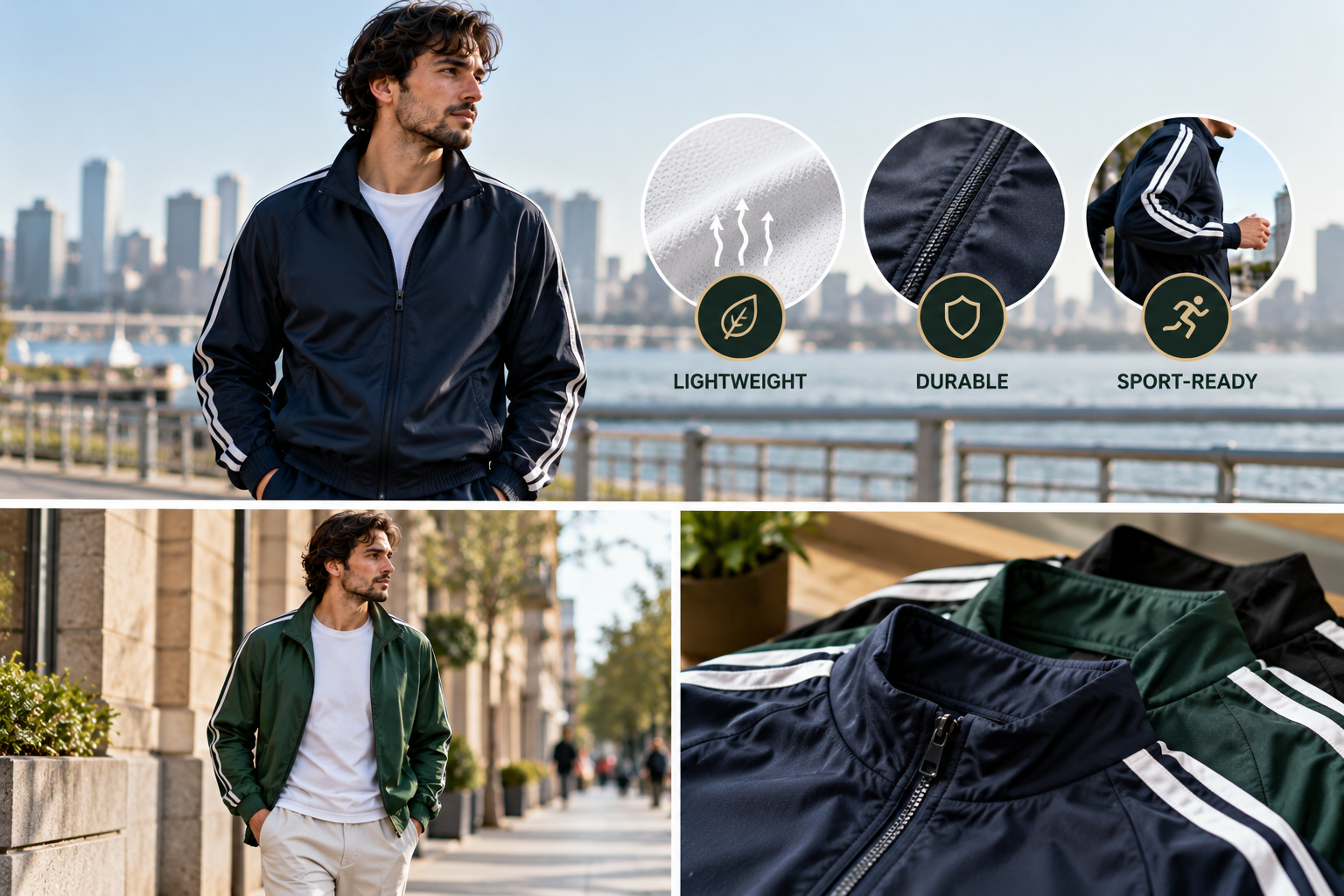
How polyester supports sweat transport without absorbing much water into the fibre
Polyester is hydrophobic and has low moisture regain, but good wicking is not automatic. Liquid sweat moves mainly through capillary spaces between fibres and yarns, so filament shape, yarn geometry, knit structure, and surface treatment matter.[4][10]
Sportswear research shows that polyester fabrics can retain less sweat than cotton in exercise settings, while results for thermal comfort and performance still vary with fabric construction and test conditions.[5][6][11]
Using the center zipper and stand collar to control heat release
Clothing ventilation changes when openings are widened or closed. Research on clothing air exchange shows that fabric permeability, wind, movement, neck openings, and cuffs all alter ventilation around the body.[12]
Opening the center zipper creates a direct route for warm, humid air to escape during higher-output activity. Closing it and raising the collar reduces that opening when the wearer is cooling down.
The cotton-blend penalty during high-sweat sessions
Cotton contains hydrophilic groups that take up more water than polyester. Exercise studies report greater clothing water regain in cotton garments than polyester under some testing conditions.[5][6]
That does not make every cotton blend unsuitable for movement. It does mean a cotton-rich track jacket can become wetter and heavier during prolonged sweating, which is less useful when rapid drying is the main requirement.
| Fabric Composition | Primary Function | Moisture Behavior | Sport-Readiness |
|---|---|---|---|
| Polyester tricot | Warm-up and light training layer | Low fibre moisture uptake; wicking depends on yarn geometry, knit structure, and finish | Strong for mobility and sweat management when construction is designed for activity |
| Poly-elastane knit | Higher-mobility training layer | Low moisture uptake with added elastic recovery | Strong where stretch and close fit matter |
| Poly-cotton blend | Casual or low-output use | Cotton fraction absorbs more water and can retain more sweat mass | Better suited to light activity than prolonged high-sweat sessions |
What Determines the Long-Term Durability of a Track Jacket?
The durability of a track jacket depends on the dimensional stability of its synthetic knit, while its smooth filament surface remains vulnerable to pulls, abrasion, and concentrated hardware stress.
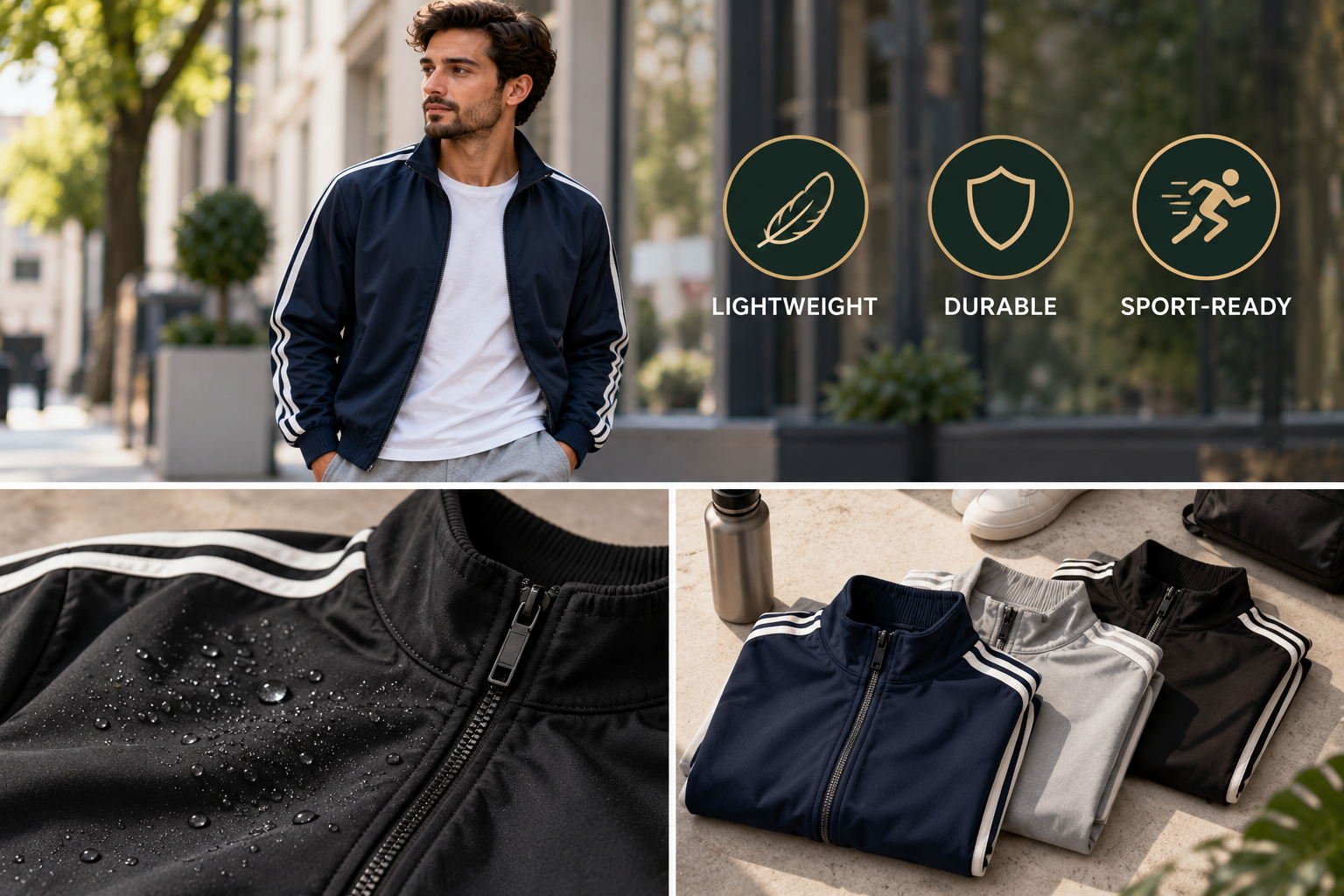
Why warp-knit polyester can retain shape through repeated use
Warp knits are described as relatively stable and run-resistant compared with many weft-knit structures. Polyester also responds well to heat-setting, a textile process used to improve dimensional stability and shape retention.[1][13]
That does not justify one universal recovery percentage. Finished stability changes with yarn type, knit density, heat setting, elastane content, laundering, and garment construction.
The filament snag vulnerability of smooth tricot
The same smooth filament surface that feels low-friction can be damaged by hooks, sharp edges, or rough contact that catches exposed yarn segments. Snag risk is a surface-mechanics problem rather than a sign that the entire knit is structurally weak.
Open hook-and-loop fasteners, rough gym equipment, and sharp hardware can create localized pulls. Once a filament is displaced, the visible damage may remain even when the surrounding fabric still holds its shape.
Auditing zipper, pocket, abrasion, and heat-sensitive zones
Zipper tape, pocket corners, cuffs, and hem edges concentrate repeated loading. A durable jacket needs secure stitching and reinforcement at those points because fabric strength alone does not protect the attachment.
Polyester is thermoplastic. Research on heat-treated polyester knits shows that post-heat exposure can change fabric dimensions, so care temperatures matter when the goal is long-term shape retention.[13][14]
Track Jacket Durability & Snag Audit Checklist
- Hook-and-loop contact: Keep exposed hook surfaces away from smooth tricot because they can catch and pull filament loops.
- Rough gym hardware: Watch contact with knurled bars, sharp bench edges, and textured equipment that can abrade the face of the knit.
- High heat: Follow the garment care label; polyester is thermoplastic and excessive heat can alter dimensions or surface finish.
- Zipper alignment: Start the zipper squarely and avoid sideways pulling that concentrates force at the slider, tape, and bottom stop.
What Are the Environmental Boundaries of a Track Jacket?
A knit track jacket works best in dry or controlled conditions; high air permeability limits wind protection, and ordinary tricot construction does not create a waterproof rain barrier.
Why porous knit construction loses warmth in strong wind
Wind can move air through permeable textiles and replace the warmer air held near the body. Experimental and numerical clothing research shows that higher air permeability and stronger wind can reduce effective thermal resistance.[15][16]
That is useful during exercise when the body needs heat loss, but it becomes a liability during rest in cold wind because convective cooling rises.
Why ordinary tricot is not a rain shell
Polyester fibre itself absorbs little water, yet a porous knit still contains open pathways for liquid water. A jacket needs a water-repellent treatment, coating, membrane, or other barrier system to improve rain protection beyond the base knit.[17]
A standard track jacket should therefore be treated as a warm-up or mid-layer unless its manufacturer specifies a weather-resistant finish or shell construction.
Why layering changes the jacket’s role in cold weather
A wind-resistant outer shell can reduce air penetration while the track jacket underneath contributes light insulation and moisture movement. Layered clothing works by assigning different jobs to different materials rather than expecting one permeable knit to do everything.[15][18]
In freezing conditions, the required insulation still depends on activity level, wind, exposure time, and the rest of the clothing system.
Track Jacket vs. Windbreaker and Running Shell: Which Fits Your Workout?
Choosing between a knit track jacket and a woven windbreaker requires prioritizing either soft mobility and warm-up comfort or stronger wind and light-weather deflection.
| Performance Metric | Knit Track Jacket | Woven Windbreaker / Running Shell |
|---|---|---|
| Primary function | Warm-up, cool-down, indoor training, and mobile layering | Wind deflection and light-weather protection |
| Fabric structure | Looped knit with higher compliance and air exchange | Tight woven shell with lower air permeability |
| Wind resistance | Limited when knit permeability is high | Stronger when weave and finish reduce air penetration |
| Rain defense | Limited unless specially treated | Often better when the shell uses a water-repellent finish or barrier construction |
| Movement feel | Soft, quiet, and compliant | Less compliant unless stretch yarns or stretch weaving are used |
Compare knit compliance and quiet movement with wind deflection
Knit structures deform through their loops and tend to feel softer and quieter during movement. A tightly woven shell restricts direct airflow more effectively, which is why windbreakers are better suited to exposed running conditions.[1][15]
A plain polyester tricot jacket should not be described as having four-way stretch unless its construction or elastane content supports that range. The safer distinction is compliant knit mobility versus lower-permeability woven weather protection.
Compare warm-up comfort with ultralight running-shell priorities
A brushed or thicker track-jacket interior can hold more still air than a very thin running shell, which favors pre-session warmth and recovery comfort.
A running shell is designed around another priority: low carried mass and reduced wind penetration. The right choice depends on whether the session demands warmth and mobility or exposure protection.
Final Verdict: When Is a Track Jacket the Right Activewear Choice?
A track jacket is an effective activewear choice for dry outdoor training, gym warm-ups, travel comfort, and transitional layering when the wearer accepts its limits against snags, strong wind, and sustained rain.
Ideal scenarios for warm-ups, dry training, and transitional layering
The garment works well where mobility, moderate warmth, ventilation, and low fibre moisture uptake matter at the same time. Gym warm-ups, track sessions in mild weather, travel, and pre- or post-workout use fit that profile.
Sport-readiness still depends on the actual fabric and pattern. A dense cotton-rich lifestyle jacket and a technical polyester tricot layer may look similar while behaving very differently under sweat and movement.
When to choose woven or more abrasion-resistant outerwear instead
Cold wind and sustained rain favor a woven weather shell with lower air permeability and an appropriate water-repellent or waterproof system. Repeated contact with rough equipment favors a fabric designed for higher abrasion and snag resistance.[15][17]
A track jacket earns its place as a light, mobile athletic layer, but its porous knit and exposed filament surface set clear limits in severe weather and abrasive environments.
Sources
- ScienceDirect Topics. Warp Knit — warp-knit construction, tricot structure, run resistance, flatness, and elasticity. View source.
- Applied Ergonomics / ScienceDirect. Evaluation of thermal and moisture management properties on knitted fabrics. View source.
- Ergonomics / PubMed. Clothing impact on post-exercise comfort: skin-clothing physiology in transient environment. View source.
- Textiles / MDPI. Factors Affecting the Sweat-Drying Performance of Active Sportswear—A Review. View source.
- Applied Ergonomics / PubMed. The effect of polyester and cotton T-shirts on thermal responses during exercise and recovery. View source.
- Measurement / ScienceDirect. Difference in hydrophobic and hydrophilic multilayered systems — cotton and polyester moisture regain. View source.
- Textiles / MDPI. Textile Transformation: structural, thermal and moisture properties of sports clothing fabrics. View source.
- International Journal of Clothing Science and Technology / ScienceDirect. Research on the fit raglan sleeve based on armhole depth and body-sleeve connection. View source.
- Sensors / MDPI. The Effect of Sleeve Pattern and Fit on E-Textile EMG Electrode Performance. View source.
- Colloids and Surfaces A / ScienceDirect. Spreading of water microdroplets simulating human sweating in polyester yarns and fabrics. View source.
- Wilderness & Environmental Medicine / ScienceDirect. Exercising in a Hot Environment: Which T-shirt to Wear?. View source.
- Elsevier Ergonomics Book Series / ScienceDirect. The effect of fabric air permeability on clothing ventilation. View source.
- Research Journal of Textile and Apparel / ScienceDirect. Thermal behaviour of heat treated polyester knitted fabrics. View source.
- Textile Science and Technology / ScienceDirect. Heat-Setting — polyester dimensional stability and shrinkage behavior. View source.
- International Journal of Thermal Sciences / ScienceDirect. The effective thermal resistance of permeable textile ensembles in windy environments. View source.
- International Journal of Thermal Sciences / ScienceDirect. Numerical analysis of heat and flow transfer in porous textiles — wind velocity and air permeability. View source.
- Colloids and Surfaces A / ScienceDirect. Water-repellent polyester textile produced through a hydrophobic surface treatment. View source.
- Applied Ergonomics / ScienceDirect. A quasi-physical model for thermal insulation and moisture vapor resistance of clothing. View source.
Source policy: Evidence citations use peer-reviewed textile, clothing, ergonomics, thermal-comfort, and sportswear research plus academic textile references. No retail product or track-jacket sales page is used as evidence. Unsupported universal GSM ranges, fixed stretch-recovery percentages, and unverified historical warm-up specifications were removed or softened.