
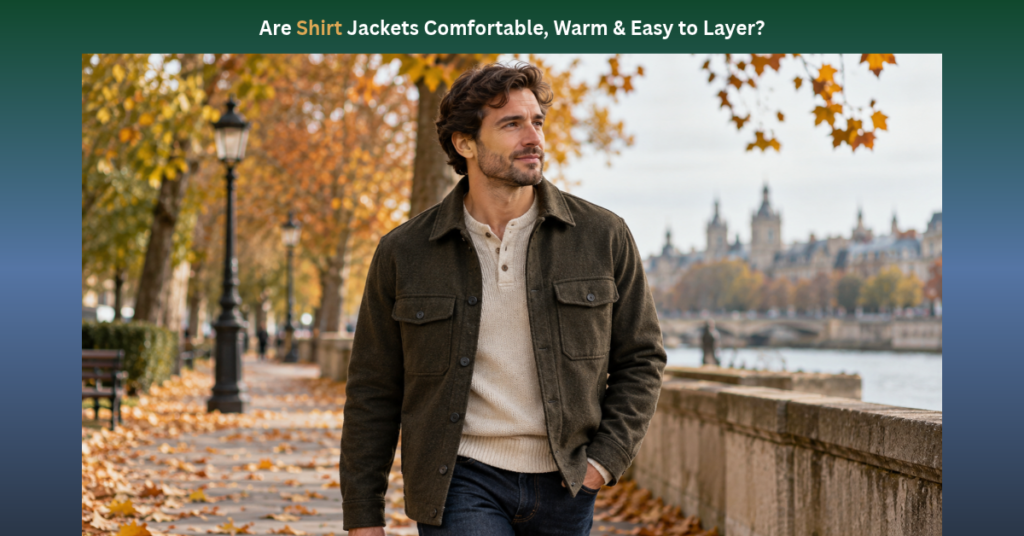
Are Shirt Jackets Comfortable, Warm, and Easy to Layer?
A shirt jacket can balance casual comfort, transitional warmth, and flexible layering, but the result depends on fabric weight, lining construction, and fit.
A shacket may look simple, yet textile density, sleeve friction, closure gaps, and shoulder ease change how it behaves in use. Those details determine whether it feels closer to a heavy shirt, a light jacket, or an insulating mid-layer.
This guide examines shirt-jacket construction to assess comfort and warmth, explain how the garment layers over other clothing, and define where its weather protection stops.
How Heavyweight Textiles Transform a Button-Down Into a Shirt Jacket
A shirt jacket separates itself from a standard button-down through denser cloth, heavier trim, and construction built for light outerwear use rather than indoor shirting.
Upgrading from shirting fabric to outerwear-weight textiles
GSM is a measure of fabric mass per unit area, not a universal category label for shirts or jackets. ISO 3801 defines methods for measuring woven-fabric mass per unit area, but it does not establish one numeric threshold at which a shirt becomes outerwear.[1]
A shirt jacket feels more substantial when fabric mass is paired with thickness, weave density, yarn structure, and finishing. Those properties change drape, bending stiffness, air permeability, and resistance to deformation, which means two fabrics with the same GSM can behave differently.[2][3]
How shirt collars, cuffs, and hems preserve a relaxed silhouette
Point collars, barrel-style cuffs, and shirt-like hems retain the familiar shape of a button-down even when the cloth is much heavier.
Comfort depends on the mechanical behavior of that cloth. Textile research links softness and handle to bending, compression, surface friction, thickness, and extensibility, which explains why a heavy shell can still feel relaxed if it remains pliable.[2]
Why snap plackets and hand pockets shift the garment toward outerwear
Larger buttons or a snap placket make a thick front easier to operate than small shirting buttons, while side hand pockets add a function that ordinary indoor shirts rarely need.
Those features improve utility and handling, not waterproofing. Weather performance still depends on shell structure, seam construction, surface finish, and how well the openings close.
What Makes a Shirt Jacket More Comfortable Than Structured Outerwear?
Shirt jackets often feel less restrictive than structured coats because they rely on softer tailoring, relaxed shoulder geometry, and fabrics that bend instead of holding a rigid form.
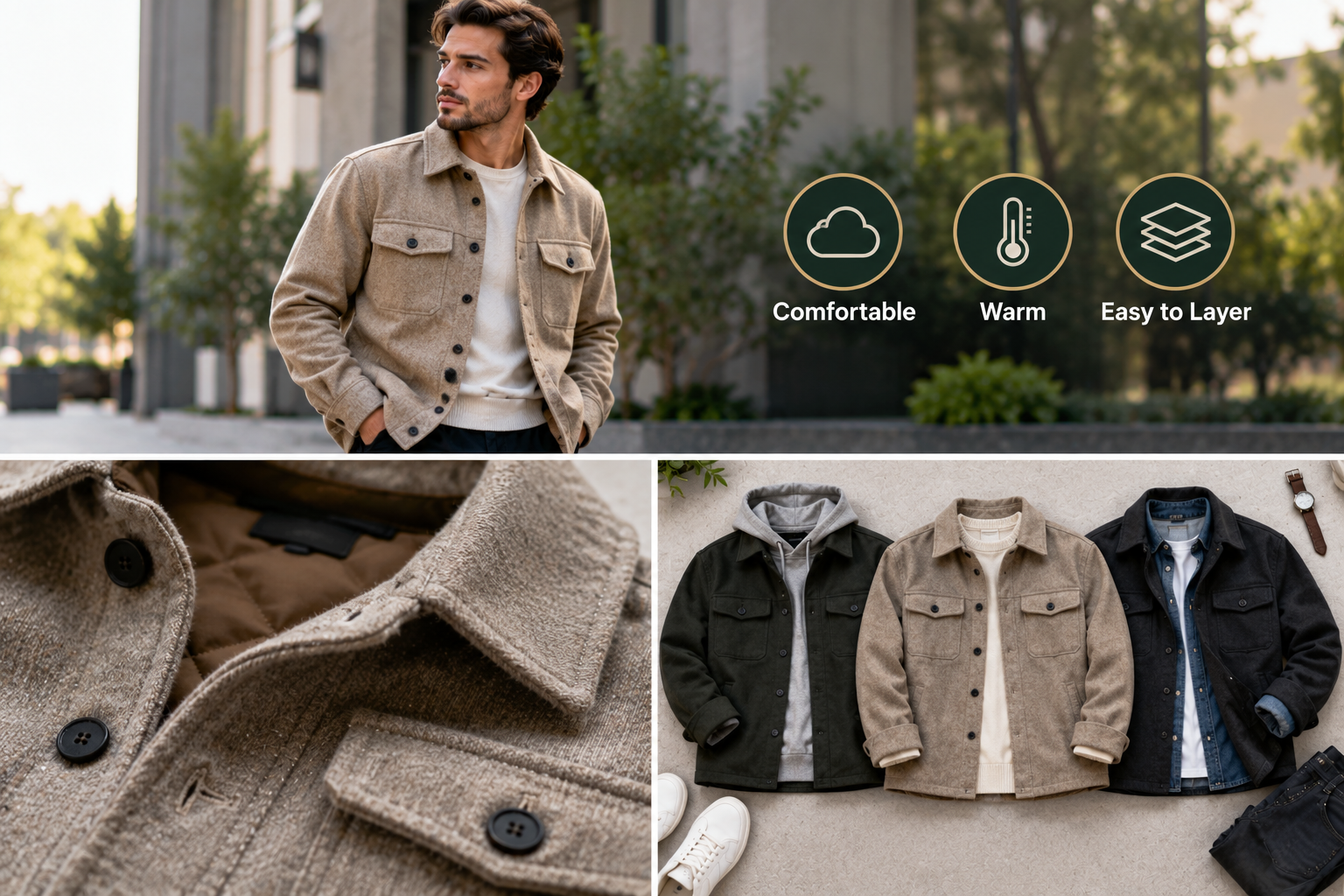
How unconstructed shoulders and back pleats reduce upper-body stiffness
Without rigid shoulder padding or heavy internal canvas, the shell can follow the back and shoulders more freely. Extra torso ease or a rear pleat leaves room for reaching, bending, and layering.
Garment comfort is not controlled by one pattern feature. Fabric extensibility, bending rigidity, shear behavior, fit, and seam placement all affect how easily clothing moves with the body.[2][4]
Why brushed flannel and soft fleece interiors feel comfortable over a T-shirt
Brushing lifts surface fibres and changes how the fabric feels against the body. A softer, more compressible face reduces the harsh contact associated with rigid or rough workwear cloth.
Textile comfort research treats softness as a combination of compression, flexibility, smoothness, and friction rather than a single property. That is why two shirt jackets with similar thickness can feel very different against bare forearms or a thin base layer.[2][5]
The break-in difference between rigid cotton twill and softer wool blends
Dense cotton twill may begin stiff, while a softer wool blend or heavily washed fabric can drape more freely from the first wear. Fibre, yarn, weave, finishing, and garment wash matter more than the material name by itself.
Weave architecture has a measurable effect on abrasion, tear, drape, and comfort properties, so fabric construction matters as much as whether the label says cotton, wool, or blend.[3]
How Fabric Density and Interior Linings Dictate Shirt Jacket Warmth
Shirt-jacket warmth comes from shell thickness, air permeability, and any fleece or quilted lining that holds extra still air around the body.
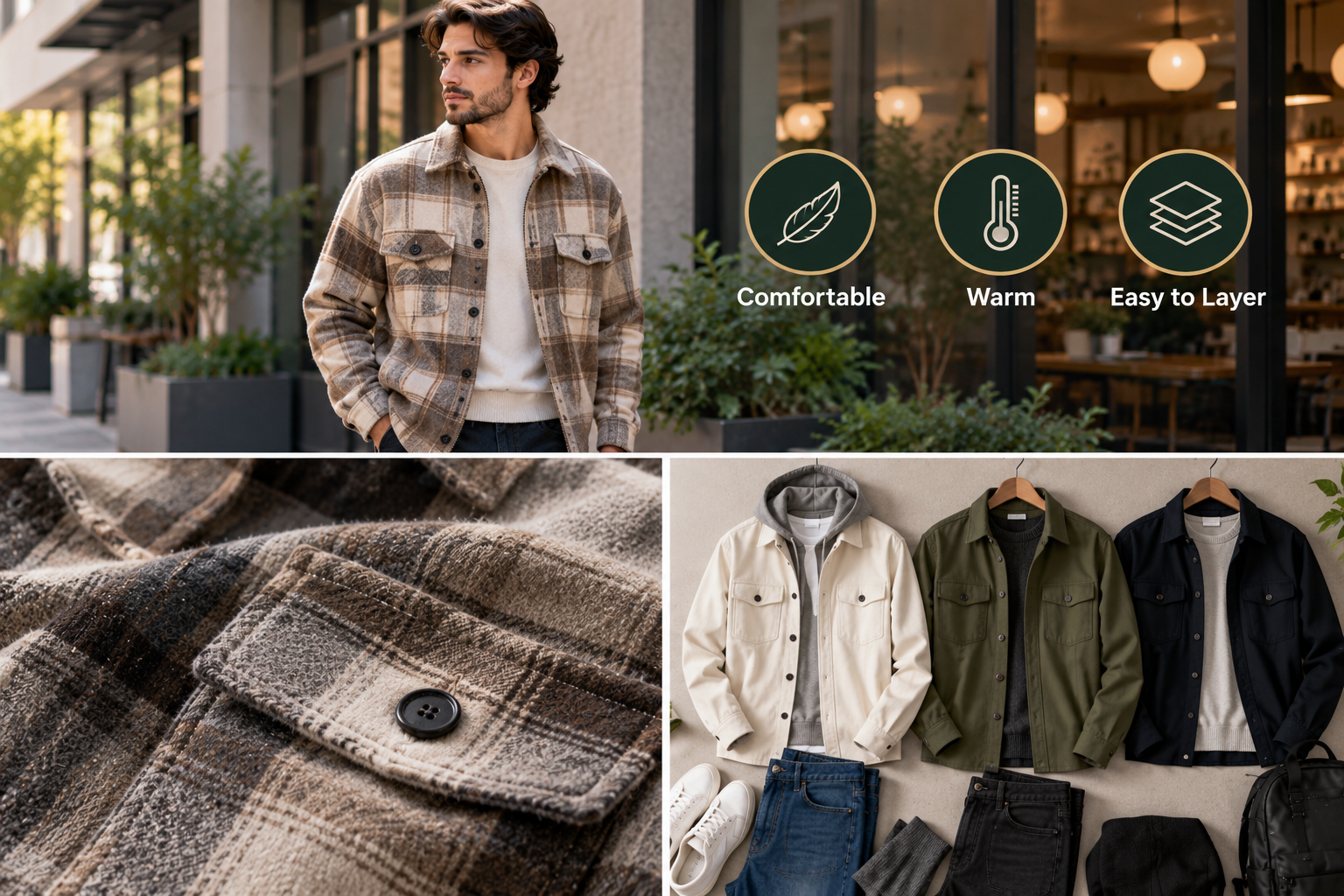
Unlined wool and cotton flannel as mild-weather insulation
Warmth depends on thickness, porosity, trapped air, and resistance to airflow rather than the fabric name alone. Dense wool or flannel can slow convective heat loss better than thin shirting, but an unlined shell still has limited loft.[6][7]
Wool can also absorb moisture into its fibre structure. That hygroscopic behavior affects comfort and moisture balance, but it should not be confused with waterproofing.[8]
How sherpa fleece and quilted linings add thermal resistance
A lofted fleece or quilted lining adds thickness and creates more still-air space. Clothing research links thermal resistance closely to thickness, trapped air, and layered construction.[6][7]
That added insulation does not translate into one reliable temperature rating for every sherpa-lined shacket. Fit, wind, activity level, base layers, and lining thickness all change the outcome.
Why button and snap plackets remain vulnerable to drafts
Buttons and snaps close the front at separate points instead of forming a continuous barrier. Small gaps let moving air replace warmer air inside the garment, especially when wind presses against the chest.
Clothing-ventilation research shows that openings and air permeability alter heat and moisture exchange around the body. A zippered and well-shielded front can control that pathway more completely than an open placket.[9]
| Construction Type | Relative Fabric / Lining Build | Thermal Role | Wind Resistance |
|---|---|---|---|
| Unlined cotton twill or flannel | Heavier woven shell without added insulation | Useful for mild transitional layering; warmth comes mostly from fabric thickness and trapped air around the body | Low to moderate, depending on weave density and openings |
| Unlined Melton or dense wool blend | Dense wool-rich shell with compact surface | Adds more thermal resistance than a light shirt fabric without relying on bulky fill | Moderate when the weave and closure reduce airflow |
| Quilted or sherpa-lined shirt jacket | Outer shell plus lofted lining or batting | Retains more still air and increases warmth relative to an unlined shell | Moderate; front and cuff openings can still admit drafts |
How to Layer a Shirt Jacket Without Sleeve Bunching or Bulk
A shirt jacket layers cleanly when the armholes, sleeve volume, and lining surface leave enough room while reducing fabric-on-fabric drag.
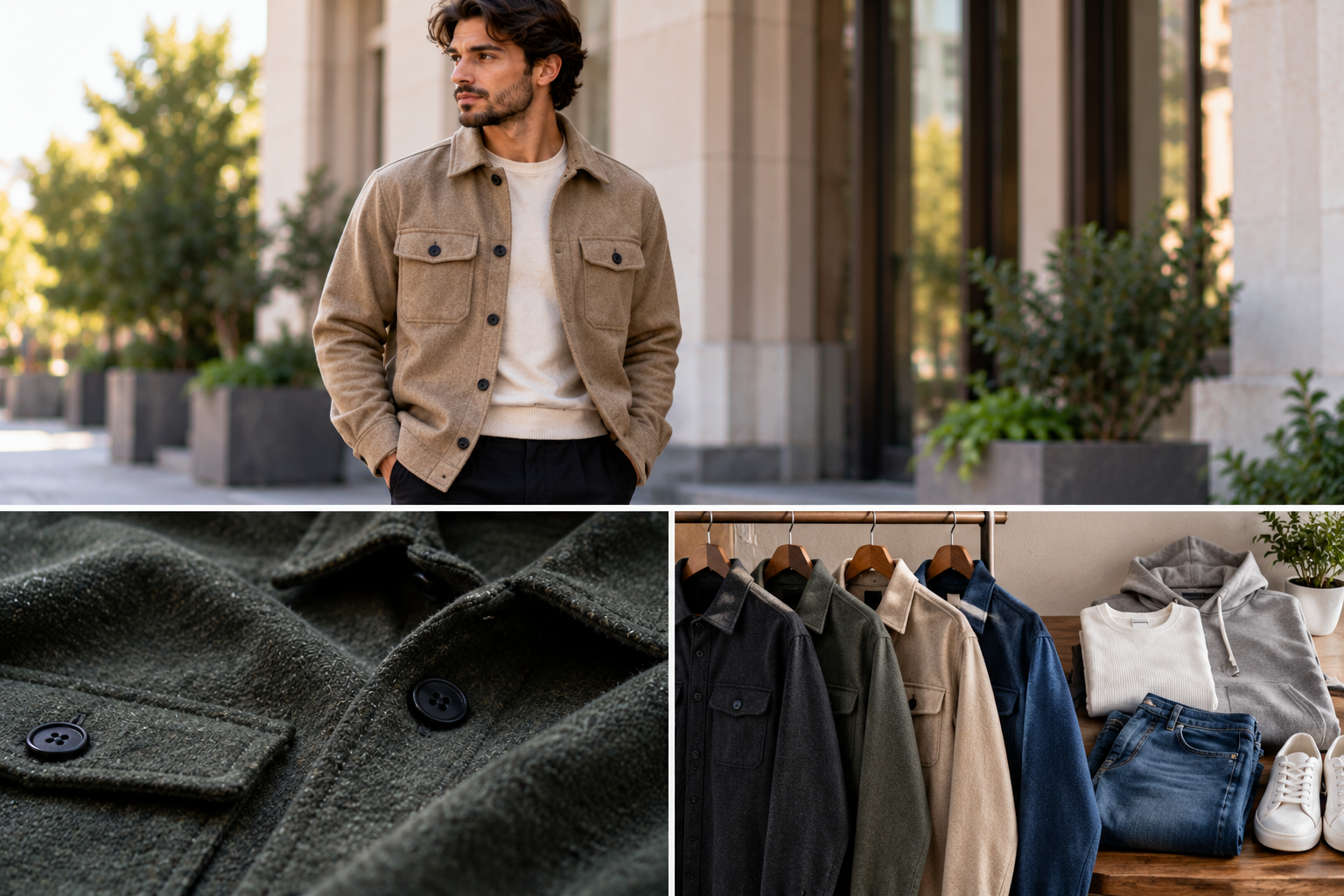
Why deep armholes and boxy cuts accommodate hoodies and knitwear
Thick base layers need room. A relaxed torso and lower armhole make space for a hoodie or sweater without forcing several layers into a tight underarm zone.
Too much room creates another problem. Excess ease can increase air exchange and make the shacket bulky under another coat, so the fit only needs enough space for the intended base layer.
How smooth sleeve linings reduce fabric drag
Sleeve bunching is partly a friction problem. Surface smoothness affects both tactile comfort and how easily one fabric slides over another.[5][10]
A smooth polyester or nylon taffeta lining creates less drag against long sleeves than a rough brushed interior. Fabric weight alone does not determine that friction, so a single lining GSM cannot predict layering ease.
Using an unlined shirt jacket as a mid-layer under a shell
A low-bulk shacket can sit beneath a rain shell or winter coat if the outer garment has enough chest, shoulder, and sleeve room. The shacket then supplies moderate insulation while the outer shell handles wind or rain.
This arrangement works best with an unlined or lightly lined shacket. A thick sherpa body can overfill the outer coat and restrict arm, shoulder, and neck movement.
| Base / Outer Garment | Required Shirt Jacket Feature | Layering Outcome |
|---|---|---|
| Heavy pullover hoodie | Deep armholes and relaxed torso ease | Reduces underarm pinching and chest compression |
| Chunky knit sweater | Smooth sleeve lining and enough sleeve circumference | Reduces fabric-on-fabric drag during dressing |
| Waterproof rain shell | Low-bulk unlined or lightly lined body | Functions as a thermal mid-layer without overfilling the outer shell |
What Are the Exact Weather and Fit Boundaries of a Shirt Jacket?
Shirt jackets suit dry transitional conditions, but untreated woven shells, open cuffs, and shirt-style closures leave clear weaknesses in sustained rain and strong wind.
Why untreated cotton and wool shells become poor choices in heavy rain
Natural fibres can hold substantial water, and wool can absorb moisture from the air as well as liquid water. Once wet, the shell becomes heavier and takes longer to dry.[8]
Most shirt jackets also lack waterproof membranes and sealed seams. Without a dedicated barrier, prolonged rain can pass through the cloth and stitched construction instead of staying on the surface.[11]
How wind enters through cuffs, plackets, and permeable fabric
Air permeability and garment openings both influence convective heat loss. Wind can travel through a porous weave or enter directly through open cuffs and front gaps.[9][12]
Dense Melton or tightly woven twill can reduce airflow better than loose flannel, but that does not turn a shirt jacket into a high-wind shell unless the fabric and closures are built for that job.
Why thick collars and bulky linings can clash under another coat
Layering becomes uncomfortable when two garments compete for the same space. A thick sherpa collar under a close-fitting coat can stack material around the neck and shoulders, restrict head rotation, and create pressure.
The same problem can occur at the upper arm when a bulky sleeve is inserted into a narrow outer sleeve. Fit compatibility matters as much as warmth.
Shirt Jacket vs. Chore Coat and Heavy Flannel: Which Layer Performs Best?
Choosing among a shirt jacket, chore coat, and heavy flannel comes down to three different priorities: flexible warmth, workwear durability, or lighter indoor mobility.
| Performance Metric | Heavyweight Shirt Jacket | Canvas Chore Coat | Heavyweight Flannel Shirt |
|---|---|---|---|
| Next-to-skin comfort | High when brushed or softly finished | Lower when stiff canvas contacts the body | High when soft cotton is used |
| Thermal warmth | Moderate; higher with fleece or quilted lining | Low to moderate without insulation | Low relative to heavier outerwear |
| Abrasion durability | Moderate; depends on fabric and finish | High when heavy workwear canvas is used | Low to moderate |
| Layering ease | High when fit is relaxed and sleeves are smooth-lined | Moderate; stiff sleeves can add drag | High because the fabric is thinner |
| Pocket utility | Moderate with chest and hand pockets | High with multiple utility pockets | Low to moderate |
Compare soft drape and lining options with canvas workwear durability
A shirt jacket favors pliability, brushed comfort, and optional insulation. A chore coat built from heavy canvas or firm twill places more emphasis on abrasion resistance and pocket utility.
Abrasion performance depends on fibre, yarn, weave, mass, and finish. Research on woven fabrics shows that weave architecture has a direct effect on abrasion and tear behavior.[3][13]
Compare outerwear structure with a standard flannel shirt
A shirt jacket moves toward outerwear through heavier fabric, stronger closures, larger pockets, and sometimes a lining. A standard flannel shirt stays thinner and easier to wear indoors.
GSM helps describe mass per unit area, but it should not be used as a stand-alone proof of warmth or durability. Structure and construction determine how that mass behaves in use.[1][2]
Final Verdict: When Is a Shirt Jacket the Right Outerwear Choice?
A shirt jacket works well in dry transitional climates and for frequent indoor-to-outdoor use when its shell weight, lining, and fit match the layers worn with it.
Ideal scenarios for transitional weather and flexible layering
A shacket fits mild days with frequent shifts between cool outdoor air and heated interiors. Its shirt-like cut keeps movement easy, while heavier fabric or a light lining adds more warmth than a standard button-down.
It can also serve travel and variable daily conditions because it moves between outer-layer and mid-layer roles without the rigid structure of a formal coat.
When to choose a softshell, rain shell, or insulated winter coat instead
Strong wind calls for a lower-permeability softshell or wind shell. Sustained rain calls for a seam-protected waterproof jacket. Severe cold calls for more loft and a closure system built to retain heat.[7][11][12]
The shirt jacket is most useful as a comfortable transitional layer, adding warmth and flexible layering without replacing dedicated storm protection or deep-winter insulation.
Sources
- International Organization for Standardization. ISO 3801:1977 — Woven fabrics: determination of mass per unit length and mass per unit area. View source.
- ScienceDirect Topics. Fabric Softness / textile comfort — relationships among bending, compression, thickness, friction, extensibility and handle. View source.
- Materials / MDPI. Effect of Weave and Weft Type on Mechanical and Comfort Properties of Hemp–Linen Fabrics. View source.
- ScienceDirect Topics. Dimensional Stability Test / Kawabata fabric evaluation — tensile, shear, bending, compression and surface properties. View source.
- Tribology International / ScienceDirect. Effect of surface modification on frictional properties of polyester fabric. View source.
- Materials / MDPI. Thermal resistance and comfort behavior of textile materials. View source.
- Building and Environment / ScienceDirect. Quantitative characterization of clothing cold-protective capability — systematic review. View source.
- PubMed. Water absorbency by wool fibers: Hofmeister effect. View source.
- PubMed. Clothing ventilation and the effects of openings and air exchange. View source.
- ScienceDirect Topics. Fabric Handle — surface friction, roughness and low-stress fabric mechanics. View source.
- Materials Science. Usage of Fusible Sewing Threads to Improve the Waterproof Property of Seam. View source.
- International Journal of Thermal Sciences / ScienceDirect. Effective thermal resistance of permeable textile ensembles in windy environments. View source.
- Materials / MDPI. Martindale abrasion and textile material performance. View source.
- Textiles / MDPI. Clothing comfort, wool, moisture and thermal behavior. View source.
- PubMed. Effect of moisture absorption on heat transfer in clothing materials. View source.
Source policy: Evidence citations use standards, peer-reviewed textile and clothing research, PubMed-indexed research, and academic technical references. No retail product or shirt-jacket sales page is used as evidence. Unsupported universal GSM bands, fixed temperature ratings, and fixed taffeta-lining weights were removed or softened.