
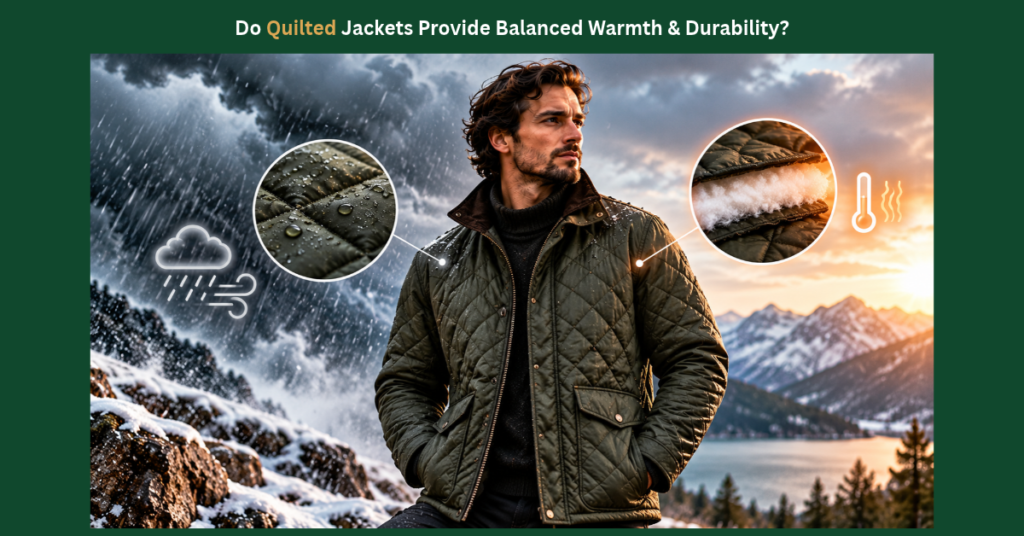
Do Quilted Jackets Provide Balanced Warmth and Durability?
A quilted jacket generally delivers a practical balance of low-bulk warmth and surface durability for transitional weather, but its service life and weather resistance are fundamentally limited by its exposed exterior stitching.
Buyers often expect quilted jackets to perform like heavy winter coats, yet the construction solves a different problem. Quilting secures an insulating layer between face fabric and lining while keeping the garment comparatively slim, which makes it useful for active wear and layering rather than severe static cold.
This guide evaluates the structural construction of quilted jackets to validate their thermal efficiency, analyze the durability of their shells versus their stitching, and map their environmental limits. Exact temperature ratings, universal denier thresholds, and fixed lock-stitch-versus-chain-stitch strength claims are not used because the evidence does not support one universal value across all jackets.
How Intersecting Baffle Stitching Creates a Stable Low-Bulk Insulator
The primary engineering function of quilted stitching is to divide insulation into small, contained pockets, helping prevent layer movement while compressing the garment into a low-bulk silhouette.
The purpose of high-density stitch patterns in preventing synthetic fill migration
Quilted fabric is built as a layered system: face fabric, filler or batting, and backing or lining are held together by stitching. University of Idaho Extension describes diamond, channel, and decorative quilt patterns and notes that the stitched layers hold the filler in position; university quilting guidance likewise describes quilting as the process that keeps layers from shifting.[1][3]
The exact stitch spacing needed depends on the batting and garment construction. Small geometric cells can restrain movement more aggressively, but more stitching also increases the amount of compressed material and exposed thread across the jacket surface.
How compressing the insulation layer creates a streamlined, low-bulk silhouette
Sewing through the shell, batting, and lining mechanically compresses the stack wherever the thread crosses it. University extension guidance on quilted fabrics treats thin-to-medium polyester batting as suitable for garments and warns against flattening batting during pressing, which reflects the direct relationship between thickness and loft.[1][2]
The result is a flatter profile than a high-loft puffer. That lower volume improves freedom of movement and reduces the amount of insulation that must bend at the elbows, shoulders, and torso.
Why a quilted structure is engineered specifically for active, transitional layering
Low bulk changes how the jacket can be used. A thinner insulated layer occupies less space beneath a shell or tailored coat and creates fewer large folds during walking, commuting, or driving.
That does not make every quilted jacket equally warm. Thermal performance still depends on insulation type, actual thickness, trapped-air volume, garment fit, wind, and ventilation. Research on clothing insulation consistently shows that air layers and garment construction strongly affect total heat transfer.[4][14][15]
Does the Low-Loft Design Deliver Genuine Thermal Regulation?
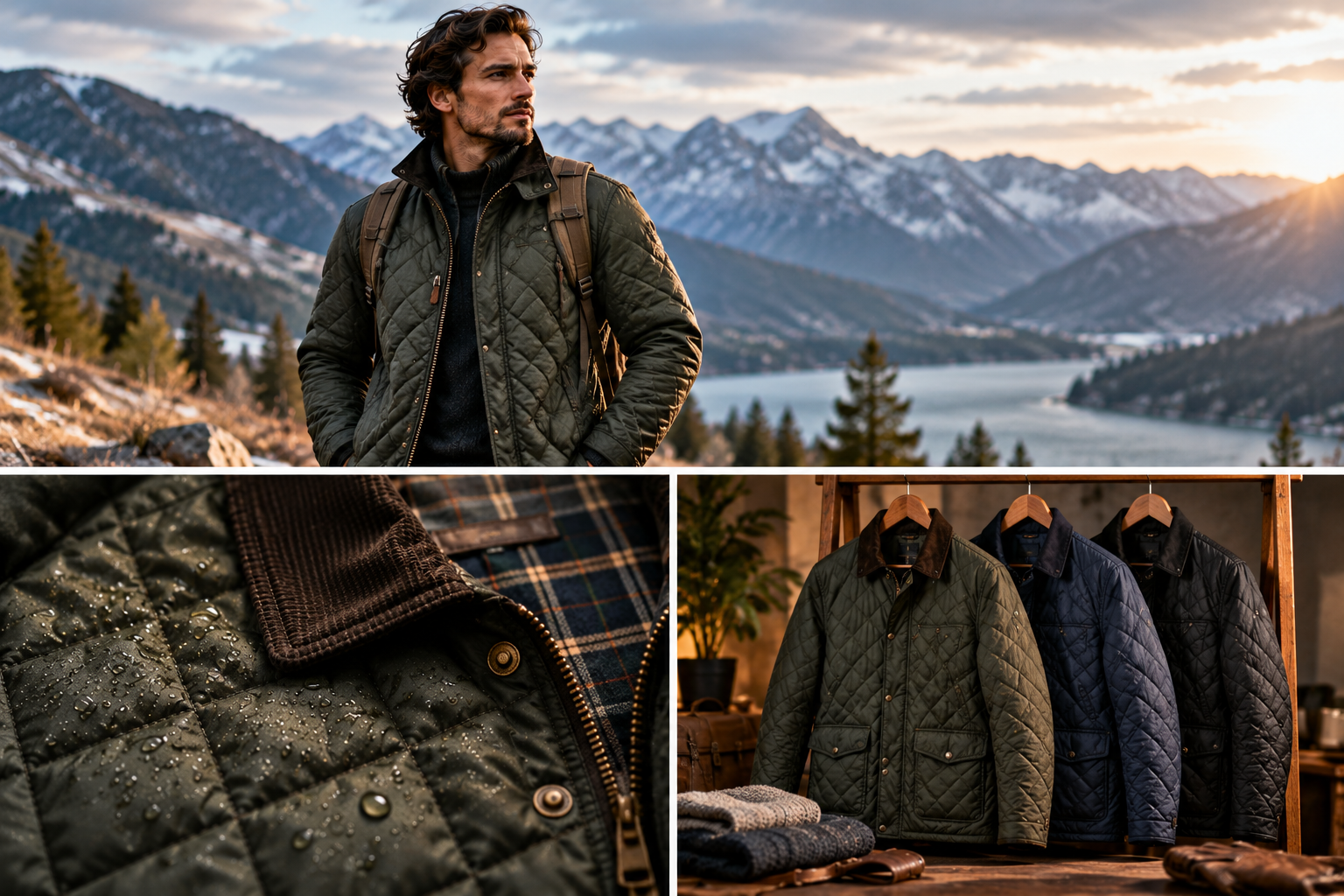
A low-loft quilted design can provide useful thermal regulation in moderate cold, but sewn-through stitch lines reduce insulation thickness locally and create colder paths through the garment.
How low-loft synthetic microfibers trap body heat during moderate temperature drops
Insulation works largely by slowing heat transfer through fibrous material and the air held within and around it. Research on thin synthetic insulation shows that the apparent insulating effect depends not only on fibre type but also on the air layer associated with the clothing system.[4][14]
A quilted jacket therefore gains warmth from the batting pockets between stitch lines, but the lower loft stores less still air than a thick puffer designed for colder static conditions.
The breathability advantage: why thinner quilted panels can reduce heat buildup during activity
Thinner clothing systems generally create less total insulation than high-loft systems, which can make them easier to regulate during active use. Heat transfer also changes with material air permeability, ventilation, wind speed, and the air gap between body and garment.[4]
This is why a low-bulk quilted layer can feel more manageable during walking or commuting: it provides insulation without surrounding the torso in the same depth of dead-air space as a high-loft winter jacket.
The structural cold spot: how sewn-through lines create localized heat-loss paths
Sewing compresses insulation along the stitch line. X-ray and thermal research on sewn insulation systems shows that conventional stitching reduces the entrapped air volume at the seam and increases heat loss along that line.[5]
A recent review of clothing for cold conditions reaches the same mechanism-level conclusion: stitching compresses materials, reduces thickness along the seam, and can lower thermal insulation locally. Research on quilted down clothing also reports colder thermal behavior along quilt lines compared with fuller insulated regions.[6][7]
The evidence supports a local cold-spot effect, but not a universal percentage loss for every quilted jacket. Needle size, stitch density, insulation depth, shell permeability, wind, and garment construction change the result.
| Structural Zone | Thermal Behavior | Functional Effect |
|---|---|---|
| Baffle center | Insulation retains more loft and trapped air away from the stitch line | Provides the main low-bulk warming effect |
| Stitched seam | Layers are compressed and insulation thickness falls at the sewing line | Creates a local heat-loss path compared with the fuller baffle center |
| Edge trim / hem | Binding, elastic, or shaping closes the edge but may still leave garment openings | Draft control depends on fit and closure design |
Evaluating the Physical Toughness and Vulnerabilities of Quilted Shells
The face fabric of a quilted jacket can be durable in daily use, but shell strength and stitch durability are separate engineering problems: a strong woven fabric does not prevent an exposed quilting thread from snagging or breaking.
The tear resistance of densely woven ripstop nylon and polyester face fabrics
Woven-fabric tear resistance depends on yarn strength, yarn mobility, weave, density, and friction between yarns. Textile fracture research shows that tear behavior is controlled by fabric geometry and yarn properties rather than fibre name alone.[8]
Ripstop is one structural strategy for limiting tear propagation. A U.S. International Trade Commission technical publication describes ripstop as a lightweight weave used where tear and abrasion resistance are desired, but that does not establish one universal denier threshold for quilted jackets.[9]
For buyers, the useful distinction is therefore structural: a reinforced or tightly woven shell may resist propagation better than a very open lightweight fabric, yet sharp punctures and severe abrasion can still initiate damage.
The snag vulnerability: why exposed exterior thread is a primary failure point
Quilted jackets deliberately place long networks of thread on the exterior surface. University extension guidance tells sewers to secure quilting stitches and prevent layer shifting, highlighting that stitch integrity is part of the garment’s structure.[1][2]
A branch, zipper tooth, hook-and-loop edge, pet claw, or rough seatbelt fitting can catch thread even when the face fabric remains intact. Once a thread is broken, the size of the affected area depends on the stitch type, back-tacking, quilting geometry, and how the damaged line is secured.
The available evidence does not justify saying that lock-stitching is always stronger than chain-stitching on every quilted shell. Seam strength depends on thread, stitch density, tension, needle damage, seam geometry, and fabric.[6]
How friction wear at the elbows and cuffs can cause localized seam failure
Repeated bending at elbows and cuffs adds cyclic flexing while contact with desks, vehicle interiors, bags, and rough surfaces adds abrasion. In woven textiles, abrasion and tearing can progressively weaken fibres even before a large visible failure occurs.
For a quilted jacket, this matters because the thread and face fabric are repeatedly loaded together at the same high-motion zones. Early repair of a broken stitch line is safer than pulling a loose thread and extending the damaged path.
| Component | Durability Interpretation | Primary Failure Mode | Practical Mitigation |
|---|---|---|---|
| Ripstop or tightly woven face fabric | Often selected to improve tear propagation resistance | Sharp puncture or abrasion can still damage yarns | Avoid sharp snagging; repair small damage before it spreads |
| Exterior quilting thread | Performance depends on thread, stitch, density, tension, and seam construction | Snagging, breakage, or local unraveling | Do not pull loose thread; secure or repair the damaged stitch line |
| Elbows, cuffs, lower back | Repeated flexing and contact raise wear demand | Thread abrasion and local fabric wear | Inspect high-contact zones and reduce repeated rough-surface friction |
What Are the Exact Weather and Layering Limits of a Quilted Jacket?
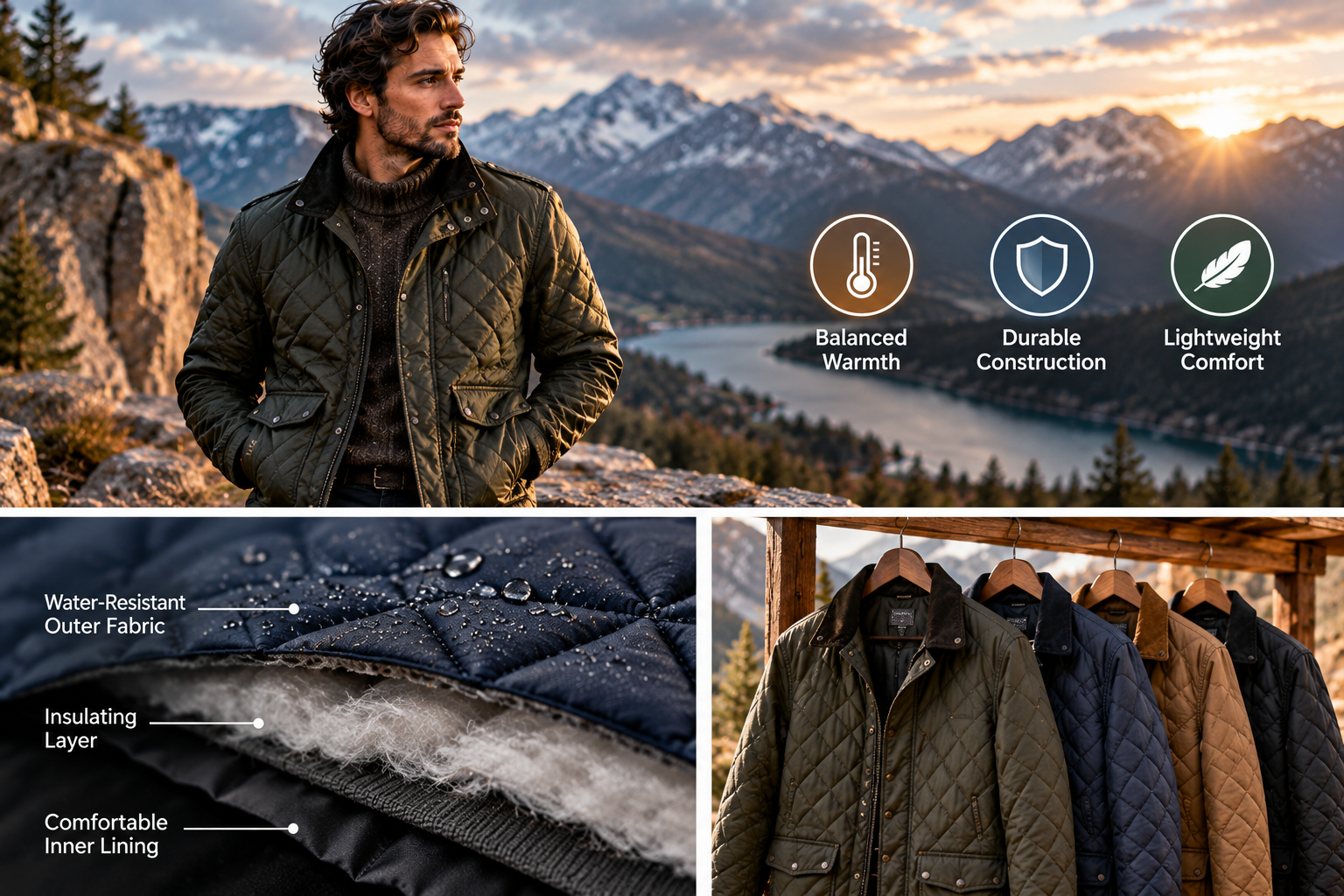
A quilted jacket works best in cool, relatively dry conditions or as an insulating mid-layer; sustained rain and strong wind expose the limitations created by permeable face fabrics and numerous stitched seams.
How DWR treatments manage light surface moisture
A Durable Water Repellent treatment changes the wetting behavior of a textile surface so droplets are more likely to bead and roll away instead of immediately spreading through the face fabric. EPA-indexed research on outdoor textiles shows that both fluorinated and non-fluorinated DWR chemistries can provide meaningful water repellency, with performance varying by chemistry and durability.[10]
DWR is water repellency, not a waterproof membrane. Its presence does not seal the thousands of needle penetrations created by quilting.
The moisture failure point: why many stitched lines increase leakage risk in sustained rain
Waterproof-garment research is explicit that conventional sewing creates needle holes that can allow water to penetrate a fabric system. Seam sealing, welding, bonding, or other treatments are used when waterproofness is required.[11]
A quilted jacket multiplies these penetration points across the whole face of the garment. If those stitch lines are not sealed and the shell is not backed by a waterproof membrane, prolonged rain can reach the insulation even when the face fabric itself initially beads water.
Why the slim profile makes the quilted jacket an effective thermal mid-layer beneath a shell
Layering solves the separation-of-functions problem. National Park Service winter guidance assigns insulation to middle layers and wind/rain protection to the outer layer, while NOAA guidance likewise recommends several layers and a tightly woven, water-repellent outer garment in cold conditions.[12][13]
A slim quilted mid-layer can therefore supply moderate insulation while a separate hardshell supplies the wind and precipitation barrier. This is more evidence-safe than assigning a universal temperature range, because activity, wind, humidity, base layers, body size, fit, and insulation weight all change comfort.
| Usage Configuration | Appropriate Conditions | Thermal Role | Weather Protection |
|---|---|---|---|
| Standalone outer layer | Cool, dry, relatively calm transitional weather | Moderate low-bulk warmth; easier heat release during activity | Limited in strong wind and sustained rain |
| Mid-layer under shell | Colder, windy, wet, or changeable conditions | Adds insulation while preserving layering flexibility | Outer shell supplies the main wind and rain barrier |
The Quilted Jacket vs. The High-Loft Puffer: Which System Performs Better?
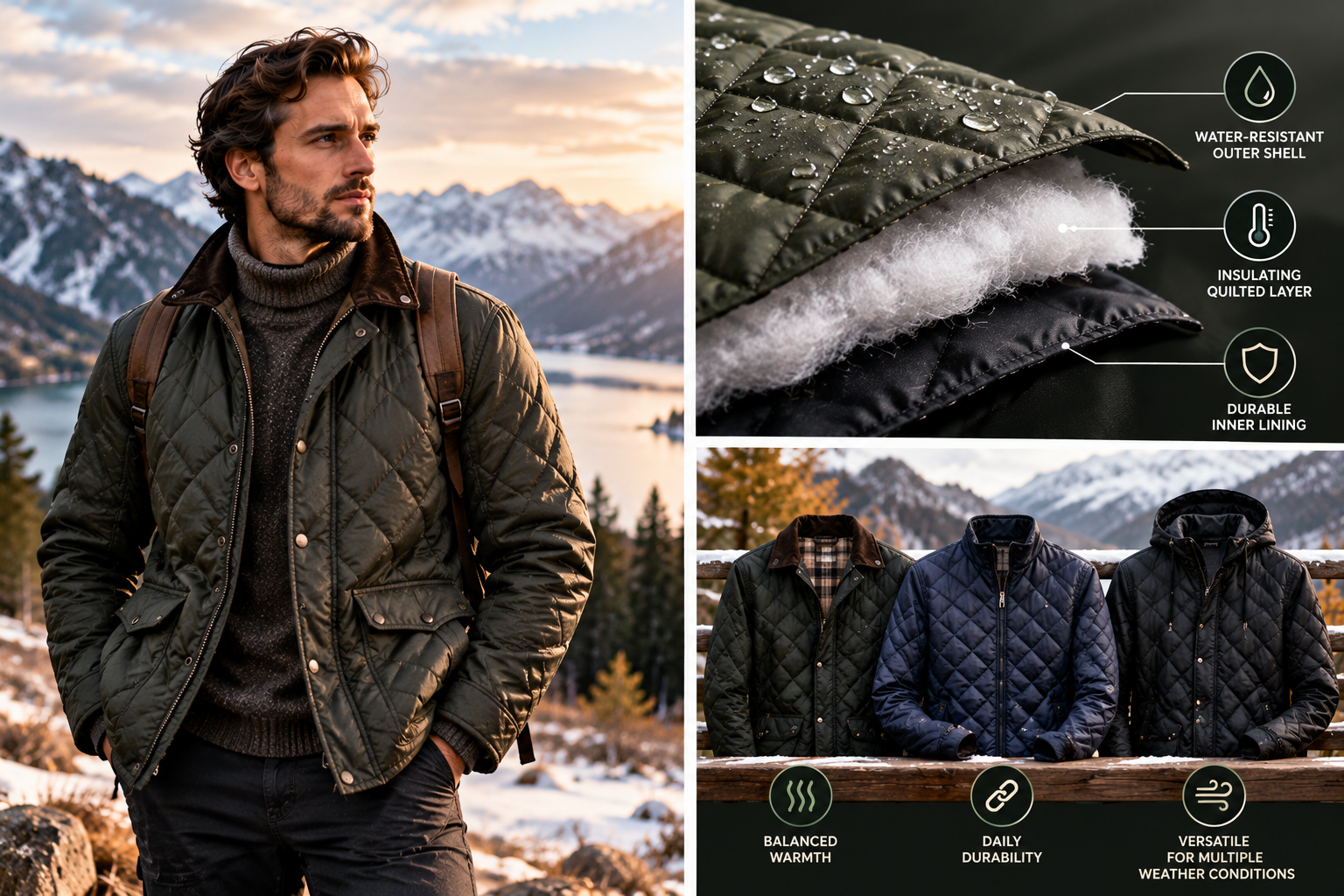
Choosing between a quilted jacket and a high-loft puffer requires prioritizing either streamlined mobility and layering efficiency or a larger volume of trapped air for colder conditions.
| Feature | Low-Loft Quilted Jacket | High-Loft Puffer Jacket |
|---|---|---|
| Insulation profile | Thin batting held by frequent quilting lines | Thicker down or synthetic loft designed to hold more air |
| Mobility & layering | High; slim profile fits more easily under another shell or coat | Lower under fitted outer layers because of greater bulk |
| Stitch-line heat loss | More exposed sewn-through lines can compress insulation locally | Depends on construction; larger baffles generally preserve more loft between seams |
| Best thermal role | Transitional outer layer or active mid-layer | Colder conditions where higher loft is needed |
| Wet / wind protection | Depends on face fabric, DWR, seam design, and any outer shell | Also depends on shell and seam construction; insulation loft alone is not waterproofing |
Compare transitional temperature regulation versus high-loft heat trapping
Higher clothing insulation is strongly associated with the amount and distribution of trapped air, not simply with the fibre label. Studies using thermal manikins and 3D air-gap measurement show that air volume and spacing materially affect clothing insulation.[14][15]
A high-loft puffer is designed to preserve more three-dimensional air space. A quilted jacket compresses its insulation more frequently at stitch lines, trading some maximum insulation potential for a slimmer profile and easier heat release during movement.[5][7]
Compare driving and seating mobility versus bulky winter restriction
Low bulk is mechanically useful in seated positions because less insulation has to compress between the wearer and a chair or seatbelt. The quilted layer also fits more easily beneath another coat when weather changes.
A high-loft puffer can provide more insulation, but that same loft occupies more space at the shoulders, neck, and torso. The trade-off is therefore not “better versus worse”; it is mobility and layering efficiency versus maximum available loft.
Final Verdict: When Is a Quilted Jacket the Right Outerwear Choice?
A quilted jacket is a strong choice for people seeking a mobile, low-bulk insulated layer for transitional climates or active layering, provided they account for stitch-line heat loss, snag exposure, and limited rain protection.
Ideal scenarios for mild transitional weather, frequent driving, and high-mobility urban wear
The construction works best where moderate insulation and mobility matter at the same time: walking, commuting, driving, light outdoor work, and layering beneath a shell or coat. Quilting stabilizes the insulation and keeps the profile slim, while the face fabric provides the first line of protection against daily friction.[1][2]
The jacket should still be judged by its actual shell, fill, fit, seam quality, and weather treatment rather than by the word “quilted” alone.
When to bypass a quilted jacket for a windproof shell or high-loft insulated coat
Strong wind, sustained rain, or prolonged exposure to severe cold changes the requirement. NPS and NOAA cold-weather guidance emphasizes layered insulation plus an outer barrier against wind and precipitation rather than relying on one thin insulating garment.[12][13]
For those conditions, a waterproof or windproof shell over insulation—or a purpose-built high-loft winter system—is the more appropriate tool. The quilted jacket’s real strength is balanced low-bulk warmth and mobility, not maximum cold protection or standalone waterproofing.
Sources
- University of Idaho Extension. Quilted Fabrics — layered construction, batting, stitch patterns, garment use and care. View source.
- South Dakota State University Cooperative Extension. Sewing Quilted Fabrics — construction, stitching and care of batting-based quilted fabrics. View source.
- University of Nebraska Medical Center. Quilting explainer — quilting holds the top, batting and backing layers together and prevents shifting. View source.
- PubMed. Impact of garment construction and environmental factors on heat transfer. View source.
- International Journal of Clothing Science and Technology / ScienceDirect index. X-ray tomography of insulation systems sewn with lockstitch and spacer stitch — stitch-line compression and heat loss. View source.
- Fibers / MDPI. Advancements in Clothing Thermal Comfort for Cold Intolerance — stitching, seam compression and insulation performance. View source.
- Thermal Science and Engineering Progress / ScienceDirect. Investigation of heat transfer through down clothing with quilting structure. View source.
- Theoretical and Applied Fracture Mechanics / ScienceDirect. Mechanics and mechanisms of tear resistance of woven fabrics. View source.
- U.S. International Trade Commission. Certain Textile Articles — rip-stop weave described as lightweight fabric providing tear and abrasion resistance. View source.
- U.S. EPA HERO. Performance evaluation of fluorinated and non-fluorinated durable water repellents for outdoor fabrics. View source.
- Materials Science (Medžiagotyra). Usage of Fusible Sewing Threads to Improve the Waterproof Property of Seams — needle holes and water leakage. View source.
- U.S. National Park Service. Dressing for Winter — middle layers insulate; outer layers repel water and stop wind. View source.
- NOAA / National Weather Service. Cold-weather clothing guidance — layering, trapped air, water-repellent outer garments and wind protection. View source.
- PubMed. 3D quantification of microclimate volume in layered clothing for prediction of clothing insulation. View source.
- PubMed / Materials. Thermal resistance and temperature gradients in textile material layers and composite clothing. View source.
Source policy: Evidence citations use university extension material, government guidance, PubMed-indexed or peer-reviewed research, technical journal articles, and government research indexes. No retail product or jacket-selling page is used as evidence. Unsupported universal temperature ratings, denier thresholds, and lock-stitch-versus-chain-stitch strength claims were intentionally removed or softened.