
Outerwear / Naval Heritage
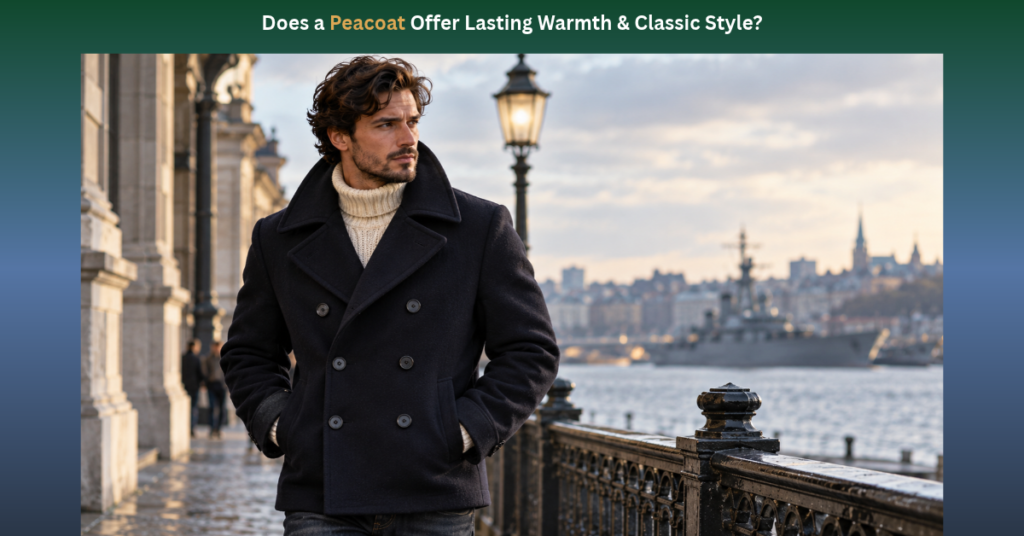
Does a Peacoat Offer Lasting Warmth and Classic Style?
An authentic peacoat can deliver reliable torso warmth, long service potential, and a recognizable classic silhouette through dense wool and double-breasted construction. Its results depend on cloth quality, fit, and exposure; a thin fashion coat is not identical to a traditional naval design.
Buyers often know the peacoat as a winter staple, yet two coats with similar collars and buttons can behave differently in wind, rain, and daily wear. Wool finishing, fabric mass, lining, placket overlap, and coat length affect performance more than a heritage label alone.
This guide evaluates the maritime engineering and textile density of the peacoat to validate its wind-blocking warmth, examine the material factors behind a long service life, analyze its tailored proportions, and map its weather and layering boundaries.
How Naval Deck Engineering and Melton Wool Define the Peacoat Blueprint
The peacoat grew from seafaring clothing that combined heavy wool, a relatively short body, and a closable collar. Its naval heritage is documented, but the exact weave, trim and button arrangement changed across periods.
The maritime origins of Kersey and Melton wool
U.S. Navy uniform histories trace the pea coat to earlier naval outerwear and note a short pea jacket in nineteenth-century uniform rules. One Navy survey records a peacoat reference in the regulations of 1841 and identifies 1886 as the year it became a regular part of the enlisted uniform.[2][3]
The Navy also explains the older term “pilot cloth,” a stout blue twilled fabric with a raised surface, as one origin of the coat’s name. Melton became a familiar dense overcoat cloth: milling or fulling uses controlled moisture, friction and heat to compact wool. Kersey is another historically associated wool coating, but a specific fabric name should not be used to certify an unexamined vintage coat.[4][5][6]
Why a short naval coat helped sailors move
A peacoat sits near the hips rather than extending to the knees. This reduces the amount of heavy cloth around the legs while climbing steps, squatting, or moving between confined working spaces. U.S. Navy historical material identifies the shorter profile as a practical advantage over a greatcoat.[2]
The trade-off is direct: better leg movement requires giving up lower-body coverage. A flared or vented hem may add stride room on a particular model, but vents and hem shape are not identical across naval periods or commercial versions. Judge the actual coat while walking and sitting.
Anchor buttons and the convertible collar
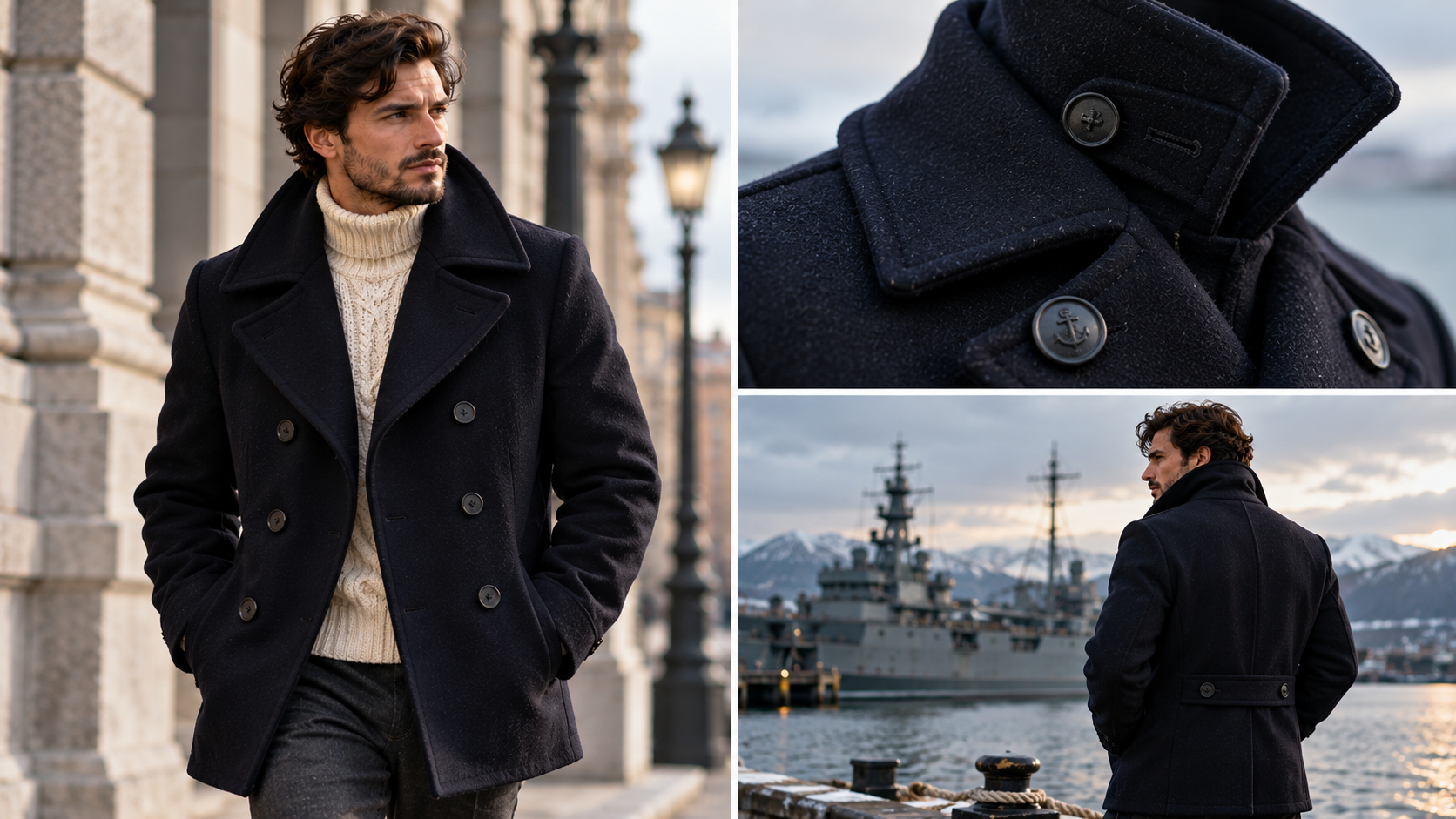
The modern U.S. Navy description specifies a dark-blue, double-breasted, hip-length coat made from Melton wool, with a convertible collar, inset front pockets, and distinctive black anchor buttons. Earlier uniform records document collar and button changes. There is no single historical eight-, ten-, or six-button count that safely describes every issue period.[1][17]
An Ulster-like broad collar can be raised toward the ears and buttoned higher in exposed weather; some coats include an additional throat fastening, while others do not. Check the actual closure at the neck rather than assuming every decorative collar seals the same way.[1][17]
How Double-Breasted Architecture Generates Core Warmth
A peacoat retains torso warmth through wool thickness, trapped air, and an overlapping double-breasted front that can slow the movement of cold air across the chest.
Why the doubled front panel matters in wind
Each side of a peacoat crosses the other at the centre front. Where the panels overlap, the wearer gains two layers of coating cloth and a longer path for incoming air. A dense face fabric also limits air permeability compared with a loose weave; studies of woven structure and clothing insulation show that permeability, fit and movement influence how much warmth is retained.[7][8][9]
The overlap is not a sealed membrane. Wind may still enter at an open button gap, the hem, sleeves or neckline, especially when the coat is too tight to close flat. For better protection, button the coat comfortably over the knitwear you actually plan to wear.
How the convertible collar changes neck exposure
Fold the broad collar upward and fasten the highest available closure to reduce direct exposure at the neck. The result depends on collar height, stiffness and the presence of a throat tab. It cannot replace a hood in driving snow or sustained freezing wind.
This is where peacoat proportions have a functional purpose: the same large lapels that frame the face when open can be brought together for extra coverage when conditions change. The Navy explicitly permits fastening the collar button in inclement weather.[1]
The role of vertical muff pockets
High, relatively vertical hand pockets give the wearer a natural place to bring the elbows closer to the body. Pocket lining material varies. Some heritage examples use soft pocket bags; corduroy cannot be assumed without examining the garment.
Pockets protect hands only while they remain inside. Gloves still matter for long cold-weather exposure, and an open pocket does not act as an insulated mitten. The important fit test is whether the pocket entrances can be reached without lifting the shoulders or opening the front of the coat.
| Structural feature | Physical execution | Thermal function | Style effect |
|---|---|---|---|
| Double-breasted overlap | Two crossing front panels secured by button rows | Extra fabric at chest; drafts still depend on closure fit | Creates a strong centre-front frame |
| Convertible broad collar | Large lapels that can be raised or secured | Reduces neck exposure when fastened | Frames shoulders and face |
| Vertical muff pockets | High or mid-front inset hand entrances | Hand shelter; pocket lining varies | Keeps hips visually uncluttered |
| Hip-length cut | Shorter skirt than a full overcoat | Less coverage for upper thighs | Works easily with trousers and denim |
What Determines Whether a Peacoat Delivers Lasting Warmth?
Longevity depends on the fabric specification, finishing, construction and how the coat is used and stored. Wool percentage or fabric weight alone cannot predict decades of performance.
Evaluating wool weight, weave density and blends
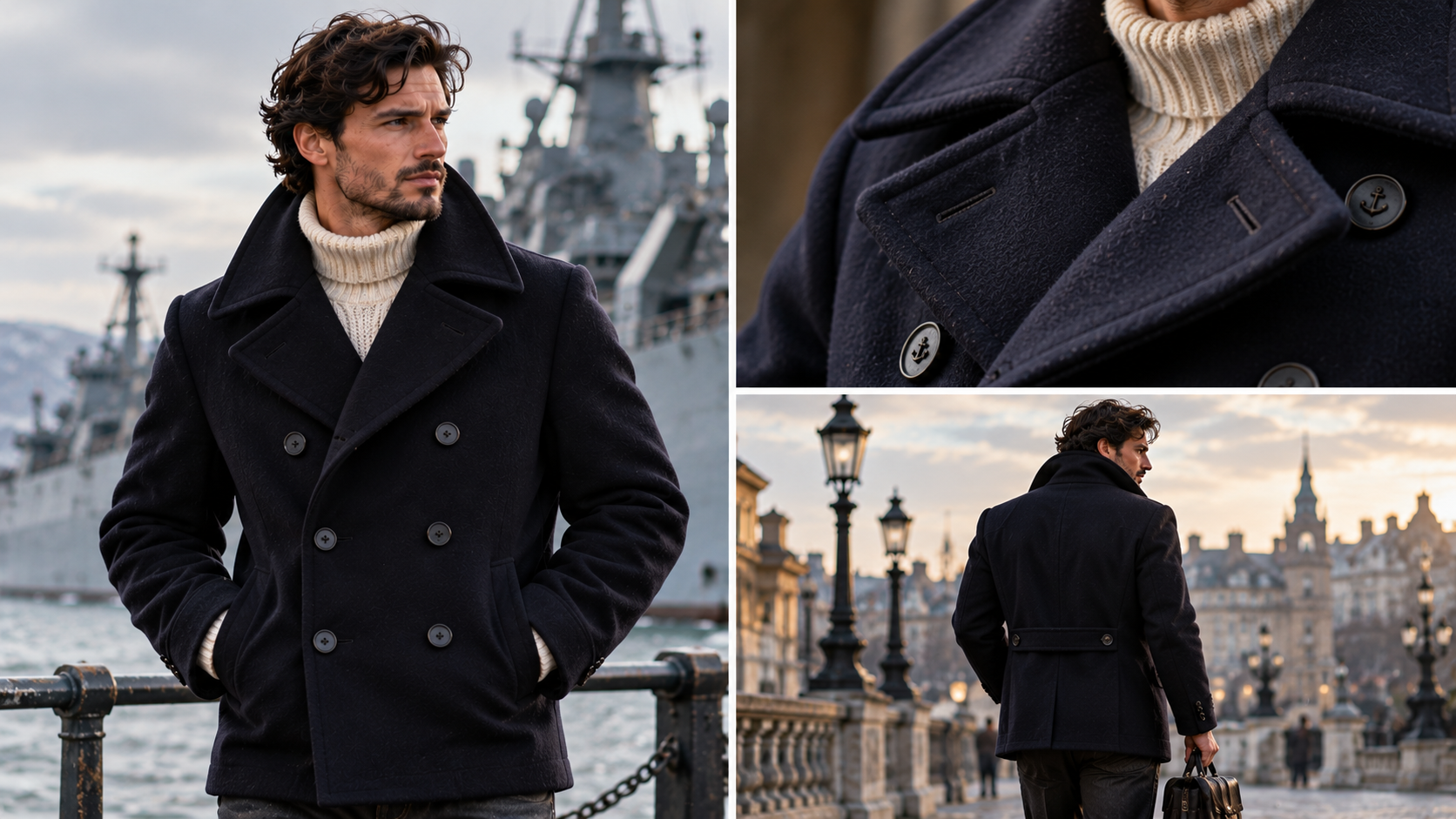
Fabric GSM measures mass per square metre. ISO 3801 describes the underlying method of determining woven-fabric mass, but the number does not measure warmth or abrasion resistance by itself. Two fabrics with the same GSM can differ in weave compactness, surface finish, air spaces and flexibility.[12][7]
Heavy, fulled wool can provide a compact wind-resistant surface. Blending wool with synthetic fibre changes yarn behavior, but it is not accurate to claim that every wool-nylon blend outlasts all-wool cloth or that a fixed percentage of polyester guarantees pilling. Studies show that pilling depends on fibre, yarn twist, fabric construction and repeated abrasion.[5][6][11]
What Bemberg, satin and insulated linings actually do
A smooth woven lining can help the peacoat move over sweaters and shirt sleeves, reducing the drag of bare wool against other fabrics. Linings sold as cupro or Bemberg and conventional satin-faced cloth are examples; their hand and composition should be checked on the care label.
Some coats add a separate insulating batting, including products sold under the Thinsulate name. The extra loft can help retain still air, but there is no universal temperature rating based on a lining label alone. Clothing research links thermal resistance to air trapped between fibres and layers, plus fit, motion and wind.[8][9]
Where buttons, pocket welts and shoulders fail first
A substantial wool coat puts repeated tension on button stitching, especially when the placket is stretched over thick clothing. Test each button for loosening, examine the pocket-welt corners where hands rub, and look along collar folds and cuff edges for thinning.
Storage matters because the full coat weight hangs from the shoulder area. The Canadian Conservation Institute advises padded hangers and cautions against thin wire hangers that offer poor support. Sound repairs and sensible storage can extend wear, but a guaranteed twenty-year lifespan cannot be inferred from the fabric label.[13][18]
| Construction class | What to verify | Likely strength | Risk or limitation | Durability verdict |
|---|---|---|---|---|
| Dense naval-style wool | Actual wool content, fabric feel and compact finish | Useful wind control and body warmth | Mass and stiffness; verify condition | Repair and inspection matter more than age claims |
| Wool-rich blended Melton | Blend label, weave, lining and seam quality | May balance firmness and wearing comfort | Performance varies with yarn and finishing | No fixed blend ratio guarantees longevity |
| Lightweight fashion coating | Wool percentage, thickness, visible weave gaps | Lower weight and easier indoor wear | May transmit more wind if thin or open | Inspect pilling and stitching before buying |
What Makes the Peacoat a Classic Style Standard?
The peacoat remains recognizable because its short naval cut, broad collar and double-breasted front create a stable set of proportions that can be worn with casual layers or smart separates.
Structured shoulders and the V-shaped upper frame
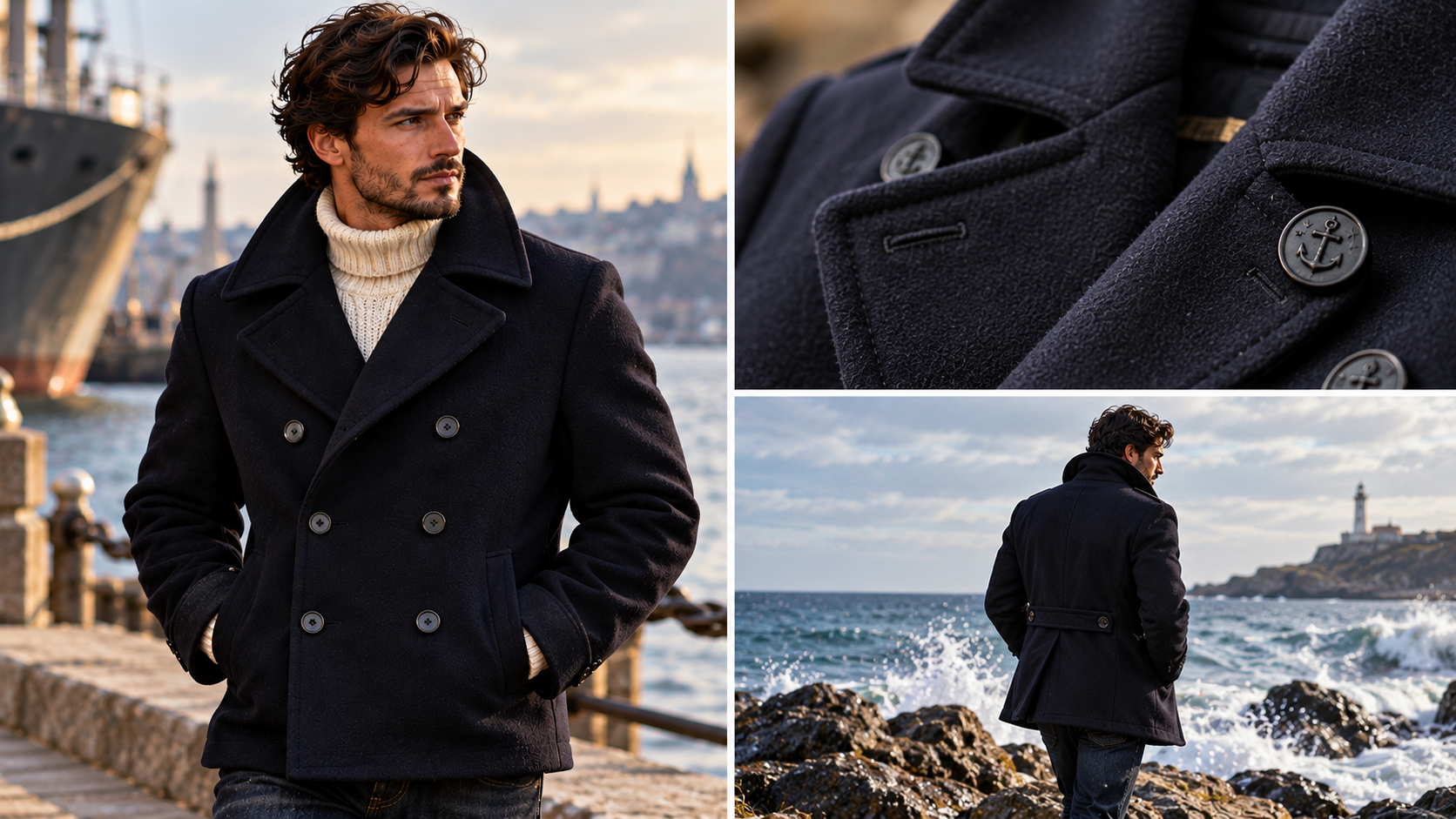
The collar visually widens the upper chest, while the buttoned front can narrow toward the waist. Fabric firmness helps the coat hold a clean outline instead of hanging like a loose shirt. Shoulder padding, waist suppression and lapel width vary across styles, so the “V” shape is an effect of tailoring rather than proof of naval authenticity.
A practical fitting rule is to check that the shoulder seam sits properly, the front closes without an X-shaped strain line, and the lapels lie cleanly when open. No number of anchor buttons will rescue a coat with an uncomfortable chest or shoulder fit.
Dressing over knitwear or office separates
A navy peacoat can sit over a thick fisherman-style sweater, chinos or denim without looking like formal evening outerwear. Over a fine-gauge knit, shirt and wool trousers, the same clean collar and matte cloth can look more polished.
The most common styling problem is bulk under the arm. Test the coat with the heaviest normal sweater, then raise both arms. If the lining drags or the front strains, the coat is too trim for that wardrobe; a roomier cut may help more than increasing sleeve length.
Why navy, charcoal and camel remain versatile
Dark navy is grounded in the coat’s naval history, with historic U.S. examples and uniform regulations naming deep blue cloth.[1][3]
Charcoal and camel are common modern alternatives rather than documented requirements of early naval uniforms. Their subdued colors combine with many winter wardrobes, but “permanent fashion” is a preference claim, not a measurable guarantee. Fabric quality, colorfastness and fit determine whether a coat continues to look good in daily use.
What Are the Weather, Fit and Coverage Boundaries of a Peacoat?
A traditional peacoat is useful in cold, dry wind, but its hip-length hem, lack of a built-in hood, and absence of sealed waterproof construction leave clear limits in severe storms and over formal suits.
The exposed-thigh boundary in severe cold
Warmth is concentrated around the chest and upper hips. The thighs remain exposed below the hem, and traditional peacoats lack an insulated hood. On bitterly cold or windy days, longer outerwear and suitable leg, head and neck coverage become important.
This is a coverage issue rather than a scientifically defensible single air-temperature cutoff. Wind speed, time outdoors, activity, base layers and individual tolerance all change comfort. Research on protective clothing shows how wind can erode effective thermal insulation.[9][16]
Why wool is not a waterproof membrane
Wool can absorb moisture vapour and help buffer humidity close to the body. That benefit does not mean woven wool is waterproof; sustained rain can wet fabric through, add water mass, and alter its heat-transfer behavior.[14][15]
Dense Melton may shed dry snow or very brief light precipitation at the surface, but a peacoat without a waterproof membrane and sealed seams should not be treated as reliable protection in prolonged heavy rain. Natural wool properties and possible finishes vary, so no precise rainfall threshold is assigned.
The suit-jacket overhang and shoulder-fit test
Many business jackets extend farther down than a hip-length peacoat. If the suit hem shows underneath, the visual result can look unfinished; the extra layers may also compress the upper arms and shoulders.
If covering a suit is a daily requirement, wear the suit while trying on the outer coat and inspect the hem from behind. A longer wool overcoat is the clearer solution when the suit jacket must stay completely covered.
| Exposure or fit scenario | Peacoat role | Reason to choose another layer |
|---|---|---|
| Brisk dry urban wind | Useful with dense wool and a closed front | Open cuffs and neckline can still leak air |
| Light snow or short drizzle | Limited, condition-dependent surface shedding | No membrane or taped seams |
| Long heavy rain | Poor protective choice | Wool may wet through and become heavy |
| Extended severe cold | Limited lower-body and head coverage | Thighs and head need additional protection |
| Full-length business blazer | Fit-dependent and often short | A longer overcoat covers the tailored hem |
Peacoat vs. Full-Length Overcoat and Duffle Coat: Which Winter Layer Wins?
Choosing between a peacoat, a full-length overcoat and a hooded duffle coat depends on how much leg coverage, formalwear space, and head protection the wearer needs.
| Metric | Peacoat | Full-length overcoat | Hooded duffle coat |
|---|---|---|---|
| Typical hem | Hip or upper hip | Knee to calf, depending on model | Often mid-thigh to knee |
| Front closure | Double-breasted overlap | Single or double breasted | Toggle-and-loop, sometimes covered |
| Head protection | Separate hat or hood | Usually separate | Integrated hood on common designs |
| Driving and stairs | Shorter skirt limits bunching | Long skirt needs managing when seated | Roomy, may be bulky |
| Suit coverage | Can expose jacket hem | Best suited to covering a suit | More casual and shape-dependent |
Driving mobility versus long overcoat coverage
A peacoat’s shorter skirt lets a wearer settle into a car seat or move up stairs without gathering as much wool under the thighs. A knee-length overcoat sacrifices some of that convenience but keeps more of the legs and a tailored jacket underneath covered.
For frequent formal meetings, hem coverage should outrank the convenience of a shorter coat. For walking between buildings, commuting by car and wearing smart-casual clothes, a peacoat is often the simpler choice.
Double-breasted closure versus a hooded duffle
A duffle coat typically provides a roomy shape and an integrated hood, and its toggle fastenings create a different appearance from a closely tailored peacoat. Toggle gaps may admit air unless a supporting placket is present; the exact wind performance depends on the construction.
The comparison is not a permanent ranking of warmth. A thick duffle can retain more air than a thin peacoat, while a dense, well-fitting peacoat may control chest drafts more closely. Compare fabric, fit, hood, and length on the actual garments.
Final Verdict: When Is a Peacoat the Right Winter Investment?
A heavyweight wool peacoat is a reasonable choice for cold, comparatively dry urban conditions and smart-casual wardrobes when the wearer values chest wind protection, a compact hem and consistent tailoring.
Best use: brisk commutes and versatile winter dressing
Choose a peacoat when the main task is walking or driving in cool-to-cold weather with manageable precipitation. A dense wool shell, secure double-breasted front, comfortable shoulder fit and serviceable buttons will matter more than a claimed heritage year or unsupported ounce category.
For years of use, inspect the lining, button stitches, pocket welts and fabric wear. Quality finishing and sensible storage improve the chances of long service, while a specific lifespan cannot be promised.[11][13]
When a longer overcoat or technical parka makes more sense
Choose a knee-length overcoat if formal suit hems must be covered. Choose a waterproof shell for long exposure to heavy rain. For severe cold or prolonged outdoor activity, choose an insulated coat with suitable length, hood and weather control.
The peacoat earns its place through dense wool, chest overlap, practical mobility and a restrained silhouette; it should not be mistaken for a full-length, seam-sealed storm garment.
Sources
- U.S. Navy Uniform Regulations. Peacoat (E1–E6), Article 3501.41: fabric, silhouette, collar, buttons, pockets. Read source.
- Naval History and Heritage Command. Historical Surveys of the Evolution of U.S. Navy Uniforms: early pea coat records. Read source.
- Naval History and Heritage Command. Uniforms of the U.S. Navy 1941: peacoat pattern, length and pockets. Read source.
- Naval History and Heritage Command. Origin of Navy Terminology: pea coat and pilot cloth etymology. Read source.
- American Wool Council. Types of Wool & Processing: milling, fulling, yarn and fabric finishing. Read source.
- Vintage Fashion Guild. Fulling: compact felted wool fabrics including Melton. Read source.
- Fibers (MDPI). Factors of Weave Estimation and the Effect of Weave Structure on Fabric Properties. Read source.
- Materials (MDPI). Measurement Methods of the Thermal Resistance of Materials Used in Clothing. Read source.
- PubMed / Applied Ergonomics. A quasi-physical model for thermal insulation and moisture vapour resistance of clothing. Read source.
- International Wool Textile Organisation. About Wool: fibre crimp, elasticity and trapped air. Read source.
- Sensors (MDPI). A Method for the Assessment of Textile Pilling Tendency Using Optical Coherence Tomography. Read source.
- International Organization for Standardization. ISO 3801:1977: woven fabric mass per unit length and unit area (standard overview). Read source.
- Canadian Conservation Institute. Hanging Storage for Costumes: padded hangers and fabric stress. Read source.
- International Wool Textile Organisation. Breathability and Wool: moisture vapour absorption and release. Read source.
- PubMed. Effects of moisture absorption in clothing on the human heat balance. Read source.
- PubMed / Safety and Health at Work. Thermal Insulation of Protective Clothing Materials in Extreme Cold Conditions. Read source.
- Naval History and Heritage Command. Uniform Changes: Navy peacoat button and collar changes. Read source.
- Canadian Conservation Institute. Basic Care: Textiles, including dry storage and handling. Read source.
Source policy: References are naval documentation, textile science, museum/conservation guidance and research resources—not retailers. Published-source landing pages are included only where their descriptive content is freely readable. Fixed temperature bands, fabric-weight cutoffs, blend percentage rankings and guaranteed lifespans were omitted because the cited evidence does not establish such universal thresholds.