
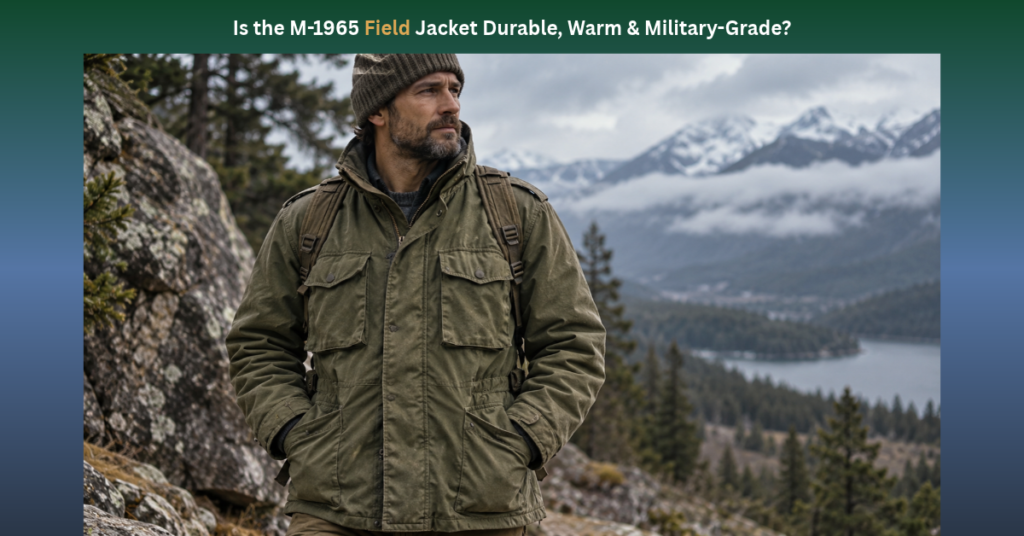
Military fieldwear · textile engineering
Is the M-1965 Field Jacket Durable, Warm, and Military-Grade?
An authentic M-1965 field jacket combines a tough nylon-cotton shell with field-oriented storage and adjustable openings, but its warmth in cold weather depends heavily on the removable quilted liner.
A surplus label, a convincing olive finish, or a heavy zipper does not settle whether a jacket follows military specifications. The fabric, hood and cuff construction, internal liner attachments, and contract identification matter more than the familiar silhouette. Civilian versions can look nearly identical while using different materials.
This guide evaluates the structural engineering of the M-1965 field jacket to validate its military-spec hardware, explain its NYCO sateen durability, analyze its modular liner system, and define its weather and replica boundaries.
How the U.S. Military Cold-Wet System Engineered the M-1965 Blueprint
The M-1965 field coat belongs to a layered U.S. military cold-weather clothing system; its design pairs a wind-resistant woven shell with an insulating liner that can be added or removed as conditions change.[3][5]
From the M-1951 to MIL-C-43455 and later MIL-DTL-43455
The M-65 followed the M-1951 field-jacket system. The coat specification appeared as MIL-C-43455 in 1966 and was redesignated MIL-DTL-43455 in 2007. The Defense Logistics Agency lists the later specification as canceled in January 2020. These are document milestones, not proof that every jacket sold as an M-65 was issued by the military.[1][2][4]
The spec defines a straight-front cold-weather field coat made from water-repellent fabrics. That wording matters: the military requirement identifies a particular kind of field garment, not a guarantee of waterproof performance or unlimited durability. Examining the label and the matching construction is more useful than treating the term “military-grade” as a performance score.[1][3]
Why the coat was designed as one part of a cold-wet system
Layering is built into the garment. The military clothing references describe the field coat as an outer layer in cold-wet conditions and an intermediate layer in cold-dry conditions. A compatible button-in insulated liner adds trapped air when the wearer needs more warmth, while the shell alone is better suited to milder movement-heavy use.[3][5][7]
This is not the same design as a single heavy winter parka. The shell handles abrasion, pockets and some wind; the liner handles much of the insulation. Gloves, base layers, headwear and other outer garments remain part of the complete cold-weather clothing system.[5]
Four pockets, storm collar, concealed hood and drawcords
The classic M-65 uses two bellows-style chest pockets and two lower front pockets, a convertible stand-up collar, a concealed hood inside the collar, and drawcord adjustment at the waist and hem. The zipper-and-snap front closes against the wind without turning the cloth into an impermeable barrier.[3]
The collar hood is a deployable emergency layer for limited exposure. It is thin and stores compactly, so it does not replace a substantial insulated hood. Pocket dimensions, trim and hardware may differ across contract generations; design features should be checked against the jacket’s stated version.[2][3]
What Makes the M-1965 Design Authentically Military-Grade?
The field coat earns its military-spec identity through defined garment construction and functional details, not merely through a rugged look or a brand description.[1][3]
How bi-swing back pleats improve shoulder reach
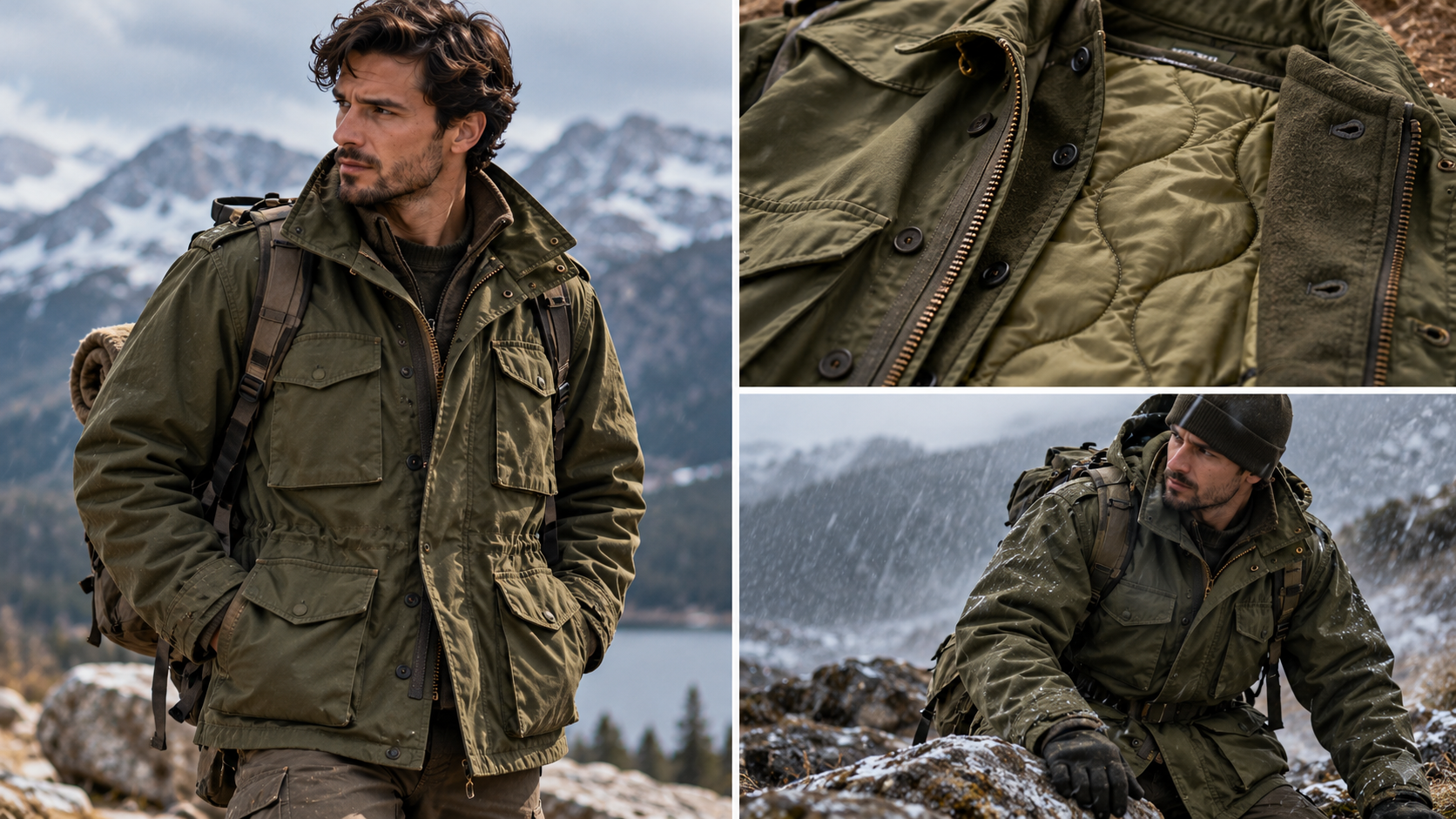
The bi-swing back includes folded panels behind the shoulders that expand when the arms move forward. This supplies movement room within a relatively firm woven shell. It is especially useful when reaching, carrying equipment, or bringing the arms across the chest. The movement comes from the garment pattern, not from elastic stretch in sateen cloth.[3]
A replica may preserve the outline but sew the back flat. To check function, spread the jacket across the shoulders and move the arms forward: the pleat should open without forcing the hem to ride sharply upward. Fit and size still influence the result.
What the collar hood can and cannot do
The undercollar compartment houses a lightweight stowable hood with a drawcord. The official clothing description also identifies attachment points for an additional cold-weather hood, which is distinct from the concealed lightweight hood.[3]
The roll-out hood can interrupt wind and brief precipitation around the head. It does not offer the loft, facial coverage or sealed construction of a dedicated severe-weather hood. Check whether the pouch zipper moves freely and whether the hood fabric remains intact at its attachment edge.
Front closures, cuffs and hand-protection extensions
The front combines a slide fastener with a protective snap flap. Adjustable cuffs and fold-out hand extensions close gaps around the wrist and help cover part of the hand. The official coat record documents these features but does not make one brass zipper gauge mandatory for every generation.[3]
Snap tension, zipper alignment, cuff fasteners and stitching are all functional tests. A heavy-looking zipper that separates under load is no advantage. A clean military label adds useful provenance information, but construction details must agree with it.
| Structural component | Issue-specification reference | Commercial version: what to verify |
|---|---|---|
| Shell fabric | Nylon/cotton wind-resistant sateen; read the actual issue label and revision | May use cotton twill, lighter blends, or other weaves; examine composition and hand |
| Front closure | Slide fastener with protective snap flap; hardware can vary by production period | Check closure quality, alignment, teeth, snaps and usable storm flap |
| Back and shoulder fit | Functional bi-swing back pleats for reach | Some versions omit pleats or substitute stitched detailing |
| Liner attachment | Internal buttons and attachment points for field-coat liner | Confirm compatibility; similar-looking liners may not match |
| Cuffs and hood | Adjustable cuffs with hand extensions; collar-concealed hood | Check working tabs, hood compartment and drawcord rather than appearance |
How 50/50 NYCO Sateen Delivers Field Durability
The durability of an issue-style M-65 begins with dense nylon-cotton wind-resistant sateen, then depends on seam construction, trim quality and how the garment has aged.[3]
Why nylon-cotton blending works for ordinary field wear
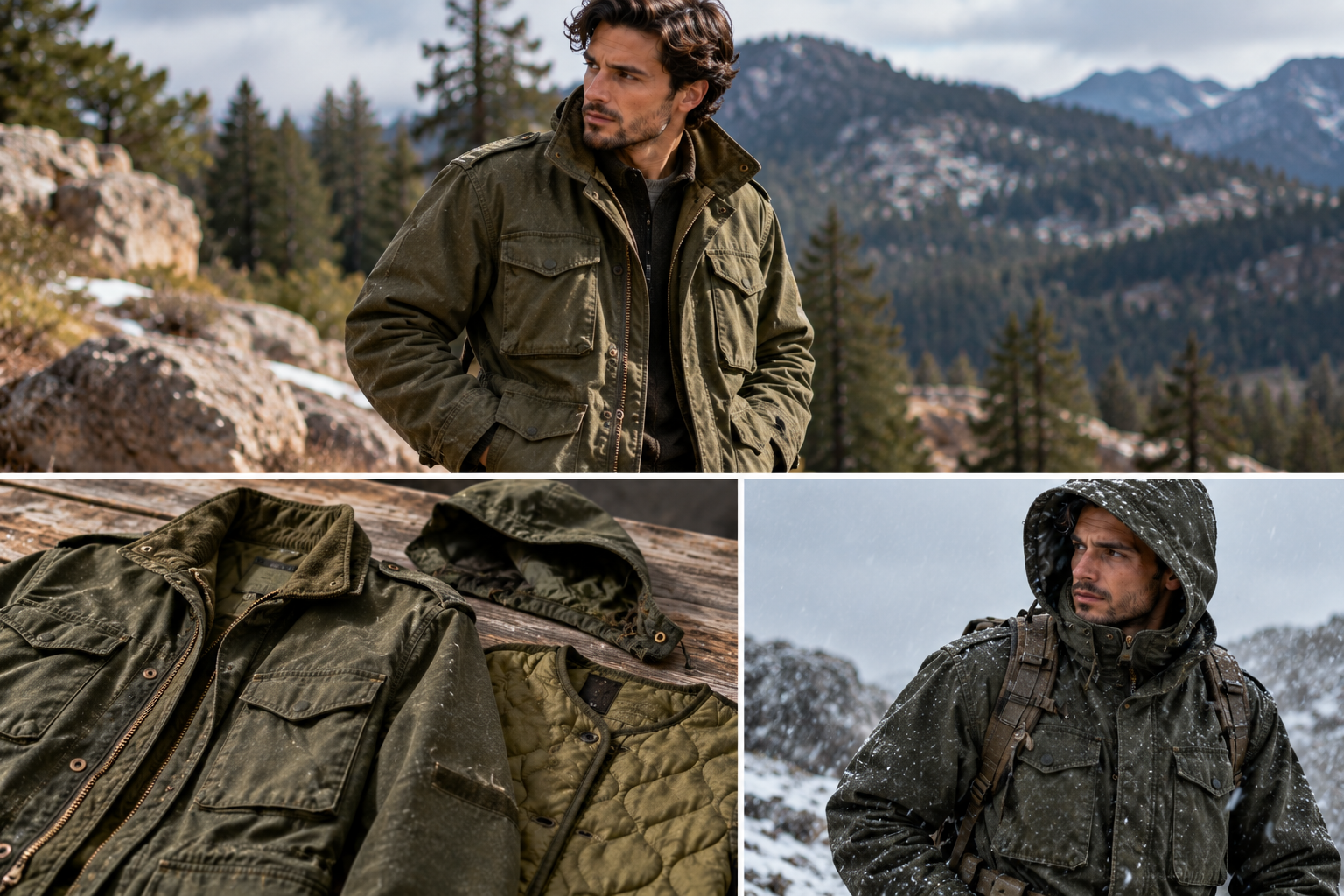
NYCO describes a nylon-cotton fibre blend. Many M-65 issue-style shells use a roughly equal blend; the official coat description identifies nylon-cotton wind-resistant sateen and its relevant cloth specification. Nylon can improve resistance to some forms of abrasion and tensile loading, while cotton affects handle and moisture behavior. Open-access research on cotton–nylon woven fabrics confirms that the blend changes air permeability and moisture transport, but it does not test a vintage M-65 or establish a universal tear-strength figure for one.[3][8]
Neither nylon nor cotton turns the garment into flame-protective clothing. Untreated cotton can burn, and common nylon can soften or melt near high heat. Sparks, campfires and hot equipment should not be treated as harmless simply because the jacket is associated with the military.[9]
Why the sateen weave changes snagging and wind behavior
Wind-resistant sateen is a compact woven construction. Its surface, yarn density and finishing affect snagging, rubbing and air movement. That can make a field coat more protective than an open, thin shirt fabric while preserving enough flexibility for routine work.[3][10]
The brief proposed one fixed nine-ounce fabric weight for every version. That number is not used as an across-the-board claim because specifications, contract revisions and commercial versions vary. Weave, composition and condition should be checked independently of any advertised weight.
Where an aging field jacket fails first
Inspect the zipper tape at the collar and center front, the reinforcement behind pocket snaps, the ends of the cuff adjustment tabs, and the drawcord channel at the waist. Repeated manipulation puts concentrated strain on these places even when the broad fabric panels look sound.
Faded fabric is not proof of failure, but broken teeth, opened seam allowances, weak snap backing, frayed hood fabric and local holes change how the coat performs. Repairability is part of durability; a decades-old example should be judged by its current condition, not its age alone.
How the Modular ALS-92 Liner Controls Cold-Weather Warmth
The M-65 gains much of its cold-weather insulation from a button-in quilted liner rather than from the dense woven outer shell itself.[6][7]
What the unlined shell does for heat retention
The shell reduces some airflow around the body because of its wind-resistant weave, protective front and adjustable openings. It does not contain the large volume of lofted insulation found in a winter parka. Research on permeable textile layers shows that wind and fabric permeability influence effective thermal resistance.[3][10]
No credible military-source basis was found for assigning every M-65 shell a 30 mph wind rating or a fixed comfortable temperature interval. Warmth changes with physical activity, wind, underlayers, fit and how long the wearer remains still.
The button-in quilted liner and the ALS/92 naming distinction
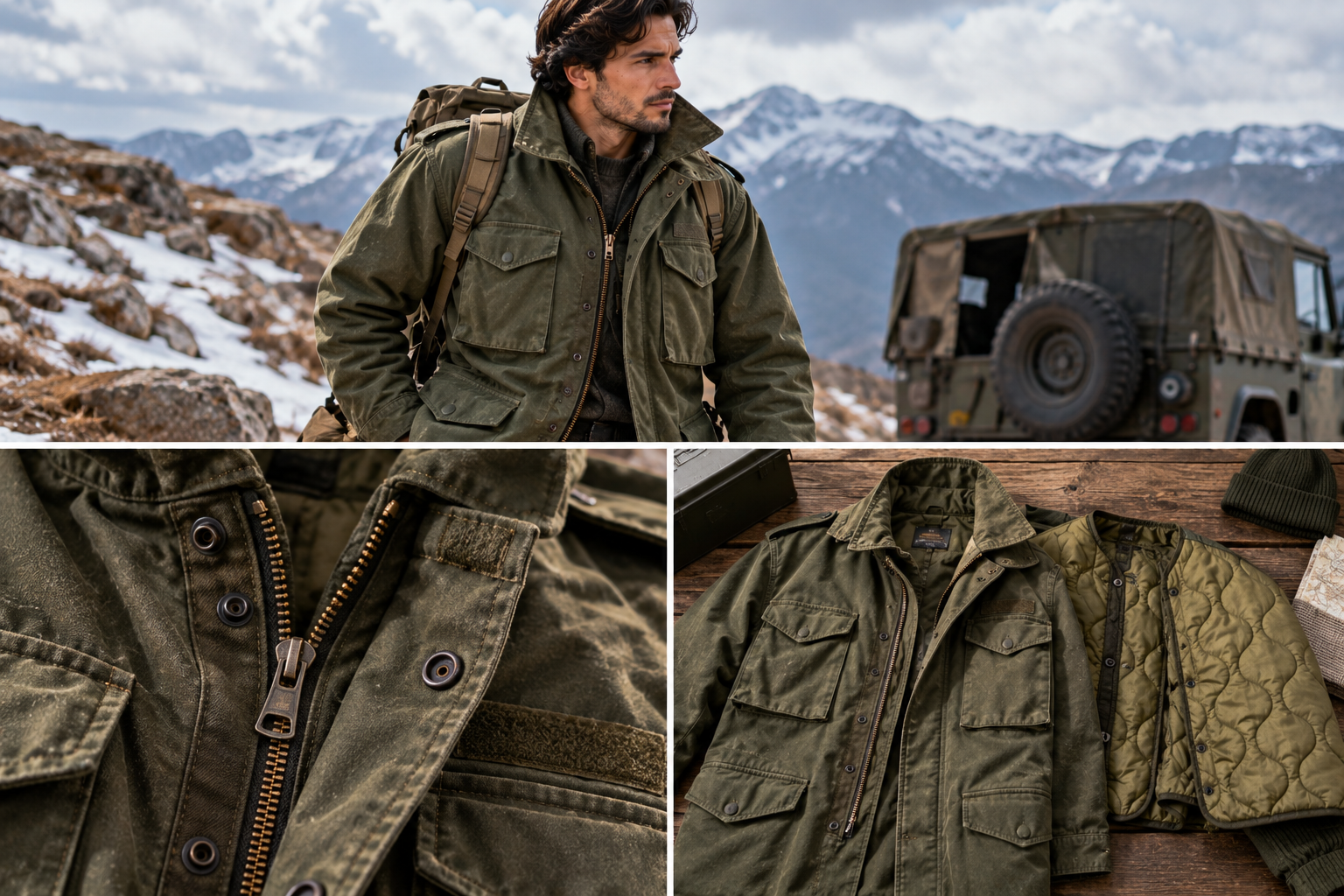
The official military liner specification is MIL-L-43536, covering a field-coat liner made with quilted polyester batting. The field clothing reference describes ripstop nylon covering and buttonhole tabs that secure the liner at the body and sleeves. “ALS/92” is a widely used name for a later liner style; that label alone should not be treated as proof of original government issue or identical specification details.[6][7]
Polyester batting increases thickness and traps still air. That is the main warming mechanism. The familiar wavy quilting helps stabilize batting across the liner, but warmth depends on the amount and condition of insulation, not on quilting appearance alone.[6][7]
Why underarms and button spacing still lose heat
Military liner descriptions include open underarms and attachment points along the front and cuffs. These help attachment and movement, yet they leave paths for ventilation and local heat loss. The outer shell and clothing worn underneath must manage those spaces.[7]
A liner can improve cold-weather use substantially without converting the M-65 into a stand-alone extreme-cold system. If the underlayers are too bulky, the shell may compress them and make arm movement harder. Layer with enough ease to maintain both loft and mobility.
| Configuration | Thermal mechanism | Conditions suited to | Primary limitation |
|---|---|---|---|
| M-65 shell without liner | Dense weave reduces wind movement; modest trapped air | Dry, cool weather with active movement | Little standalone loft for prolonged cold exposure |
| M-65 with hoodie / fleece | Mid-layer holds air; shell reduces airflow | Cooler dry conditions with room for the underlying garment | Bulky fit can compress layers or reduce arm mobility |
| M-65 with compatible quilted liner | Polyester batting adds loft beneath outer shell | Cold-weather layered use with suitable base clothing | Open underarms and spaced attachments can admit drafts |
What Are the Weather and Commercial Replica Boundaries of the M-65?
The traditional M-65 is water-repellent rather than seam-sealed waterproof, and its performance depends on the actual shell, finish and construction rather than the familiar field-jacket outline.[1][11]
Quarpel, DWR and the difference between repellent and waterproof
Quarpel is a historical water-repellent treatment name associated with military clothing specifications. On any individual field coat, the reliable evidence is its documented finish and its present condition; it would be inaccurate to assume every vintage or civilian shell carries a functioning Quarpel treatment. The coat specification describes water-repellent fabrics, while the cloth specification identifies certain Quarpel-treated classes rather than a taped waterproof membrane.[1][15]
Surface repellency can make droplets bead for a time. Waterproof barriers are a different construction system: fabric treatment, membrane or coating performance, and seam design have to work together. Textile research distinguishes these functions rather than treating a spray test as proof of storm protection.[11][12]
Wet-weight penalty and drying time in prolonged rain
Once a repellent finish stops shedding water, moisture can enter through the fabric and stitched openings. The cotton portion of a nylon-cotton shell also holds moisture differently from a completely hydrophobic cloth. More retained water means more carried mass and a longer drying problem.
The brief’s suggested total garment weight and universal saturation figures are omitted because the outcome changes with size, fabric, liner and water exposure. What matters for the buyer is the boundary: an M-65 is not a substitute for a waterproof shell in hours of heavy rain.[11][12]
Why commercial replicas cannot be judged by styling alone
A civilian “M-65-style” coat may use a different woven shell, lighter trim, decorative pleats or incompatible liner buttons. Those differences can change wear life, wind management and warmth. They do not automatically make the coat unusable; they mean it should be judged under its real specification rather than a borrowed military claim.
Inspect the fibre label, coat contract or specification information if present, rear pleats, cuff extensions, hood compartment and internal liner-button pattern. Even genuine surplus can have replacement hardware or repairs, so provenance and current functional condition belong in the same evaluation.[1][3]
| Exposure | M-65 response | Practical consequence |
|---|---|---|
| Brush, abrasion and cool wind | Dense woven shell, cargo pockets and adjustable openings are useful | Protects against routine rubbing; snag and tear risk remains |
| Light shower or dry snow | Water-repellent finish can reduce initial wetting when intact | Check existing finish condition; not a waterproof guarantee |
| Sustained heavy rain | No waterproof membrane or sealed seams in traditional configuration | Shell may wet through; choose a seam-protected rain jacket |
| High-output, light-pack travel | Heavy fabric, multiple closures and optional liner add bulk | Choose a lighter layer if weight and ventilation dominate |
M-1965 Field Jacket vs. Modern Tactical Softshell and BDU Shirt Jacket: Which Performs Best?
The M-65, a technical softshell and a BDU-style field coat serve different jobs: the M-65 emphasizes cargo utility and modular warmth, a softshell often favors active mobility, and a BDU coat is closer to an unlined uniform layer.[3][13][14]
| Performance metric | M-1965 field jacket | Modern tactical softshell | BDU-style field shirt |
|---|---|---|---|
| Construction priority | Durable woven shell and cargo access | Mobility, comfort and fabric-specific weather control | Uniform-style utility and lighter layering |
| Primary fabric | Nylon/cotton sateen on issue-spec variants | Synthetic woven textile; stretch and finish vary | Cotton or cotton/nylon woven combat fabrics |
| Abrasion / hot sparks | Good routine wear resistance; nylon blend is not flame-rated | Abrasion and heat behavior depend on textile; synthetics may melt | Varies by weave and fibre; not inherently flame-rated |
| Cold-weather system | Compatible button-in quilted liner | Insulation varies; many rely on separate layers | No integrated M-65 liner system |
| Airflow and activity | Closed weave can feel hot during hard exercise | Often better fit for active movement | Unlined and comparatively easy to ventilate |
| Cargo utility | Four front pockets and drawcord adjustment | Varies, often slimmer zippered storage | Utility pockets but lighter shell role |
Heavy field utility versus softshell movement and venting
The M-65 makes sense when large pockets, a solid woven outer layer and the option of attaching a separate liner matter more than low weight. A synthetic softshell may provide stretch, lighter packing and more freedom for repeated high-output movement, but those features depend on the exact fabric and finish.[3][10]
Neither category carries an automatic flame-safety claim. Untreated cotton is combustible, while standard nylon and polyester can melt at high temperatures. For known hot-work hazards, use tested protective clothing instead of assuming an old field jacket or modern softshell is suitable.[9]
Field-coat insulation and hood versus the lighter BDU role
The BDU combat coat has its own military uniform history and specifications. It is not a shortened M-65 and does not share its button-in cold-weather liner system or concealed storm collar. BDU designs can use cotton/nylon twill or ripstop, with fabric varying by uniform type and revision.[13][14]
For a cool day with frequent movement, a lighter BDU-style layer can be easier to ventilate. For changing cold weather with pocket-heavy work, the M-65 offers more covered construction and a compatible quilted liner, while weighing more and packing larger.[3][7]
Final Verdict: When Is the M-1965 Field Jacket Worth Buying?
The M-1965 is a sound option for dry-weather utility, brush contact and flexible cold-season layering when the fabric and construction match the intended use and the liner is available.
Best situations for field wear and modular everyday layering
Choose an M-65 when a dense woven shell, broad pocket access, moving-room shoulder pleats, adjustable cuffs and removable insulation are genuinely useful. Its design works across variable cool conditions without relying on one fixed insulation level.[3][7]
If buying surplus, examine the coat as a functional object: match the label to the design, check the back pleats, move each fastener, examine pocket corners and confirm whether the liner is present. Condition matters more than the appeal of an old contract date.
When to choose a waterproof shell or insulated parka
Select a seam-protected waterproof jacket for sustained rain and a dedicated high-loft insulated system for severe cold, especially when movement is limited. Pick lighter, more breathable gear when packing weight and sustained aerobic movement matter more than cargo capacity.[10][11]
The M-65 is at its best as a durable field shell with optional added insulation; its military history does not cancel the limits of unsealed fabric, removable batting and a relatively heavy woven build.
Sources
- Defense Logistics Agency (DLA). MIL-DTL-43455: Coat, Cold Weather, Field — scope, revision and cancellation record. Read source.
- Clothing and Individual Equipment (CIE) Hub. MIL-C-43455 / MIL-DTL-43455 revision history, including 1966 specification and 2007 redesignation. Read source.
- Clothing and Individual Equipment (CIE) Hub. M-65 Cold Weather Field Coat — construction, function, pockets, pleats, hood and fabric. Read source.
- Clothing and Individual Equipment (CIE) Hub. M-1951 Field Jacket Shell and Liner — preceding field-jacket system. Read source.
- Clothing and Individual Equipment (CIE) Hub. M-65 Cold-Wet / Cold-Dry Clothing System — layered use and field configuration. Read source.
- Defense Logistics Agency (DLA). MIL-L-43536: Liner, Cold Weather Coat — quilted polyester batting specification. Read source.
- Clothing and Individual Equipment (CIE) Hub. M-65 Cold Weather Coat Liner — button attachment, open underarms, polyester batting and nylon layers. Read source.
- Fashion and Textiles (Springer Nature). Comfort related woven fabric transmission properties made of cotton and nylon — open-access woven NYCO-blend research. Read source.
- U.S. Occupational Safety and Health Administration (OSHA). Protection From Flames and Electric Arcs — hazards of untreated cotton and meltable nylon/polyester fibres. Read source.
- International Journal of Biometeorology (Springer Nature). Impact of garment construction and environmental factors on heat transfer — open-access study of wind, fabric permeability and insulation. Read source.
- PLOS ONE. Effects of household water-repellent agents and number of coating layers on the physical properties of cotton woven fabrics — open-access water-repellency research. Read source.
- Nano-Micro Letters (Springer Nature). Highly Permeable and Liquid-Repellent Textiles with Micro-Nano-Networks for Medical and Health Protection — open-access barrier-material research. Read source.
- Clothing and Individual Equipment (CIE) Hub. Temperate Battle Dress Uniform — field garment and fabric context. Read source.
- Clothing and Individual Equipment (CIE) Hub. MIL-C-44048: Coats, Camouflage Pattern, Combat — BDU coat specification variants. Read source.
- Clothing and Individual Equipment (CIE) Hub. MIL-C-43191: cotton/nylon wind-resistant sateen, including Quarpel-treated fabric classifications. Read source.
Evidence sources: U.S. Defense Logistics Agency specification records, military clothing documentation, and scholarly textile research. No retailer or shopping page is used as evidence. Specification variations, hardware gauges, blanket temperature claims and fabric-weight values are not presented as universal.