
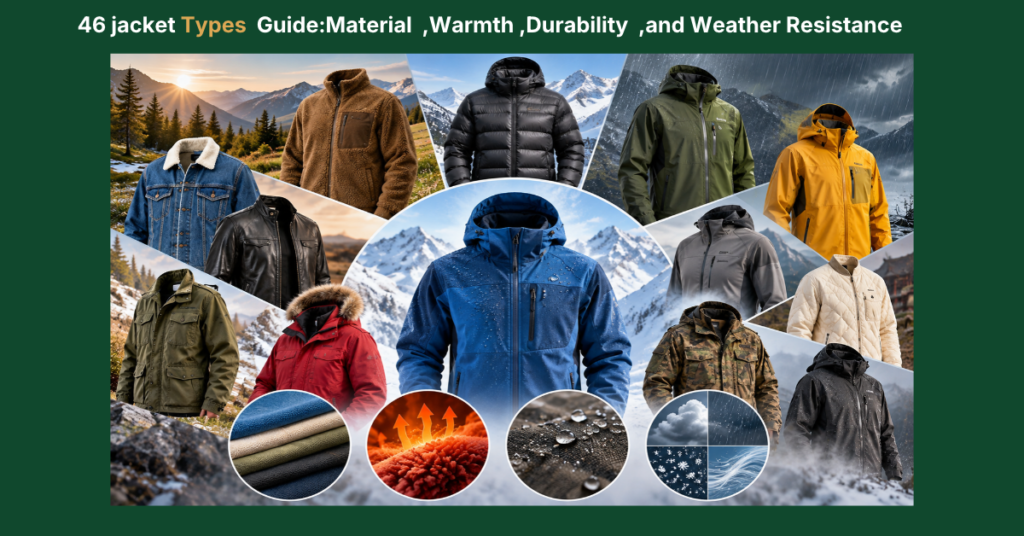
46 Jacket Types Guide: Material, Warmth, Durability, and Weather Resistance
Classifying outerwear effectively requires evaluating jackets based on their material mechanics, thermal retention capabilities, abrasion resistance, and weatherproofing thresholds.
With 46 jacket types covering everything from lightweight windbreakers to heavyweight wool overcoats, choosing by name alone creates unnecessary confusion. A more useful approach is to group jackets by structural purpose, then compare them against the conditions that actually matter: temperature, precipitation, wind, activity level, and abrasion exposure.
A jacket designed to retain heat during low-output winter use solves a different problem from a shell intended to block rain during active movement. A waxed barn jacket places more emphasis on structural longevity than a breathable fleece mid-layer. A tailored overcoat provides warmth and coverage, but it does not perform the same job as a seam-sealed hardshell.
The 46 jacket types in this guide are therefore organized into six functional clusters:
- High-loft insulators
- Hardshells and rainwear
- Active mid-layers
- Heritage and workwear
- Tactical and military utility
- Tailored outerwear and overcoats
The goal is to understand how each structure works, where it performs well, and where its limitations become important.
How Fabric and Fill Materials Dictate Outerwear Performance
Outerwear performance is generally governed by three primary structural metrics: thermal loft for heat retention, hydrostatic head for water resistance, and material denier for physical durability.
These metrics describe different properties. A highly lofted jacket may retain heat effectively but offer little rain protection. A high-denier shell may resist abrasion yet provide almost no insulation. A waterproof membrane can block external moisture while creating a greater need to manage sweat during activity.
Material selection works best when these properties are evaluated together rather than treated as interchangeable signs of quality.
How down loft and synthetic insulation trap radiant body heat
Insulation does not generate heat. It slows the transfer of heat away from the body.
High-loft materials create a three-dimensional structure containing many small air spaces. Air held relatively still within these spaces reduces heat transfer and helps limit convective heat loss.
Down plumage achieves loft through clusters that expand and create a large volume relative to their weight. Synthetic fill uses manufactured fibers arranged to create similar air-trapping spaces.
A thicker insulating layer can generally hold more still air, but warmth does not depend on thickness alone. Construction, fill distribution, compression, moisture, garment fit, and exposed areas also influence thermal performance.
Natural down is commonly associated with a favorable warmth-to-weight ratio, while synthetic fill is often selected where moisture exposure is more likely. A precise comparison of wet down against wet synthetic insulation requires controlled evidence. [2]
How tightly woven face fabrics and DWR coatings repel water
Weather resistance often begins with the face fabric.
A tightly woven outer fabric reduces the size and number of openings through which wind and water can enter. Many technical jackets also use a Durable Water Repellent, or DWR, treatment on the exterior surface.
DWR is intended to encourage water to bead and roll from the face fabric before the material becomes saturated. [1]
This treatment is different from the waterproof membrane itself.
A technical shell may combine:
- A woven face fabric for mechanical protection
- DWR for surface water shedding
- A polyurethane membrane or another waterproof layer for liquid-water resistance
- Seam sealing to reduce leakage through stitch lines
DWR performance can decline with wear, contamination, and repeated laundering. [1] A jacket should therefore not be classified as fully waterproof solely because water beads on its surface.
Why material denier determines abrasion resistance and garment lifespan
Denier is a unit used to describe the linear mass density of fibers or yarns. [5]
In practical outerwear discussions, higher denier numbers often indicate heavier, thicker yarns. These fabrics are commonly selected where abrasion resistance and structural durability matter.
That relationship is useful, but denier is not a complete durability score. [6]
A higher-denier fabric is not automatically indestructible. Abrasion resistance also depends on:
- Fiber type
- Yarn construction
- Weave or knit structure
- Ripstop reinforcement
- Surface coating
- Seam construction
- Garment design
Exact denier thresholds for specific durability levels should not be treated as universal without material-specific testing. [5][6]
Outerwear Materials Primer
| Metric | Definition | Primary Function |
|---|---|---|
| Loft | The thickness and air-trapping volume of an insulating material. | Supports thermal retention by holding insulating air. |
| Hydrostatic Head | A laboratory measurement of the water pressure a fabric can withstand before leakage occurs. | Helps quantify waterproof capability. |
| Denier | A measurement of the linear mass density of fibers or yarns. | Helps describe yarn size and often relates to structural durability. |
These measurements answer separate questions. Loft addresses insulation. Hydrostatic head addresses resistance to water pressure. Denier describes yarn mass rather than complete garment durability.
High-Loft Insulators: Jackets Built for Extreme Thermal Retention
High-loft insulators prioritize thermal retention in sub-zero environments by utilizing thick layers of down or synthetic fill to trap body heat.
This cluster includes seven jacket types:
- Down jacket
- Puffer jacket
- Quilted jacket
- Parka
- Fishtail parka
- Shearling jacket
- Gilet
Their shared purpose is insulation, but they achieve it through different materials, coverage levels, and constructions.
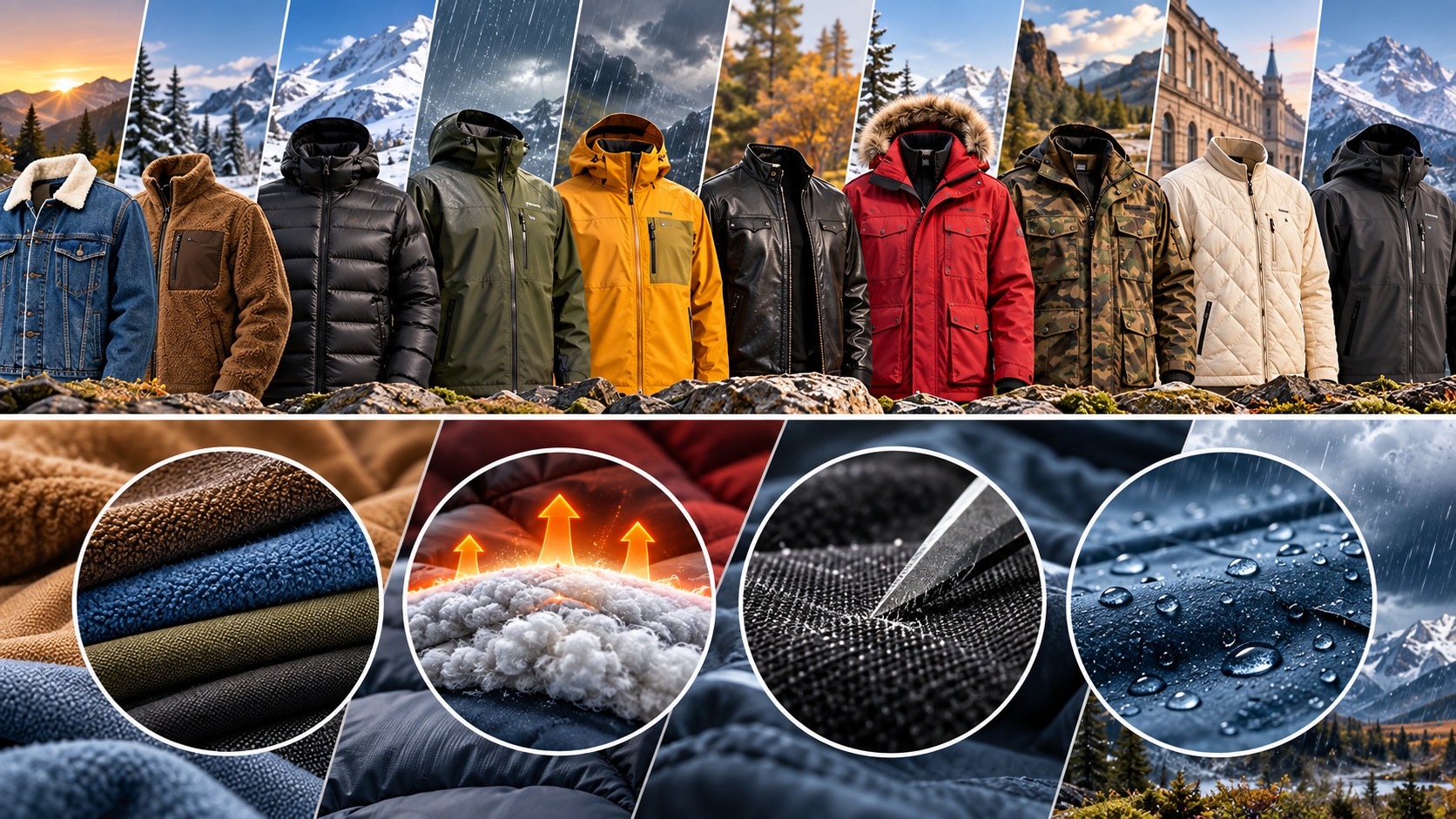
Down, Puffer, and Quilted jackets: Maximizing loft for sub-zero thermal retention
Down jackets use natural down plumage as the primary insulating material. The down expands into a high-loft structure that traps air while adding relatively little weight.
A puffer jacket describes the recognizable insulated construction built around visibly filled chambers. A puffer may contain down or synthetic insulation, so the term refers more to jacket construction than to one specific fill material.
Quilted jackets use stitched sections to stabilize insulation and reduce uncontrolled movement of the fill.
Baffles and quilt lines help hold insulation in defined areas. The size, shape, and spacing of those chambers can affect how evenly insulation remains distributed.
Down generally offers a favorable warmth-to-weight ratio. Synthetic insulation is commonly used when moisture resistance and easier drying are priorities. A direct statement that synthetic fill always retains more insulation when wet than down requires controlled comparison data. [2]
These jackets work best when thermal retention matters more than maximum breathability.
Parka and Fishtail Parka jackets: Extended coverage for extreme wind and cold
Parkas extend insulation below the waist to increase coverage.
Longer hems reduce the amount of exposed torso and upper-leg area compared with shorter insulated jackets. Many parkas also include insulated or protective hoods that reduce heat loss around the head and neck.
The fishtail parka uses an extended rear hem that splits into two sections. Its longer cut provides additional coverage while preserving some freedom of movement.
Neither name guarantees a specific insulation level. A lightweight fishtail parka and an expedition-oriented down parka may share a general silhouette while performing very differently.
For cold selection, examine:
- Fill type
- Loft
- Hood construction
- Garment length
- Wind resistance
- Closure design
Shearling and Gilet jackets: Balancing core warmth with natural materials and arm mobility
Shearling jackets use sheepskin with the wool left attached to the hide. The dense natural wool provides loft, while the leather side adds structure and some resistance to wind.
A gilet takes the opposite structural approach.
By removing the sleeves, a gilet concentrates insulation around the torso while allowing unrestricted arm movement. This makes it useful where core warmth matters but full-sleeve insulation would interfere with activity.
A heavily insulated gilet can provide substantial torso warmth, but exposed arms make it less suitable as a standalone layer in severe cold.
Shearling emphasizes full-material insulation and structural weight. A gilet emphasizes mobility and selective insulation.
Hardshells and Rainwear: Prioritizing Absolute Weatherproofing
Hardshells and rainwear are engineered to block precipitation and wind, typically utilizing sealed seams and coated membranes that require a trade-off with thermal breathability.
This cluster includes ten jacket types:
- Rain jacket
- Hardshell jacket
- Anorak
- Windbreaker
- Smock
- Cagoule
- Trench coat
- Mac coat
- Cape
- Poncho
The main question here is no longer how much insulation the garment provides. It is how effectively the outer layer prevents weather from reaching the layers underneath.
Rain, Hardshell, and Anorak jackets: Understanding hydrostatic head ratings and seam sealing
Rain jackets are designed primarily around precipitation protection.
Hardshell jackets take this purpose further by combining weather-resistant face materials, waterproof membranes, and structural details intended for exposed environments.
Anoraks typically use a pullover construction with reduced front opening length. This can simplify the shell structure and reduce the amount of full-length zipper area exposed to weather.
Hydrostatic head testing measures how much water pressure a fabric can withstand before leakage begins. [3][4] Higher measured resistance can indicate greater waterproof capability, but no universal threshold should be presented here without an authoritative standard. [3][4]
Fabric performance is only part of waterproofing.
Needle holes created during sewing can create routes for water ingress. Seam sealing or seam taping is therefore important in jackets intended for sustained rain.
A technically waterproof shell usually depends on the interaction of:
- Waterproof membrane or coating
- Face fabric
- DWR
- Seam construction
- Zipper design
- Hood coverage
- Cuff and hem adjustment
Windbreaker, Smock, and Cagoule jackets: The trade-off between absolute weatherproofing and breathability
Windbreakers prioritize protection from moving air with relatively low material weight.
They often use tightly woven nylon or polyester fabrics that reduce wind penetration without relying on thick insulation.
Smocks use pullover construction and are often designed around mobility, weather resistance, and simplified closures.
A cagoule is a lightweight hooded outer layer traditionally associated with rain and wind protection.
The key trade-off is vapor movement.
A highly impermeable barrier may block rain effectively but also restrict the escape of moisture vapor generated during physical activity. As activity rises, sweat accumulation and interior condensation become more important.
This is why a garment intended for high-output movement cannot be evaluated by waterproofing alone.
Trench Coat, Mac Coat, Cape, and Poncho jackets: Heritage and drape-based water runoff systems
Trench coats and Mac coats rely heavily on extended coverage and water-shedding outer materials.
A Mac coat, or Macintosh-style coat, traditionally uses a weather-resistant construction with a relatively clean silhouette. A trench coat adds structured closures, overlapping front panels, and extended length.
Capes and ponchos reduce reliance on fitted sleeve construction.
Their broad surfaces and open drape help direct rain away from the torso. A poncho can also cover equipment such as a backpack, depending on its dimensions.
These garments often use gravity, length, and drape to manage rainfall rather than depending entirely on close-fitting membrane systems.
Waterproof vs. Breathability Grid
| Jacket Cluster | Weatherproofing Focus | Breathability Level | Common Environment |
|---|---|---|---|
| Technical Hardshells | High, especially when membrane and seams are properly constructed | Low to Moderate, depending on membrane and ventilation | Heavy rain, exposed wind, alpine or cold environments |
| Windbreakers / Smocks | Moderate wind protection, often water-resistant rather than fully waterproof | Moderate | Light precipitation, wind, active movement |
| Trench / Mac Coats | Moderate, often through treated fabrics and extended coverage | Moderate | Urban environments, moderate rain, lower-output movement |
The categories overlap. Construction matters more than the product name alone.
Active Mid-Layers: Balancing Breathability and Moderate Warmth
Active mid-layers balance moderate thermal insulation with breathability, allowing for moisture evaporation during dynamic physical movement.
This cluster contains eight jacket types:
- Fleece jacket
- Softshell jacket
- Track jacket
- Athletic jacket
- Coach jacket
- Shacket
- Blouson
- Techwear jacket
These garments sit between full weather shells and maximum-insulation jackets.
Fleece and Softshell jackets: Maximizing warmth-to-weight ratios during high-output activity
Fleece relies on raised synthetic fibers to create loft.
That loft traps insulating air while the porous fabric structure allows comparatively easy movement of air and moisture vapor.
This makes fleece effective as a mid-layer, but the same permeability can reduce warmth in strong wind.
Softshell jackets address part of that limitation by using a more structured woven face.
A softshell commonly provides:
- Moderate wind resistance
- Stretch
- Abrasion protection
- Greater breathability than many waterproof hardshells
- Light weather resistance
It generally sacrifices absolute precipitation protection in exchange for mobility and vapor transfer.
The choice between fleece and softshell depends on exposure. Fleece favors insulation and breathability. Softshell adds greater surface protection.
Track, Athletic, and Coach jackets: Lightweight synthetic barriers for pre- and post-activity wear
Track jackets are lightweight layers designed around movement.
Athletic jackets cover a broad category, but many use low-weight synthetic fabrics that reduce wind exposure without adding substantial insulation.
Coach jackets typically use a simple collared silhouette and lightweight woven shell material.
These jackets can reduce direct wind chill during warm-ups, cooldowns, commuting, or mild weather.
Their low bulk makes them easy to layer, but they should not be confused with high-loft cold-weather insulation.
Shirt, Blouson, and Techwear jackets: Integrating functional storage with transitional warmth
A shacket combines the structure of a shirt with the heavier material weight of light outerwear.
It occupies a useful transitional position between indoor clothing and a conventional jacket.
A blouson uses a shorter cut with a gathered or fitted waist. Its structure reduces excess fabric around the lower torso while retaining enough room for light layering.
Techwear jackets place greater emphasis on utility features such as:
- Multiple pockets
- Concealed storage
- Adjustable closures
- Articulated construction
- Synthetic face fabrics
The label itself does not guarantee waterproofing, durability, or insulation. Those qualities depend on the specific fabric and garment construction.
Heritage and Workwear: Maximizing Material Abrasion Resistance
Heritage and workwear jackets prioritize structural durability and physical abrasion resistance, typically utilizing heavy natural materials like leather, waxed cotton, and dense denim.
This cluster includes eight jacket types:
- Biker jacket
- Moto jacket
- Flight jacket
- Bomber jacket
- Barn jacket
- Chore jacket
- Denim jacket
- Varsity jacket
- Harrington jacket
Flight and bomber jackets overlap historically and structurally, but the terms are still used as distinct product categories in modern outerwear.
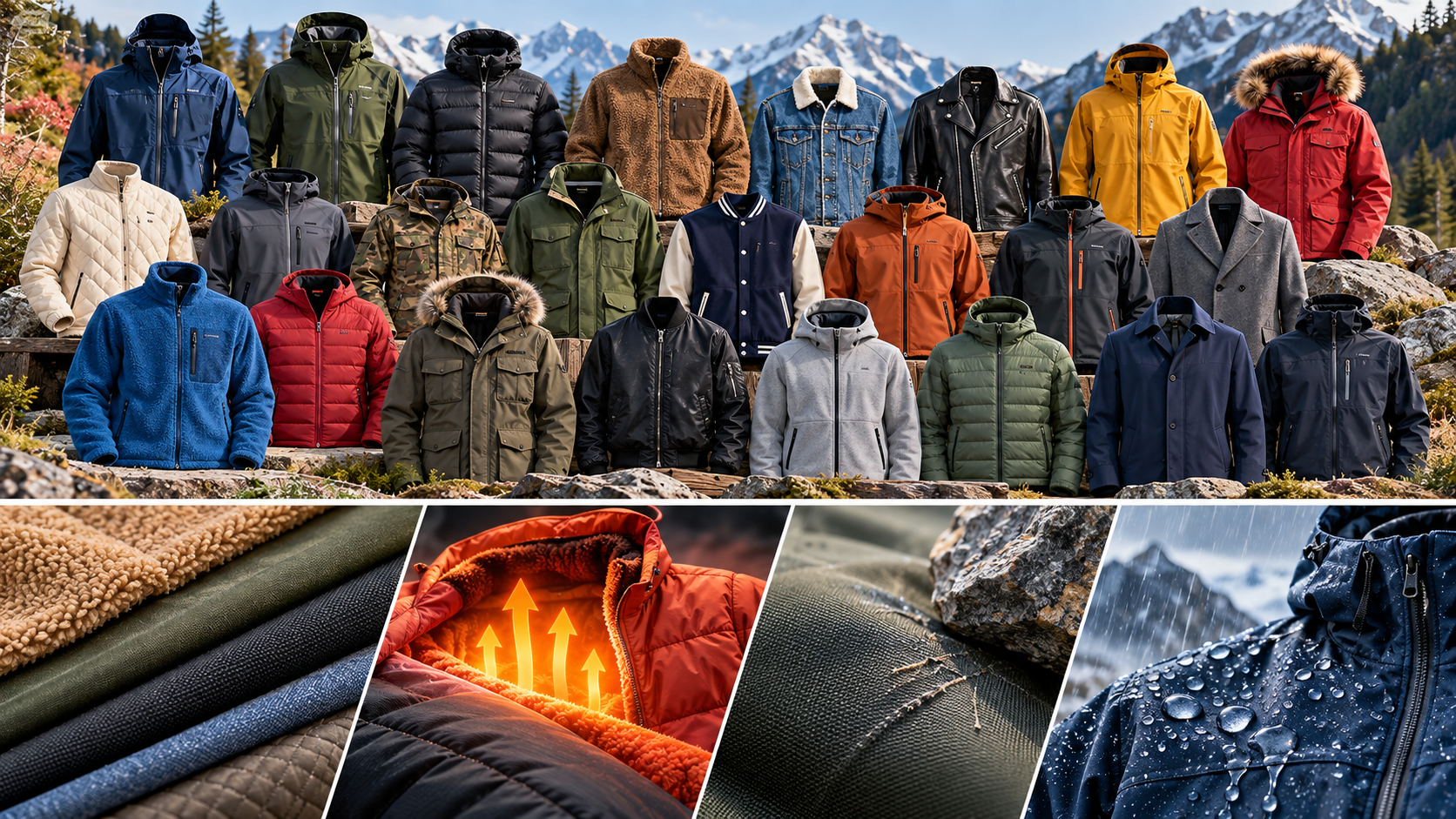
Biker, Moto, Flight, and Bomber jackets: Leather and nylon structures built around wind resistance and durability
Biker and moto jackets commonly use leather because of its dense structure and abrasion resistance.
Heavy leather can provide significant protection from wind and surface friction, though actual protective performance depends on leather thickness, construction, reinforcement, and intended use.
Flight jackets were developed around the needs of aviation environments.
Bomber jackets evolved from closely related military flight-jacket structures and now cover a broader range of civilian materials and insulation levels.
Many modern bomber jackets use nylon or polyester shells. Historical and military examples may use heavier materials and insulated linings.
Claims about exact denier values or standardized abrasion performance require model-specific evidence. [5][6]
Barn, Chore, and Denim jackets: High abrasion resistance for physical work environments
Barn jackets frequently use canvas or waxed cotton.
Waxed cotton combines a tightly woven base material with a wax treatment that improves resistance to surface moisture and helps the fabric tolerate rough outdoor use.
Chore jackets emphasize practical durability and accessible storage. Dense cotton canvas, duck cloth, or similar fabrics are common because they tolerate repeated contact with tools and work surfaces.
Denim jackets use dense cotton twill.
Heavy denim can withstand repeated abrasion better than many lightweight apparel fabrics, though it is not inherently waterproof.
In brush, workshop, agricultural, or labor environments, these jackets often prioritize repairability and structural longevity over low weight.
Varsity and Harrington jackets: Blending durable wool and cotton twill for everyday structural longevity
Varsity jackets traditionally combine a heavyweight wool body with contrasting sleeves, though modern versions vary widely.
The dense wool body provides moderate insulation and a substantial structure suited to cool, dry conditions.
Harrington jackets are shorter and lighter. Cotton or cotton-blend shells are common, providing moderate wind resistance and a cleaner transitional-weather profile.
Neither category is primarily designed for heavy rain.
Their strengths are moderate warmth, everyday durability, and compact structure.
Tactical and Military Utility: Function-Driven Storage and Protection
Tactical and military outerwear is engineered for environmental adaptability, featuring reinforced fabrics and modular pocket configurations designed for secure gear carriage.
This cluster includes five jacket types:
- M-1965 Field jacket
- Military jacket
- Tactical jacket
- Utility jacket
- Safari jacket
The defining feature is functional organization rather than one specific fabric.
M-1965 Field and Military jackets: Standardized weather resistance and heavy-duty cotton canvas blends
The M-1965 Field jacket belongs to a military field-jacket tradition built around layering, durability, and practical storage.
Field jackets commonly use cotton-synthetic blends or similarly durable woven materials.
Multiple pockets allow equipment to be distributed across the torso rather than concentrated in one location.
Military jackets as a wider category vary considerably. Some prioritize insulation. Others emphasize wind resistance, camouflage, abrasion resistance, or compatibility with additional layers.
The military label alone is therefore not a reliable indication of warmth or waterproofing.
Tactical and Utility jackets: Modern synthetic materials optimized for modular storage and tear resistance
Tactical jackets emphasize equipment access and organization.
Common design elements include:
- Reinforced pocket openings
- Multiple storage zones
- Ripstop fabrics
- Adjustable cuffs
- Articulated sleeves
- Reinforced elbows or shoulders
Ripstop construction uses reinforcement yarns integrated into the fabric to help limit the spread of small tears.
Utility jackets use similar storage-driven logic but cover a wider civilian range. Their performance depends on material weight, pocket loading, stitching, and reinforcement.
Storage should not be treated as a secondary detail. Heavy items can distort lightweight fabrics, so a jacket intended for gear carriage needs enough structural support to distribute weight.
Safari jackets: Lightweight, breathable protection optimized for hot, abrasive environments
Safari jackets solve a different problem.
Rather than retaining maximum body heat, they provide coverage in warm environments while preserving ventilation.
Lightweight woven cotton or linen can shield the skin from sun, vegetation, and minor abrasion while allowing more airflow than heavy workwear fabrics.
Multiple front pockets provide accessible storage without requiring a separate bag for small equipment.
The safari jacket therefore belongs in the utility category because of environmental coverage and storage, not because it resembles cold-weather tactical outerwear.
Tailored Outerwear and Overcoats: Formal Warmth and Drape
Tailored outerwear and overcoats rely on dense, heavyweight wools and extended lengths to provide formal thermal protection against wind and cold.
This cluster contains seven jacket types:
- Overcoat
- Topcoat
- Car coat
- Peacoat
- Duffle coat
- Blazer
- Coat
These garments prioritize controlled drape, extended coverage, and structured layering rather than technical membranes or high-loft synthetic insulation.
Overcoat, Topcoat, and Car coat jackets: Variations in length and wool density for formal winter layering
An overcoat is designed to be worn over other clothing.
Its longer cut and heavier construction make it suitable for cold-weather formal layering.
A topcoat is generally lighter and less bulky. It provides additional warmth without the same degree of winter insulation associated with heavier overcoats.
A car coat is shorter.
Its reduced length improves mobility while seated, making it more practical for driving and urban movement.
The three types differ mainly in length, material weight, and intended layering depth.
Peacoat and Duffle coat jackets: Heavy wool structures designed for cold, windy conditions
Peacoats use dense wool construction and a double-breasted front.
When closed, the overlapping front places two layers of fabric across part of the chest. The short-to-medium length maintains mobility while the dense wool helps reduce wind penetration.
Duffle coats use longer bodies and characteristic toggle closures.
Their heavyweight wool construction provides substantial warmth in cool and cold conditions.
Neither should be assumed waterproof. Dense wool can handle some light moisture, but sustained rain requires a garment specifically designed for precipitation protection.
Blazer and Coat jackets: Lightweight structural layers prioritizing shape over absolute weather resistance
Blazers prioritize shape, drape, and structured presentation.
They can provide mild warmth, especially when made from heavier wool, but most lack high-loft insulation, seam sealing, or waterproof membranes.
The general term coat covers a broad range of outer garments.
A coat may be insulated, tailored, waterproof, or purely structural, so its technical performance cannot be determined from the name alone.
This is a useful reminder across the entire taxonomy: jacket labels describe families of construction, not guaranteed specifications.
Jacket Cluster Comparison
This comparison summarizes the structural roles described throughout the guide. Individual jackets can vary by fabric, insulation, finish, construction, and intended use.
| Jacket Cluster | Primary Performance Goal | Typical Construction Emphasis | Typical Use | Main Limitation |
|---|---|---|---|---|
| High-Loft Insulators | Thermal retention | Down, synthetic fill, shearling, quilted or baffled construction | Cold and low-output conditions | Can become too warm during high-output activity and may require a shell for wet or windy exposure |
| Hardshells and Rainwear | Precipitation and wind protection | Tightly woven face fabrics, waterproof layers, seam sealing, weather-focused closures | Rain, wind, exposed conditions | Greater weather protection can reduce vapor movement and comfort during intense activity |
| Active Mid-Layers | Moderate warmth with breathability | Raised fleece, softshell weaves, lightweight synthetic fabrics, stretch and mobility | Dynamic movement in cool or cold conditions | Usually provides less absolute weather protection than a dedicated shell |
| Heritage and Workwear | Abrasion resistance and structural longevity | Leather, waxed cotton, canvas, dense denim, wool, durable woven fabrics | Work, brush, workshops, riding, everyday durable wear | Often heavier and less optimized for sustained precipitation or high-output activity |
| Tactical and Military Utility | Environmental adaptability and organized storage | Reinforced fabrics, multiple pockets, ripstop, adjustable closures, articulated construction | Gear carriage, field use, utility-focused environments | Performance varies widely because the category does not guarantee one insulation or waterproofing level |
| Tailored Outerwear and Overcoats | Formal warmth, coverage, and controlled drape | Dense wool, extended lengths, structured tailoring and layering space | Cold urban and formal environments | Usually lacks the seam sealing and technical waterproofing of dedicated rain shells |
How to Select the Exact Jacket for Your Climate and Activity
Selecting an appropriate jacket requires matching specific climatic demands—temperature, precipitation, and wind—with the intended level of physical activity.
Abrasion exposure should be considered at the same time.
The selection process becomes easier when each environmental problem is separated.
Ask five questions:
- How cold is the environment?
- How much rain or snow exposure is expected?
- How strong is the wind?
- How much heat will the body generate through activity?
- How much contact will the jacket have with rough surfaces?
Those answers usually identify the correct functional cluster more reliably than brand, style name, or appearance.
Pairing a technical hardshell with a high-loft insulator for freezing, wet environments
Cold and precipitation require two different forms of protection.
A high-loft insulator controls heat loss.
A hardshell controls wind and external moisture.
Using them as separate layers allows each garment to focus on one function. The insulation can provide loft while the shell protects that insulating layer from wind and precipitation.
This arrangement also adds flexibility.
If activity increases, the user can remove or vent one layer. If conditions become wetter or windier, the outer shell remains available without requiring a heavier insulated jacket.
For freezing, wet conditions, separating insulation from weather deflection is often more adaptable than expecting one garment to maximize every performance metric.
Choosing highly breathable mid-layers for dynamic, cold-weather movement
High-output activity changes the outerwear problem.
The body generates more heat and moisture, so maximum insulation can become counterproductive.
A fleece or breathable softshell can provide moderate warmth while allowing more moisture vapor to escape than a heavily insulated static-use jacket.
The objective is to reduce excessive sweat accumulation.
If clothing becomes saturated during movement, the wearer may cool rapidly once activity decreases.
For dynamic cold-weather use, the jacket system therefore needs enough insulation to manage cold without trapping unnecessary heat and moisture.
Relying on heavy-duty canvas, waxed cotton, or leather for dry, high-abrasion environments
Abrasion changes the priority again.
In workshops, dense brush, agricultural work, motorcycling, or environments with repeated surface contact, delicate lightweight fabrics can be vulnerable to tearing or puncture.
Heavy canvas, waxed cotton, dense denim, and leather place more material between the wearer and abrasive surfaces.
Barn jackets, chore jackets, biker jackets, and moto jackets fit this use case more naturally than ultralight technical shells.
This does not mean heavy heritage materials outperform technical synthetics in every durability test.
Modern engineered fabrics can be extremely abrasion resistant. The correct comparison requires fiber type, denier, weave, coating, and construction data rather than material name alone.
Climate and Activity Recommendation Matrix
| Climate Condition | Activity Level | Recommended Jacket Cluster | Example Jackets |
|---|---|---|---|
| Freezing, Dry | Low / Static | High-Loft Insulators | Down Parka, Quilted Jacket |
| Cold, Heavy Rain or Wind | Low to Moderate | Hardshell over Mid-Layer | Technical Hardshell, Anorak |
| Cool, Dry | High / Dynamic | Active Mid-Layers | Fleece, Softshell |
| Moderate, Dry | High Abrasion / Labor | Heritage and Workwear | Chore Jacket, Waxed Barn Jacket |
| Hot, Sun Exposure | Moderate | Tactical and Utility | Safari Jacket, Lightweight Utility Jacket |
| Freezing, Dry and Formal | Low / Static | Tailored Overcoats | Heavy Wool Overcoat, Peacoat |
No single row should be treated as a universal rule.
A freezing environment with high physical activity may call for less insulation than a milder environment where the wearer remains stationary for hours. Heavy rainfall can make waterproofing more important than insulation. Strong wind can make a breathable fleece inadequate unless a shell is added.
The jacket must match the complete environment.
Final Selection Logic
The 46 jacket types differ because they solve different physical problems.
High-loft insulators such as down jackets, puffers, parkas, shearling jackets, and gilets focus on thermal retention.
Rain jackets, hardshells, anoraks, cagoules, trenches, Macs, capes, and ponchos prioritize protection from precipitation.
Fleece, softshell, track, athletic, coach, shacket, blouson, and techwear jackets favor movement, moderate warmth, and transitional use.
Biker, moto, flight, bomber, barn, chore, denim, varsity, and Harrington jackets place greater emphasis on durable materials and structural longevity.
Field, military, tactical, utility, and safari jackets organize the garment around environmental adaptability and storage.
Overcoats, topcoats, car coats, peacoats, duffle coats, blazers, and other coats use tailored structure, heavyweight wool, length, and drape to provide formal coverage and warmth.
The useful question is therefore not which jacket type is best.
It is which structure solves the conditions you actually face.
Start with temperature. Add precipitation and wind. Then account for activity level and abrasion exposure. Once those variables are clear, the 46 jacket types become a manageable functional system rather than a long list of competing names.
Sources
- GORE-TEX. “Durable Water Repellent (DWR) in GORE-TEX Products.” GORE-TEX DWR guidance.
- REI Co-op. “Buying Down & Synthetic Insulated Jackets.” REI insulation guide.
- ISO. ISO 811:2018, “Textiles — Determination of resistance to water penetration — Hydrostatic pressure test.” ISO 811:2018.
- AATCC. TM127, “Water Resistance: Hydrostatic Pressure.” AATCC TM127.
- ASTM International. ASTM D861, “Standard Practice for Use of the Tex System to Designate Linear Density of Fibers, Yarn Intermediates, and Yarns.” ASTM D861.
- ASTM International. ASTM D3884-22, “Standard Guide for Abrasion Resistance of Textile Fabrics.” ASTM D3884.