
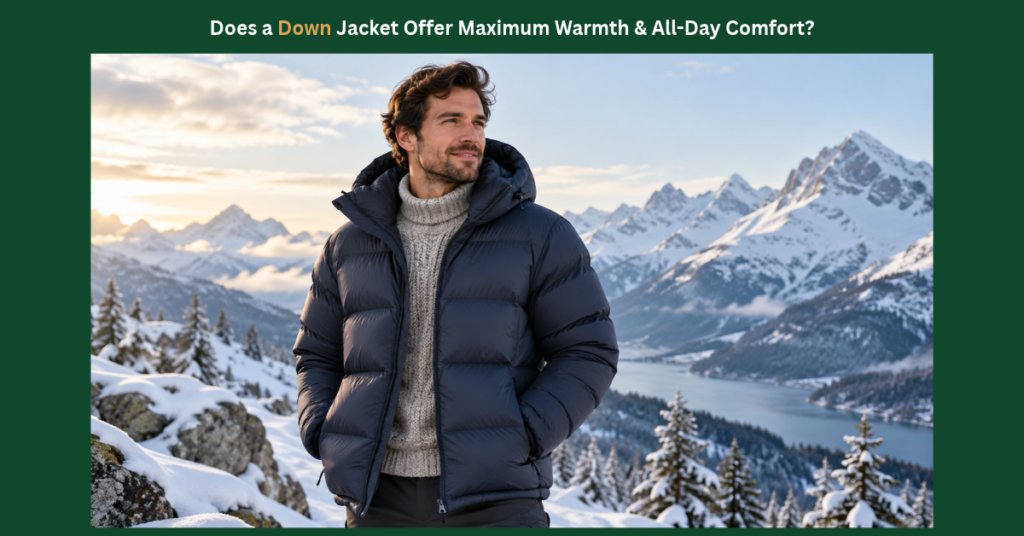
Does a Down Jacket Offer Maximum Warmth and All-Day Comfort?
A high-quality down jacket generally delivers exceptional warmth and physical comfort due to a favorable warmth-to-weight ratio, but its performance depends strictly on keeping the natural plumage dry.
Buyers often expect premium down to work as a universal winter solution. Its biology shows why that expectation is only partly right: loft gives down excellent dry-cold performance, but Fill Power is not a temperature rating, total fill weight matters, and moisture can flatten the clusters that hold insulating air.
This guide evaluates the structural mechanics of natural down to validate its thermal capacity, explain its ergonomic comfort, and map its exact weather-protective boundaries.
How Natural Plumage Clusters Create Thermal Loft
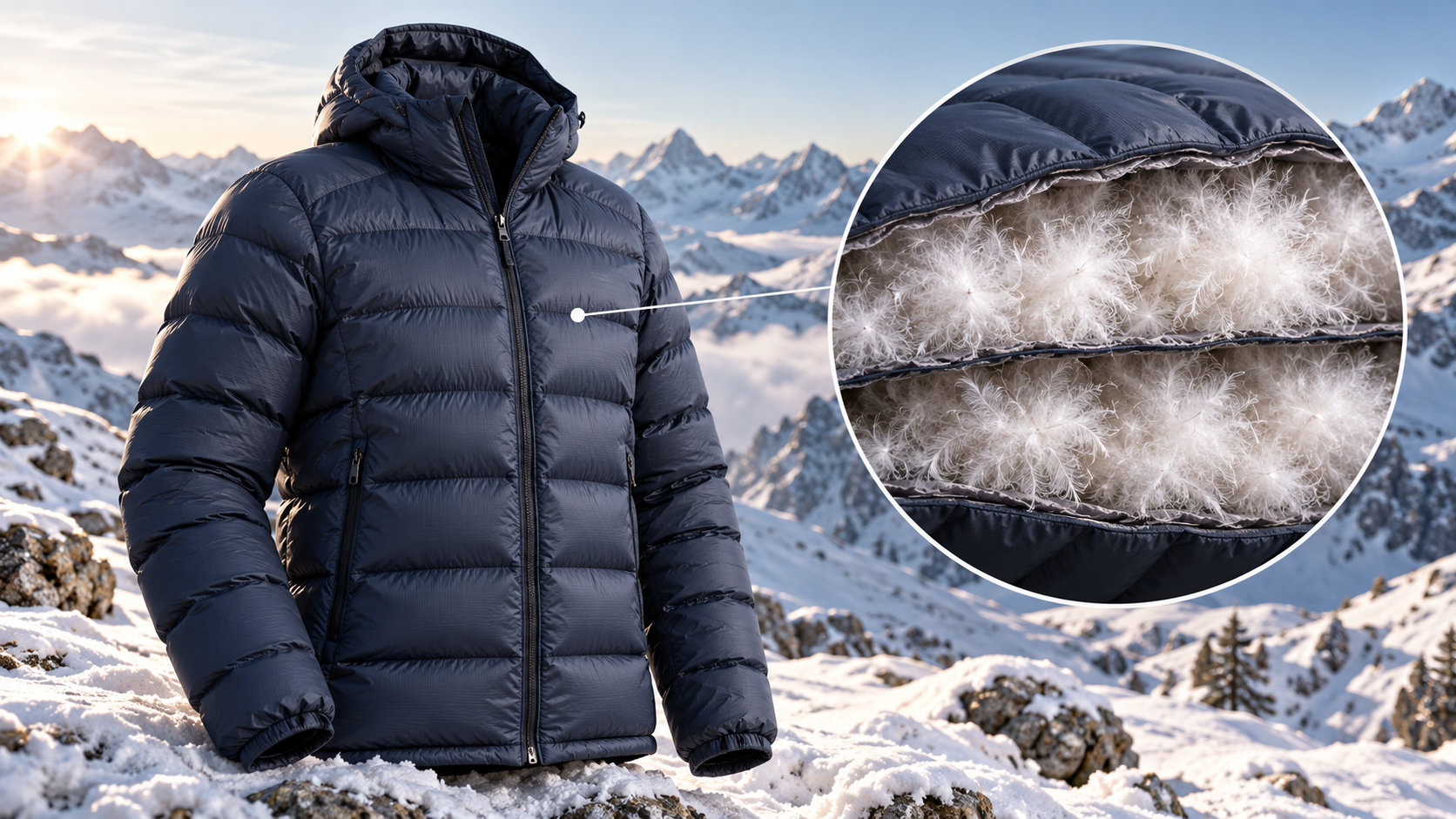
The foundational performance of a down jacket relies on the biological structure of goose or duck plumage, which expands to help create a thick layer of heat-trapping loft.
The biological structure of down plumage versus standard rigid feathers
Down is the soft, plumulaceous insulation beneath a bird’s outer feathers. University of Connecticut teaching material describes down and semiplumes as insulating feather types that may lack a strong central rachis; biological research also shows differences in feather size, barbule length, and nodus density.[1][2]
Unlike a rigid flight feather, a down cluster spreads outward in many directions. Inside a jacket, those loose clusters can expand into a three-dimensional layer rather than a flat vane.
How thousands of microscopic air spaces help trap body heat
Most of the insulation comes from air held within that expanded structure. Biological descriptions of down focus on its air-trapping form, and thermal research identifies still air as a major barrier to conductive and convective heat loss.[2][3]
More loft usually means more air space around the clusters. The jacket does not create heat; it slows the escape of the heat your body already produces.
The role of quilted baffle construction in preventing down migration and cold spots
Because down is loose, the jacket has to keep it distributed. Baffles divide the garment into compartments so the fill does not settle away from parts of the torso and leave thin areas.[4]
sewn-through and box-wall baffles affect warmth differently. Chambers that preserve loft keep more insulating air in place, while heavily compressed or sewn-through lines can become local thermal bridges.[5]
Evaluating Thermal Warmth Through Fill Power Metrics
down fill power (FP) measures the loft volume produced by a given mass of down. It is useful for comparing down quality, but it does not tell you the finished jacket’s temperature rating.
Understanding Fill Power: why higher FP creates more loft at the same mass
IDFL defines Fill Power by the volume a specified amount of down occupies under standardized conditions. In U.S. testing it is commonly expressed in cubic inches per ounce, so a larger volume means more loft for the same mass of filling.[6][7]
So 800-fill and 500-fill should be read as a loft comparison under a standardized test: at the same mass, the higher-FP sample occupies more volume. That alone does not make every 800-FP jacket warmer than every 500-FP jacket.
The relationship between total fill weight and sub-zero thermal retention
fill power and fill weight tell you two different things: how much loft the down can produce and how much down is in the garment. IDFL measures these separately, so a jacket using a small amount of high-FP down can still contain less total insulation than a jacket with more lower-FP down.[8]
Actual warmth comes from the combination of Fill Power, fill weight, baffle geometry, coverage, fit, shell construction, wind, and activity. That is why one FP number cannot be converted into a reliable temperature limit.
The overheating risk: why maximum loft is not always maximum comfort
Cold-weather guidance recommends adjusting insulation to activity and avoiding excess perspiration, because moisture inside clothing increases discomfort and heat loss. A very warm jacket can become uncomfortable during sustained aerobic work if the wearer cannot vent or remove a layer.[9][10]
For daily wear, the useful question is whether the jacket’s total insulation matches the weather and your activity level—not whether the label carries the highest Fill Power number.
| Fill Power Rating | What the Number Means | Compressibility / Loft | Temperature Meaning |
|---|---|---|---|
| 500–600 FP | Lower loft volume per unit mass than higher-FP down | Moderate | Cannot assign a reliable temperature rating from FP alone |
| 650–750 FP | Higher loft volume per unit mass | High | Warmth still depends on fill weight, baffle design, fit, shell and conditions |
| 800–900+ FP | Very high loft volume per unit mass | Very high | Not automatically a severe-cold rating without total fill and garment data |
Does the High Warmth-to-Weight Ratio Provide All-Day Comfort?
A down jacket can feel comfortable for long periods because its insulation is light and compressible, but comfort still depends on breathability, fit, activity, and how well the system handles moisture.
The ergonomic advantage: achieving warmth without the heavy physical burden of dense coats
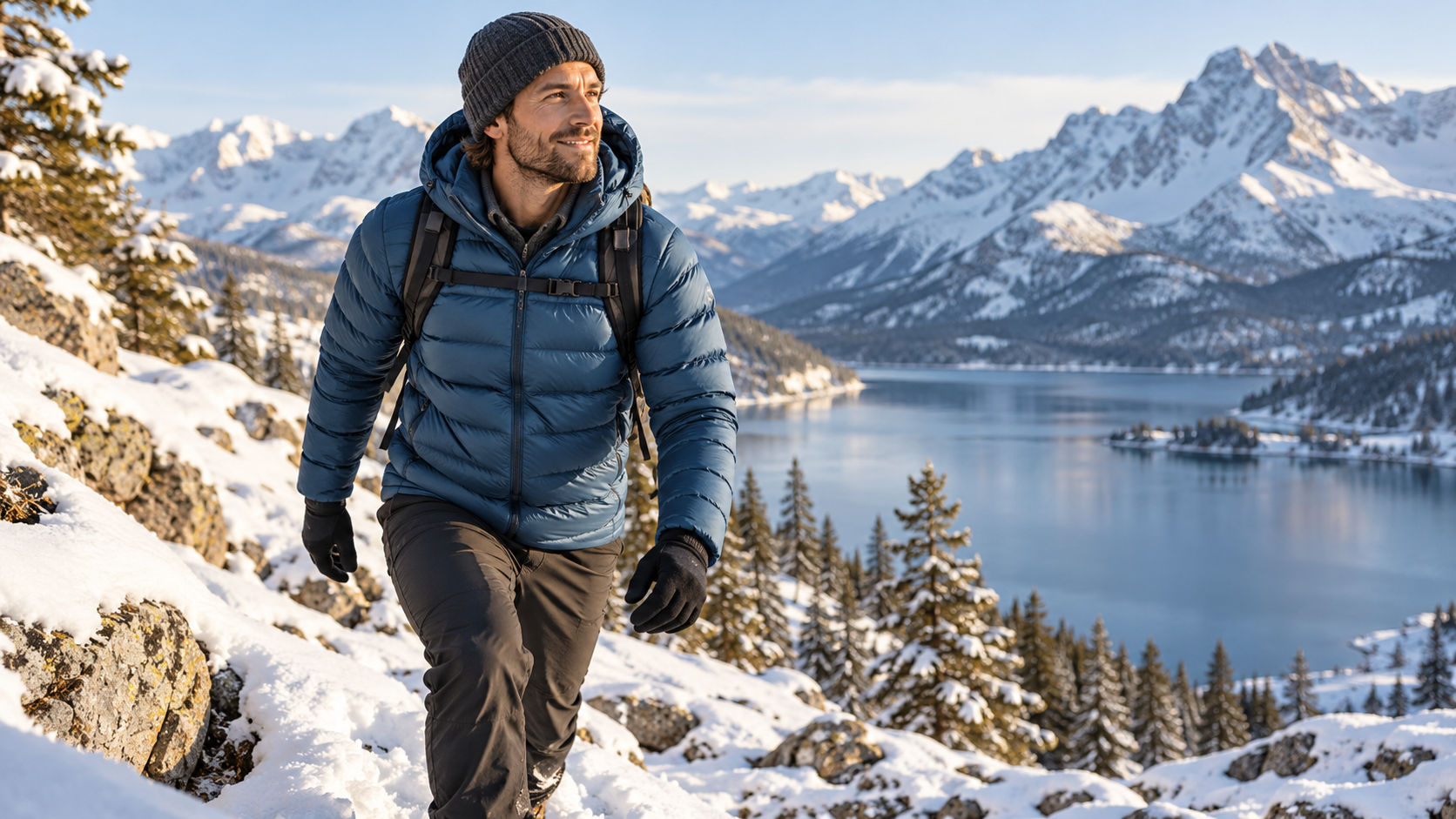
Tests of cold-protective insulation systems show strong dry-state thermal performance from goose and duck down. Older comparative work also shows that different materials can reach similar insulation levels when enough material is used.[11][12]
The benefit is not that every down jacket weighs less than every wool or canvas coat. It is that good down can build a large insulating volume from a relatively small mass of compressible fill.
Compressibility and mobility: how high-loft down allows flexible movement
IDFL tests compression and recovery because those properties matter to loose insulation. Good down can be packed down and then regain loft after pressure is removed.[6][13]
Inside a jacket, that softness lets the fill bend around elbows and shoulders instead of behaving like a dense, rigid layer. Patterning, baffle size, shell stiffness, and fit still determine how freely the jacket moves.
The breathability bottleneck: how densely woven down-proof shells can trap perspiration
Down-proof shells rely on a tight weave to keep feathers from leaking. Textile research found that increasing fabric tightness and weft density improves down-proofness but reduces air permeability.[14]
That trade-off becomes noticeable during activity. A tight shell helps hold in fill and block wind, but it can also reduce direct air exchange. Water-vapor comfort then depends on the fabric, coatings, vents, fit, and the moisture gradient across the garment.[15]
| Garment / System | Physical Weight | Mobility | Thermal Interpretation |
|---|---|---|---|
| High-fill down jacket | Can achieve substantial loft with relatively low fill mass | High when cut and baffled well | High dry-state insulation can be achieved with a light, compressible fill |
| Heavy wool coat | Varies widely by fabric and construction | Varies with tailoring and fabric stiffness | Warmth cannot be inferred from garment category alone |
| Canvas winter parka | Varies widely by shell, lining and insulation | Varies with bulk and cut | Insulation package, not canvas alone, determines warmth |
The Moisture Threshold: When Does Down Lose Its Warmth and Comfort?
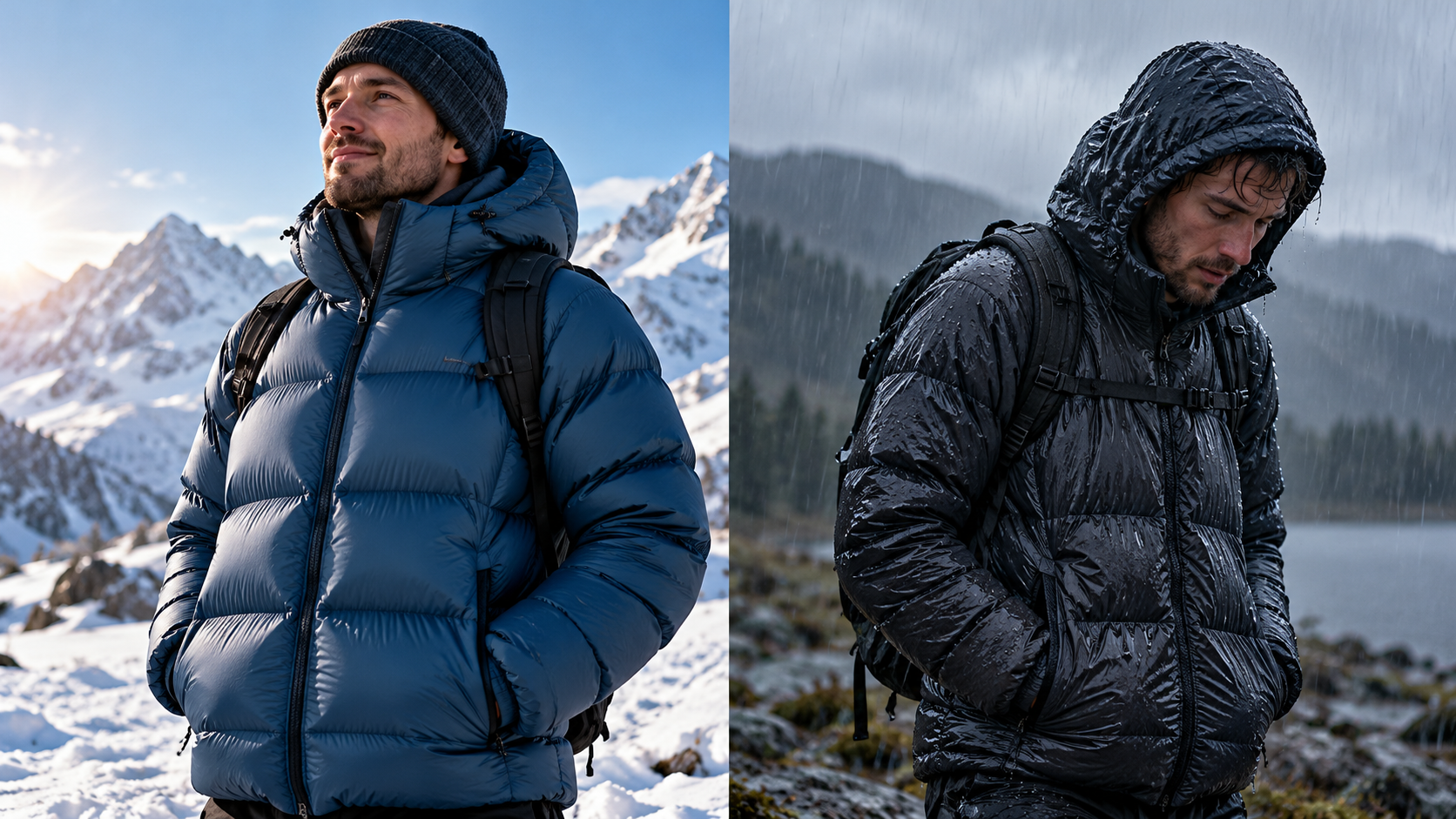
A primary vulnerability of natural down is moisture; when exposed to heavy precipitation or excessive sweat, down clusters can collapse and lose their ability to trap heat.
The thermal failure of wet plumage: how moisture collapses the loft and reduces warmth
NOAA and U.S. Antarctic field guidance warn that wet down loses most or nearly all of its insulating value and can take a long time to dry.[16][17]
The reason is loss of loft. As water mats fibres and clusters together, the air space between them shrinks; with less trapped air, the insulation slows heat loss less effectively.
How factory DWR coatings manage light moisture but do not make down waterproof
DWR treatments make textile surfaces resist wetting. EPA-indexed research shows that both fluorinated and non-fluorinated systems can repel water, but performance varies and a DWR finish is not the same as a waterproof membrane.[18]
A DWR-treated shell can delay wetting from snow, mist, or a short drizzle. Sustained rain can still enter through fabric, seams, zippers, and openings.
The limits of hydrophobic down treatments in sustained wet-weather exposure
Hydrophobic treatment can slow how quickly the down itself wets. It does not make natural down waterproof, and prolonged rain can still overwhelm the system.
Cold-weather guidance separates these jobs: down can provide insulation inside the system, while a waterproof, breathable, windproof shell handles rain and wind.[19]
| Weather Exposure | Untreated Down | Hydrophobic / Treated Down | Synthetic Insulation |
|---|---|---|---|
| Dry cold / dry snow | Excellent use case when loft remains dry | Excellent use case | Good to high depending on design |
| Light mist / brief drizzle | Depends heavily on shell and DWR | May resist wetting longer, but still depends on shell | Generally more moisture-tolerant |
| Heavy rain / saturation | Poor: wetting collapses loft and slows drying | Still not a substitute for waterproof protection | Usually the safer insulation choice for persistently wet conditions |
Down vs. Synthetic Insulation: Which Sustains Comfort in Unpredictable Weather?
down and synthetic insulation make different trade-offs. Down favors high dry-state loft and compressibility; synthetic insulation gives up some of that advantage for better tolerance of wet conditions and faster recovery.
Compare dry-state loft, compressibility, and insulation efficiency
In one study comparing goose down, duck down, and synthetic nonwoven insulation, the tested down systems showed higher dry-state thermal resistance, with separate differences in water-vapor resistance and air permeability.[11]
That result does not prove that every down fill is warmer per ounce than every synthetic fill. It does show why down remains attractive for dry-state insulation, while Fill Power and compression testing help explain its loft and packability.[6][13]
Compare thermal reliability during active perspiration and heavy precipitation
Cold-weather guidance often favors wool or synthetic middle layers when wet conditions are likely because many synthetic systems keep more of their insulating structure when damp, while saturated down performs poorly.[10][16][20]
If rain, heavy perspiration, or repeated wet-dry cycles are likely, synthetic insulation usually gives a larger moisture margin. In dry cold, down remains appealing when low mass and packability matter.
Final Verdict: When Is a Down Jacket the Right Winter Investment?
A down jacket is an effective investment for dry, freezing climates and static exposure, provided the wearer pairs it with a waterproof shell in wet conditions.
Ideal scenarios for dry, sub-zero climates, static exposure, and ultralight travel
Down is at its best when it stays dry and fully lofted. It works especially well when you need substantial insulation that can compress for storage and recover after unpacking.[6][13][17]
Fill Power alone cannot define the jacket’s cold limit. Total fill weight, baffle coverage, fit, hood and hem design, shell protection, activity, and weather all change the result.
When to bypass a down jacket for a synthetic mid-layer or waterproof insulated system
Persistent rain, very humid conditions, or high-output activity can make synthetic insulation, stronger ventilation, or a waterproof outer shell the better choice.[19][20]
The core trade-off is simple: down is excellent at creating dry-state loft, but its warmth and comfort depend on protecting that loft from moisture.
Sources
- University of Connecticut, Rubega Lab. Lecture Notes: Feathers — down and semiplumes as insulating feather types. View source.
- PubMed. Down feather morphology reflects adaptation to habitat and thermal conditions across the avian phylogeny. View source.
- ScienceDirect Topics. Down feathers — fluffy structure and insulating air pockets. View source.
- ScienceDirect Topics. Jacket Design — baffles prevent down migration and cold spots. View source.
- MDPI Textiles. Analyzing the Effects of Sewing Compression on Thermal Efficiency in Baffled Jackets. View source.
- IDFL. What Is Fill Power? — fill power, loft, compression and moisture sensitivity. View source.
- IDFL. Down and Feather Testing — standardized fill-power measurement and interpretation. View source.
- IDFL. Explanation of Down and Feather Tests — fill power and net fill weight as separate measurements. View source.
- U.S. Government / GovInfo. Principles of Cold Weather Clothing and Equipment — perspiration, dryness, trapped air and layer adjustment. View source.
- CDC / NIOSH. Cold Weather Safety — layering, moisture management and wet-condition insulation guidance. View source.
- International Journal of Clothing Science and Technology / ScienceDirect. Assessment of non-woven, goose down and duck down as thermally insulating clothing materials. View source.
- PubMed / Science. Thermal insulating capabilities of outdoor clothing materials. View source.
- IDFL. Natural and Synthetic Fill Testing Options — fill power, compression and recovery testing. View source.
- Physics Procedia / ScienceDirect. Study on Downproofness of Down Home Textile Fabrics — fabric tightness, air permeability and downproofness. View source.
- Coatings / MDPI. A Highly Breathable and Machine-Washable ePTFE-Aided Down-Proof Cotton Fabric. View source.
- NOAA Library. Cold Water Safety and Survival — down provides no insulation when wet; synthetics retain most insulation when wet. View source.
- U.S. Antarctic Program. Extreme Cold Weather Clothing — down loses most loft when wet and takes a long time to dry. View source.
- U.S. EPA HERO. Performance evaluation of fluorinated and non-fluorinated DWRs for outdoor fabrics. View source.
- CDC Yellow Book / NCBI Bookshelf. Sample clothing layering for cold climate — down or microfiber insulation plus waterproof breathable windproof shell. View source.
- U.S. Geological Survey. A primer on clothing systems for cold-weather field work — synthetics preferred over down in very damp climates. View source.
Source policy: Evidence citations use university teaching material, PubMed-indexed research, peer-reviewed textile research, government cold-weather guidance, NOAA/USAP field material, EPA-indexed DWR research, and IDFL technical testing references. No retail product or jacket-selling page is used as evidence. Unsupported universal temperature ratings and garment-weight comparisons were intentionally removed or softened.