
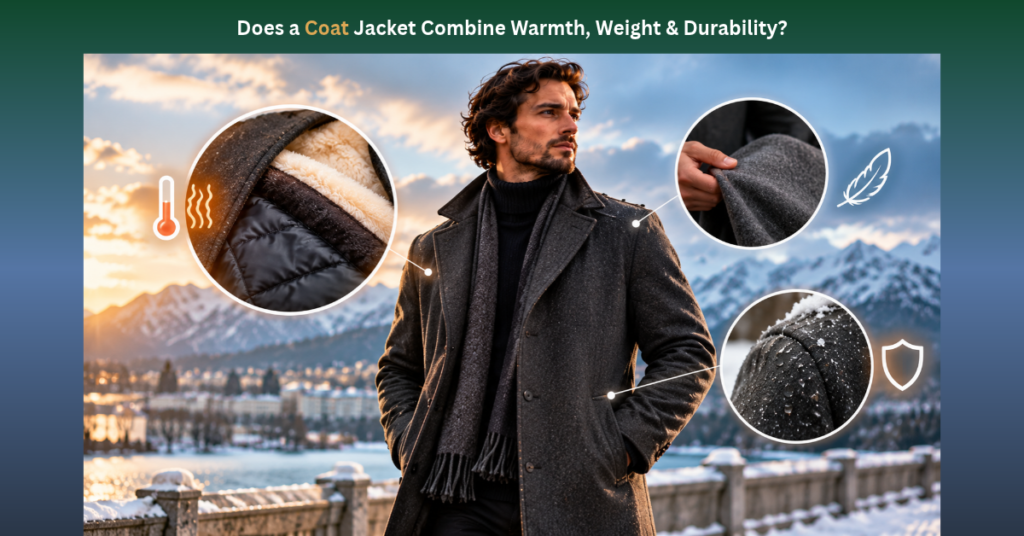
Does a Coat Jacket Combine Warmth, Weight, and Durability?
A coat jacket delivers a practical balance of substantial weight, wind resistance, and multi-season durability, but its thermal capacity relies on dense woven fibers rather than high-loft insulation.
Buyers can expect a hybrid coat jacket to handle every winter condition because the fabric feels substantial. Its real role is narrower: dense cloth, structured tailoring, and hip-to-mid-thigh coverage support drape, wind control, and everyday durability, but they do not create the sealed rain protection of a hardshell or the deep loft of a winter parka.
This guide evaluates the structural engineering of coat jackets to validate their weight and drape, explain their dense-weave thermal mechanics, audit their physical durability, and map their exact weather boundaries.
How the Coat Jacket Bridges Heavy Coat Density and Jacket Mobility
A coat jacket is a hybrid outerwear garment engineered with high-GSM fabrics and mid-thigh coverage, bridging the gap between casual waist-length jackets and full-length overcoats.
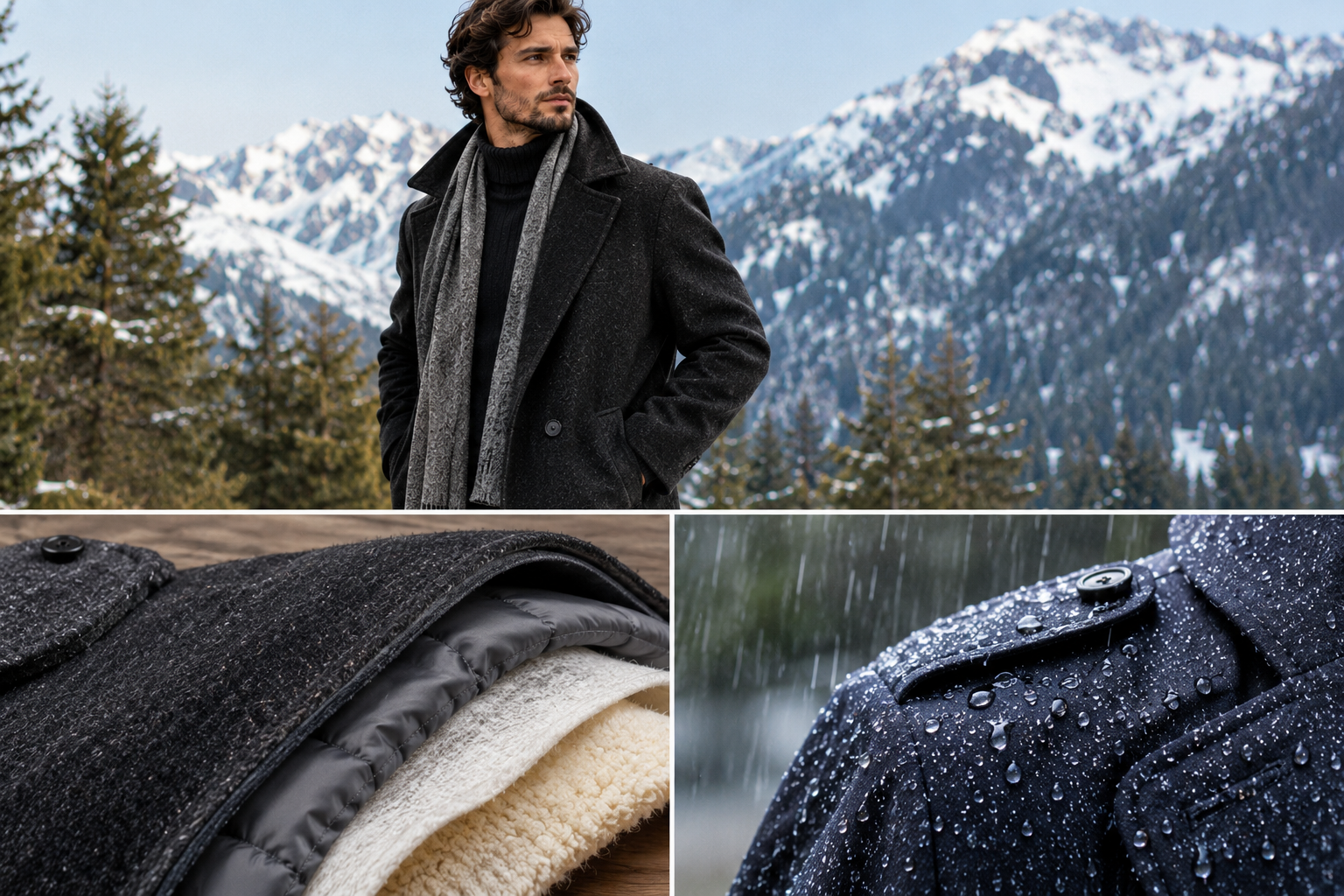
Defining the hybrid silhouette: hip-to-thigh coverage with heavy outerwear textiles
The boundary is architectural rather than purely stylistic. A coat jacket uses heavier outerwear cloth and reaches farther down the torso than many casual jackets, yet it stops short of the long hem associated with a traditional overcoat.
That shorter hem leaves more freedom around the legs during sitting, stair climbing, and walking. The trade-off is less lower-body coverage than a long overcoat.
Why fabric GSM separates cloth mass from marketing labels
Fabric GSM means grams per square meter, a measurement of mass per unit area. ISO standards define methods for determining woven-fabric mass per unit area, so GSM is useful for comparing how much textile material is present across the same surface area.[1][2]
GSM does not create a universal scale where one number automatically means “casual jacket,” “coat jacket,” or “overcoat.” Weave, fibre type, finishing, thickness, and interlining still affect stiffness, drape, warmth, and abrasion performance, so fixed category cutoffs are not used here.
How structured shoulders and interlining manage garment shape and load
Tailored coats use internal support to stabilize fronts, collars, lapels, button areas, and other zones that must hold their shape. Research on fusible interlinings shows that these hidden layers reinforce the garment and help control drape in areas exposed to repeated wear.[3]
Bemberg serves a different purpose from structural interlining. It is used as a smooth lining material that can improve moisture handling and sleeve entry, while canvas or fusible interlining provides shaping and reinforcement.[4]
| Garment Type | Typical Coverage | Fabric / Structure | Primary Ergonomic Role |
|---|---|---|---|
| Casual jacket | Usually waist to hip | Often lighter and less structured | Prioritizes mobility and low bulk |
| Hybrid coat jacket | Hip to mid-thigh | Dense woven shell with tailored structure | Balances core coverage, drape, and everyday mobility |
| Full-length overcoat | Commonly extends toward knee or below | Structured long outer layer | Adds coverage but places more material around the legs |
How Physical Fabric Weight Dictates Wind Deflection and Structural Drape
The physical mass of a coat jacket can improve wind resistance and support a clean drape, but fabric mass works with weave density, thickness, fit, and construction rather than acting alone.
The mechanical role of dense fabric in wind resistance
Wind reduces clothing insulation by moving air through and around the garment. Research on permeable textile systems shows that material structure, air permeability, and wind speed all change effective thermal resistance.[5]
A dense woven shell can limit direct air penetration better than an open structure, but weight alone does not make fabric windproof. A heavy fabric with an open structure can still leak air.
How Melton wool and heavy twill support stable drape
Melton-style wool coatings are known for dense, compact surfaces, while twill structures are common where flexibility and abrasion performance matter. Textile research shows that weave, fabric mass, yarn density, and surface structure all affect the way cloth hangs and wears.[6][7]
Heavier cloth also has more gravitational pull, which can help a tailored coat hang smoothly. The final drape still depends on fibre stiffness, finishing, lining, interlining, pattern geometry, and fit.
When garment mass becomes an ergonomic cost
Every added layer, reinforcement, lining, and extra length contributes to total garment mass. A well-shaped shoulder can spread that load, but it cannot remove it.
There is no universal fatigue threshold for coat jackets because wearer size, shoulder shape, fit, carrying time, and garment balance differ. A useful fit test is whether the coat stays stable without concentrated pressure at the neck, shoulder points, or armholes.
| Fabric Weight Class | What GSM Tells You | Wind / Drape Implication | Ergonomic Implication |
|---|---|---|---|
| Lighter coat fabric | Lower mass per unit area than heavier alternatives | Usually softer and easier to move, but less resistant to wind penetration if the weave is open | Lower carried mass |
| Midweight structured fabric | Moderate mass per unit area | Can combine a stable hang with useful wind resistance | Balance depends on cut, lining, and shoulder construction |
| Heavy structured fabric | High mass per unit area | Can improve body, drape, and abrasion life when construction is appropriate | More material mass can increase shoulder load during long wear |
How Dense Weaves and Interlinings Generate Low-Bulk Thermal Warmth
A coat jacket generates low-bulk thermal warmth by holding air within dense yarns, fabric layers, and the garment microclimate, though open lapels and front gaps can let cold air replace that trapped layer.
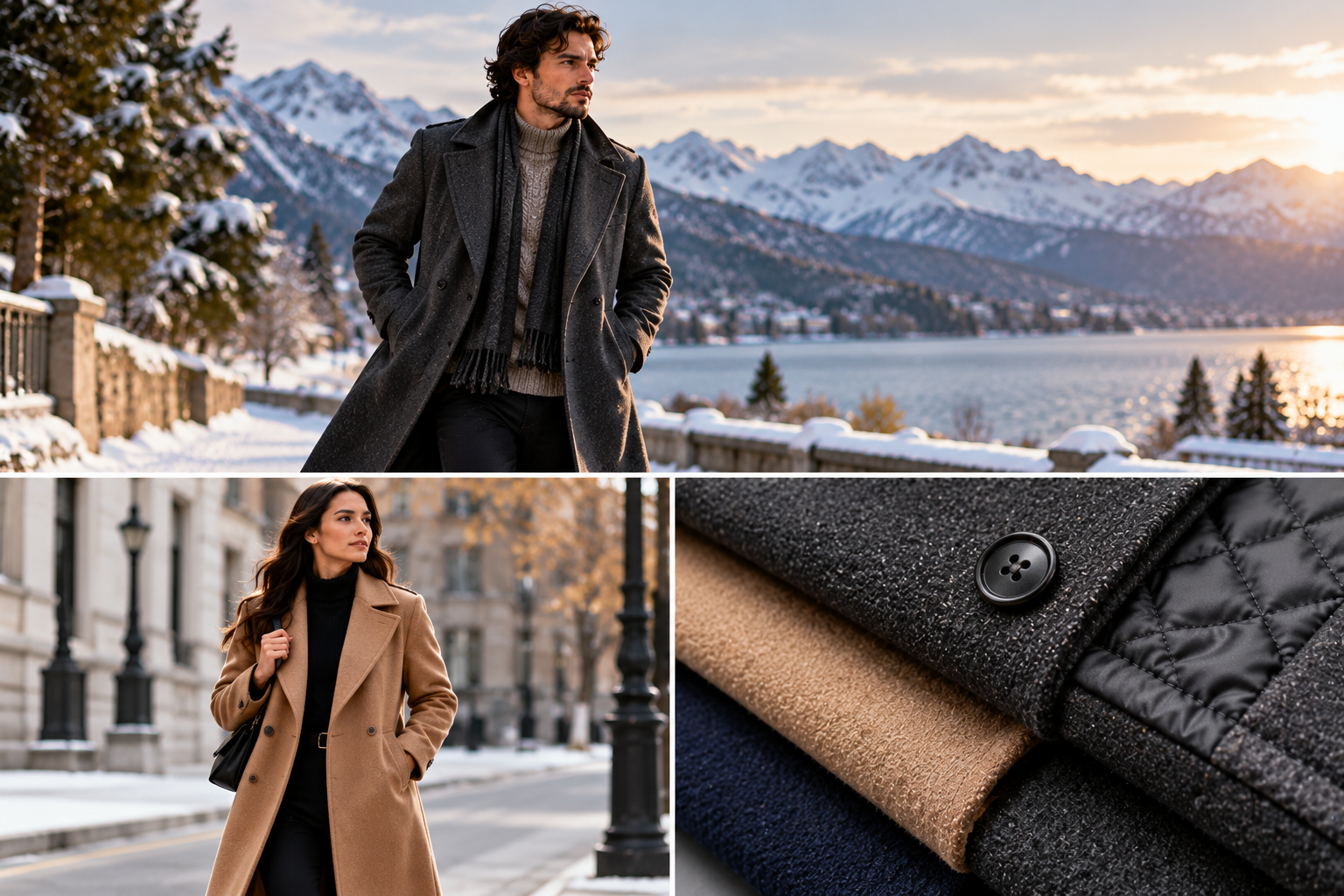
Trapping body heat through textile air spaces rather than puffer loft
Textile insulation depends heavily on still air. Reviews of clothing thermal resistance note that air occupies much of the volume inside woven fabrics and garment systems, and that trapped air contributes strongly to insulation.[8]
Wool adds natural crimp and fibre structure that can maintain small air spaces. That mechanism uses less bulk than a thick down chamber, but it also holds less air than a high-loft puffer built for severe cold.[9][10]
The role of lining and structural interlining in the internal microclimate
A lining creates a smooth interior surface and can reduce friction against the clothing underneath. Bemberg lining is used for smoothness, moisture handling, and reduced cling.[4]
Structural interlining has another job: it stabilizes coat fronts, lapels, collars, cuffs, and other shaped areas. These hidden layers can change stiffness and airflow, but they are not high-loft insulation unless an insulating material is actually present.[3]
The thermal leak point: lapels, button fronts, and garment openings
Clothing ventilation changes thermal and vapor resistance because outside air can replace warmer air held inside the garment. Research on clothing openings, wind, and movement shows that airflow through openings can materially change heat and moisture transfer.[11][12]
Open lapels, button spacing, cuffs, and hem movement therefore matter in freezing wind. Dense cloth can slow air passing through the fabric while still losing warmth through larger openings.
What Determines the Multi-Season Durability of a Heavy Coat Jacket?
The multi-season durability of a heavy coat jacket depends on fibre and weave properties, abrasion exposure, seam quality, reinforced hardware points, and storage that supports the garment’s weight.
Why dense wool and heavy twill can resist everyday abrasion
Abrasion life depends on more than fibre name. Textile research shows that fabric mass, weave, yarn mobility, yarn density, fibre cohesion, and surface friction can all change resistance to wear.[6][13]
Twill can perform well under abrasion because its yarn paths allow useful movement, while denser or heavier fabrics can survive more wear when the rest of the construction is suitable. Wool pilling also depends on fibre length, fineness, crimp, friction, yarn structure, fabric construction, and finishing rather than density alone.[14]
Auditing button shanks, pocket welts, and lining seams
Heavy cloth transfers repeated force into small construction points. Buttons are pulled through the front, hands load pocket openings, and arm movement flexes the armhole and sleeve lining again and again.
Interlining is commonly used to reinforce buttonholes, plackets, pocket details, collars, and fronts. Buyers should inspect reinforcement and seam condition instead of assuming a thick shell automatically protects every hardware point.[3]
How storage can deform a heavy tailored garment
There is no evidence-based wire-hanger deformation threshold that applies to every coat jacket. Conservation guidance takes a simpler approach: lightweight wire hangers do not provide enough support, and broad padded hangers spread garment weight across a larger shoulder area.[15][16]
That support matters more as the garment becomes heavier or more structured. Long-term point loading can stress shoulder seams and alter shape even when the exterior fabric remains intact.
Structural Stress-Point Audit Checklist
- Button Shank Reinforcement: Check whether buttons are supported by secure stitching or a backing button where the fabric is heavy.
- Pocket Welt Reinforcement: Inspect pocket corners for bar-tacks or other reinforcement at repeated stress points.
- Collar & Shoulder Support: Make sure internal shaping lies flat and the hanger supports a broad shoulder area.
- Sleeve Lining Seams: Inspect armhole and sleeve lining seams for pulled stitches, fraying, or separation.
What Are the Exact Moisture and Weather Limits of Heavy Woven Shells?
Heavy woven coat jackets can resist brief surface moisture, but they are not waterproof by default; once wool or cotton-rich fabric takes up enough water, garment mass and thermal behavior change.
Light snow and mist versus the absence of waterproof seam sealing
Wool has a relatively water-repellent outer fibre surface even though its interior can absorb water vapor and liquid over time. This helps explain why brief droplets or dry snow may remain on the surface before deeper wetting occurs.[17][18]
That surface behavior is not waterproof construction. Sewing creates needle holes, and waterproof garments normally use seam tape, bonding, welding, or other sealing methods to block leakage through those openings.[19]
The saturation penalty: added water mass and changing thermal behavior
Untreated wool fibres can retain considerable liquid water, and research confirms that water uptake changes both mass and heat-flow behavior.[18][20]
No fixed “times heavier” multiplier is assigned because the finished result depends on fibre blend, fabric construction, finish, lining, and degree of saturation. The practical result is straightforward: retained water adds mass and changes the coat’s internal climate.
Why direct high heat is risky for wet wool and tailored structure
Woolmark care guidance recommends natural air drying and warns against direct heat sources such as radiators because concentrated heat can damage the garment. Wet garments also carry extra water weight, which can stretch or distort unsupported areas.[21]
A tailored coat contains more than its outer fabric. Lining, interlining, adhesives, padding, and shaping layers can respond differently to heat and moisture, so aggressive drying can disturb the original shape.
| Environmental Exposure | Coat Jacket Capability | Physical Impact & Reaction |
|---|---|---|
| Dry cold / wind | Good when the weave is dense and the garment closes well | Dense fabric and trapped air reduce convective heat loss, but openings still matter |
| Light snow / brief mist | Limited short-duration resistance | Wool surfaces can initially resist droplets; repellency depends on fibre, finish, weave, and exposure |
| Heavy / sustained rain | Poor without a waterproof barrier | Wool and cotton-based fabrics can take up moisture; added water increases mass and changes thermal comfort |
| Direct high heat while wet | High damage risk | Heat and poor drying practice can distort, shrink, or damage wool garments and internal structure |
Coat Jacket vs. Overcoat and Puffer: Which Balances the Three Metrics Best?
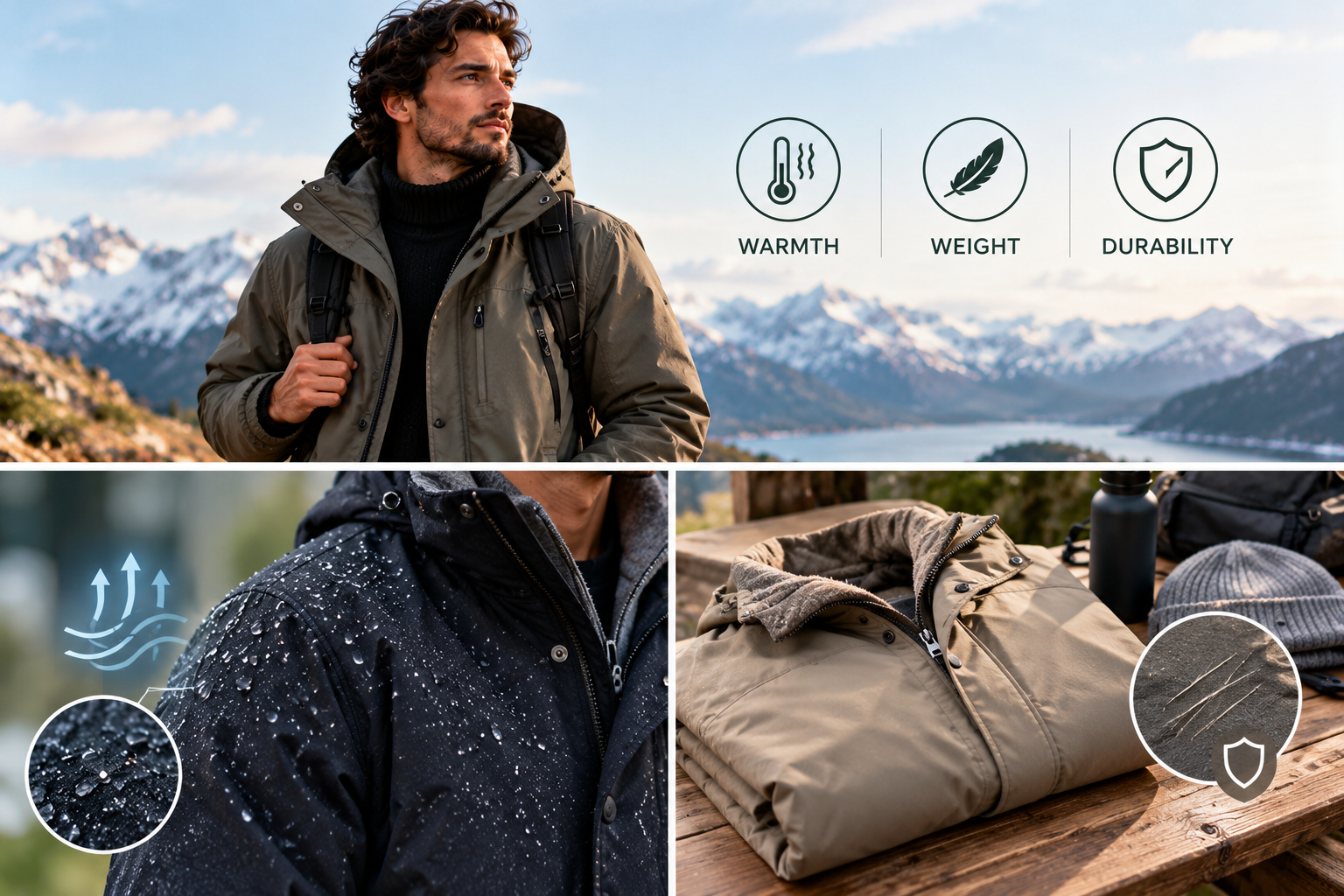
Comparing a coat jacket with a full-length overcoat and a high-loft puffer shows three different ways to trade garment mass, coverage, mobility, abrasion resistance, and thermal insulation.
| Performance Metric | Hybrid Coat Jacket | Full-Length Overcoat | High-Loft Down Puffer |
|---|---|---|---|
| Physical mass | Moderate to heavy depending on cloth and structure | Often higher because of longer coverage | Can achieve high insulation with relatively low fill mass |
| Thermal mechanism | Dense fabric, trapped air, lining, and coverage | Similar dense-fabric mechanism with more body coverage | High loft and trapped-air volume |
| Abrasion / tailored structure | Strong when dense wool/twill and reinforced tailoring are used | Strong with comparable heavy dress coatings | Depends heavily on thin shell fabric and construction |
| Driving / stair mobility | Good with hip-to-mid-thigh cut | Longer hem can interfere more with sitting and leg movement | Usually high because of light, flexible construction |
| Rain defense | Limited unless a separate waterproof barrier is present | Limited unless waterproof construction is present | Depends on shell and seam design; insulation itself is not a rain barrier |
Compare tailored abrasion durability with high-loft puffers
Dense wool and twill coat fabrics can suit repeated urban friction when yarn, weave, mass, and finishing are appropriate. A puffer works differently: its warmth comes from lofted insulation held inside a shell, so abrasion performance depends heavily on that shell fabric rather than on the insulation itself.[6][10][13]
Down systems can produce high dry-state thermal resistance from a relatively light insulating fill, which is why puffers tend to outperform dense dress cloth when maximum warmth for minimum carried mass is the priority.[22]
Compare mobility and coverage with full-length overcoats
A longer overcoat covers more of the legs and can reduce exposed area, while a hip-to-mid-thigh coat jacket leaves more room around the knees during driving, sitting, and stair climbing.
This comparison is architectural rather than absolute. Fit, ease allowance, fabric stiffness, and total garment mass can make either design feel restrictive when the pattern does not match the wearer.[23]
Final Verdict: When Is a Coat Jacket the Optimal Outerwear Choice?
A coat jacket is an effective outerwear choice for dry winter commutes and smart-casual layering where structured durability and wind resistance matter more than extreme cold insulation.
Ideal scenarios for dry urban wear and structured layering
The garment works best where dense fabric, clean drape, moderate torso coverage, and abrasion-resistant tailoring matter more than packability or expedition-level insulation.
For commuting, driving, office transitions, and dry cold, the coat-jacket format provides a practical mix of structure and movement without the long hem of an overcoat.
When to choose a waterproof shell or high-loft insulated system instead
Sustained rain calls for waterproof fabric and protected seams rather than untreated heavy cloth. Severe cold with low activity calls for more insulating air volume than a dense woven shell usually provides.[19][22]
The coat jacket has a clear role: structured, durable protection for dry-to-lightly damp cold, not universal storm defense or maximum sub-zero insulation.
Sources
- ISO. ISO 3801:1977 — Textiles — Woven fabrics — Determination of mass per unit length and mass per unit area. View source.
- ISO. ISO 7211-6:2020 — Determination of mass of warp and weft per unit area of fabric. View source.
- Polymers / MDPI. A Review of Fusible Interlinings Usage in Garment Manufacture. View source.
- Asahi Kasei Bemberg. Bemberg lining — moisture handling, smoothness and comfort functions. View source.
- International Journal of Thermal Sciences / ScienceDirect. The effective thermal resistance of permeable textile ensembles in windy environments. View source.
- ScienceDirect Topics. Textile structure and fabric mechanical properties — weave, abrasion and durability relationships. View source.
- Materials / MDPI. Quantitative Assessment of Woven Fabric Surface Changes During Martindale Abrasion. View source.
- Materials / MDPI. Measurement Methods of the Thermal Resistance of Materials Used in Clothing. View source.
- Animals / MDPI. Wool: From Properties and Structure to Genetic Insights and Sheep Improvement Strategies. View source.
- Thermal Science and Engineering Progress / ScienceDirect. Investigation of heat transfer through down clothing with quilting structure. View source.
- PubMed. Vapour transfer in two-layer clothing due to diffusion and ventilation. View source.
- PubMed. Relationship between clothing ventilation and thermal insulation. View source.
- ScienceDirect Topics. Wet abrasion — effects of fabric mass, yarn mobility, density and weave on abrasion resistance. View source.
- International Journal of Clothing Science and Technology / ScienceDirect. Reducing pilling of knitted woolen fabric based on micro-scale. View source.
- Canadian Conservation Institute. Hanging Storage for Costumes — support, padded hangers and weight distribution. View source.
- Smithsonian Museum Conservation Institute. Padded Hangers for Garments — hanging weight and support. View source.
- Textiles / MDPI. Clothing Thermophysiological Comfort: wool surface behavior, moisture and thermal resistance. View source.
- PubMed. Water absorbency by wool fibers: Hofmeister effect. View source.
- Materials Science. Usage of Fusible Sewing Threads to Improve the Waterproof Property of Seam. View source.
- PubMed. Effects of moisture absorption in clothing on the human heat balance. View source.
- Woolmark. How do I dry wool? — natural drying and direct-heat precautions. View source.
- International Journal of Clothing Science and Technology / ScienceDirect. Assessment of non-woven, goose down and duck down as thermally insulating clothing materials. View source.
- International Journal of Clothing Science and Technology / ScienceDirect. Effect of body dimensions and jacket measurements on tailored-jacket appearance and ease. View source.
Source policy: Evidence citations use standards, peer-reviewed textile and clothing research, PubMed-indexed studies, government conservation guidance, museum conservation references, and technical textile sources. No retail product or coat-selling page is used as evidence. Unsupported universal GSM bands, fixed saturation multipliers, and wire-hanger deformation thresholds were removed or softened.