
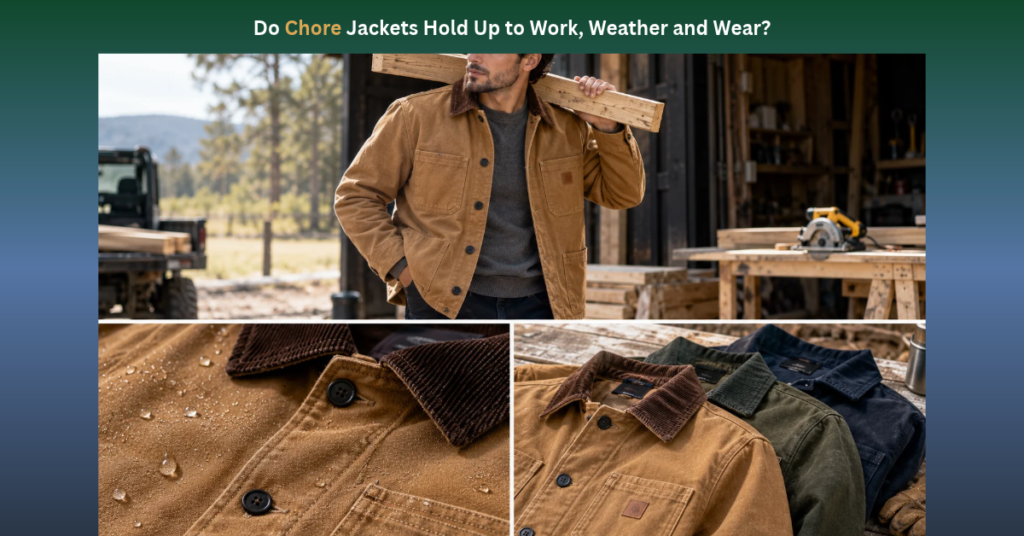
Do Chore Jackets Hold Up to Work, Weather, and Wear?
A traditional chore jacket delivers high abrasion resistance and useful storage for physical work, but its weather protection and warmth depend on the cotton structure and any added treatment or lining.
Heritage styling can make the chore coat look tougher than every situation actually demands. The useful test is mechanical: how the fabric handles friction, how seams and pockets handle load, how much air the shell admits, and what happens when untreated cotton becomes wet.
This guide evaluates the structural engineering of chore jackets to validate their labor utility, audit their long-term wear durability, and map their environmental and weather boundaries.
How French Labor Origins and Dense Cotton Weaves Define the Chore Jacket
The chore-jacket blueprint grew from French industrial workwear, where an unstructured protective layer had to tolerate dirt, repeated movement, and daily manual use.
The bleu de travail blueprint: an unlined protective layer for manual work
French public archives describe the bleu de travail as protective clothing closely associated with labor, while a University of Paris heritage project traces blue work clothing as a visible marker of manual workers from the industrial era onward.[1][2]
The exact date at which one jacket pattern became the modern chore coat is less secure than the broader workwear history. For that reason, the garment is treated here as part of the nineteenth-century French work-clothing tradition rather than assigned to one unverified invention date.
Comparing cotton moleskin, duck canvas, and herringbone twill
These fabrics differ because weave, yarn twist, density, surface finish, and mass change abrasion, tear, drape, and air-flow behavior. Textile references show that woven structure has a direct effect on mechanical and fluid-flow properties, while abrasion resistance also depends on fabric mass, fibre binding, yarn mobility, and weave.[3][4]
Moleskin is best understood as a dense cotton work cloth with a smooth raised or sheared face, duck as a dense canvas family, and HBT as a herringbone twill structure. There is no universal ounce range that defines every authentic chore jacket, so the brief’s fixed weight bands are not treated as standards.
How a boxy unconstructed torso supports reach and layering
A straight, roomy body allows the jacket to shift over a work shirt without the internal canvas or shoulder structure found in tailored coats. Garment-construction references show that cut, seams, linings, and interlinings all influence drape and local stiffness.[5]
The useful design target is enough ease for shoulder reach and bending without so much excess that loaded pockets swing or the shell interferes with tools.
| Textile Type | Relative Workwear Weight | Primary Physical Character | Best-Fit Environment |
|---|---|---|---|
| Herringbone Twill (HBT) | Light to medium workwear class | Diagonal / chevron woven structure; flexible feel depends on yarn and density | Warm workshops and mild transitional use |
| Cotton Moleskin | Medium to heavy workwear class | Dense cotton cloth with a raised or sheared surface; compact hand | Cool, dry indoor-outdoor work |
| Heavy Duck Canvas | Heavy workwear class | Dense plain-weave canvas with high surface durability when well specified | High-friction manual work and tool-heavy use |
What Makes the Chore Jacket Engineered for Active Physical Work?
A chore jacket supports physical work through accessible patch storage, simple cuffs, a loose torso, and hardware that can be serviced without complex tailoring.
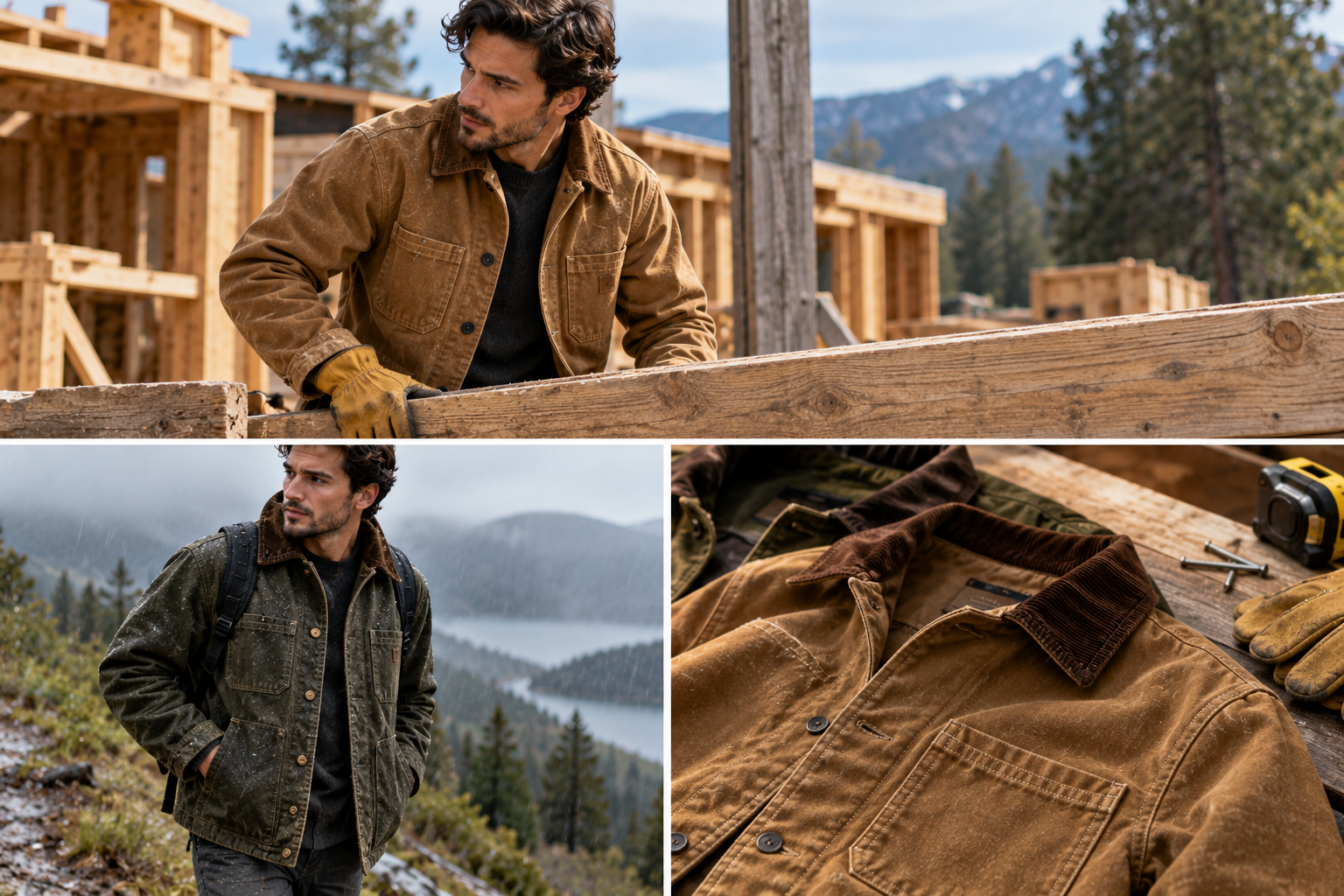
The utility-pocket system: storage that stays reachable while moving
Large lower patch pockets let the wearer reach notebooks, gloves, fasteners, or hand tools without opening the jacket. A chest pocket adds smaller-item storage while keeping the lower torso clear enough to bend.
Pocket capacity is useful only when the attachment can handle repeated loading. Heavy contents concentrate force at pocket corners, which is why reinforcement belongs at those transition points rather than across the entire garment.
Why simple cuffs are easy to roll above the forearm
An unlined barrel-style cuff can fold back without fighting a thick interlining. That matters during messy work, washing, painting, or any task where the sleeve needs to move away from the wrist.
The cuff still needs enough circumference to pass over the forearm. A narrow sleeve may look clean but works against the loose, adaptable pattern that gives the chore jacket its utility.
How simple buttons support repairable workwear
Buttons keep the closure mechanically simple. If one fails, the repair can be localized without replacing a zipper track or bonded component.
The snag risk depends on button size, projection, thread attachment, and the work environment, so no one button material is automatically safer for every task.
How Chore Jackets Withstand Friction and Daily Wear
Long service life comes from the interaction between dense woven fabric, suitable seams, reinforced stress points, and repair before small failures spread.
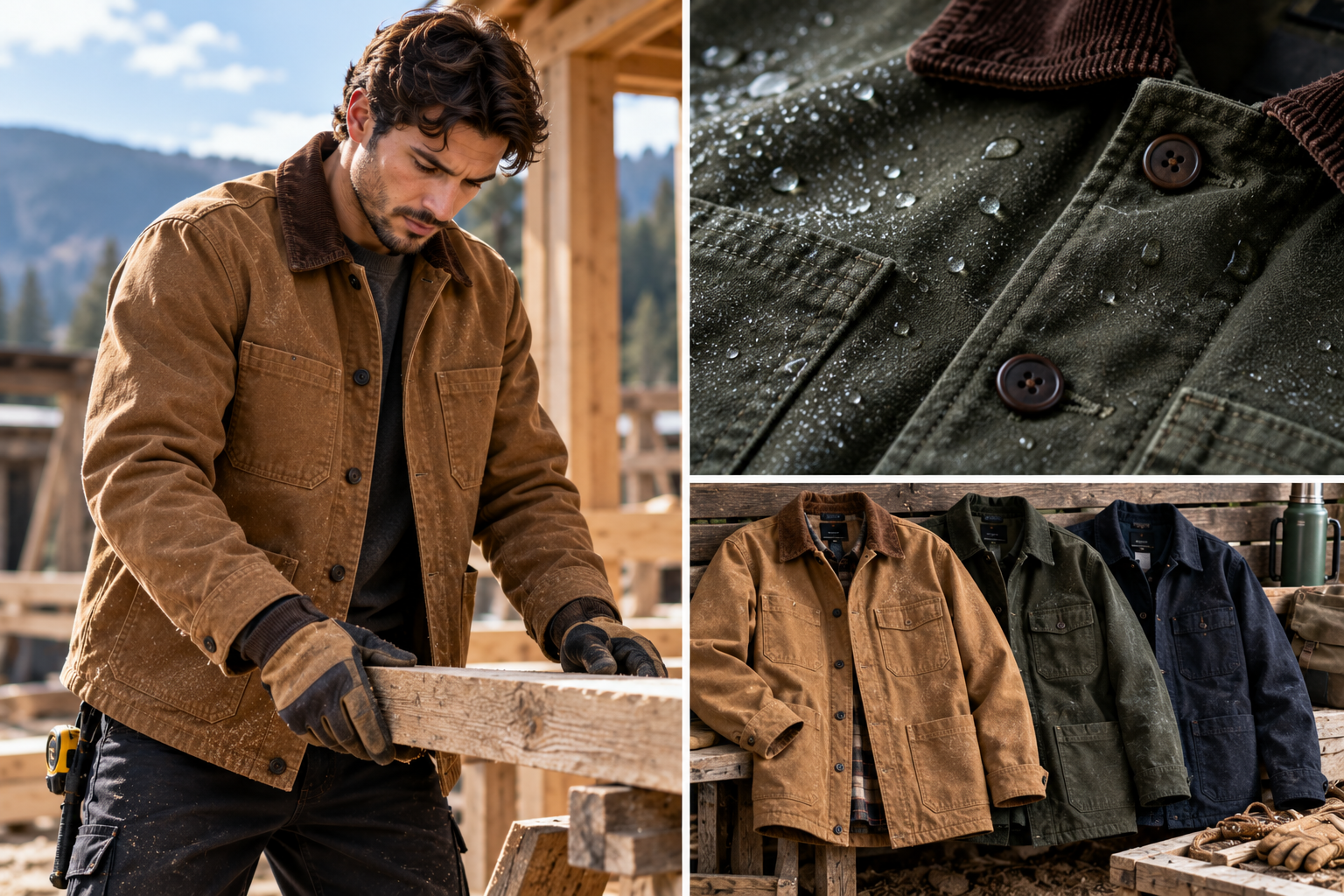
How seam construction manages repeated load
Seam strength is not created by needle count alone. Garment-manufacturing references show that seam performance depends on stitch type, seam type, thread structure, fabric construction, and the balance between thread strength and fabric strength.[6][7]
Multiple rows of stitching and flat-felled constructions can add security and protect raw edges, but the brief’s proposed numerical strength advantage for triple-needle seams is not presented because no matched test data were supplied.
Why dense woven cotton resists surface abuse
Abrasion behavior changes with fibre binding, fabric mass, yarn mobility, surface roughness, and weave. Textile references report that structure and mass can materially affect abrasion life, which explains why compact workwear fabrics tend to tolerate rubbing better than light shirting.[3][4][8]
A dense surface does not make cotton puncture-proof. Sharp edges can still cut yarns, and rough contact gradually removes fibre from exposed zones.
Auditing elbows, collars, pocket corners, and buttonholes
Wear accumulates where motion and contact repeat. Elbows flex against surfaces, collar folds rub at the neck, hands pull on pocket openings, and buttonholes see repeated edge friction.
That visible aging is the practical side of workwear patina. It should be distinguished from structural failure: fading and softening can be harmless, while opening seams, torn pocket corners, and enlarged buttonholes need repair.
| Garment Component | Common Wear Stress | Useful Reinforcement | Inspection & Maintenance |
|---|---|---|---|
| Lower pocket corners | Repeated pull from hands, notebooks, and tools | Bar-tack reinforcement, rivet, or dense back-tacking | Check for opening stitches before the pocket tears into the body shell |
| Armholes and side seams | Body movement and repeated tension | Strong seam type with enough rows / thread strength for the fabric | Secure loose thread ends and repair local separation early |
| Buttonholes | Repeated insertion, removal, and edge friction | Dense buttonhole stitching and stable surrounding cloth | Watch for fraying and restitch before the opening enlarges |
What Are the Weather and Thermal Boundaries of a Chore Jacket?
Dense cotton can slow airflow in dry weather, but an untreated unlined chore jacket is not a waterproof rain shell and provides limited insulation in freezing conditions.
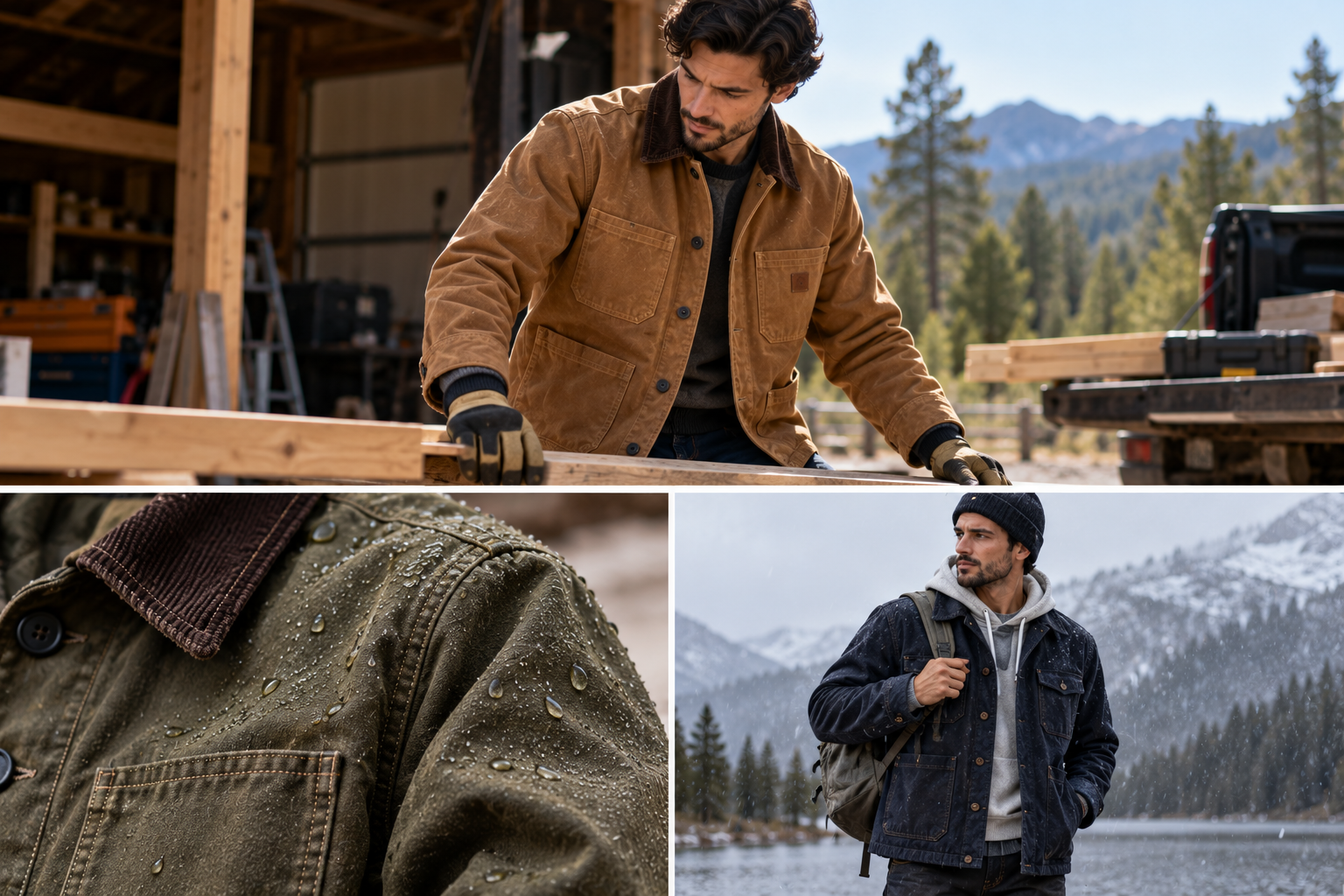
How weave density affects wind penetration
Wind removes heat faster when air passes through clothing. Thermal research shows that higher fabric permeability and stronger wind can reduce effective insulation, while lower-permeability outer layers reduce internal air movement.[9][10]
A dense moleskin or canvas shell can therefore feel calmer in dry wind than a looser fabric, but the result depends on actual permeability, garment openings, fit, and wind speed rather than fabric name alone.
The saturation penalty of untreated cotton in rain
Cotton is hydrophilic and absorbs moisture. Clothing-science research notes that cotton has strong water absorbency but slow drying compared with more hydrophobic fibres.[11]
Once an untreated shell wets through, added water raises garment mass and changes heat transfer. The saturation penalty is practical: the jacket becomes heavier, colder-feeling in wind, and slower to dry.
How wax and linings change the weather role
Water-repellent finishes work by lowering surface energy so droplets spread less readily. Research on cotton treatments shows that wax-based coatings can raise water repellency, while coating chemistry and fabric construction influence durability and air permeability.[12][13][14]
Wax improves surface shedding but does not automatically seal needle holes or seams. A lining adds thermal resistance by creating more thickness and trapped air, yet cold-weather performance still depends on wind, fit, activity, and insulation depth.[9][15]
| Environmental Exposure | Traditional Unlined Chore Jacket | Waxed / Lined Variant |
|---|---|---|
| Dry wind / cool air | Useful when the weave is dense enough to slow air movement | Usually stronger wind control with added coating or lining |
| Light mist / brief drizzle | Limited; untreated cotton can begin absorbing moisture | Better surface water repellency when the treatment is intact |
| Sustained heavy rain | Poor choice; woven cotton lacks a waterproof membrane and sealed seams | Improved water shedding, but waxed cloth is still not equivalent to a seam-sealed rain shell |
| Freezing cold | Limited because the traditional shell has little insulating loft | Warmer with a substantial lining, though performance depends on wind, fit, activity, and insulation thickness |
Chore Jacket vs. Barn Jacket and Denim Trucker: Which Workwear Layer Fits Best?
Choosing among a chore jacket, waxed barn jacket, and denim trucker means choosing between utility storage, weather treatment, and a shorter denim structure.
| Performance Metric | Traditional Chore Jacket | Waxed Barn Jacket | Denim Trucker Jacket |
|---|---|---|---|
| Primary design focus | Unlined utility, storage, and mobility | Weather-treated outdoor workwear | Cropped denim structure and abrasion resistance |
| Indoor wearability | High when unlined | Lower when heavily treated or insulated | High to moderate |
| Pocket utility | High with large patch pockets | Moderate to high depending on pattern | Lower; typically smaller chest / hand storage |
| Rain defense | Low without treatment | Higher when wax finish is maintained | Low without a dedicated finish |
Compare unlined utility with weather-treated workwear
The traditional chore jacket stays easy to wear indoors because it is often unlined and relatively simple. A waxed barn-style jacket shifts the balance toward outdoor exposure by adding a water-repellent surface and, in some versions, more insulation.
Wax treatment also changes hand and breathability. Textile research on wax-coated cotton reports greater water resistance alongside changes in stiffness and air permeability, so weather protection is not a free upgrade.[13][14]
Compare longer utility storage with cropped denim structure
A chore jacket usually devotes more front area to large patch pockets and a straighter torso. A trucker jacket is typically shorter and more fitted, which reduces storage volume but can keep the hem clear of the hips.
Both can use durable woven cotton, yet pocket architecture and body length make them different tools even before fabric weight is considered.
Final Verdict: When Is a Chore Jacket the Right Utility Investment?
A traditional chore jacket is a strong choice for workshops, dry transitional commutes, travel that benefits from large pockets, and daily wear where abrasion resistance and mobility matter.
Ideal use: dry work, accessible storage, and unrestricted movement
The jacket makes sense when the job demands repeated reaching, pocket access, and a shell that can take surface wear without the stiffness of heavily structured outerwear.
Dense cotton, repairable construction, and a loose pattern support that role, especially in dry or mildly windy conditions.
When to choose a rain shell or insulated winter coat instead
Sustained rain calls for a waterproof shell with a dedicated barrier and protected seams. Severe cold calls for meaningful insulating loft and better control of air leakage.[9][16]
The chore jacket earns its place through work utility and durable woven construction, while rain protection and deep-cold insulation remain separate jobs.
Sources
- Archives nationales du monde du travail. Bleu de travail — du vêtement protecteur au symbole mythique. View source.
- Université Paris 1 Panthéon-Sorbonne. Le bleu de travail : une couleur identitaire ? — history of blue work clothing in French industrial labor. View source.
- ScienceDirect Topics. Dry Abrasion — effects of weave, mass, roughness, fibre binding, and yarn mobility on abrasion resistance. View source.
- ScienceDirect Topics. Weave Fabrics — woven structure and its influence on mechanical and fluid-flow properties. View source.
- ScienceDirect Topics. Garment Construction — effects of cut, seams, linings, and interlinings on drape and stiffness. View source.
- Garment Manufacturing Technology / ScienceDirect. Sewing, stitches and seams — seam selection and structural performance. View source.
- Design of Clothing Manufacturing Processes / ScienceDirect Topics. Stitch Type — seam performance depends on stitch, seam, thread, and textile construction. View source.
- ScienceDirect Topics. Wear of Materials — textile abrasion and wear-life mechanisms. View source.
- International Journal of Thermal Sciences / ScienceDirect. The effective thermal resistance of permeable textile ensembles in windy environments. View source.
- International Journal of Thermal Sciences / ScienceDirect. Numerical analysis of heat and flow transfer in porous textiles — wind velocity and air permeability. View source.
- Textiles / MDPI. Clothing Thermophysiological Comfort: A Textile Science Perspective — cotton moisture absorption and drying behavior. View source.
- Carbohydrate Polymers / ScienceDirect. Water-repellent finishing of cotton fabrics — modified oils and paraffin-wax context. View source.
- Polymers / MDPI. Water Repellent Coating in Textile, Paper and Bioplastic Polymers: A Comprehensive Review. View source.
- Molecules / MDPI. Sustainable Water-Resistant Cotton Fabrics Coated with a Chitosan/Wax Composite. View source.
- Applied Ergonomics / ScienceDirect. A quasi-physical model for thermal insulation and moisture-vapor resistance of clothing. View source.
- Safety and Health at Work / ScienceDirect. Thermal Insulation of Protective Clothing Materials in Extreme Cold Conditions. View source.
Source policy: Evidence citations use government archives, university heritage material, peer-reviewed textile and clothing research, and academic technical references. No retail product page or chore-jacket sales page is used as evidence. Unsupported ounce ranges, fixed seam-strength advantages, and universal temperature or rainfall ratings were removed or softened.