
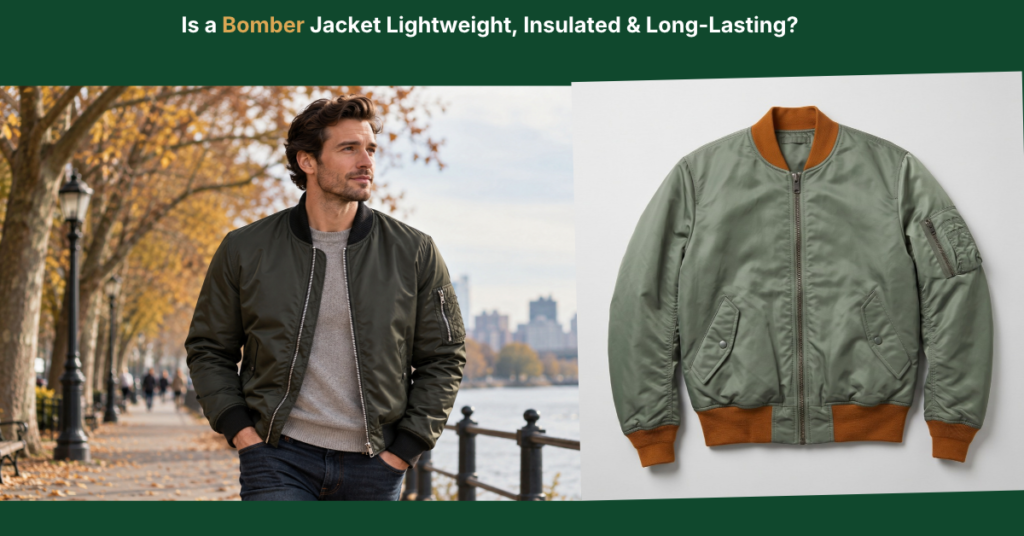
Is a Bomber Jacket Lightweight, Insulated, and Long-Lasting?
Quick Answer
Yes, but construction matters. An unlined nylon bomber can be light and packable, while insulated versions can provide moderate warmth. Long-term durability depends on the shell construction and the condition of the ribbed cuffs, collar, and waistband. A standard bomber is best suited to dry, transitional weather rather than heavy rain or extreme cold.
A bomber jacket generally offers a strong balance of relatively low bulk, wind resistance, and moderate insulation, but its long-term durability depends heavily on the shell material and the condition of its elastic trims.
That balance changes from one bomber to another. An unlined nylon shell can function as lightweight transitional outerwear, while leather, shearling, or heavily insulated versions belong to a much heavier class. A cropped bomber can also hold warmth around the torso without providing the same coverage as a parka.
This guide evaluates the structural mechanics of a bomber jacket to validate its weight class, explain its thermal heat-trapping features, and map its exact durability boundaries.
How Military Aviation Origins Dictated the Bomber’s Structural Design
The modern bomber-jacket silhouette is closely associated with military aviation, where compact outerwear needed to balance wind resistance with mobility in seated environments. Specific claims about the MA-1’s historical transition from leather to nylon require an authoritative aviation source. [TODO: SOURCE NEEDED]
The MA-1 blueprint: replacing heavy leather with densely woven flight nylon for high-altitude use
The brief identifies the MA-1 flight jacket as the key structural reference for the modern bomber. It also directs the article to explain a historical shift from heavy leather toward flight nylon.
The claim that nylon was adopted specifically to prevent damp material from freezing at high altitude should not be presented as established fact without a valid source. [TODO: SOURCE NEEDED]
What can be stated from the brief is that material choice changes the bomber’s physical behavior. Dense synthetic shells can reduce bulk compared with heavy leather while preserving a compact outer layer.
How the cropped fit and ribbed trims support cockpit-style mobility
The bomber’s short body keeps excess fabric away from the hips and lap, which makes the silhouette easier to manage while seated.
Ribbed cuffs, collar sections, and waistbands also narrow the openings around the garment. That close fit can reduce draft entry compared with loose, open hems and cuffs.
The result is a compact outerwear structure built around mobility and enclosure rather than long-body coverage.
Does a Bomber Jacket Function as a Lightweight Layer?
A bomber jacket can function as a lightweight, packable layer when it is built from an unlined nylon or cotton shell rather than heavy leather, shearling, or winterized insulation.
Why unlined nylon and cotton bombers work as lightweight transitional outerwear
An unlined bomber keeps the design simple. The shell provides a compact barrier against moving air without adding the thickness of a high-loft insulating layer.
That makes lightweight nylon or cotton versions useful for spring and autumn conditions where the wearer needs a removable outer layer rather than maximum cold-weather protection.
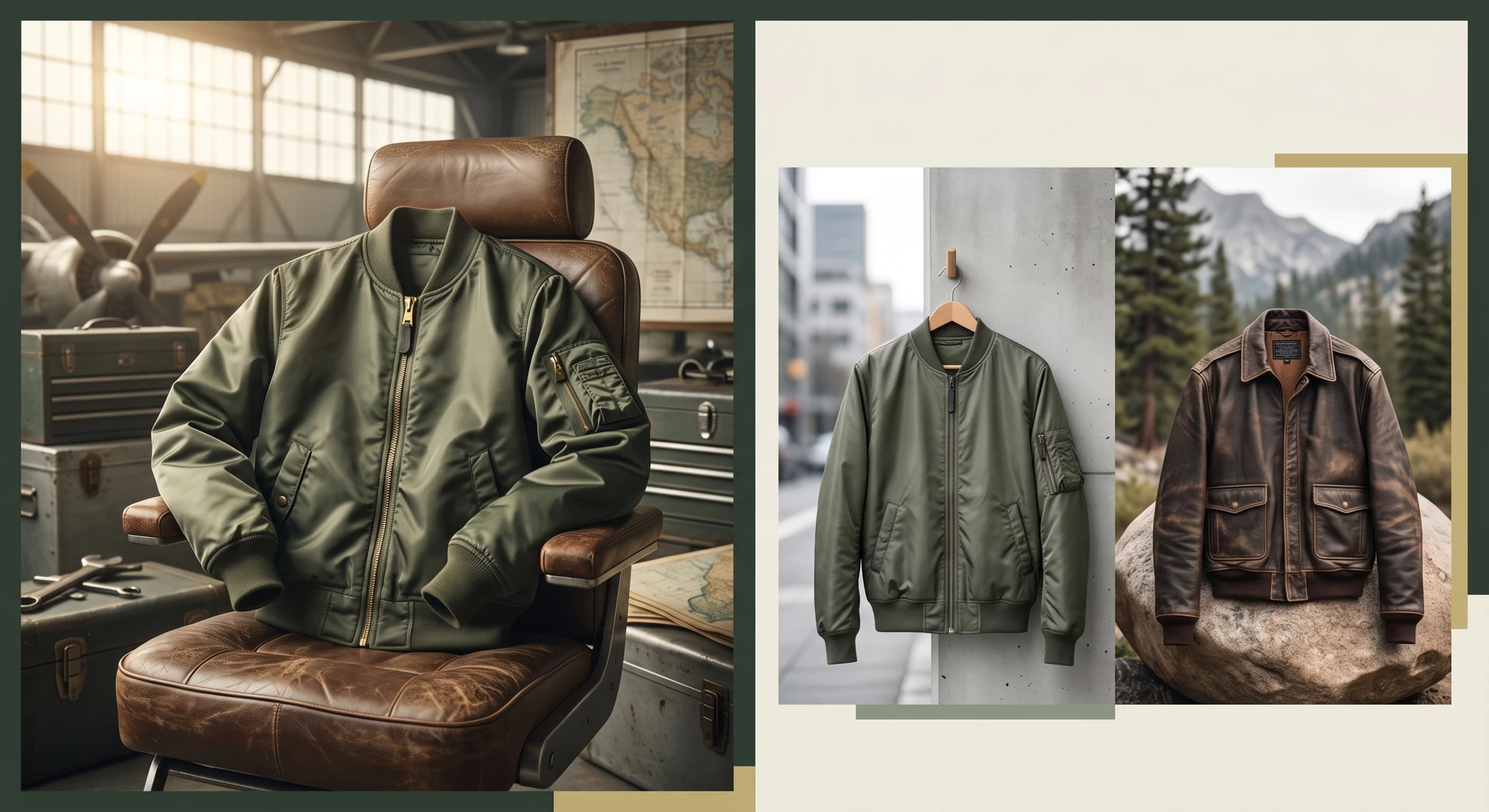
The short cut also reduces material compared with longer coats, which helps the bomber remain compact for commuting, travel, and active daily use.
The weight penalty: how heavy leather and shearling variations eliminate the lightweight advantage
Leather and shearling bombers solve a different problem. Their heavier materials increase structure, surface durability, and visual weight, but they remove much of the packability associated with an unlined flight-nylon shell.
A buyer should therefore avoid treating ‘bomber jacket’ as one fixed weight category. The silhouette may remain similar while the material changes the garment from a light transitional layer into substantial outerwear.
How the Bomber Silhouette Traps Body Heat Without Excessive Bulk
Insulated bomber jackets can retain body heat by combining synthetic polyester fill with close-fitting ribbed trims that reduce the escape of warmed air around the cuffs and waist.
The role of synthetic polyester fill in thermal retention
Polyester fill creates thickness inside the jacket without requiring the dense mass of leather. The brief frames this as the bomber’s primary insulation mechanism.
The fill creates air spaces within the jacket structure. Those spaces help slow heat loss from the torso and improve thermal retention compared with an unlined shell.
Exact warmth-to-weight comparisons between poly-filled nylon and heavy leather require controlled evidence and should not be expressed as a precise superiority claim here. [TODO: SOURCE NEEDED]
How elasticized ribbed knit cuffs and waistbands help seal out cold drafts
Ribbed knit trims fit closer to the body than wide, open sleeve ends and hems.
At the cuffs and waistband, that tighter fit can reduce direct draft entry and help keep the warmer air inside the jacket’s core from escaping as quickly.
This sealing effect supports the insulation, but it does not turn the bomber into a full-coverage winter system.
The thermal failure point: why the lack of a hood and shorter length limit sub-zero use
A standard bomber is cropped around the waist and usually lacks an integrated hood.
Those design features reduce total body coverage compared with longer parkas. The lower torso, head, and neck therefore require separate protection when conditions become much colder.
For that reason, a bomber should be treated as moderate cold-weather outerwear rather than a garment designed for extreme winter exposure.
What Determines the Long-Term Durability of a Bomber Jacket?
The long-term durability of a bomber jacket depends on both the resistance of the shell and the condition of the ribbed knit trims, which can age differently from the main body fabric.
The abrasion and wind resistance of tightly woven flight nylon during daily wear
The brief positions flight nylon as a densely woven synthetic shell intended to resist routine snagging, surface wear, and wind penetration during ordinary use.
That does not mean every nylon bomber has the same durability. Fabric density, yarn construction, stitching, reinforcement, and finishing still determine how well a specific jacket tolerates abrasion.
Nylon should therefore be described as a practical daily-wear shell material rather than as puncture-proof or indestructible.
Why ribbed knit trims are common structural failure points
The cuffs, collar, and waistband rely on elasticized knit construction rather than the denser shell material used across most of the jacket.
Repeated stretching, friction, pilling, and contamination can change the shape and surface of those trims over time.
Once the ribbing loosens, the jacket can lose part of the close seal that helps reduce draft entry.
How improper machine washing can affect synthetic insulation loft
The brief identifies improper high-heat washing and drying as a possible durability problem for synthetic insulation.
A precise statement that machine washing compresses or melts poly-fill requires authoritative care or material evidence. [TODO: SOURCE NEEDED]
Without that evidence, the safe conclusion is that care practices should follow the specific garment label because shell fabrics, fill, coatings, and trims can respond differently to heat and agitation.
Nylon vs. Leather Bombers: Which Material Maximizes Performance?
Choosing between a nylon and leather bomber jacket means balancing low bulk and insulation potential against the heavier structure and abrasion resistance associated with leather.
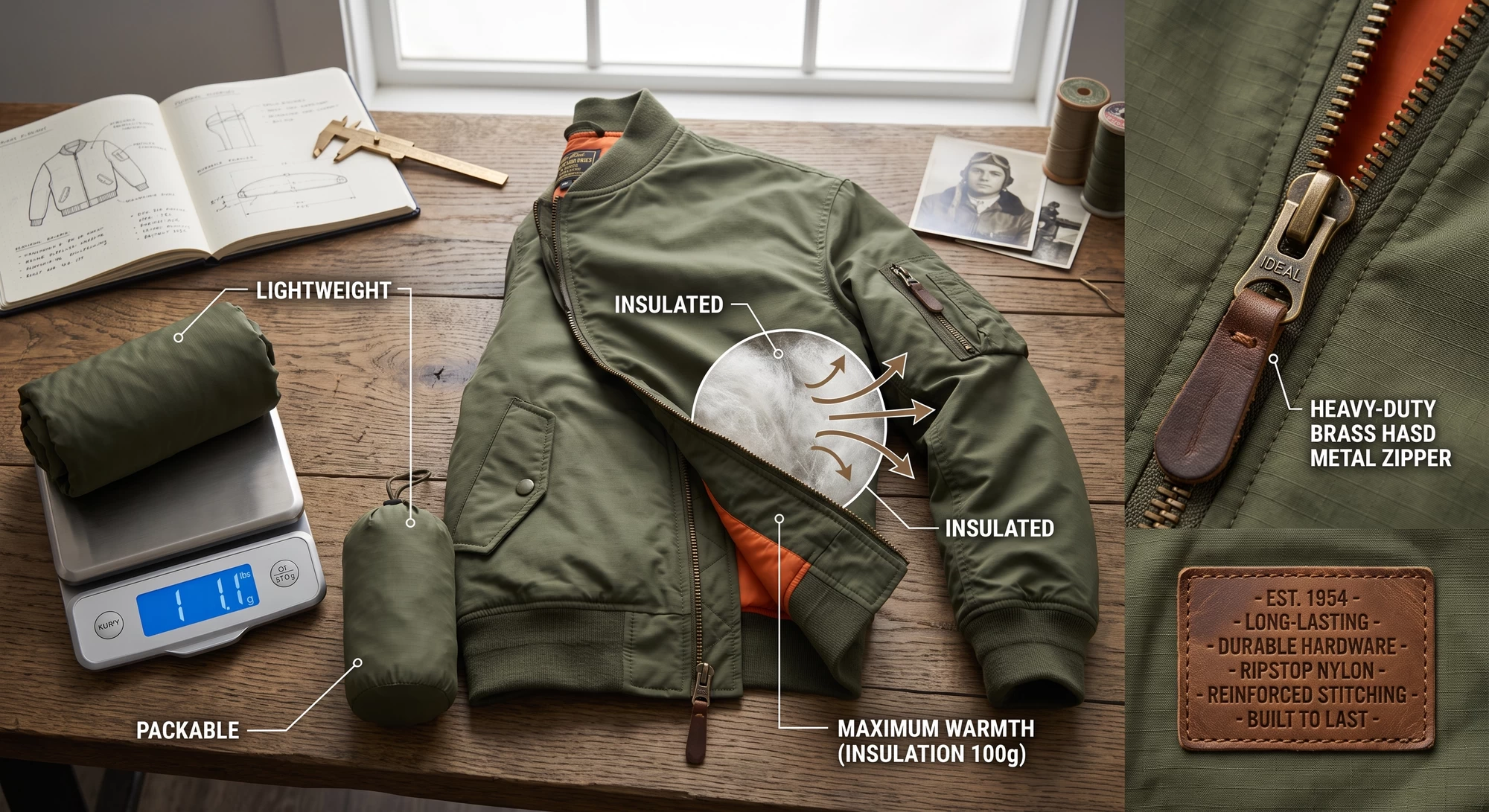
A precise claim that poly-filled nylon provides a superior warmth-to-weight ratio per ounce compared with leather requires controlled evidence. [TODO: SOURCE NEEDED]
| Feature | Nylon Bomber | Leather Bomber |
|---|---|---|
| Weight | Usually lighter, especially when unlined | Heavier |
| Warmth-to-Weight | Can be efficient when paired with synthetic fill | Depends strongly on leather thickness and lining |
| Durability | Good for routine daily wear; can still puncture or tear | Strong abrasion resistance but still dependent on leather quality and construction |
| Weather Resistance | Can offer moderate resistance when treated | Not a substitute for a waterproof shell and may require more careful moisture management |
Compare warmth-to-weight behavior between synthetic nylon and heavy natural leather
Nylon itself is a shell material rather than the source of most thermal insulation. A nylon bomber becomes warmer when insulation such as polyester fill is added behind the shell.
Leather contributes more mass and surface density, but weight alone does not establish insulation efficiency.
That is why material thickness, lining, fill, fit, and air leakage all need to be considered before making a direct warmth-to-weight comparison.
Compare long-term lifespan, patina development, and rain-resistance limits
Leather is valued for structural longevity and the way its surface appearance changes with use. Nylon tends to remain lighter and easier to integrate into technical or casual outerwear systems.
Neither material name guarantees rain protection. A treated nylon shell may shed light moisture better than an untreated shell, while leather can absorb moisture and stiffen if it is not properly cared for.
For sustained heavy rain, a purpose-built waterproof shell remains the more appropriate category.
Final Verdict: When Does a Bomber Jacket Make the Most Sense?
A bomber jacket is a strong choice for dry, transitional climates where mobility, wind resistance, compact layering, and moderate insulation matter more than full-length weather protection.
Ideal scenarios for dry, transitional climates requiring wind resistance and arm mobility
A lightweight bomber works well for spring and autumn commuting, travel, and active daily use where a long coat would add unnecessary bulk.
An insulated version can extend that range into colder conditions, provided the wearer does not need the total coverage of a parka.
Material choice remains decisive. Nylon emphasizes low bulk, while leather and shearling move the bomber toward heavier, more substantial outerwear.
When to bypass a bomber for extended parkas or technical hardshells
Choose a longer insulated parka when the priority is deeper cold protection and greater body coverage.
Choose a technical hardshell when sustained precipitation is the main environmental problem.
The bomber makes the most sense when its compact structure, moderate thermal retention, and material-specific durability match the conditions the wearer actually faces.
Sources
- Smithsonian National Air and Space Museum. “Jacket, Flying, Type A-2, United States Army Air Forces, Gen. Charles E. Yeager.” Historical reference for early U.S. military flight-jacket construction, including waist-length leather design, knit cuffs and waistband, and zipper-front structure. View source.
- Alpha Industries. “Origins of the Heritage Collection.” Reference for Alpha’s military production history and the MA-1’s use of flight nylon as a lighter, water-resistant alternative to earlier leather bomber constructions. View source.
- Alpha Industries. “MA-1 Bomber Jacket (Heritage).” Product-construction reference for flight nylon, nylon lining, polyester fill, knit rib collar/cuffs/waistband, above-hip length, and intermediate-weather positioning. View source.
- Alpha Industries. “About Us: The Alpha Industries Story.” Historical reference for Alpha’s MA-1 military contracts and the later replacement of nylon flight jackets by CWU Nomex models. View source.
- REI Co-op. “Timber Mountain Insulated Jacket.” Garment-care example showing that a synthetic-insulated polyester jacket may specify machine washing on a cold gentle cycle and tumble drying on low. Care instructions remain garment-specific and should not be generalized to every bomber jacket. View source.
Evidence note: These references support only the claims described above. Exact warmth-to-weight comparisons and other claims still carrying evidence-needed markers remain unresolved and are not treated as proven by this source list.