
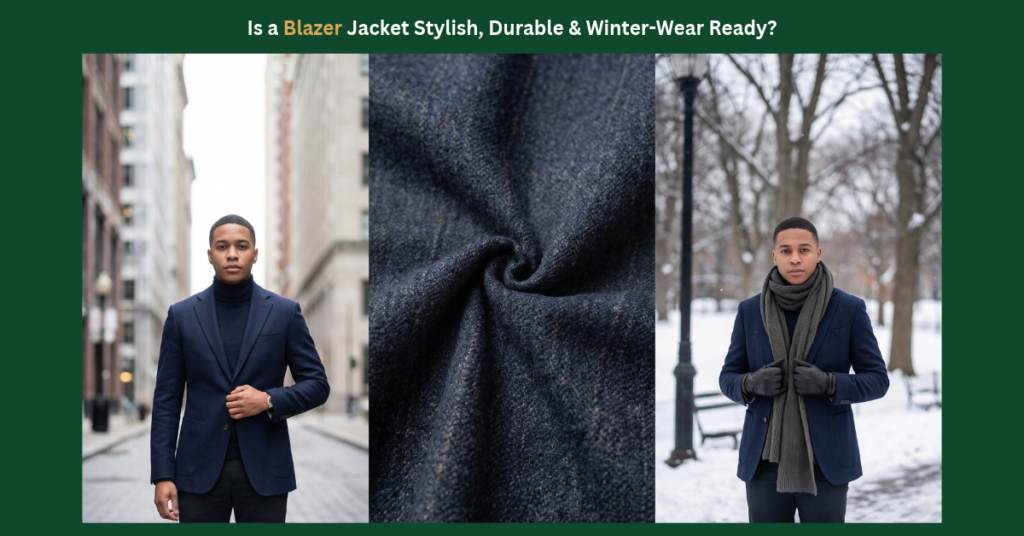
Is a Blazer Jacket Stylish, Durable, and Winter-Wear Ready?
A tailored blazer generally offers enduring style and physical durability, but its readiness for winter weather depends heavily on the fabric weight and the wearer’s layering strategy.
Buyers sometimes expect a heavy wool blazer to perform like a standalone winter coat. Its tailored construction sets a stricter boundary: canvas, lapels, wool face fabric, and lining can create shape and moderate warmth, but they do not automatically provide the sealed coverage or weather barrier of purpose-built outerwear.
This guide evaluates the structural engineering of blazers to validate their style and durability, explain their thermal heat-trapping mechanics, and map their exact winter weatherproofing boundaries.
How Tailored Construction Defines the Blazer’s Signature Style
The signature style of a blazer is typically engineered through internal structural components, such as canvas interlinings and shoulder construction, which help physically shape the fabric around the wearer.
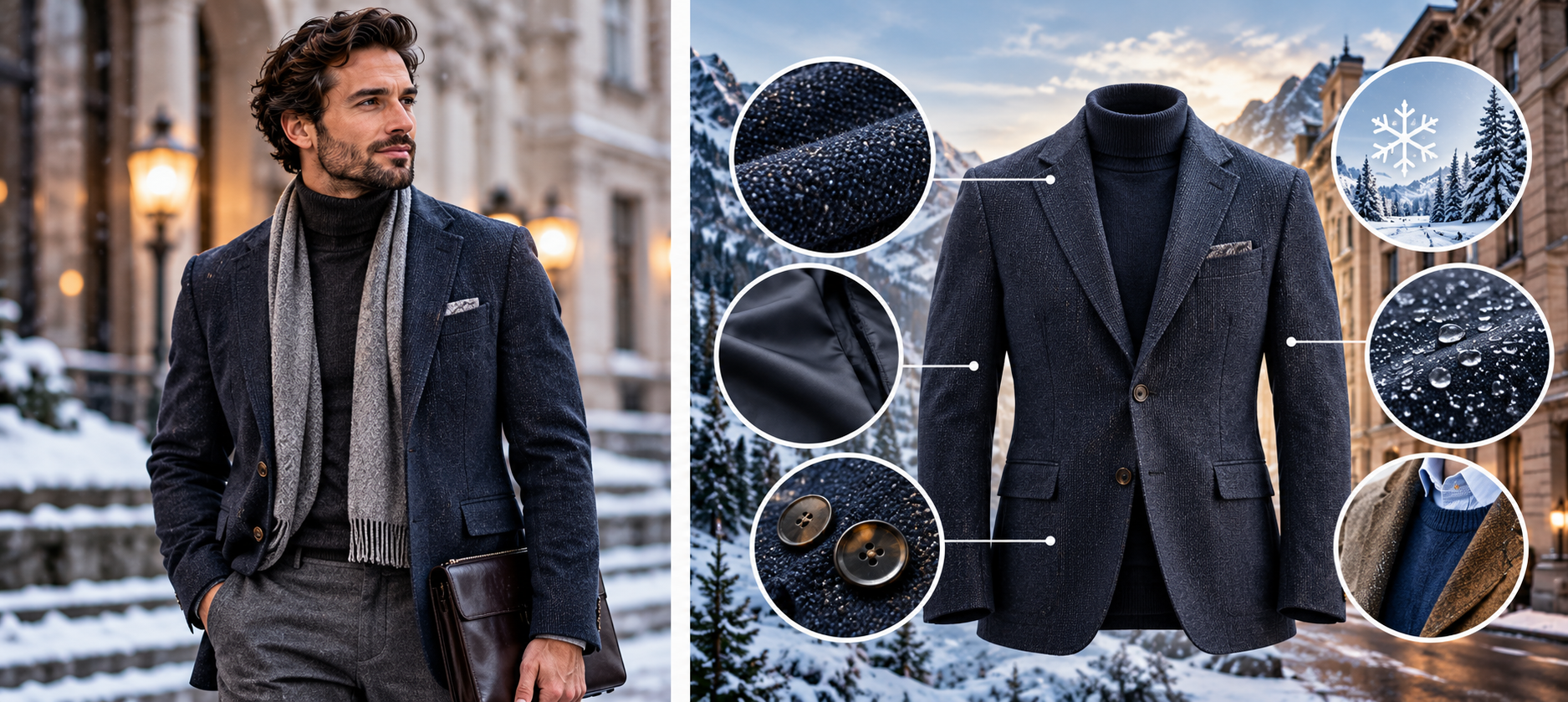
The role of half-canvas or full-canvas construction in shaping the jacket
Canvas is an internal structural layer placed between the outer cloth and lining. Proper Cloth explains that full-canvas construction extends from the shoulder to the bottom of the jacket and through the lapel, while half-canvas construction mainly supports the chest and lapel area.[1]
That internal structure gives the front of the jacket more shape and helps the cloth hang cleanly instead of relying only on the outer fabric. Proper Cloth also uses floating horsehair canvas in sport-coat construction, showing how traditional tailoring materials remain part of modern blazer engineering.[2]
How structured shoulders and notched lapels elevate casual layering into formalwear
Shoulder padding, sleeve heads, and lapels create visible geometry around the upper body. Proper Cloth notes that shoulder padding adds structure and visual volume, while sleeve heads help the fabric drape cleanly over the upper arm.[1]
Notched lapels reinforce that tailored outline. Current Brooks Brothers wool blazers and sport coats continue to use notched lapels as a core tailored detail.[3]
Why heavier wool can create a cleaner drape than very lightweight cloth
Fabric weight, weave, elasticity, and finishing all influence drape, so no single fibre guarantees a sharper silhouette. Structured tailoring and sufficiently substantial wool cloth help the garment resist collapse and maintain shape.
Wool has natural crimp and stretch that help tailored cloth retain shape. Proper Cloth notes that merino wool has natural stretch, a smooth finish, a gentle drape, and good shape retention over time.[4]
What Determines the Long-Term Durability of a Tailored Jacket?
The long-term durability of a blazer depends on fabric construction, tailoring quality, friction exposure, and maintenance rather than on fibre name alone.
Identifying high-friction failure points at the elbows, cuffs, and pocket seams
Daily wear concentrates repeated bending and rubbing at the elbows and cuffs, while pockets carry stress at their openings and seams. Those zones therefore deserve more attention than low-contact areas such as the center back.
A blazer worn several times each week will generally show polish, thinning, seam strain, or surface abrasion first where the body repeatedly flexes or where hands and objects contact the cloth.
Why densely woven worsted wool is valued for tailored daily wear
Worsted merino wool is widely used in tailoring because it can provide a smooth finish and controlled drape. Proper Cloth notes that merino wool has natural stretch and maintains its shape well over time, while also explaining that merino can be used in worsted suiting fabrics.[4]
That does not prove that worsted wool universally outlasts every cotton or polyester blend. Fibre quality, yarn twist, weave density, fabric weight, finishing, and garment use can reverse simple material rankings, so durability should be judged from the actual cloth rather than the fibre label alone.
How cleaning frequency and construction affect long-term shape retention
Many tailored wool jackets are labeled for professional dry cleaning. Brooks Brothers lists dry-clean care on current wool blazers, while Proper Cloth recommends professional cleaning for tailored clothing and advises doing it only as often as necessary.[3][5]
The evidence used here does not establish that repeated dry cleaning chemically destroys a canvas interlining at a predictable rate. A safer maintenance rule is to follow the garment’s care label, spot-clean when appropriate, air the jacket between wears, and avoid unnecessary full cleaning when the garment is not actually soiled.
Can a Blazer Provide Genuine Thermal Warmth in Winter?
A blazer provides the most substantial thermal warmth in winter when it is constructed from heavier wool fabrics and combined with layers that reduce exposed skin and trapped-air loss.
How heavy winter fabrics like tweed, flannel, and cashmere trap body heat
Wool fibres have natural crimp that creates small pockets of still air. Woolmark identifies those air pockets as part of wool’s insulating mechanism and explains that wool also manages moisture vapour, helping the microclimate around the body remain more stable.[6]
Tweed and heavier flannel use more substantial fabric structures than summer linen or lightweight cotton blazers. Current tailoring ranges also distinguish warm lambswool, cashmere, and tweed jackets from lightweight wool-linen options intended for warm climates.[7][8]
The vulnerability of the deep V-neck opening to wind chill and heat loss
A blazer’s lapels form a large V-shaped opening over the upper chest. Even if the body fabric is warm, that open neckline leaves a direct path for moving air unless a shirt, scarf, turtleneck, sweater, or outer coat fills the gap.
This is one reason a blazer should be treated as tailored clothing with moderate thermal value rather than as a sealed winter shell.
Why unlined or half-lined blazers retain less still air than fully lined versions
Lining adds another layer inside the garment and reduces direct contact between moving air and the wearer’s inner layers. A fully lined blazer therefore has more material separating the body from the environment than an unlined version.
Construction still matters more than lining alone. Proper Cloth offers half-canvassed jackets in lined and unlined configurations, showing that canvas structure and lining coverage are separate design variables.[2]
| Fabric Type | Typical Season | Insulating Properties |
|---|---|---|
| Linen / Cotton | Warm-weather or transitional use | Low to moderate; prioritizes breathability over heat retention |
| Worsted Wool | Three-season tailoring | Moderate; wool regulates temperature while maintaining a smooth tailored surface |
| Tweed / Heavy Flannel | Cold-weather tailoring | Higher; heavier wool structures hold more insulating air and reduce heat loss |
What Are the Exact Weatherproofing Limits of a Blazer?
While a heavy wool blazer offers useful dry-weather warmth, it usually lacks the waterproof membrane, DWR system, and sealed construction found in purpose-built rain and winter outerwear.
High vulnerability to moisture: why saturation is a problem for tailored construction
Wool can manage moisture vapour and remain comfortable across changing conditions, but a tailored blazer contains more than wool fibre. Proper Cloth and Woolmark both describe wool’s moisture-management and shape-retention benefits, while the blazer’s canvas, lining, lapels, shoulders, pockets, and seams still have to retain their intended structure.[4][6]
Heavy rain or wet snow therefore creates a garment-care problem even when the wool fibre itself is not immediately ruined. A soaked tailored jacket should be dried according to its care instructions rather than treated like a technical shell.
The general lack of technical DWR systems on traditional tailoring
A DWR finish is a technical surface treatment designed to make water bead and roll away. GORE-TEX explains that DWR reduces the surface energy of face fabric, but also stresses that DWR is not the same thing as the waterproof membrane beneath it.[9]
Current wool-blazer examples from Proper Cloth and Brooks Brothers emphasize tailoring construction, wool composition, lining, lapels, and care rather than a technical waterproof membrane or DWR system.[2][3]
Purpose-built outerwear states those protections explicitly. Proper Cloth, for example, sells its Bond Technical Wool Raincoat as dedicated rain outerwear and notes that its outerwear is designed to layer over sweaters and suit jackets, showing the difference between tailored wool clothing and weather-engineered outerwear.[10]
The necessity of knitwear layering to extend the blazer’s cold-weather range
A sweater or turtleneck adds insulation under the blazer and closes much of the exposed chest area created by the lapels. Woolmark describes mid-layers as a core part of a layering system for cold conditions because they add insulation while still managing moisture.[11]
Layering extends the useful range of a blazer, but it does not make the blazer waterproof or eliminate the need for an outer coat in severe wind or precipitation.
| Weather Condition | Layering Strategy | Blazer Suitability |
|---|---|---|
| Mild / Cool (Dry) | Dress shirt or light knit | Excellent |
| Cold (Dry) | Heavy sweater or turtleneck | Good |
| Freezing / High Wind | Add an overcoat or weather-protective outer layer | Poor as a standalone layer |
| Rain / Wet Snow | Use a waterproof outer shell or weather-resistant coat | Poor as a standalone outer layer |
The Winter Blazer vs. the Overcoat: Layering for Extreme Cold
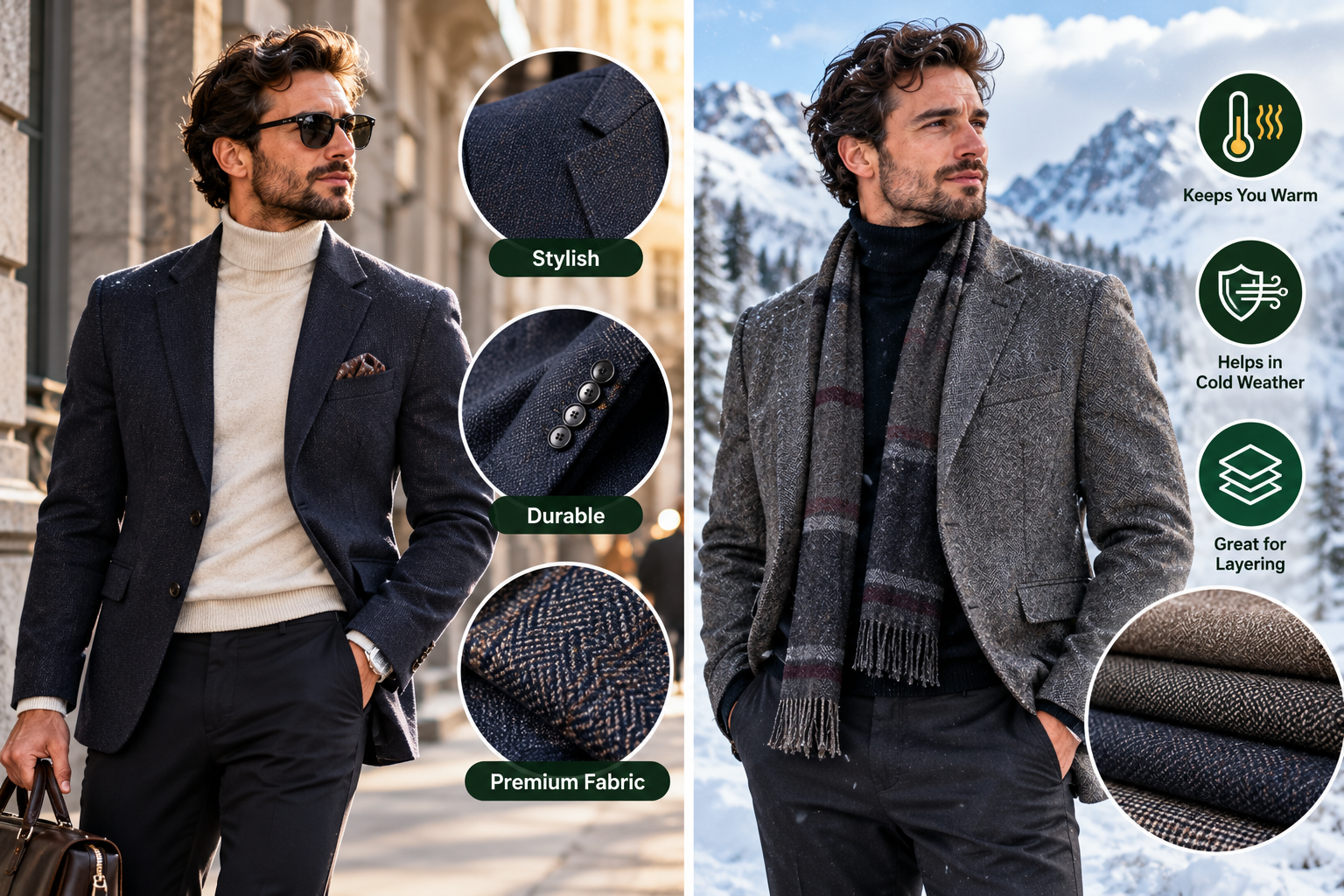
Comparing a winter blazer with an overcoat shows that the blazer is optimized for tailored indoor-to-outdoor transitions, while the overcoat adds the coverage and weather protection needed for harsher outdoor exposure.
| Feature | Heavyweight Blazer | Wool Overcoat / Topcoat |
|---|---|---|
| Indoor Wearability | Excellent | Low; usually removed indoors |
| Outdoor Warmth | Moderate | Higher because of greater coverage and outerwear construction |
| Wind Resistance | Low to moderate; chest remains relatively open | Higher in purpose-built long outerwear |
| Moisture Defense | Usually limited | Varies; some topcoats add membranes or weather-resistant construction |
Compare indoor temperature regulation with severe outdoor wind exposure
A heavyweight blazer can be comfortable indoors and during short dry outdoor transitions because wool regulates temperature and the garment remains relatively compact.[6]
A topcoat or long outer coat adds more coverage over the blazer. Proper Cloth designs its Bond raincoat to layer over suit jackets, while Brooks Brothers maintains a current wool-overcoat collection built around warm formal outerwear such as topcoats, duffle coats, and balmacaan coats.[10][12]
There is no universal temperature at which every person must add a topcoat. Wind, humidity, fabric weight, activity level, individual cold tolerance, and time outdoors all affect that decision.
How pairing a tailored blazer beneath a heavy overcoat creates a complete winter system
The blazer can remain the formal indoor layer while the overcoat takes responsibility for greater outdoor coverage. The outer coat also covers the blazer’s open neckline and protects more of the torso from wind and precipitation.
This division of roles matches the logic of layered clothing: insulation and presentation can sit inside, while the outer layer handles environmental exposure.[11]
Final Verdict: When Is a Blazer the Right Choice for Winter?
A heavyweight blazer is a strong choice for dry, cool winter days and temperature-controlled formal settings, provided it is layered appropriately for the conditions.
Ideal scenarios for dry, cool winter days and temperature-controlled formal settings
Tweed, flannel, lambswool, and other substantial wool blazers work best when the wearer moves between indoor spaces and limited outdoor exposure. Their tailored construction maintains a formal silhouette while wool adds useful insulation and temperature regulation.[6][7]
This is the environment in which the blazer’s style, structure, and moderate warmth complement one another rather than compete with severe weather.
When to bypass a standalone blazer in favor of a heavier outer layer
High wind, sustained rain, wet snow, and prolonged freezing exposure push the blazer beyond its intended role. In those conditions, use an overcoat, waterproof outer shell, insulated parka, or another purpose-built outer layer over the blazer rather than expecting the blazer to do both jobs.
The blazer is winter-ready as a tailored layer, not as a universal winter coat: heavier wool improves warmth, knitwear extends insulation, and a true outer layer supplies the weather protection the blazer lacks.
Sources
- Proper Cloth. Jacket Construction and the Options Proper Cloth Offers. View source.
- Proper Cloth. Bedford Mocha Windowpane Wool Jacket — floating horsehair canvas and unlined construction example. View source.
- Brooks Brothers. Classic Fit Wool Tweed Windowpane Sport Coat — notch lapel, wool composition, and dry-clean care. View source.
- Proper Cloth. Wool Suiting Fabric Basics. View source.
- Proper Cloth. How to Care for a Suit: Cleaning Instructions for Tailored Clothing. View source.
- The Woolmark Company. Wool Is Naturally Breathable. View source.
- Proper Cloth. Moss Lambswool Cashmere Bedford Jacket — a warm lambswool-cashmere flannel jacket for fall and winter. View source.
- Proper Cloth. Bedford Mocha and Green Plaid Wool and Linen Jacket — lightweight warm-climate fabric example. View source.
- GORE-TEX. Durable Water Repellent (DWR) in GORE-TEX Products. View source.
- Proper Cloth. The Bond Technical Wool Raincoat — tailored outerwear designed to layer over suits and provide dedicated rain protection. View source.
- The Woolmark Company. Merino Wool Mid-Layers. View source.
- Brooks Brothers. Wool Overcoats for Men — current wool overcoat and topcoat collection for warm formal outerwear. View source.
Evidence note: This article does not claim that worsted wool universally outlasts every cotton or polyester blend, does not claim that dry cleaning predictably destroys canvas construction, and does not assign a universal temperature at which every blazer requires an overcoat. Those outcomes depend on cloth, construction, care, weather, activity, and the wearer.