
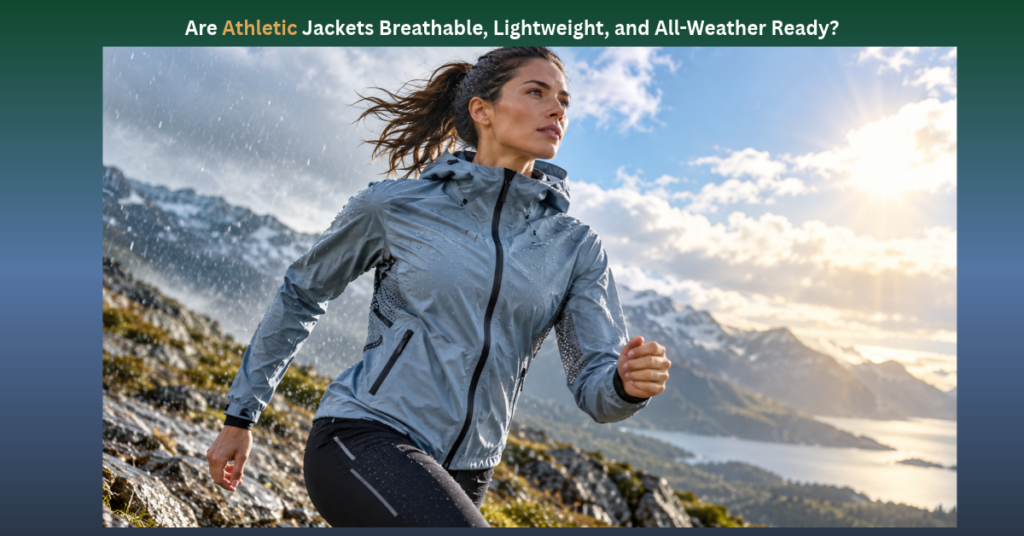
Are Athletic Jackets Breathable, Lightweight, and All-Weather Ready?
An athletic jacket generally delivers high breathability and lightweight mobility for cardiovascular activities, but its weather protection is typically limited to wind and light drizzle rather than heavy rain or sub-zero cold.
“All-weather” labels can give buyers the wrong idea about a thin active shell. A running or training jacket is built to move, release sweat, and stay light; those priorities do not give it the same storm protection or insulation as a technical rain shell or winter coat.
This guide evaluates the synthetic textile engineering of athletic jackets to validate their moisture-venting capabilities, explain their lightweight ergonomics, and map their exact failure points in severe weather.
How Synthetic Blends and Elastane Dictate Athletic Jacket Performance
Athletic jacket performance relies primarily on tightly woven synthetic polyester or nylon blended with elastane, creating an unlined shell that balances wind deflection with mechanical stretch.
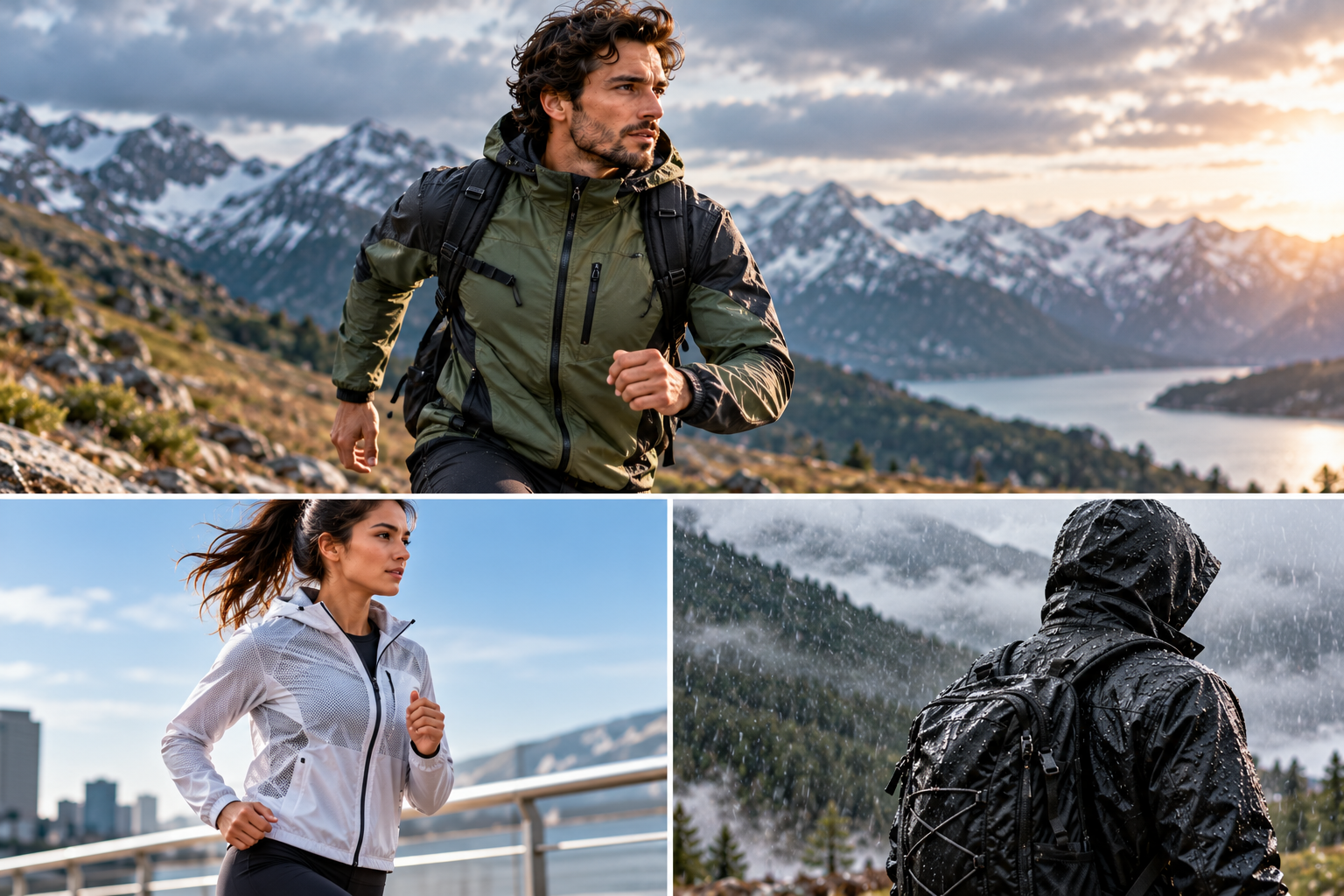
The role of tightly woven polyester in balancing wind deflection with vapor release
Polyester and nylon work well in sportswear because manufacturers can build them into light fabrics with controlled air permeability, moisture transport, and drying behavior. Research on active sportswear shows that sweat transfer also depends on yarn construction, fabric thickness, airflow, and the surrounding conditions.[1][2]
A tighter weave can cut direct airflow and reduce fabric flapping. It also leaves less open space for heat and water vapor to move through, so the fabric has to balance wind control with ventilation.
How elastane (spandex) adds recoverable stretch for dynamic movement
Elastane gives woven or knitted sports fabrics recoverable stretch. Textile references describe spandex as useful where close fit, repeated bending, and elastic recovery are part of the garment’s job.[3]
Stretch is not fixed by the word “elastane.” Yarn placement, fabric structure, elastane content, and finishing all change how far the material moves and how well it recovers. No universal stretch percentage applies to every jacket.
Why an unlined interior suits high-output athletic use
Exercise generates substantial body heat, and clothing can slow both heat loss and sweat evaporation. Sports-medicine research shows that extra insulation can make cooling harder during exercise, which helps explain why many active shells omit fleece and quilted linings.[4]
With fewer layers, the jacket carries less bulk and gives heat and moisture a shorter path to the outside air. That suits running, cycling, and fast hiking, but it also leaves little loft for warmth when activity stops.
Does the Material Structure Provide Genuine High-Output Breathability?
Most unlined athletic jackets can support high-output breathability when air-permeable fabric is paired with effective ventilation, but coatings, laminates, and garment design can sharply change that behavior.
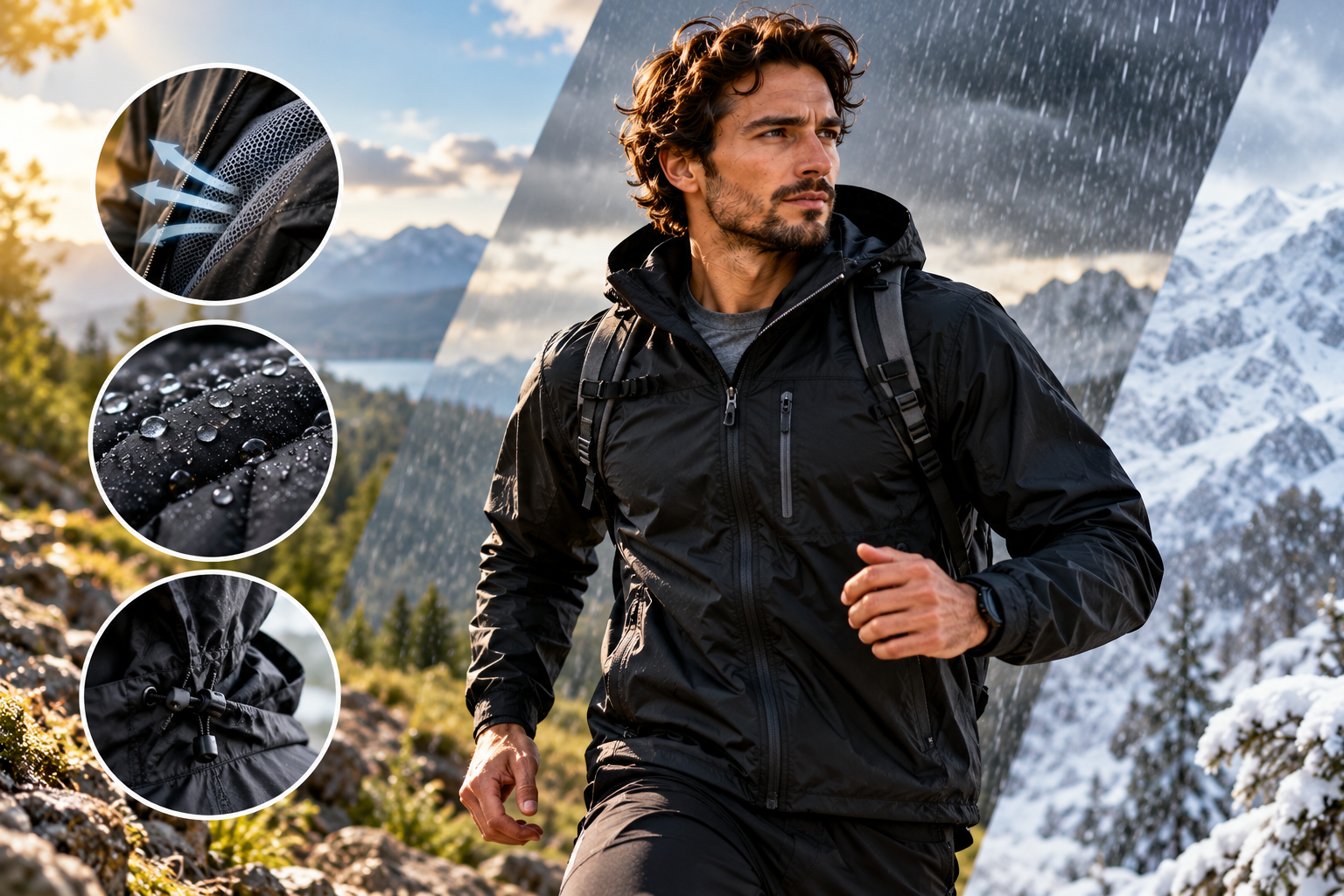
How moisture-wicking synthetic fabrics move perspiration toward evaporation
Moisture-wicking depends on more than polyester resisting water absorption. Fibre shape, capillary spaces, fabric construction, and surface treatments can move liquid away from a wetter inner surface and spread it over a wider area where it can evaporate.[1][5]
In one controlled exercise study, a polyester-elastane shirt retained less sweat than cotton under the tested conditions. Broader reviews also show that fabric claims alone do not determine whole-body cooling; fit, airflow, sweat rate, construction, and environment still matter.[5][6]
Why mechanical venting matters during intense cardiovascular work
Moisture vapor transmission rate (MVTR) describes vapor movement through a material, but cooling does not depend on fabric diffusion alone. Open vents can release warm, humid air directly from the clothing system.
Manikin and wearer studies show that ventilation and strategically open fabric areas can reduce thermal or evaporative resistance and improve heat and moisture transfer during movement.[7][8]
Pit-zips, back-yoke vents, mesh pocket bags, and other openings can therefore help during hard exercise. They give heat another escape route when sweat and metabolic heat build faster than the fabric can pass them.
Why polyurethane barriers can reduce direct airflow while improving rain resistance
Polyurethane is common in waterproof-breathable coatings and membranes. Research on coated and laminated outdoor fabrics shows that PU systems can increase resistance to liquid water, while vapor transfer changes with coating chemistry, thickness, pore structure, and laminate design.[9][10]
A solid non-porous PU layer blocks direct airflow more strongly than an uncoated weave. Microporous and hydrophilic PU systems can still move water vapor, so not every PU-coated jacket behaves the same way.
| Venting Mechanism | Structural Design | Moisture & Heat Management Effect |
|---|---|---|
| Air-permeable synthetic weave | Thin woven polyester or nylon without a continuous waterproof barrier | Allows passive air and water-vapor transfer; performance depends on weave, finish, thickness, and wind |
| Mechanical vents | Pit-zips, back-yoke openings, mesh zones, or ventilated pockets | Creates direct convective exchange when metabolic heat exceeds what the fabric can release |
| PU coating or membrane | Continuous or microporous polymer layer applied or laminated to the shell | Raises liquid-water resistance but changes air and vapor transfer; exact breathability depends on membrane chemistry and construction |
How Unlined Shells Minimize Physical Weight Without Restricting Mobility
Unlined athletic shells minimize physical weight by using thin synthetic fabrics and removing bulky insulation, producing a compact garment designed around movement rather than static warmth.
Why athletic jackets omit heavy insulation instead of chasing a fixed weight target
The sub-10-ounce figure in the brief is not treated as a universal standard. Jacket mass changes with size, fabric density, pockets, hood hardware, zippers, reinforcement, and weather protection. Fewer layers and less insulation simply mean less material to carry.
That lighter construction also suits active use. Exercise already generates heat, so unnecessary static insulation can increase thermal strain when the workload is high.[4][11]
How articulated sleeves and slim patterning support running and cycling motion
Elastane alone does not determine mobility. Patterning decides how much fabric is available when the shoulders flex, elbows bend, arms swing, and torso rotates. A closer athletic cut can also reduce loose fabric movement in wind.
Stretch yarns and articulated pattern pieces do different jobs. The fabric deforms around the body, while the cut reduces resistance caused by excess material or poorly placed seams.[3]
Why thin shells are easier to compress and carry
A jacket without fleece, quilting, or rigid interlining has less material to fold. Thin synthetic shells can therefore take up little room in a running vest, daypack, or pocket.
Compact size does not prove storm performance. Some shells pack small because they leave out insulation, membranes, reinforcement, or seam construction that heavier weather-protective jackets may use.
| Structural Feature | Design Execution | Ergonomic Benefit for Active Use |
|---|---|---|
| Unlined shell | Thin synthetic fabric without fleece or quilted insulation | Reduces bulk and makes the jacket easier to carry and layer |
| Elastane stretch | Spandex added to a woven or knitted synthetic structure | Improves recoverable stretch and helps the fabric follow arm and torso movement |
| Articulated patterning | Pre-shaped elbows, shoulder shaping, and athletic torso cut | Reduces excess folding and fabric pull during repetitive movement |
The “All-Weather” Myth: Defining the Exact Moisture and Thermal Limits
Despite frequent “all-weather” marketing claims, standard athletic jackets are typically water-resistant rather than waterproof, and an unlined shell provides little standalone insulation once activity drops.
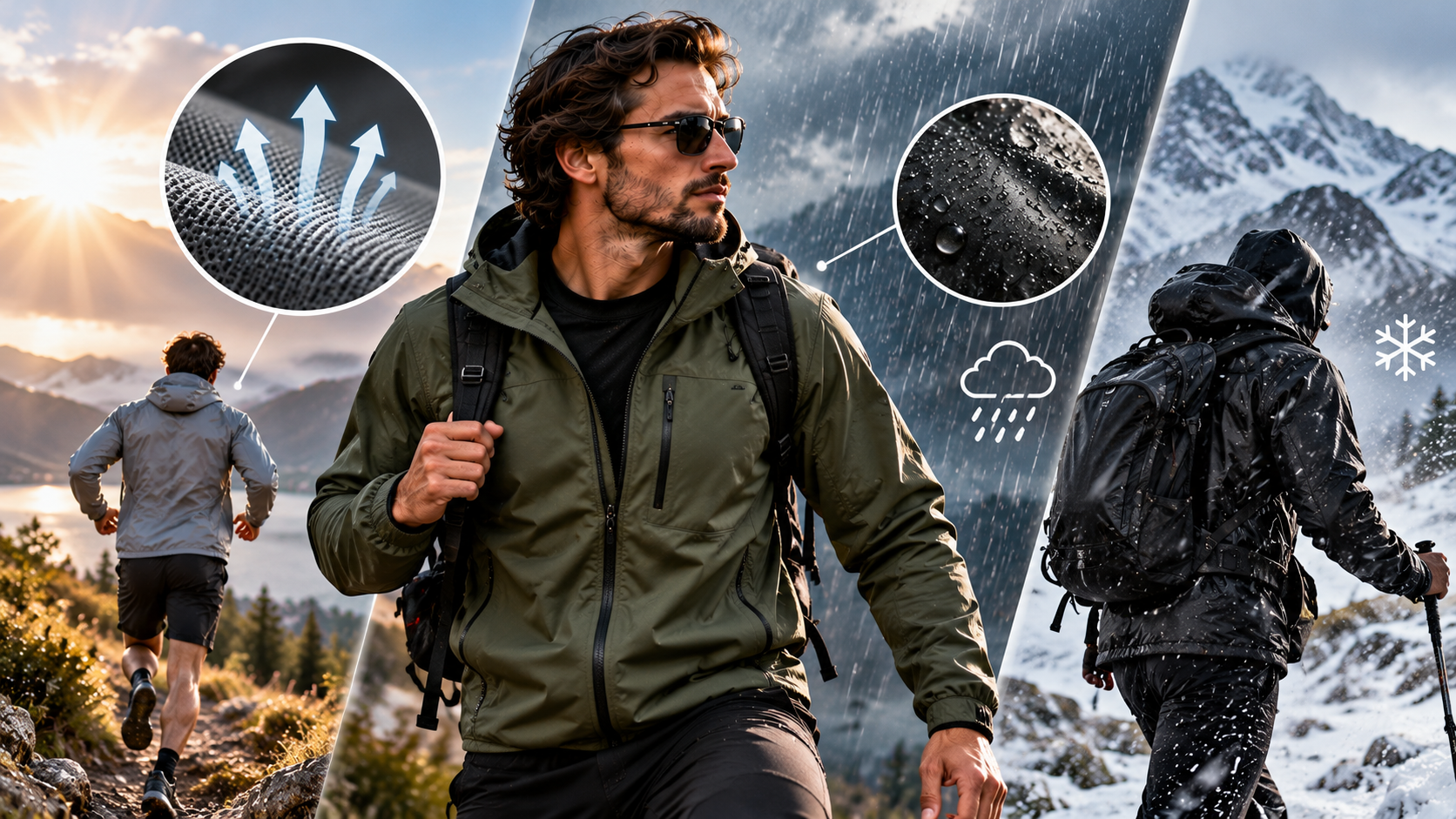
How DWR treatments manage light surface moisture
Durable Water Repellent (DWR) finishes reduce surface wetting, making droplets more likely to bead instead of spreading straight into the fabric. EPA-indexed outdoor-apparel research confirms that several DWR chemistries can provide strong water repellency.[12]
Water repellency and waterproofing are different properties. DWR changes how the surface wets; by itself, it does not turn the jacket into a sealed rain barrier.
The moisture failure point: why sustained rain exposes unsealed construction
Hydrostatic head is a laboratory measure of resistance to water penetration under pressure. Research on coated and laminated outdoor fabrics measures it separately from surface repellency and water-vapor permeability because each test describes a different part of wet-weather performance.[9][10]
Seams create another route for water. Technical apparel references note that stitch holes can weaken waterproof and windproof construction unless they are covered by seam tape, sealant, bonding, or welding.[13]
A DWR-treated active shell without a waterproof membrane or sealed seams may handle mist or a short shower. Longer rain exposure can eventually wet the face fabric and enter through construction points.
The thermal failure point: why an unlined shell is not a winter insulator
A thin shell can cut wind, but low-activity warmth comes from insulation and trapped air. National Park Service guidance separates those jobs: middle layers provide insulation, while the outer layer handles wind and precipitation.[14]
Once the wearer stops running or cycling, an unlined shell has little loft to hold warm air. In freezing or sub-zero conditions, it works as one layer in a system rather than as a complete winter coat.
| Weather Condition | Athletic Jacket Capability | Structural Reason |
|---|---|---|
| Dry wind / cool air | Good use case | A close woven shell can reduce direct airflow while preserving a thin active profile |
| Light mist / brief drizzle | Limited protection | DWR can reduce surface wetting for a period, but repellency is not waterproofing |
| Sustained heavy rain | Poor unless built as a waterproof shell | Unsealed seams and non-membrane fabrics provide water-entry paths under prolonged exposure |
| Freezing or sub-zero cold, standalone | Poor for low activity | An unlined shell contains little loft and therefore little insulating dead-air volume |
Athletic Shells vs. Technical Hardshells: Which Layer Handles True Storms?
Choosing between an athletic jacket and a technical hardshell requires deciding whether your primary need is rapid sweat evaporation during intense exercise or sealed protection against heavy rain.
| Performance Metric | Athletic Jacket / Active Shell | Technical Hardshell |
|---|---|---|
| Primary function | Heat release, wind reduction, mobility | Sustained rain and storm barrier |
| Air exchange | Usually higher when the fabric is air-permeable and vented | Usually lower because the barrier layer limits direct airflow |
| Water protection | Often DWR-led water resistance; seams may be unsealed | Waterproof membrane/coating plus seam sealing or taping |
| Mobility | Often soft, stretchy, and low bulk | Depends on laminate and pattern; barrier construction may feel stiffer |
| Packability | Often compact because insulation and heavy reinforcement are omitted | Varies; waterproof layers, hood structure, zippers, and seam tape add material |
Compare moisture vapor transmission and air permeability with hydrostatic water resistance
An air-permeable athletic shell can release heat quickly because air moves through the textile and through purpose-built vents. Exercise studies show that porosity and ventilation can improve evaporative cooling under suitable conditions.[7][8][15]
A technical hardshell is built for a different task. Waterproof-breathable systems use membranes or coatings to resist liquid water, and seam sealing closes the needle holes created during garment construction.[9][10][13]
That barrier usually allows less direct airflow than an open active shell, even though modern membranes can still transfer water vapor. A single MVTR or hydrostatic-head number cannot serve as a universal dividing line across every test method and garment.
Compare dynamic stretch with sealed storm construction
Athletic shells often use a soft hand, elastane-assisted stretch, minimal lining, and close patterning because repetitive arm and torso movement is central to their purpose.[3][16]
Storm hardshells devote more construction to weather control: barrier laminates, protective face fabrics, hood structure, weather-resistant closures, and sealed seams. Those parts can add stiffness or bulk, although mobility varies by fabric and pattern design.
Final Verdict: When Is an Athletic Jacket the Smartest Activewear Choice?
An athletic jacket is a highly effective choice for high-cardio outdoor activities in cool, windy, or lightly damp conditions, provided the wearer layers appropriately when temperatures drop or storms arrive.
Ideal scenarios for high-cardio outdoor activities, dry wind, and light transitional weather
Running, cycling, fast hiking, and outdoor training generate substantial metabolic heat. In those conditions, a light shell can cut direct wind while leaving enough air and vapor movement for sweat to evaporate.[4][5][15]
Its strongest role is active movement in dry wind, cool air, mist, or brief drizzle—not long periods of low-output exposure in severe cold.
When to bypass an athletic shell for an insulated mid-layer or a fully waterproof rain jacket
For sustained rain, a membrane or coated hardshell with protected seams is the better tool. For cold during low activity, the wearer needs an insulating mid-layer or insulated outer layer because an unlined shell provides little loft.[13][14]
The choice comes down to four practical inputs: activity level, rain intensity, ambient temperature, and required mobility. Athletic jackets fit best where movement and heat release matter more than complete storm sealing or deep insulation.
Sources
- Textiles / MDPI. Factors Affecting the Sweat-Drying Performance of Active Sportswear. View source.
- Textiles / MDPI. Textile Transformation: functional treatment effects on polyester sports fabrics. View source.
- ScienceDirect Topics. Sportswear — stretch and elastic recovery in active clothing. View source.
- PubMed / Sports Medicine. Clothing and thermoregulation during exercise. View source.
- PubMed. Effects of a moisture-wicking synthetic shirt during exercise in heat. View source.
- PubMed / Sports Medicine. Impact of clothing on exercise in heat. View source.
- PubMed. Critical heat stress evaluation of clothing ensembles with different levels of porosity. View source.
- PubMed. Ventilation holes and garment design effects on thermal comfort. View source.
- Coatings / MDPI. Water repellency, waterproofing and water-vapor permeability of coated and laminated outdoor fabrics. View source.
- Coatings / MDPI. Waterproofness and breathability of polyurethane-coated textile systems. View source.
- PubMed. Influence of clothing on thermoregulation and comfort during exercise in heat. View source.
- U.S. EPA HERO. Performance evaluation of fluorinated and non-fluorinated DWRs for outdoor fabrics. View source.
- ScienceDirect Topics. Jacket design and seam sealing for waterproof outer shells. View source.
- U.S. National Park Service. Dressing for Winter — insulation and weather-protective layers. View source.
- PubMed. Novel ventilation design in sports clothing and thermal-comfort effects. View source.
- Materials / MDPI. Comparative analysis of elastic polyester sportswear fabrics. View source.
Source policy: Evidence citations use peer-reviewed sportswear and textile research, PubMed-indexed studies, EPA-indexed DWR research, U.S. National Park Service guidance, and technical textile references. No retail product or jacket-selling page is used as evidence. Unsupported universal garment-weight, MVTR, hydrostatic-head, and stretch-percentage thresholds were removed or softened.