
Vintage Odor Eradication Diagnostic
Vintage Odor Eradication Diagnostic
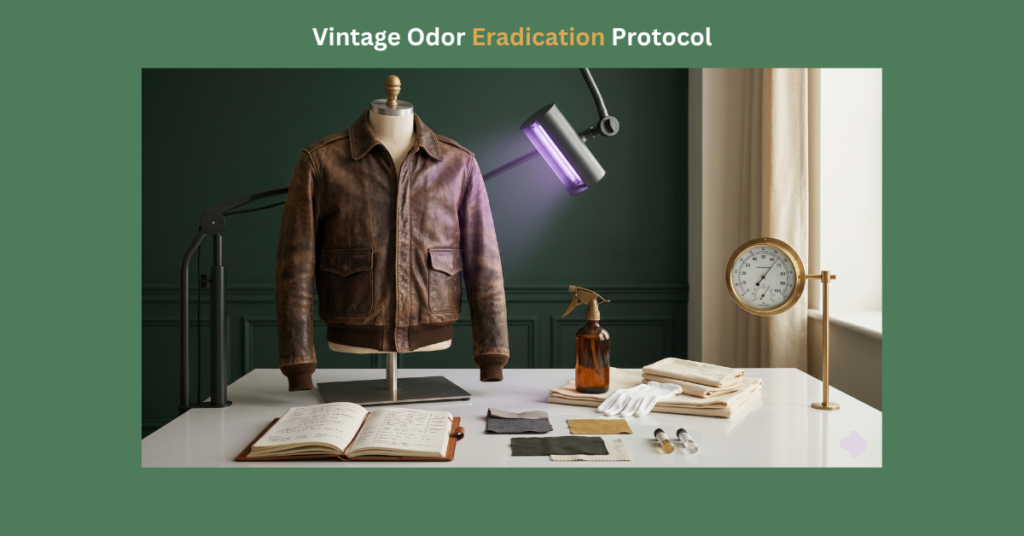
Eradicating vintage odors without damaging heritage garments requires a methodical protocol that bypasses destructive aqueous laundering in favor of targeted chemical neutralization, controlled environmental testing, and empirical data tracking.
Collectors face a paradox: the methods required to clean modern clothes will permanently destroy the structural integrity of vintage textiles. This protocol provides a definitive, non-destructive framework for diagnosing, testing, and chemically neutralizing deep-set vintage odors.
1. Diagnose Why Conventional Washing Fails
Conventional aqueous laundering fails to remove embedded vintage odors because water and standard surfactants cannot penetrate deep-set volatile organic compounds (VOCs), and instead actively compromise the structural integrity of aged organic materials like leather and waxed canvas.
Specific embedded volatile organic compounds dictate the exact olfactory profile of deadstock and vintage apparel. 2-Nonenal (C9H16O) emerges from the lipid peroxidation of omega-7 fatty acids, presenting a greasy, musty scent. Isovaleric Acid (C5H10O2) develops via the microbial degradation of leucine by Staphylococcus epidermidis, presenting a sharp, sour profile. Polar water molecules categorically fail to solubilize these lipophilic, nonpolar compounds.
Aqueous laundering aggressively initiates cellular degradation in heritage materials. The Smithsonian Museum Conservation Institute and the Victoria and Albert Museum have extensively documented the catastrophic risks of wet cleaning. Introducing water to aged hides triggers the hydrolytic breakdown of collagen in leather. It actively strips paraffin and beeswax from canvas structures. Most critically, improper washing can induce the toxic conversion of trivalent chromium to hexavalent chromium (Cr(VI)) in vintage tanned leathers.
Polar water structurally repels lipophilic compounds like 2-Nonenal.
Critical Structural Hazard
Rule: Never use aqueous laundering on delicate heritage materials (e.g., aged leather, waxed canvas).
Reason: It triggers structural hazards (like lipid stripping and collagen breakdown) and fails to chemically solubilize nonpolar VOCs like 2-nonenal.
*For detailed material care after odor removal, refer to our comprehensive guides on How to Condition Vintage Leather or explore The Chemistry of Denim Preservation.
2. Select Non-Destructive Treatment Vectors
Neutralizing heritage garment smells requires selecting specific, non-destructive treatment vectors that chemically dismantle odor-causing molecules without mechanical abrasion. These interventions act as independent variables for your testing phase.
UV/Direct Sunlight
Denatures microbial DNA. Specifically, using the UV-C sub-band at 254 nm forms cyclobutane pyrimidine dimers (CPDs), halting RNA transcription and neutralizing biological odor sources.
Acetic Acid/White Vinegar
Neutralizes alkaline odors via atomization. Acetic acid acts as a proton donor with a pKa of 4.76, efficiently converting volatile ammonia and biogenic amines into odorless amine salts.
Thermal Reduction/Freezing
Retards bacterial off-gassing. Dropping temperatures induces metabolic dormancy in psychrotolerant bacteria at -18°C to -40°C, drastically lowering the VOC vapor pressure.
Ozone Chamber (O3)
Deep gas saturation for extreme cases. Ozone acts via electrophilic attack, cleaving electron-rich carbon-carbon double bonds in complex VOCs to permanently alter their chemical structure.
3. Control Environmental Variables
Skewed olfactory testing is prevented by rigidly controlling environmental variables, isolating the garment, and enforcing strict resting periods to measure the true residual odor rather than the temporary scent of the treatment vector. Elevating temperatures increase VOC volatility, while high humidity displaces polar VOCs from hydrophilic binding sites.
*Standards ISO 17299-1 and ISO 13299 require maintaining a neutral baseline of 23°C and 50% relative humidity.
The Control Protocol
4. Track Treatment Efficacy
Treatment efficacy is accurately tracked using a structured vintage odor data collection log that maps specific micro-interventions against a standardized 1-10 olfactory severity scale and strict material integrity checks. The metric standard demands absolute precision: 10 represents Acutely Unwearable/Pungent, and 1 represents Olfactory Neutral. This closely aligns with the subjective rating parameters defined in the ISO 17299-3 gas chromatography standard.
ISO Standard Olfactory Severity Scale
A material integrity check determines the viability of your method. A “Fail” state means adverse chemical alteration has occurred. This includes the stiffening of the collagen network in leather, the loss of paraffin wax in canvas, or the hydrolysis of glycosidic bonds in cotton.
| Test Iteration | Treatment Vector Applied | Exposure Duration | Pre-Score (1-10) | Post-Score (1-10) | Net Reduction | Integrity Check |
|---|---|---|---|---|---|---|
| 1 | e.g., UV-C | 2 Hours | 8 | 6 | -2 | PASS |
| 2 | ||||||
| 3 |
5. Analyze Test Results
The safest odor eradication pathway is identified by synthesizing the empirical test data to isolate the specific treatment vector that delivers the highest net odor reduction without triggering a material integrity failure.
Data Segmentation
Isolate the vector with the highest Net Odor Reduction without triggering an integrity “Fail”.
Pattern Recognition
Reverse-engineer the chemical profile. If UV-C succeeded, it’s a biologically active biofilm. If acetic acid succeeded, it’s highly volatile alkaline biogenic amines.
Insight Formulation
Synthesize the empirical data into a definitive conclusion to guide your final restoration.
Insight Example: “The data demonstrates that Thermal Reduction (freezing) yielded a negligible -1 reduction, whereas a highly diluted Acetic Acid mist followed by 4 hours of UV exposure yielded a -5 reduction while maintaining a ‘Pass’ on material integrity.”
6. Execute Targeted Hypothesis
A neutral-smelling heritage garment is achieved by executing a final, targeted hypothesis protocol that scales up the most successful diagnostic test vector based on your documented quantitative data. Final execution must overcome the physical architecture of the garment. You must manipulate the textile to defeat micro-shadowing during UV-C exposure or prevent localized fluid pooling to avoid acid hydrolysis during atomization.
7. Troubleshoot Edge-Cases (FAQ)
Troubleshooting common edge-cases requires strict adherence to environmental aeration protocols and an absolute refusal to compromise material integrity for faster olfactory results.
Why is a 12-hour resting period mandatory between tests?
Without the 12-hour aeration in a climate-controlled space, you are testing the smell of the treatment vector (e.g., the vinegar itself), not the garment’s actual residual odor.
What do I do if my most effective treatment vector triggered a material “Fail”?
Immediately discard that vector. Even if it successfully neutralizes the VOCs, compromising the structural integrity or patina (e.g., stiffening leather or stripping wax) permanently damages the vintage asset. Revert to the vector with the second-highest reduction score.
Finalize Heritage Restoration
Finalizing your heritage outerwear restoration demands prioritizing material integrity over rapid scent removal, as structural damage is permanent while odor eradication can always be safely iterated.
Rule: Always prioritize material integrity over rapid scent removal.
Reason: Because you cannot undo stripped wax or cracked leather, but you can always run a second, gentler eradication iteration.
Result: A beautifully preserved, completely wearable piece of heritage outerwear.