
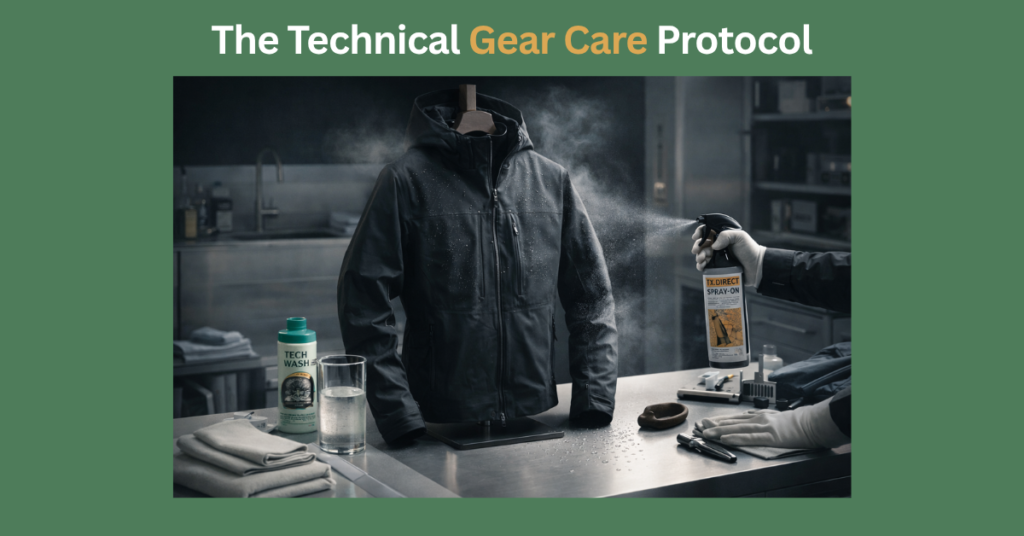
The Technical Gear Care Protocol
The Technical Gear Care Protocol
A Definitive Guide to Outerwear Maintenance
A professional “technical gear care protocol” protects your financial investment by preserving the microscopic membrane integrity and chemical water repellency of high-performance outerwear.
Most premium apparel fails not because of use, but because of neglect. Owners often ruin high-cost technical shells and insulated layers by treating them like standard laundry. Standard household cycles destroy the delicate balance of textile engineering. This guide provides a scientifically grounded framework to transform you from a casual consumer into a technical gear steward.
Why Adopting a Technical Gear Care Protocol Saves Expensive Outerwear From Ruin
Adopting a “technical gear care protocol” prevents the irreversible degradation of breathable membranes and the clogging of textile pores caused by standard household detergents.
Never guess when it comes to washing premium materials.
Buying a great jacket is only half the equation; improper maintenance strips its defensive properties and shortens its functional lifespan.
Throwing a $400 Gore-Tex shell in standard laundry detergent clogs the microscopic pores, ruining its breathability. Standard detergents contain surfactants and fragrances that leave a hydrophilic residue, which attracts water rather than repelling it.
Phase 1: Establish the Fundamental Outerwear Maintenance Rule
Establishing the fundamental “outerwear maintenance” rule requires defining the non-negotiable chemical and physical constraints specific to your garment’s construction material.
The core distillation of gear care involves matching the cleaning agent to the specific textile technology. Using the wrong chemistry causes permanent damage to the fibers. Per ASTM D1776 Standards, the proper conditioning of textiles is essential to maintain structural integrity under environmental stress.
Down/Insulation
Requires pH-neutral down-wash to maintain natural oils and Loft.
Leather
Requires moisture-balancing lipids to prevent fiber cracking.
Waterproof Shells
Requires surfactant-free cleaners to maintain Durable Water Repellent (DWR) integrity and protect the ePTFE membrane.
Phase 2: Identify the Necessary Tools and Metrics
Successful “technical jacket care” requires a specialized toolkit of surfactant-free cleaners and a frequency schedule based on heavy-use metrics rather than calendar dates. To execute this protocol, assemble the following essential items:
- Surfactant-free cleaner: Products like Nikwax Tech Wash or Grangers Performance Wash.
- Soft horsehair brush: For removing localized debris without abrading the face fabric.
- Specialized conditioner: High-quality lipids for leather or technical wash-in/spray-on DWR for shells.
Metric Callout
Wash your technical outerwear after every 15–20 hours of heavy use. Body oils, salts, and smoke accumulate rapidly, degrading the internal membrane if left unaddressed.
Technical Fact
If a jacket loses water resistance, place it in the tumble dryer on low-to-medium heat. This thermal exposure reactivates the factory DWR polymer chains, restoring the surface tension required for water beading.
Phase 3: Diagnose Past Outerwear Damage
To “diagnose” existing outerwear damage, you must evaluate the structural resonance of the garment, identifying where salt, oils, or improper storage have compromised its performance.
The “Resonance Matrix” defines how gear interacts with your biology. If the fabric “wets out” (absorbs water) in the shoulders or back, user oils have likely compromised the DWR.
Hanging a heavy leather jacket on a thin wire hanger.
Stretched-out shoulders and a compromised silhouette.
Deep lipid conditioning to restore flexibility and a transition to a wide-shoulder wooden hanger to maintain structural form.
Phase 4: Execute a Single Physical Care Action
Executing a single “jacket care action” is the catalyst for shifting from theoretical knowledge to verifiable physical restoration of garment performance. Theoretical knowledge does not restore a membrane. You must move from intent to execution to prevent delamination—the irreversible separation of the garment layers.
| Approach | Intent vs. Execution |
|---|---|
| ❌ Sub-optimal | “I need to clean my coat eventually.” |
| ✅ Protocol Standard | “I will order specialized down-wash today and spend 30 minutes on Sunday washing and tennis-ball-drying my puffer.” |
Phase 5: Track Your Maintenance Results
Tracking “technical gear maintenance” through a structured application log ensures you maximize the lifespan of the garment and identify when a membrane has reached its end-of-life. Maintenance is data-driven. A log prevents over-washing and ensures you notice when DWR treatments begin to fail faster than expected, which may indicate the end of the membrane’s lifecycle.
| Maintenance Action | Date Executed | The Result Was |
|---|---|---|
| Wash and re-treat rain shell | 2026-04-10 | Water beads up perfectly again; saved me from buying a $300 replacement. |
| Specialized down-wash cycle | 2026-11-15 | Loft recovered by 25%; thermal efficiency restored for winter. |
| Lipid leather conditioning | 2027-01-05 | Suppleness restored; eliminated surface micro-cracking. |
Conclusion: Review Your Checklist to Build a Bulletproof Routine
To “review” your maintenance protocol, use this final checklist to ensure your technical outerwear remains a functional asset rather than a liability.
-
Verify Cleaner: Ensure the agent is free of surfactants, dyes, and fragrances.
-
Secure Fasteners: Zip all pockets and close all Velcro tabs to prevent abrasion during the cycle.
-
Check Temperature: Follow Gore-Tex official guidelines; usually warm wash (40°C/104°F).
-
Restore DWR: Apply heat via tumble dryer to reactivate chemical repellency.
-
Audit Storage: Ensure gear is stored dry and uncompressed in a ventilated space.
Proper care is the final stage of manufacturing. Knowledge is the ultimate tool for overcoming gear failure.
Resolve Common Maintenance Questions (FAQ)
To “resolve” lingering hesitations, we have compiled direct, evidence-based answers to the most common questions regarding “technical outerwear maintenance.”