
How to Conduct a Jacket Wardrobe Audit to Eliminate Bloat
How to Conduct a Jacket Wardrobe Audit to Eliminate Bloat
A successful “Jacket Wardrobe Audit” requires moving past emotional attachment and utilizing a ruthless, logical framework to eliminate outerwear bloat, cure daily decision fatigue, and curate a highly functional jacket rotation. Accumulation fatigue traps both physical closet space and financial capital in unworn garments.
This protocol provides a step-by-step system to perform a total inventory dump, map your outerwear overlaps, execute a decisive purge, and fund high-quality grails. Mastering this methodology is the required foundational work before you can successfully learn How to Build a Capsule Wardrobe.
Why Auditing Your Outerwear Collection Cures Decision Fatigue
Auditing your outerwear collection cures decision fatigue by removing the visual clutter that forces your brain to make unnecessary micro-choices every morning. The psychological concept of decision fatigue, pioneered by social psychologist Roy F. Baumeister, proves that willpower is a finite daily resource depleted by cluttered closets.
Recognize the true cost of hoarding by identifying the three primary symptoms of wardrobe bloat:
- Symptom 1: Depleted physical closet space causing garments to crush and wrinkle.
- Symptom 2: Trapped financial capital tied up in unworn “someday” pieces.
- Symptom 3: Defaulting to the exact same jacket every day out of sheer overwhelm.
Once you recognize the psychological cost of a bloated closet, the only cure is a physical, total extraction of the garments.
How to Perform a Total Jacket Inventory Dump
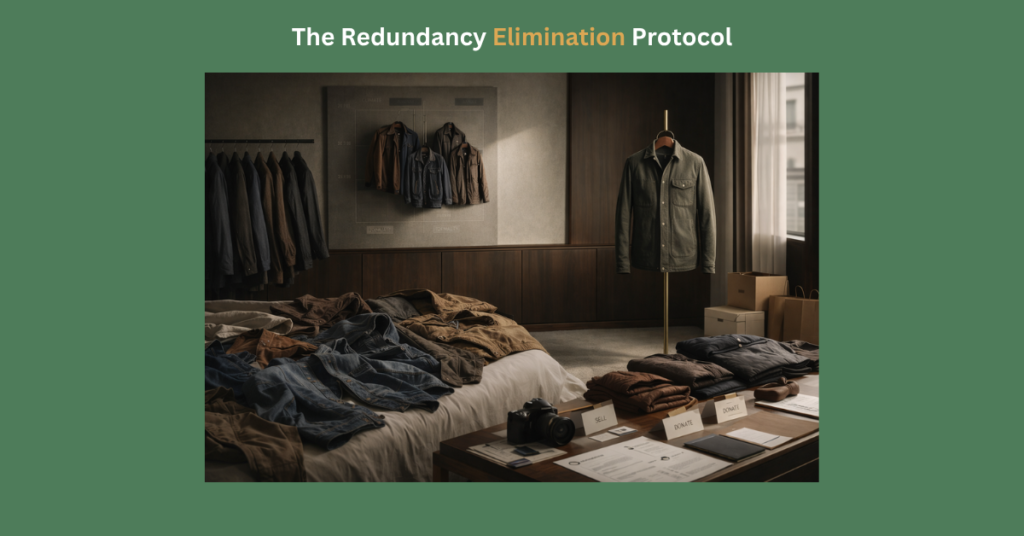
To perform a total jacket inventory dump, you must physically extract every piece of outerwear you own from all closets, hooks, and storage bins, placing them into a single, highly visible pile. You must pull every jacket out, relying on zero memory. This rigid process prevents you from hiding items they feel guilty about never wearing. Throw them all on the bed to confront the sheer volume of your collection.
Immediate objective assessment is the next required action. Apply the 12-month rule to every single item in the pile to separate theoretical utility from actual use.
The Objective 12-Month Inventory Tool
| Jacket Name/Type | Primary Intended Purpose | Worn in Last 12 Months? (Y/N) |
|---|---|---|
| Navy Peacoat | Formal Winter Commute | No |
| Denim Trucker | Casual Weekend Wear | Yes |
| Black Parka | Extreme Winter Snow | Yes |
Map Coat Overlaps Using the 2×2 Temperature and Formality Matrix
Mapping coat overlaps using a 2×2 Temperature and Formality Matrix instantly visualizes the exact areas where your wardrobe is bloated with redundancies or lacking utility. Explicitly define the Y-Axis as “Climate” (ranging from Mild/Transitional to Extreme Weather) and the X-Axis as “Context” (ranging from Casual/Beater to Formal/Sartorial).
Place every jacket from your bed pile into one of these four resulting quadrants. The Y-Axis specifically tracks temperature variations, heavily utilizing transitional weights often found in resources documenting The Best Transitional Jackets for Unpredictable Weather. The X-Axis forces you to define the exact social environments where the garment functions.
The Redundancy Rule: Any single quadrant containing three or more jackets indicates immediate bloat and requires a mandatory purge.
Choose Which Redundant Jackets to Keep, Sell, or Donate
Choosing which redundant jackets to keep, sell, or donate requires abandoning emotional attachment and applying strict, pass-or-fail utility tests to every overlapping garment. Beware the Sunk Cost Fallacy. Do not keep a jacket simply because it was expensive, rather than because it provides current value.
Test 1: The Fit Check
If the jacket pinches the shoulders or restricts layering today, it is an automatic Sell or Donate. Do not keep clothes for a future body size.
Test 2: The Reach Test
If you are running late on a rushed Tuesday morning, the jacket you instinctively grab is the Keeper. The others in that quadrant are redundant.
Test 3: The Sentimentality Trap
Keep jackets for strict, ongoing utility, not because they represent past memories or past price tags.
Execute Your Jacket Rotation Purge to Fund High-Quality Grails
Executing your jacket rotation purge immediately clears physical space and allows you to liquidate redundant pieces to fund high-quality, long-lasting “grails.” A purge is only successful when the items physically leave the property; otherwise, they will slowly migrate back into the closet.
- Hang the Keepers: Return only the victorious items to the closet, leaving visible space between hangers to enjoy the lack of clutter.
- Bag the Donations: Put items destined for charity into black trash bags immediately, and place them in your car. Assign a hard 48-hour deadline for drop-off.
- Photograph the Sell Pile: For high-value items, take photos today in natural light to list on secondary markets (like Grailed or Poshmark), converting fabric bloat back into liquid resale value. Utilize existing guides on How to Sell Used Menswear Online to maximize your return.
Frequently Asked Questions About Jacket Wardrobe Audits
To resolve common edge cases, here are the most frequently asked questions regarding Jacket Wardrobe Audits and climate-specific rotation strategies.
What if I live in a climate with extreme weather swings?
How often should I perform this outerwear audit?
Conclusion: Maintain Your Curated Jacket Rotation
In conclusion, maintaining your newly curated jacket rotation requires strict gatekeeping at the point of purchase to protect the hard-earned breathing room in your closet. Adopt a rigid one-in-one-out policy moving forward.
If you purchase a new grail piece (e.g., a high-end leather jacket), you must immediately sell or donate an older jacket from that exact same quadrant of the formality/temperature matrix. A ruthless audit transforms your closet from a storage unit of past mistakes into a highly functional tool for daily style.