
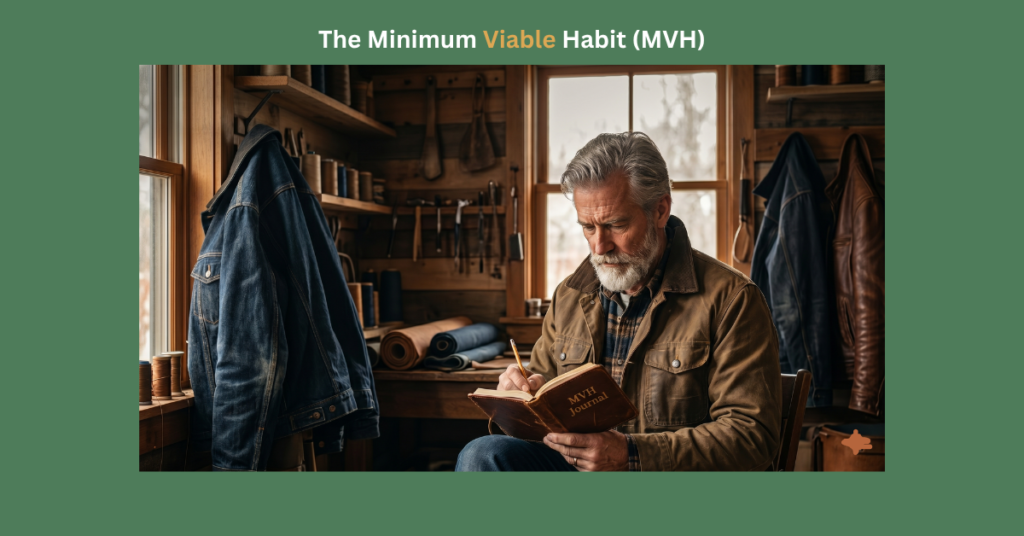
How to Build a Minimum Viable Habit (MVH) to Break In Heavy Jackets
How to Build a Minimum Viable Habit (MVH) to Break In Heavy Jackets
A step-by-step behavioral blueprint to soften raw denim, heavy leather, and waxed canvas without the agony.
Breaking in heavy leather, raw denim, or waxed canvas jackets requires abandoning painful, full-day wear tests and adopting a Minimum Viable Habit (MVH): a strategic, low-friction daily routine that uses consistent body heat and micro-movements to soften “cardboard armor” without the exhaustion that leads to quitting.
Investing in high-quality heritage menswear often results in frustration when the garment feels like a straightjacket, leaving it hanging neglected in the closet. The solution is not sheer willpower. The MVH protocol operates precisely at the intersection of micro-behavioral psychology and thermodynamic material relaxation.
This guide provides a complete, step-by-step system to build a daily jacket break-in habit that guarantees a perfectly molded, comfortable fit in 30 days.
Why traditional jacket break-in routines fail
Traditional jacket break-in routines fail because attempting a full-day wear of stiff, heavy fabric immediately causes physical exhaustion and restricted movement, transforming excitement into frustration and guaranteeing the jacket stays in the closet.
Behavioral science perfectly explains this failure rate. According to the Fogg Behavior Model (B=MAP)[1], a behavior only occurs when Motivation, Ability, and a Prompt converge at the same moment. Traditional methods demand extraordinarily high Motivation to overcome severely restricted Ability, which is directly caused by the physical agony of a rigid garment. Your habit inevitably crashes the moment that initial motivation naturally wanes.
Furthermore, wearing an unbroken jacket incurs a massive cognitive cost. Fighting rigid starch bonds in denim or the dense collagen fiber networks in horsehide acts as a continuous low-level stressor on your body, draining your executive function throughout the day.
- Rule: Avoid full-day wear immediately.
- Reason: Exhaustion from extreme stiffness leads to quitting.
- Result: The expensive jacket becomes a permanent closet fixture.
What makes the Minimum Viable Habit successful?
The Minimum Viable Habit (MVH) is successful because it prioritizes daily consistency over high intensity, utilizing your natural body heat and localized micro-movements to gently break down rigid fibers over time.
Thermodynamics handle the heavy lifting when you apply a steady 37°C (98.6°F) ambient body heat transfer to these dense materials. For a heavy leather jacket, body heat lowers the viscosity of internal waxes and fatliquors. This thermal reaction allows these oils to coat the triple-helix collagen fibrils so they slide against one another without snapping. When you break in raw denim, heat combined with imperceptible skin moisture acts to safely relax the rigid hydrogen bonds within the starch (sizing) matrix. Finally, for a waxed canvas jacket, body heat softens the crystalline structure of the wax matrix without liquefying it, as standard paraffin only melts between 46°C and 68°C.
Advanced Mechanism: Kinetic energy at 37°C safely lowers viscosity and relaxes hydrogen bonds without degrading core fiber integrity.
The Old Way vs. The MVH Protocol
Traditional Break-In
- High Intensity
- Mechanical force (crushing/bending)
- Micro-tears and structural degradation
- High quit rate
MVH Protocol
- High Consistency
- Natural 37°C body heat
- Safe relaxation of dense collagen/starch bonds
- 100% completion rate
Choose a low-friction activity for your daily habit
Choosing a low-friction, stationary activity for your daily habit ensures you can easily wear your stiff jacket without requiring deep arm movements or complex physical exertion.
Behavioral psychologists refer to this as habit stacking, which involves anchoring a new routine to an existing behavior. Formulating strict implementation intentions around a stationary trigger eliminates the psychological barrier to entry. You simply put the jacket on while doing something you were already going to do.
Select your daily stationary trigger:
Behavioral Science: Tethering to an existing anchor completely bypasses the friction of executive decision-making.
Set the optimal time limit for your protocol
Setting an optimal, highly restricted time limit based on your fabric’s weight prevents physical fatigue and guarantees you can successfully complete your daily habit without dread.
Fabric weight determines the required thermodynamic exposure time. Denim weighing over 16oz qualifies as heavyweight, while 20-25oz is considered ultra-heavy. Leather thickness relies on ounces per square foot, where one ounce equals roughly 1/64th of an inch. Match your specific garment to the matrix below to establish your baseline.
| Fabric Type | Time Limit |
|---|---|
| Ultra-heavy (20oz+ denim / 3.5oz+ front-quarter horsehide) | 5 Minutes |
| The Sweet Spot (14-18oz denim / standard steerhide) | 15 Minutes |
| Medium canvas/softer leather | 30 Minutes |
Exceeding these precise times during Week 1 causes active physical fatigue and cognitive depletion, directly risking habit burnout.
Choose the most consistent environment
Choosing a highly consistent, climate-controlled environment for your break-in protocol eliminates weather dependency, ensuring you can execute your habit whether it is raining, snowing, or humid outside.
Heavyweight leather and raw denim are highly hygroscopic materials. This means they readily absorb and release moisture, making them highly susceptible to drastic shifts in humidity and ambient temperature.
-
Best
Climate-controlled living room A stable indoor climate maximizes the 37°C body heat transfer directly into the jacket fibers.
-
Poor
Drafty garage Cold air keeps leather and wax completely stiff, fighting your body heat and halting the softening process.
-
Variable
Humid kitchen Atmospheric moisture can cause the cotton cellulose in denim to swell by up to 40% in diameter, making the garment tighter and significantly more restrictive.
Define your official MVH formula
Defining your official Minimum Viable Habit formula translates your selected activity, time limit, and environment into a binding psychological contract that removes all daily friction.
Writing this formula down entirely eliminates daily decision fatigue. Before finalizing your contract, you must understand the biomechanics of zipper waves. Zipping a highly rigid jacket forces the chest to bow outward. Because the zipper tape lacks the stretch dynamics of the surrounding textile or leather, this tension creates permanent, undulating damage along the front of the garment. Leave it open.
Prevent common jacket break-in mistakes
Preventing common jacket break-in mistakes requires identifying and avoiding high-commitment scenarios that sabotage your daily consistency and invite the urge to quit.
The Mistake (Bad Example)
Wearing a 22oz jacket to work all day.
This is a high-commitment, weather-dependent error. Dry heat outdoors can flash-evaporate essential fatliquors from leather. Furthermore, forced physical exertion causes severe chafing at the popliteal fossa (if breaking in heavy jeans) or the inner elbows.
The Fix (Good Example)
Wearing it over a t-shirt during morning coffee for 10 minutes.
This features zero weather dependency, provides an easy psychological out, and is highly repeatable.
Commit to your 30-day jacket break-in mission
Committing to a 30-day jacket break-in mission shifts your focus from achieving instant comfort to achieving daily execution, allowing time and friction to do the heavy lifting.
Research conducted by Phillippa Lally at University College London[2] demonstrates the science of habit formation. While it averages 66 days for total habit automaticity, hitting 30 days of unbroken consistency serves as the critical threshold required to establish deep neural pathways within the basal ganglia.
I commit to consistency over perfection. I will execute my MVH formula daily for 30 days.
The 30-Day MVH Execution Tracker
Bookmark this page or check off one box immediately after completing your daily time limit.
Neurological Milestone: Completing this 30-box grid visually tracks the structural changes occurring in your basal ganglia as the habit reaches permanent automaticity.
Frequently asked questions
To ensure total clarity, here are the answers to the most frequently asked questions regarding the execution of the Minimum Viable Habit for heavy jackets.
What if I miss a day of my jacket break-in routine?
Can I zip the jacket during my MVH time?
Does body heat really soften raw denim that fast?
Launch your jacket break-in habit today
In conclusion, breaking in a heavy jacket is a marathon won through micro-habits, not a sprint won by enduring agonizing, full-day wear.
Applying 37°C body heat softens leather and fabrics safely, while low-friction activities and strict time limits protect your motivation. This combination of thermodynamic physics and behavioral psychology is the only reliable way to tame heritage menswear.
Scientific & Literary References
- Fogg, B. J. (2009). A behavior model for persuasive design. Proceedings of the 4th International Conference on Persuasive Technology. Stanford University.
- Lally, P., van Jaarsveld, C. H. M., Potts, H. W. W., & Wardle, J. (2010). How are habits formed: Modelling habit formation in the real world. European Journal of Social Psychology, 40(6), 998-1009.
- Clear, J. (2018). Atomic Habits: An Easy & Proven Way to Build Good Habits & Break Bad Ones. Avery Publishing.