
Why Does Jacket Style Matter When Choosing a Jacket?
Jacket style matters when choosing a jacket because the garment’s visual silhouette and architectural cut dictate both its environmental utility and its seamless integration into your daily social and professional wardrobe. Purchasing outerwear based purely on technical specifications—such as hydrostatic head ratings or insulation density—while ignoring the visual silhouette frequently results in aesthetic mismatches that render the garment unwearable in daily life. An incredibly waterproof shell fails its primary duty if its structural cut prevents it from fitting neatly over a structured blazer. Conversely, selecting garments purely for visual appeal without analyzing their structural geometry leads to restricted mobility, inadequate environmental defense, and a fragmented wardrobe architecture.
This guide provides a rigorous framework to assess outerwear aesthetics for specific environments, compare tailored garment silhouettes, and avoid high-stakes style mistakes. We systematically analyze the architecture of men’s and women’s outerwear to bridge the gap between technical apparel performance and sartorial advice. By mastering these foundational styling principles, you construct a resilient wardrobe capable of adapting to shifting environmental demands. Outerwear functions as the terminal defensive layer of your personal presentation. It dictates the initial physical impression you broadcast to your environment. Therefore, understanding the interplay between garment geometry and functional apparel evaluation guarantees long-term satisfaction and utility. Ignorance of these structural mechanics generates financial waste and wardrobe dissonance.
Why evaluating jacket style dictates both performance and daily utility
Evaluating jacket style dictates both performance and daily utility by ensuring the garment’s visual silhouette structurally aligns with its intended end-use environment. A highly specialized garment loses its practical value the moment its design language conflicts with the social or physical requirements of the wearer’s surroundings. The structural lines, pocket placement, and fabric drape all dictate how efficiently the piece functions. Integrating a garment into your lifestyle requires an objective diagnostic analysis of its physical parameters.
Rule: Aligning your outerwear’s visual silhouette with the intended end-use environment guarantees seamless physical mobility and appropriate social presentation. Proper structural alignment prevents the functional and aesthetic friction of wardrobe mismatch.
Reason: A highly technical cut looks severely out of place and functions poorly in a formal or professional setting. Garments engineered for alpine ascents prioritize aggressive articulation, high-visibility color palettes, and helmet-compatible hoods. These aggressive features violently disrupt the clean, minimalist lines required for professional attire. The excess fabric engineered for reaching maneuvers, combined with rigid waterproof zippers, clashes against the soft tailoring of worsted wool suits.
Example: Consider the scenario of wearing a brightly colored, articulated hardshell over a tailored business suit. This specific combination causes severe fabric bunching at the chest and shoulders. The active-fit shoulders compress the suit’s structured padding, resulting in a severe aesthetic mismatch and restricted physical comfort. The wearer experiences restricted biomechanics and broadcasts a disorganized visual profile to their professional peers.
How to assess your outerwear aesthetics for your specific environment
Assessing your outerwear aesthetics requires a systematic evaluation of your daily environments to determine whether an urban, active, or technical silhouette is required. You must audit your standard transit routes, professional obligations, and weekend mobility patterns. This data directly informs the physical geometry your clothing must possess. Implementing this diagnostic framework eliminates emotion-driven purchasing errors.
The Urban Commute: Evaluate longer silhouettes like trench coats and Mac coats for over-suit coverage and professional presentation. An urban professional requires garments that shield delicate suiting fabrics from environmental degradation while preserving a sharp, unified vertical line. Structured topcoats utilize specific tailoring techniques, such as raglan sleeves or meticulously constructed shoulders, to physically encapsulate a suit jacket without compressing its internal padding. The extended hem lengths prevent the internal blazer from protruding beneath the outerwear, a structural failure that destroys the visual harmony of traditional menswear. By isolating the commute as a distinct environmental challenge, the wearer guarantees that their presentation remains immaculate upon arrival.
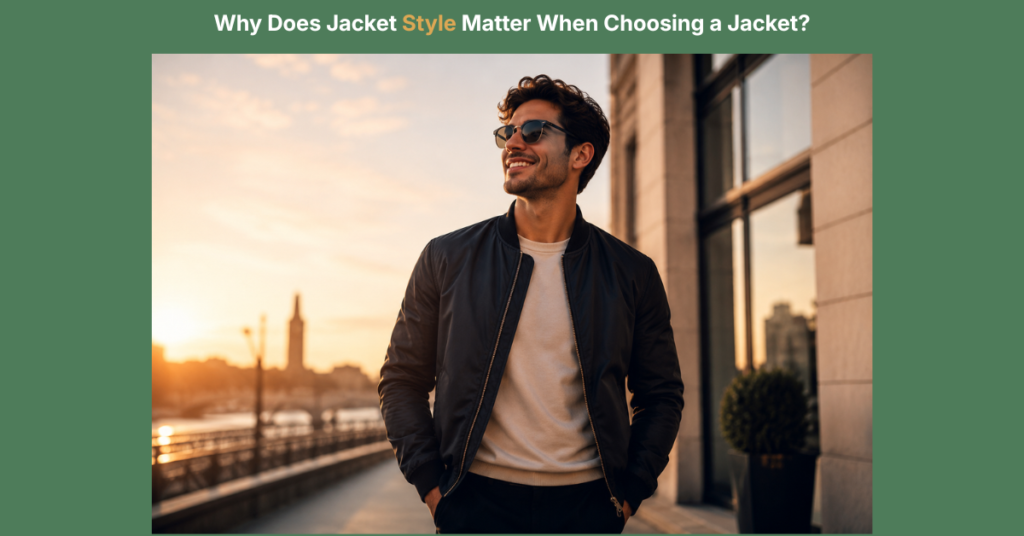
The Active Transition: Look for cropped bomber or moto styles for casual, high-mobility flexibility. A Bomber Jacket or classic aviator style terminates exactly at the natural waistline, utilizing a ribbed hem to lock the garment in place during dynamic movement. This precise cutoff eliminates excess fabric around the hips and thighs, ensuring maximum freedom of movement when driving, cycling, or navigating fast-paced weekend environments. Casual aesthetics demand unrestricted biomechanical movement. For a deeper analysis of these specific casual geometries and their functional integration into a transitional wardrobe, explore how to style a bomber jacket.
The Technical Pursuit: Assess drop-tail hems and athletic fits engineered explicitly for outdoor environments. High-output physical activities require garments that adapt to dynamic body mechanics. A drop-tail hem provides extended coverage for the lower back during forward-leaning maneuvers, while articulated elbows and gusseted underarms eliminate lifting constraints during aggressive outdoor tasks. These specialized cuts manage internal microclimates and provide maximum coverage against hostile weather conditions.
| Daily Environment Type | Primary Functional Requirement | Appropriate Garment Silhouette |
|---|---|---|
| Formal Business / Corporate Commute | Over-suit encapsulation, minimalist drape | Mac Coat, Traditional Trench Coat |
| Casual Weekend / High-Mobility Transit | Biomechanical freedom, waist-level termination | Bomber Jacket, Leather Moto Jacket |
| Aggressive Outdoor / Weather Defense | Microclimate management, full-range articulation | Articulated Hardshell, Technical Parka |
Compare tailored garment silhouettes to match your daily wardrobe
Comparing tailored garment silhouettes allows you to precisely match outerwear cuts to your daily wardrobe, seamlessly differentiating between minimalist formalwear and utility-heavy outdoor apparel. The architecture of your outermost layer must geometrically align with the layers situated beneath it. Forcing incompatible silhouettes together destroys the physical integrity of both garments. A clinical evaluation of these interactions preserves your clothing investments.
If: The user predominantly wears business casual or formal office attire. This includes structured blazers, tailored trousers, and fine-gauge knitwear that require space to drape properly without compression.
Do: Select a minimalist topcoat or a neutral-toned Mac coat rather than a baffled puffer. Ensure the overcoat features soft shoulders and an extended length to fully encapsulate the layers underneath. Avoid high-volume down insulation that visually distorts the body’s natural lines and applies unnecessary pressure to delicate suiting fabrics.
Result: The jacket seamlessly integrates with the outfit without compromising professional presentation standards or warping the suit’s shoulders. The wearer maintains an authoritative presence, protected from the elements, while the internal layers remain pristine, unwrinkled, and structurally intact.
| Style Category | Ideal Under-Layers | Best Suited Occasion |
|---|---|---|
| Minimalist Mac Coat / Trench | Tailored suits, structured blazers, fine knitwear | Corporate environments, formal events, urban commutes |
| Aviator Style / Bomber Jacket | T-shirts, lightweight sweaters, casual denim | Weekend transitions, driving, casual social gatherings |
| Baffled Puffer / Alpine Shell | Heavy fleece, technical base layers, activewear | Extreme cold environments, outdoor technical pursuits |
Avoid jacket style mistakes that clash with your functional needs
Consumers frequently compromise environmental protection and professional presentation by committing jacket style mistakes, specifically prioritizing fleeting aesthetic trends over functional needs. A garment represents a specific engineering solution; misapplying that solution generates physical discomfort and social friction. Disregarding the relationship between hemline and weather exposure drastically reduces a garment’s efficacy. Protecting your financial investment requires strict adherence to functional geometry rather than superficial fashion cycles.
The Length Mistake: Buying a cropped aviator style for heavy rain protection. An aviator silhouette exposes the waistline and lower body to vertical precipitation and horizontal wind shear, failing to create a sufficient microclimate.
Fix: Opt for a parka or trench coat design that extends past the waistline to shed water efficiently away from the trousers. This extended geometry creates a physical barrier that guides moisture down to the ground, fully shielding the internal layers and maintaining core body temperature during severe weather events.
The Trend Mistake: Choosing a heavily branded, neon streetwear piece that quickly falls out of fashion. Hyper-specific visual designs lack the versatility required for daily integration, locking the user out of diverse social settings and generating a high cost-per-wear ratio.
Fix: Invest in timeless, neutral silhouettes that survive seasonal trend cycles and maintain long-term cost-per-wear value. Classic architectural cuts—like the Mac coat or traditional bomber—rely on functional geometry rather than artificial branding to generate visual appeal. Neutral tones integrate effortlessly into existing wardrobe architectures.
To understand how timeless silhouettes interact with weather defense, review our comprehensive guide on The Anatomy of a Trench Coat.
The ultimate jacket style checklist to verify before checkout
Use this ultimate jacket style checklist to perform a rapid, foolproof visual audit of the garment’s practicality, structural integration, and long-term aesthetic relevance before finalizing checkout. This diagnostic tool forces an objective evaluation of the physical item against your established wardrobe architecture. It eliminates emotion-driven purchasing errors by requiring hard factual answers about the garment’s functional and social capabilities.
Review the following diagnostic parameters. A failure to validate any of these exact metrics indicates a high probability of wardrobe mismatch and eventual garment abandonment.
- • [ ] Does this silhouette layer smoothly over my most commonly worn mid-layers?
- • [ ] Is the visual design appropriate for my daily social or professional environment?
- • [ ] Will this aesthetic and colorway remain relevant in my wardrobe three years from now?
Answering these questions affirmatively confirms the garment operates as a highly functional, long-term asset rather than a temporary, isolated purchase.
Commit to your ideal jacket style to maximize your wardrobe versatility
In conclusion, committing to your ideal jacket style maximizes your wardrobe versatility by structurally guaranteeing the garment enhances your personal presentation while meeting your functional demands.
Always ensure your outerwear visually matches the specific context of your lifestyle. A coat that radically clashes with your existing wardrobe will remain unworn in the closet, regardless of its premium technical specifications. Identify your daily dress code, select a complementary cut, and ensure your outerwear enhances your personal presentation every single day.