
Does Jacket Packability Matter When You Are Buying?
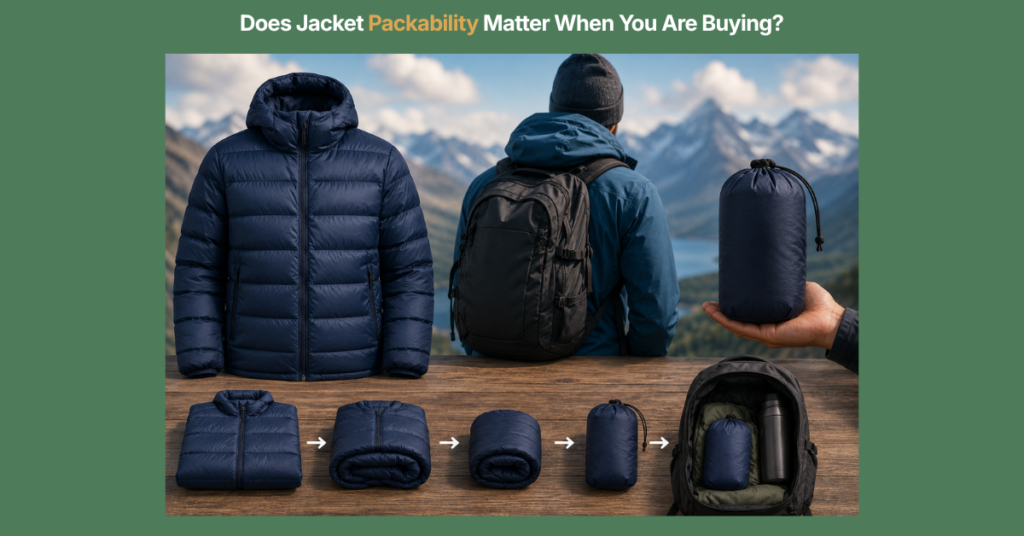
Jacket packability matters when buying because a garment’s compressed volume directly dictates transit flexibility and luggage capacity, forcing consumers to evaluate spatial efficiency alongside thermal defense. Purchasing outerwear based purely on aesthetics or flat-layout size frequently results in transit bottlenecks and compromised luggage space during critical travel logistics. This guide provides a rigorous diagnostic framework for testing compressible jacket materials, avoiding packing mistakes that permanently damage performance fabrics, and streamlining spatial logistics.
Why analyzing jacket packability determines your overall travel comfort
Analyzing jacket packability determines your overall travel comfort by aligning the outerwear’s compressed storage size precisely with your physical transit limitations and maximum luggage capacity. Prioritizing compressed storage size over flat-layout aesthetics ensures that your primary weather defense does not become a logistical liability. Excess outerwear bulk restricts transit flexibility and causes unnecessary luggage strain, forcing travelers to sacrifice essential gear to accommodate a single rigid garment.
Consider a traveler attempting to navigate a crowded transit hub with a large, non-compressible synthetic parka. Because the coat cannot be reduced in size, it occupies the majority of the internal volume of a standard 30-liter daypack, forcing the wearer to carry additional items externally or utilize a larger, more cumbersome bag. Conversely, a garment engineered for high compressibility maintains the same thermal defense while occupying less than 20% of that same internal volume, leaving ample room for other travel necessities.
How to test jacket packability before completing your purchase
Testing jacket packability before completing your purchase requires a systematic physical evaluation of internal pocket integration, compressed volume measurements, and face fabric wrinkle recovery. Technical outerwear requires a diagnostic approach to ensure the garment performs under the mechanical stress of compression.
-
Internal Pocket Integration: Verify if the coat stuffs entirely into its own dedicated self-stow pocket or if it necessitates an external stuff sack. Integrated systems reduce the risk of losing storage components during transit.
-
Compressed Volume Measurement: Compare the manufacturer’s stated compressed dimensions against the interior volume of your primary carry-on or backpack. A jacket that claims to be “packable” but remains rigid after compression fails the primary spatial efficiency test.
-
Fabric Wrinkle Recovery: Evaluate how the face fabric reacts after being tightly compressed for an hour. High-performance shells should regain their original structure quickly, whereas low-quality synthetic weaves may retain creases that affect water-repellency and aesthetic integrity.
Decision Matrix: Insulation Styles vs. Compressed Dimensions
| Insulation Type | Typical Fill-Power / Weight | Average Compressed Size |
|---|---|---|
| High-Fill Natural Down | 800+ FP | 1.0 – 1.5 Liters |
| Mid-Fill Natural Down | 600 – 700 FP | 1.5 – 2.5 Liters |
| Synthetic Micro-Fiber | 60g – 100g/m² | 2.5 – 4.0 Liters |
Compare compressible jacket materials to optimize your luggage space
Comparing compressible jacket materials optimizes your luggage space by revealing the distinct spatial volume differences between high-fill-power natural down and synthetic continuous filaments. Each material requires a specific compression threshold to maintain its structural integrity and loft.
If the user’s primary transit goal requires maximum space-saving and minimal weight, then prioritize high-fill-power natural down jacket fills. The result is that the garment effortlessly compresses down to the size of a water bottle, leaving ample room in a travel pack.
If the user’s transit involves high-moisture environments where insulation must remain effective while damp, then choose synthetic continuous filament insulation. While the result is a slightly larger compressed footprint compared to premium down, the synthetic fibers maintain their loft even if the shell fabric fails, providing a safer, albeit bulkier, transit solution.
Insulation Comparison Table
| Insulation Material Type | Compression Ratio Potential | Ideal Packing Method |
|---|---|---|
| High-Fill Natural Down | High (15:1) | Compression Sack/Self-Stow |
| Synthetic Filament | Moderate (8:1) | Structured Folding/Roll |
| High-Loft Synthetic | Low (4:1) | Loose Packing (Avoid) |
Avoid jacket packing mistakes that permanently damage performance fabrics
Consumers frequently ruin their outerwear investments by committing jacket packing mistakes, specifically subjecting technical fabrics to prolonged storage compression or improper moisture management. Performance gear is engineered for utility, not for permanent reduction in volume.
The Storage Mistake: Leaving a highly compressible coat stuffed inside its tiny transit bag for months at home.
The technical fix: Only compress the garment during active transit; store it loose on a large-diameter hanger to preserve long-term insulation loft and prevent premature fiber breakdown.
The Wet-Packing Mistake: Rolling up a damp jacket into a tight compartment.
The technical fix: Ensure the shell fabric and internal insulation are completely dry before compression to block mold development and prevent face fabric delamination.
To maximize the structural lifespan of your garments, follow our technical guide on How to Wash and Store Performance Outerwear.
The ultimate jacket packability checklist to verify before checkout
Use this ultimate jacket packability checklist to perform a rapid, foolproof quality audit of a garment’s space-saving attributes and transit features before finalizing checkout.
- [ ] Does the compressed jacket volume align cleanly with my primary travel luggage limits?
- [ ] Is a dedicated stuff sack or internal self-stow pocket present on the garment?
- [ ] Does the outer shell utilize lightweight denier nylon to maximize compressibility?
- [ ] Does the insulation type match my target balance of warmth versus packable volume?
- [ ] Can the garment recover its loft within 30 minutes after being removed from a compressed state?
Commit to the right jacket packability level to streamline your next trip
In conclusion, committing to the right jacket packability level streamlines your next trip by structurally balancing essential weather defense with optimized spatial logistics. Always let your actual luggage limitations dictate the physical bulk of your gear choices. A winter coat that is too heavy or rigid to pack down smoothly turns into a logistical liability when you are on the move. Assess your packing limits, secure a highly compressible design that fits your space, and optimize your entire travel setup.