
Are Jacket Features Important When Choosing a Jacket?
Jacket features are critically important when choosing a jacket because the inclusion of functional components—such as mechanical ventilation, waterproof hardware, and articulated cuffs—directly dictates the garment’s field utility and environmental defense.
Purchasing outerwear based purely on base aesthetics while ignoring technical additions inevitably results in catastrophic field failures, such as internal sweat buildup or freezing drafts. When consumers evaluate a shell or insulated layer entirely on its colorway or silhouette, they bypass the structural engineering that keeps the human body alive and functional in hostile weather. The external fabric of a garment only performs as well as the hardware securing it. Missing toggles, poorly aligned zippers, or absent storm flaps immediately compromise the entire physical barrier, allowing precipitation and wind to bypass high-end ePTFE membranes.
This guide provides a rigorous diagnostic framework for assessing core outerwear components, comparing specialized garment features for carrying capacity, and avoiding high-stakes hardware mistakes. By applying strict physical evaluations to every zipper, hood, and cuff, buyers ensure their gear operates precisely as intended under duress.
Why evaluating jacket features prevents costly field failures
Evaluating jacket features prevents costly field failures by ensuring the garment possesses the precise mechanical components required for active thermal regulation and sustained weather protection.
High-performance outerwear operates as a localized microclimate management system. Every millimeter of the garment must perform a specific physiological or environmental job. Ignoring the mechanical reality of these features guarantees structural defeat.
Rule: Prioritize functional components over base aesthetics to establish a reliable baseline of physical protection and thermal efficiency.
Reason: An advanced waterproof shell fails its primary objective if it lacks the mechanical ventilation needed to dump metabolic internal heat. Even membranes with exceptional breathability ratings cannot transfer moisture faster than the human body generates it during sustained, heavy exertion.
Example: Consider the physiological consequence of sweating completely through base layers because the jacket lacked mechanical pit zips during a steep, high-output hike. The trapped moisture condensates against the interior of the cold shell, destroying the garment’s internal microclimate and initiating rapid conductive heat loss the moment physical activity ceases.
How to assess core outerwear components for your specific end-use
Assessing core outerwear components for your specific end-use requires a systematic physical evaluation of hood architecture, zipper integrity, and cuff articulation.
Structural analysis separates authentic technical apparel from visually similar casual wear. Garment hardware dictates the boundaries of user mobility and environmental isolation.
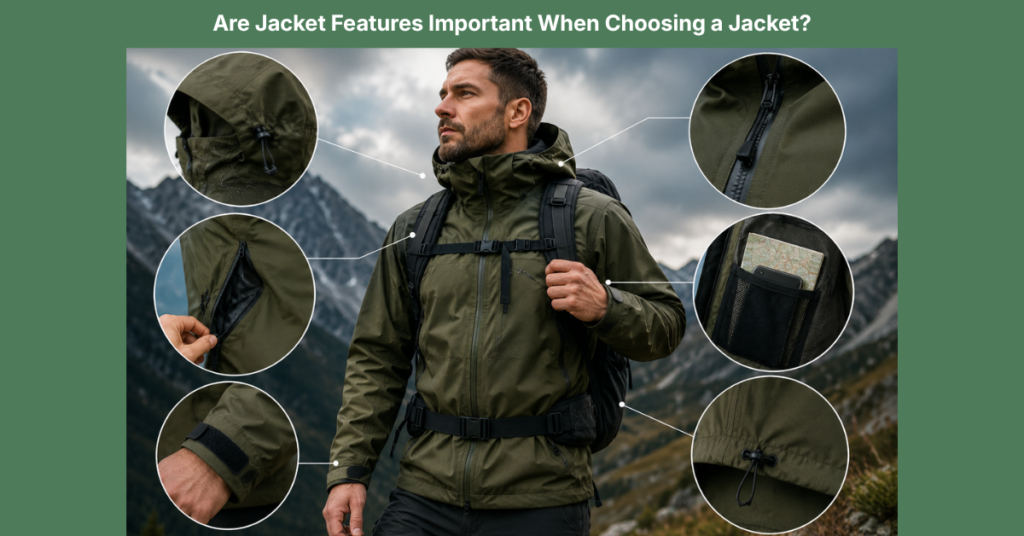
- Hood Architecture: Check for wire-stiffened brims and multi-point adjustability to maintain peripheral vision during storms. A high-volume hood must feature rear crown tensioners and front aperture drawcords. These mechanisms prevent the fabric from collapsing over the eyes during high-velocity wind events while allowing the hood to securely track with the natural rotation of the user’s head.
- Zipper Integrity: Look for two-way, water-resistant YKK VISLON zippers backed by internal storm flaps to prevent wind ingress. The structural rigidity of VISLON teeth prevents separation under heavy lateral tension. Furthermore, the mandatory internal storm flap acts as a secondary physical barricade, catching any moisture driven horizontally through the zipper tape by gale-force winds.
- Articulated Cuffs: Evaluate Velcro or elastic closures for seamless, draft-free winter glove integration. Proper cuff articulation relies on anatomical patterning that curves with the natural resting state of the human arm. Buyers should apply a dynamic fit-constraint protocol to diagnose mobility loss: extend the arms fully forward and overhead to confirm the cuffs do not recede past the wrist bone, which exposes the radial artery to rapid heat loss.
Decision Matrix: Mapping Primary Activity Against Required Core Features
| Primary End-Use Activity | Required Hood Architecture | Minimum Zipper Specification | Mandatory Cuff Construction |
|---|---|---|---|
| High-Output Alpine Climbing | |||
| Sustained Trekking / Backpacking | Low-volume, dual-point adjustable, stiffened peak. | Standard YKK coil with robust external and internal storm flaps. | Elasticized or standard Velcro tabs for quick adjustment on the move. |
| Static Urban Commuting | Storable or zip-off hood, minimal low-profile adjustments. | Single-way YKK VISLON, prioritized for rapid deployment. | Cleanly finished internal snap closures or concealed elastic bands. |
Compare specialized garment features to optimize your carrying capacity
Comparing specialized garment features optimizes your carrying capacity by precisely matching external pocket configurations and internal storage layouts to your daily logistical needs.
Pocket placement directly impacts the center of gravity and the user’s biomechanical efficiency. Technical apparel engineers design storage layouts based on the anticipated interference from climbing harnesses, heavy backpack hip belts, and chest rigs.
If: The user regularly carries physical gear (phones, gloves, tools) in wet environments…
Do: Select a layout with waterproof chest pockets and internal mesh dump pockets.
Result: The user achieves hands-free utility while safely protecting sensitive electronics from environmental moisture.
Applying this logic forces the buyer to reject garments that position standard handwarmer pockets directly beneath the compression line of a backpack waist belt. Examining the interior volume of internal mesh dump pockets reveals the garment’s capacity to safely thaw frozen winter gloves using radiant body heat without exposing the gloves to external precipitation.
| Feature Type | Functional Benefit | Ideal User Profile |
|---|---|---|
| Napoleon Chest Pockets (Waterproof) | Provides immediate access to navigation tools or electronics without disrupting harness or hip-belt placement. | Mountaineers, alpine climbers, and heavy-pack hikers. |
| Internal Stretch-Mesh Dump Pockets | Utilizes core body heat to dry wet accessories (gloves, beanies) and offers massive volume for soft items. | Backcountry skiers and high-output winter athletes. |
| Lower Bellows Hand Pockets | Maximizes overall physical storage capacity for large, non-sensitive items in non-technical scenarios. | Urban commuters, field photographers, and casual travelers. |
| Sleeve/Forearm Pass Pockets | Enables frictionless RF scanning at turnstiles or gates without unzipping the main chassis. | Resort skiers and urban transit users. |
Avoid jacket feature mistakes that compromise weather protection
Consumers frequently compromise weather protection by committing jacket feature mistakes, specifically paying premiums for over-engineered, gimmick-heavy additions that add dead weight.
Manufacturers occasionally disguise inferior fabric technology by overwhelming the buyer with an excess of superficial hardware. Every seam, zipper, and pocket introduces a structural vulnerability to the garment’s continuous waterproof barrier. More features mathematically equal more potential points of failure unless meticulously engineered and backed by fully seam-taped construction.
Paying a premium for excessive straps or built-in compasses that add physical weight without offering environmental utility.
Re-route the budget to critical, high-performance components like fully seam-taped construction or an ePTFE membrane. Advanced micro-porous laminates and high-density face fabrics provide passive, invisible performance that radically outperforms heavy, aesthetic-driven tactical hardware.
Buying a heavy winter shell without mechanical underarm vents.
Always ensure high-output garments feature pit zips to prevent internal sweat buildup and maintain a stable Moisture Vapor Transmission Rate (MVTR). Relying solely on the fabric’s breathability during intense cardiovascular output represents a fundamental misunderstanding of thermal dynamics. Mechanical venting immediately exhausts trapped convective heat.
To understand why heat extraction is as important as waterproofing, review our technical guide on Moisture Vapor Transmission Rates.