
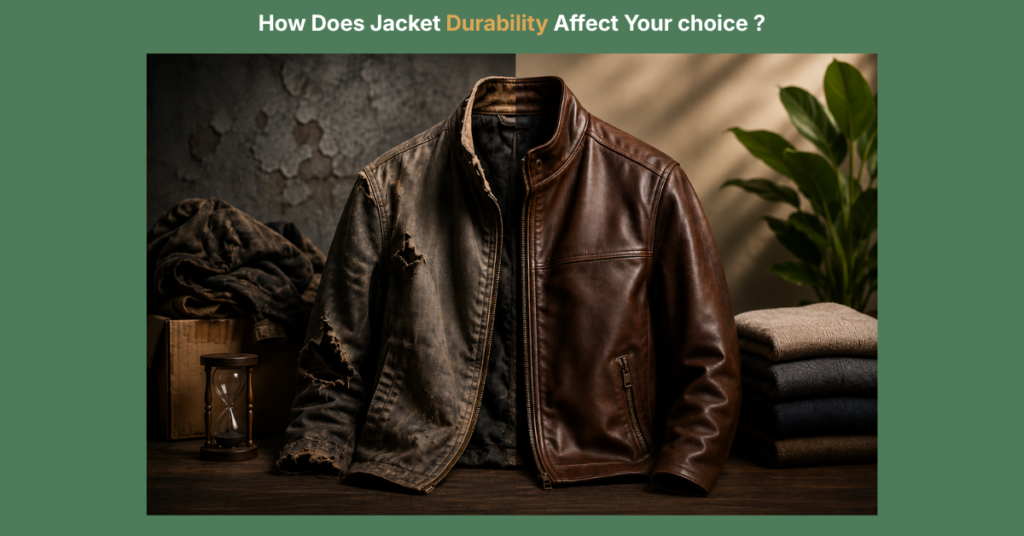
How Does Jacket Durability Affect Your Choice?
Jacket durability affects your choice by dictating the garment’s long-term financial return on investment, requiring buyers to prioritize physical textile construction over initial retail prices. Purchasing outerwear based purely on brand aesthetics frequently results in catastrophic hardware failure and expensive, repeated replacement cycles. Consumers routinely ignore textile engineering metrics in favor of fashion trends, leading directly to the acquisition of structurally compromised garments. This guide provides a rigorous diagnostic framework for assessing outerwear longevity, comparing premium garment resilience against budget alternatives, and avoiding high-stakes durability mistakes.
Transitioning from an aesthetic-driven purchasing model to a clinical, structural evaluation requires a fundamental understanding of Cost-Per-Wear (CPW) economics. Garments constructed with high-density weaves and reinforced hardware demand a higher initial capital outlay but deliver exponential value over a ten-year lifespan. Conversely, rapidly manufactured apparel utilizes sub-standard thread tensions and inferior polyurethane coatings that disintegrate rapidly under moderate field use. You must evaluate the physical properties of the materials, the precision of the manufacturing techniques, and the chemical stability of the weatherproofing treatments. True garment resilience is an objective, measurable science, not a subjective marketing claim.
Why evaluating jacket durability prevents expensive replacement cycles
Evaluating jacket durability prevents expensive replacement cycles by exposing cheap materials that degrade rapidly under elemental stress, significantly lowering the long-term cost-per-wear. Ignoring structural integrity during the acquisition phase directly guarantees premature material failure. Sub-standard textiles face rapid photodegradation from ultraviolet light, while weak seams suffer instant catastrophic blowouts under active tension.
Prioritize physical fabric construction over the brand logo to guarantee structural longevity and maximize your financial investment. Cheap materials degrade rapidly under elemental stress, such as chronic UV exposure and friction-induced abrasion, forcing repeated, costly purchases that inflate your lifetime outerwear expenditure. Consider a scenario where a budget coil zipper derails during a high-altitude winter storm; this singular mechanical failure renders the entire coat instantly useless, exposing the wearer to severe weather and initiating an immediate, emergency replacement purchase.
When buyers calculate Cost-Per-Wear (CPW), they divide the initial retail price by the total number of days the garment actively performs its intended function. A $50 fast-fashion windbreaker that delaminates after ten rainy commutes possesses a highly inefficient CPW of $5.00 per wear. A $400 technically engineered shell that withstands a decade of harsh alpine environments maintains a CPW measured in fractions of a cent. Therefore, conducting a diagnostic evaluation of the physical hardware and textile resilience fundamentally insulates your wallet against planned obsolescence.
Graphic 1: The Economics of Cost-Per-Wear (CPW)
This economic projection illustrates the compounding financial liability of budget outerwear versus the flat-line stability of premium technical gear. The red trajectory represents the “Budget Replacement Cycle”—characterized by an initially low purchase price that is quickly offset by frequent, mandatory repurchases due to rapid material failure. The green trajectory represents a “Premium Shell”; despite the higher initial capital outlay, its structural resilience eliminates replacement costs over a ten-year lifespan, fundamentally insulating the buyer against planned obsolescence.
How to assess outerwear longevity before making your jacket choice
Assessing outerwear longevity requires a systematic physical inspection of hardware integrity, stitching density, and face fabric composition before finalizing your jacket choice. High-performance apparel manufacturers leave objective, physical markers of quality throughout the garment’s construction. Identifying these specific manufacturing metrics separates authentic technical gear from superficial lifestyle apparel.
Hardware Integrity: Check for molded-tooth YKK Zippers and metal-reinforced snap closures. Authentic YKK VISLON zippers utilize injected polyacetal resin to create self-lubricating teeth that resist cross-lateral torsion, preventing the slider mechanism from jamming or separating under heavy tension.
Stitching Density: Look for high Stitches-Per-Inch (SPI) counts and fully taped seams. Premium technical outerwear dictates a minimum of 10 to 12 SPI, which tightly binds the fabric panels to prevent physical water ingress and eliminate seam bursting during intense physical mobility.
Material Composition: Evaluate face fabric durability by checking the specific Denier (D) Rating for abrasion resistance. A higher denier number indicates a thicker, heavier yarn, meaning a 70D nylon plain weave resists rock friction and branch snags far more effectively than a fragile 20D cosmetic shell. For deeper technical specifications on matching yarn weight to environmental hazards, review our comprehensive resource on Understanding Fabric Denier Ratings.
Graphic 2: Microscopic Weave Density and Denier (D) Rating
This diagram visualizes the structural disparity between low-denier cosmetic fabrics and high-denier technical textiles. On the left, a 20D uniform polyester weave exhibits thin yarns and loose spacing, rendering it highly vulnerable to abrasion forces. On the right, a 70D+ ripstop nylon utilizes significantly thicker, high-tenacity yarns interspersed with a heavy reinforced grid pattern. This architectural “ripstop” technique aggressively halts micro-tears before they can expand, multiplying the garment’s kinetic durability.
To streamline your physical evaluation process, cross-reference the garment against this diagnostic matrix.
| Component Type | Quality Indicators for Longevity |
|---|---|
| Main Closure Systems | Molded-tooth YKK Zippers; oversized pull tabs; reinforced metallic snap bases; storm flaps with integrated drainage channels. |
| Seam Architecture | 12+ Stitches Per Inch (SPI); precision micro-seam allowances; three-layer tricot seam tape bonded via high-heat welding. |
| Face Fabric Textile | Minimum 40D to 70D Denier Rating; ripstop grid structures; integration of high-tenacity Cordura Nylon panels. |
| Internal Insulation | Closed-cell baffling geometry; continuous filament synthetic fibers; high fill-power down with hydrophobic chemical treatments. |
Compare premium garment resilience against budget fast-fashion alternatives
Comparing premium garment resilience against budget fast-fashion alternatives reveals the structural corner-cutting in mass manufacturing that inevitably compromises thermal loft and weather resistance. Industrial apparel factories reduce overhead costs by substituting microporous membranes with cheap polyurethane (PU) smears and replacing high-density nylon with low-grade polyester. These invisible substitutions drastically reduce the functional lifespan of the equipment.
If the user is choosing between a $100 fast-fashion coat and a $300 technical piece, they must execute a strict comparative analysis of the internal infrastructure.
Do inspect the internal insulation baffling and the outer shell denier rating by physically compressing the garment and reviewing the attached technical specification tags.
Result: The premium construction maintains thermal loft and dryness for a decade, while the budget option tears or flattens out after one single season of moderate use.
This stark disparity in performance originates directly from the factory floor. Budget garments utilize stitch-through baffling that creates thousands of micro-punctures in the shell, inviting cold spots and moisture penetration. Premium manufacturers deploy complex box-wall baffling construction that allows insulation to reach its maximum physical volume without creating thermal weak points.
Graphic 3: Structural Architecture of a Premium 3-Layer Membrane
This cross-section depicts a premium 3-layer (3L) expanded polytetrafluoroethylene (ePTFE) construction. The outermost layer is a robust face fabric treated with a Durable Water Repellent (DWR), forcing liquid water to bead and roll off. The central core is the microporous ePTFE membrane; its pores are physically smaller than water droplets but larger than vapor molecules, guaranteeing absolute external waterproofing while allowing internal sweat vapor to vent. The innermost protective backer defends the membrane from destructive body oils and friction.
| Jacket Component | Premium Standard | Budget Flaw |
|---|---|---|
| Weatherproof Membrane | Breathable ePTFE Membrane (expanded polytetrafluoroethylene) that blocks liquid water while allowing vapor to escape. | Solid Polyurethane (PU) coating that traps sweat internally and completely delaminates after three wash cycles. |
| Abrasion Panels | High-wear zones (shoulders, cuffs) utilize 70D+ Cordura Nylon for maximum friction defense. | Uniform, low-denier polyester throughout the entire garment, highly susceptible to strap friction tearing. |
| Water Repellency | Factory-baked C6 or PFC-free Durable Water Repellent (DWR) that bonds at the molecular level to the yarn. | Cheap silicone spray finishes that wash away immediately in heavy rain, causing the face fabric to saturate. |
| Pocket Architecture | Laser-cut, welded pocket borders with AquaGuard zippers to secure electronics against moisture. | Standard coil zippers with zero water resistance and single-stitched pocket bags that tear under the weight of keys. |
Avoid jacket durability mistakes that ruin long-term weather protection
Consumers frequently ruin long-term weather protection by committing jacket durability mistakes, specifically assuming that luxury designer logos guarantee technical field performance. A high retail price tag assigned by a fashion house rarely correlates with advanced textile engineering. Shoppers continuously destroy expensive equipment through improper maintenance and a fundamental misunderstanding of technical fabrics.
The Label Mistake: Assuming a luxury designer logo guarantees technical field durability. Fix: Look for technical fabric certifications (e.g., ePTFE membranes or Cordura nylon) instead of fashion labels. Designer brands frequently utilize fragile silks, standard cottons, and unsealed seams that fail immediately upon contact with severe weather.
The Maintenance Mistake: Believing high-quality materials don’t require care. Fix: Plan to properly wash and re-apply DWR (Durable Water Repellent) to maintain the fabric’s integrity. Dirt, body oils, and campfire smoke physically clog the microscopic pores of an ePTFE membrane, destroying its breathability and causing the face fabric to “wet out.”
The Sizing Mistake: Purchasing a highly tailored, restrictive fit to achieve a sleek urban aesthetic. Fix: Size outerwear to accommodate appropriate mid-layers and guarantee an uninhibited range of motion. Tight garments place immense mechanical stress on the seams and zippers, accelerating thread fatigue and eventual blowouts.
Maintaining technical outerwear is a mandatory scientific process, not an optional chore. To maximize the lifespan of these specialized treatments, follow our technical guide on proper DWR maintenance.
The ultimate jacket durability checklist to verify before checkout
Use this jacket durability checklist to run a rapid, foolproof physical evaluation of the garment’s hardware, high-wear reinforcements, and warranty policies before finalizing checkout. Emotional purchasing decisions bypass logical quality control. You must forcefully inject a diagnostic pause into your shopping routine to verify the presence of clinical durability markers.
Reviewing a garment against a static checklist removes marketing bias from the equation. It forces the buyer to look closely at the mechanical connections, the density of the weave, and the legal guarantees provided by the manufacturer. If a jacket fails multiple points on this checklist, it represents a high-risk financial liability rather than a reliable piece of technical equipment.
Pre-Purchase Verification
A frictionless zipper pull indicates precise machining and correct tooth alignment. Reinforcements on the shoulders and elbows demonstrate that the designer anticipated actual kinetic movement and pack abrasion, rather than just static runway standing. Finally, an ironclad, lifetime warranty acts as the ultimate actuarial proof; a company only guarantees a product indefinitely if their internal failure rate data proves the construction is nearly indestructible.
Commit to superior jacket durability to guarantee years of reliable field performance
In conclusion, committing to superior jacket durability guarantees years of reliable field performance by ensuring the garment’s structural construction actively resists environmental degradation.
Always let structural integrity dictate your final purchase. A poorly made garment will inevitably fail when you need it most, costing you both comfort and replacement fees. Invest in certified materials, verify the stitching, and maximize the lifespan of your technical wardrobe.