
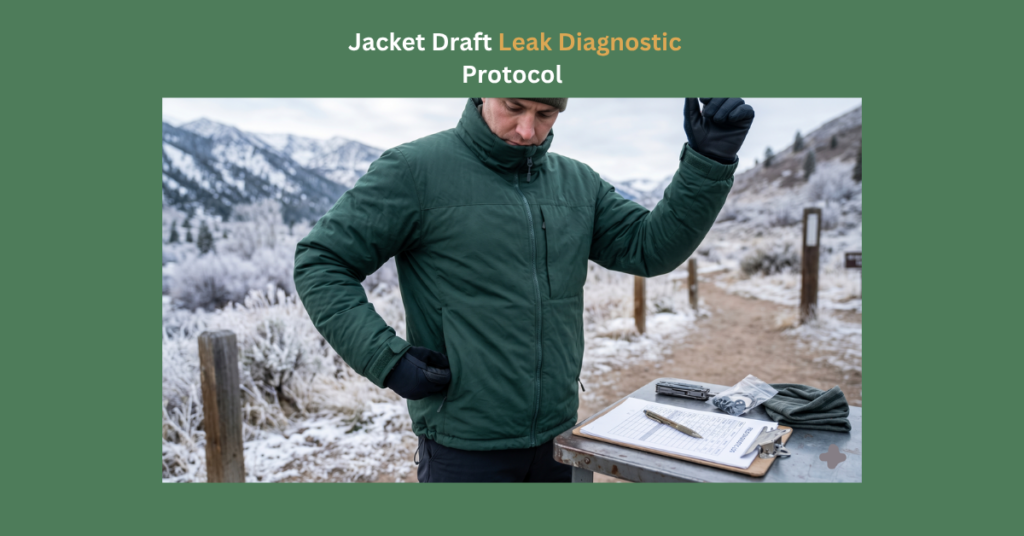
The Wind-Chill & Draft Leakage Diagnostic
The Wind-Chill & Draft Leakage Diagnostic
Diagnosing and fixing “jacket draft leaks” requires moving beyond subjective feelings of cold and applying a systematic diagnostic protocol to isolate structural failures at the hem, cuffs, and collar, where high winds actively strip away your body’s heated microclimate.
An expensive, high-loft winter coat that feels exceptionally warm indoors relies on mitigating conduction, but will fail immediately in a 15mph wind if structural gaps allow forced convective heat loss.
This guide provides a step-by-step diagnostic protocol to track, isolate, and physically plug “jacket draft leaks” using a data-driven single-session wind-chill log.
Understanding Convective Heat Loss and Jacket Insulation Failures
Sudden “jacket heat loss” in high winds occurs because the primary mechanism of heat transfer shifts abruptly from conduction to forced convection, physically displacing the thin layer of trapped, heated air resting against your body.
- Forced convection defines the process where fluid motion—in this case, wind—actively carries thermal energy away from a surface.
- High wind speeds shift heat transfer to forced convection.
- Stationary insulation relies on down clusters or synthetics mitigating conduction by trapping dead air within a baffle.
- Wind physically bypasses the textile barrier entirely through unsealed anatomical openings.
- If a fabric possesses an Air Permeability rating of 1 CFM (Cubic Feet per Minute) or lower, the failure is purely structural.
- Aerodynamic drag rapidly accelerates this temperature decay, drastically worsening the perceived Windchill Factor.
The Diagnostic Goal
The goal of this protocol is to isolate physical failure points (cuffs, hem, collar) rather than falsely attributing heat loss to the jacket’s thermal effusivity or insulation rating.
Identifying Structural Leaks: Air Permeability (CFM) and Wind Resistance
Identifying the structural weak points allowing “winter coat wind penetration” requires separating independent variables, like the jacket’s physical openings, from confounding variables like your metabolic rate or external wind speed.
Aerodynamic Forces and Visual Scan:
- Wind creates a high-pressure zone on the windward side and a low-pressure zone on the leeward (rear) side, forcing air into openings.
- The Bellows Effect (Pumping Coefficient) works alongside the Chimney Effect as the primary aerodynamic forces dismantling the microclimate.
- Thermal manikin studies demonstrate that these combined aerodynamic effects can reduce a garment’s total effective thermal insulation by up to 64% to 80%.
- Proper articulation in the garment design prevents the hem from lifting during movement, mitigating dangerous Exposure.
| Leak Point | Status | Mechanism of Heat Loss | Physiological Impact |
|---|---|---|---|
| Waistline / Hem | Loose / Uncinched | The Chimney Effect (Cold, dense air is actively pulled or pushed up the torso, displacing warm air) | Immediate convective cooling of the lower back and kidneys; rapid core temperature drop. |
| Sleeves / Cuffs | Loose / Unstrapped | Funneling (Forward motion and wind scoop freezing air directly up the arms) | Rapid cooling of the radial artery and armpits, forcing peripheral vasoconstriction in the hands. |
| Neck / Collar | Open / Unzipped | Direct Escape (The apex of the microclimate is breached, venting high-heat air) | Massive radiant and convective heat loss from the chest, neck, and jugular vein. |
Step-by-Step Diagnostic Flow: Tracking Convective Heat Loss and Drafts
Tracking “cold air drafts” requires moving from subjective physiological complaints—like misattributing cold hands to bad gloves when the radial artery is actually cooling—to objective data collection using a single-session diagnostic log.
Step-by-Step Diagnostic Flow:
- Wear exactly the same base/mid-layers (e.g., a 150gsm merino wool base and a 300gsm grid fleece) to ensure the intrinsic thermal resistance (Clo value) remains constant.
- Review Understanding the 3-Part Layering System to dial in this static control group.
- Maintain a consistent metabolic heat production (MET Level) via a standard 30-minute walk.
- Only log data in winds exceeding 10 mph (approx. 4.5 meters per second).
- Execute multiple test configurations (runs) in one active session. Rate the Overall Chill Score on a scale of 1 to 10 immediately after each run, before the body re-warms and disguises the localized thermal shock.
| Test Run (Config) | Wind Speed (Est. mph) | Hem Status | Cuff Status | Collar Status | Primary Draft Location | Overall Chill Score (1-10) |
|---|---|---|---|---|---|---|
Analyzing Wear Data to Pinpoint Windshell Layer and Insulation Drafts
Analyzing your wear data allows you to mathematically isolate the “primary jacket draft location” by correlating structural openings with localized thermal shock, eliminating subjective guesswork.
- Segment the single-session log data into High Chill Runs (Overall Chill Score of 5 or below) and Low Chill Runs (Score of 6 or above).
- Calculate averages across your data set.
- Users must cross-reference the “Primary Draft Location” column to narrow the scope if multiple variables were open simultaneously.
- If: The mathematical analysis reveals that 80% of High Chill Runs feature a loose hem, and the primary draft location is repeatedly noted as the lower torso…
- Do: Write an insight statement targeting the waistline as the singular point of failure facilitating the Chimney Effect.
- Result: You isolate the exact aerodynamic failure point, preventing unnecessary gear replacements.
Practical Troubleshooting Steps: Sealing Hem, Cuffs, and Jacket Insulation
Fixing “jacket heat leakage” requires physically sealing the hem, cuffs, and collar to prevent volumetric air exchange, because adding internal layers over an active draft merely delays the onset of the freeze.
Practical Troubleshooting Steps:
- Mechanical seals stop volumetric air exchange.
- Address the primary leak point first.
- Adding a 330gsm fleece mid-layer over an active Chimney Effect draft is mathematically less effective than engaging hem drawcords.
- If a jacket lacks a drawcord, execute a DIY retrofit: cut two incisions in the inner hem allowance, thread a 1/8-inch (3mm) elastic shock cord using a bodkin or wire hanger, secure with ABS plastic double-hole cord locks, and reinforce incisions with metal eyelets or a tight zigzag stitch.
- Replace degraded hook-and-loop (velcro) or install sew-on metal snaps for rigid cuff closures.
- Utilize a tubular microfiber neck gaiter to occupy negative space at the collar.
- Bad Fix: Tucking a loosely knit wool scarf into an open collar (porous yarn does not block wind; the unzipped collar acts as an open vent).
- Good Fix: Zipping the collar fully to the chin, ensuring the internal storm flap is seated flat, and engaging the hood’s perimeter elastic toggles to lock the microclimate.
DIY Fixes vs. Upgrading to Dedicated Windshell Layers
Comparing DIY “draft fixes” against upgrading to a dedicated Windshell reveals whether you are dealing with a correctable user error or a highly air-permeable fabric failure.
Air Permeability (CFM) Benchmarks:
- Standard mid-layer fleece allows up to 60 CFM (zero wind resistance).
- Softshells allow 5 to 10 CFM.
- Dedicated windshells (< 1 CFM) completely halt convective heat loss.
- To master these thresholds, read the authoritative research investigation on CFM Ratings on ScienceDirect.
| Criteria | Cinching/DIY Fixing Existing Jacket | Upgrading to a Dedicated Windshell Layer |
|---|---|---|
| Primary Use Case | Best for jackets with low-CFM fabrics suffering from user error (open hems/cuffs). | Best for highly air-permeable mid-layers (fleece/sweaters) that fail instantly in the wind. |
| Cost | Extremely Low ($10–$20 for DIY shock cords, eyelets, and ABS plastic cord locks). | Moderate to High ($85–$200 for a quality ultralight wind jacket). |
| Time Investment | 1 to 2 hours of measuring, threading cord with a bodkin, and basic hand-sewing. | Zero fabrication time; immediate deployment. |
| Effectiveness | Highly effective at stopping localized drafts (eliminating Chimney Effect and Funneling). | 100% effective at stopping broad-surface convective heat loss across the entire torso. |
| Breathability (MVTR) | Maintains the original Moisture Vapor Transmission Rate of the existing jacket. | May trap sweat if the windshell’s MVTR is too low during high-exertion activities. |
(Read more on balancing these factors in How to Choose a Windbreaker/Windshell)
Quick Diagnostic Checklist for Optimal Wind Resistance and Warmth
Preventing future “wind chills” requires taking your root cause analysis and turning it into a pre-outing testable hypothesis to evaluate your thermal regulation strategy systematically.
“My hypothesis is that by securely cinching the
$$Identified primary leak point, e.g., retrofitted hem drawcord$$
and ensuring my
$$Secondary leak point$$
is sealed, I can eliminate drafts at my
$$Primary draft location, e.g., lower back and kidneys$$
and increase my Overall Chill Score to at least an
$$8/10$$
on my next high-wind excursion.”
Quick Diagnostic Checklist:
- Did I identify the primary draft location definitively using my single-session empirical log?
- Did I apply the physical fix (cinch, strap, or DIY drawcord retrofit) specifically to that identified failure point?
- Is my base-layer and mid-layer configuration exactly the same for this validation test?
- Is the ambient outdoor wind speed currently exceeding the 10+ mph testing threshold?
- Upon returning indoors, did my post-test Overall Chill Score successfully reach an 8/10 or higher?
Summary Section: Guaranteeing Winter Warmth and Wind Resistance
Reviewing your “jacket draft leak diagnostic” proves that guaranteeing winter warmth relies on isolating physical variables and trusting empirical field data over a brand name or a price tag.
- Even a $500 expedition-grade parka will freeze you if the hem is left uncinched in a gale.
- Marketing specs (waterproof membranes, down fill-power) do not account for mechanical unsealing.
- By trusting your session log, you isolate the Chimney Effect at the waistline, retrofit a simple $15 shock cord, and fully restore thermal performance instead of prematurely replacing the coat.
Key Takeaways:
- Isolate the structural variables: Understand the critical difference between fabric air permeability (measured in CFM) and structural gaps acting as aerodynamic wind scoops.
- Track the draft across multiple runs in one session in 10+ mph winds: Use identical base layers to eliminate confounding variables and prevent subjective physiological bias.
- Cinch the primary leak point before adding internal layers: Stop forced convection at the boundary layer rather than attempting to insulate over an active draft.
- Retest your hypothesis in the field: Execute a validation test using the exact same environmental controls to mathematically prove the fix.
FAQ: Winter Coat Wind Penetration and Jacket Insulation
To provide immediate troubleshooting, this section directly answers the most common questions regarding “winter coat wind penetration” and structural gear failures.
What if my jacket doesn’t have a hem drawcord?
Problem & Fix: You are experiencing a severe structural limitation for high winds. You must either upgrade to a jacket with a sealed hem, perform a DIY retrofit by threading a shock cord through the bottom seam, or wear a longer, tight-fitting Base layer to tuck deeply into your pants.
Cause: Without a mechanical seal at the waist, the jacket acts as an open cylinder, allowing the Chimney Effect to instantly strip the microclimate of trapped heat regardless of insulation rating.
Why am I losing jacket heat directly through the main front zipper?
Cause: The wind is cutting through the microscopic gaps between the zipper teeth.
Fix: Check if the internal or external storm flap is folded backward. If the jacket lacks a flap, apply a polyurethane zipper lubricant or layer a solid windshell over the garment.
Underlying Problem: Standard coil and Vislon (molded plastic) zippers are inherently air-permeable. Unless it utilizes a PU coating (like YKK AquaGuard), an unshielded zipper in 20+ mph winds will leak air directly onto the chest.
Does a thicker base layer stop cold air drafts?
Answer / Fix: No. Base layers trap stationary heat. They do not block active “winter coat wind penetration” originating from structural gaps like loose cuffs.
Cause: Convective cooling functions independently of thickness. Thick fleece features a high CFM rating, meaning freezing air funneling up a loose cuff (the Bellows Effect) will easily penetrate it.
Are underarm zippers (pit zips) a source of draft leaks in high winds?
Answer / Fix: Yes, if they lack internal backing or water-resistant PU coatings. Ensure pit zips are fully closed and the storm flaps are seated flat before entering high-wind zones.
Cause: Zippers are inherently porous. Even a small gap under the armpit acts as a direct wind scoop, bypassing the insulation layer and rapidly cooling the core via forced convection.
Can I fix a drafty collar without wearing a bulky scarf?
Answer / Fix: Yes. A properly designed jacket collar should seal against the chin. If it’s too loose, use the hood’s perimeter toggles to cinch the collar tight against a tubular microfiber neck gaiter.
Cause: Scarves are typically knit and highly air-permeable (high CFM). They fail to stop forced convection, allowing the Chimney Effect to vent your trapped body heat out the top of the jacket.