
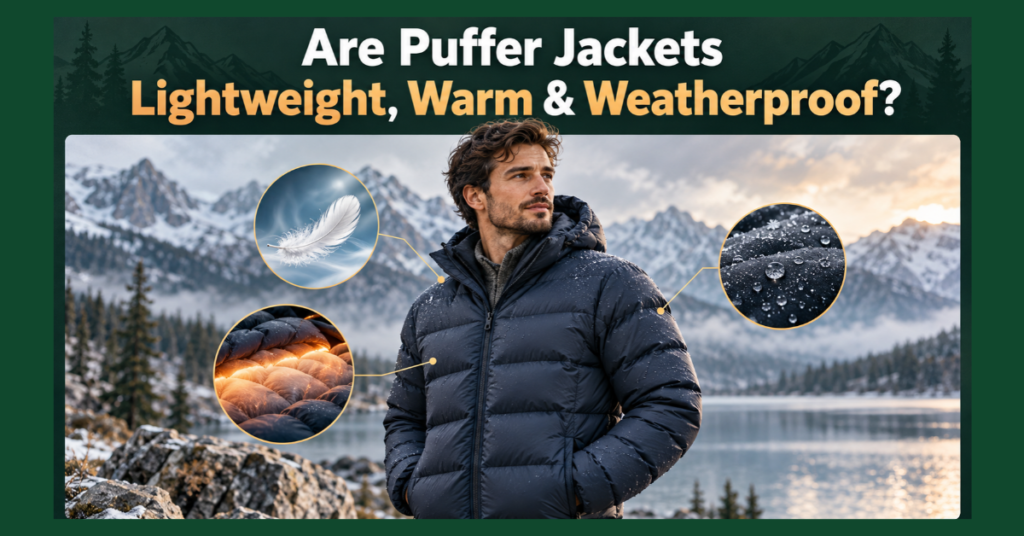
Are Puffer Jackets Lightweight, Warm, and Weatherproof?
A puffer jacket generally provides a highly effective balance of lightweight compressibility and thermal retention, but its weatherproofing is usually limited to wind and light precipitation rather than sustained heavy rain.
Buyers often expect a puffer to act as a complete all-weather shield. Its construction shows a stricter boundary: baffles and loft are excellent at trapping heat, yet the same lightweight shell and stitched structure do not automatically create a waterproof barrier.
This guide evaluates the structural engineering of puffer jackets to validate their weight class, explain their thermal heat-trapping mechanics, and map their exact weatherproofing boundaries.
How Baffle Construction and Loft Create the Puffer Jacket Core
The core performance of a puffer jacket relies on stitched compartments, known as baffles, which hold insulating material in place and create heat-trapping loft.
The purpose of quilted baffles in preventing insulation migration and cold spots
Loose insulation needs to remain distributed across the torso and sleeves. Baffles divide the jacket into smaller chambers so the fill does not simply settle into the lowest part of the garment.
That distribution matters because warmth depends on maintaining loft across the body. Technical jackets use fully baffled or box-wall construction to preserve loft and reduce cold spots in demanding conditions.[4][5]
How ultralight ripstop nylon face fabrics protect the fill without adding bulk
Puffer shells are often made from thin nylon fabrics because the shell must contain the insulation without adding unnecessary mass. Ripstop constructions reinforce a lightweight woven face fabric with a grid structure.
Lower-denier fabrics can reduce shell weight, but denier alone is not a universal quality score. Patagonia lists a 20-denier ripstop shell on its Down Sweater, while Rab uses 20D and 30D fabrics in technical down pieces.[4][5]
The practical tradeoff is between packability and abrasion tolerance. Very light shell fabrics require more care around rocks, branches, and sharp gear.
Does the Puffer Deliver a High Warmth-to-Weight Ratio?
Premium puffer jackets can deliver a high warmth-to-weight ratio because the insulating fill expands to create volume without requiring the dense mass of heavy outerwear materials.
Why premium puffers feel exceptionally light compared with heavy wool or canvas jackets
A puffer relies heavily on trapped air for insulation. Down plumules create small air spaces, while synthetic fills use fiber structures that also hold warm air close to the body.[1][2]
That mechanism allows useful insulation without depending on a heavy shell. Down is especially valued for combining low mass, high loft, and compressibility.[1][2]
The compressibility factor: how puffers pack down into small travel pouches
Much of a puffer’s active volume comes from lofted air. Compression pushes much of that air out temporarily, allowing the garment to occupy far less space.
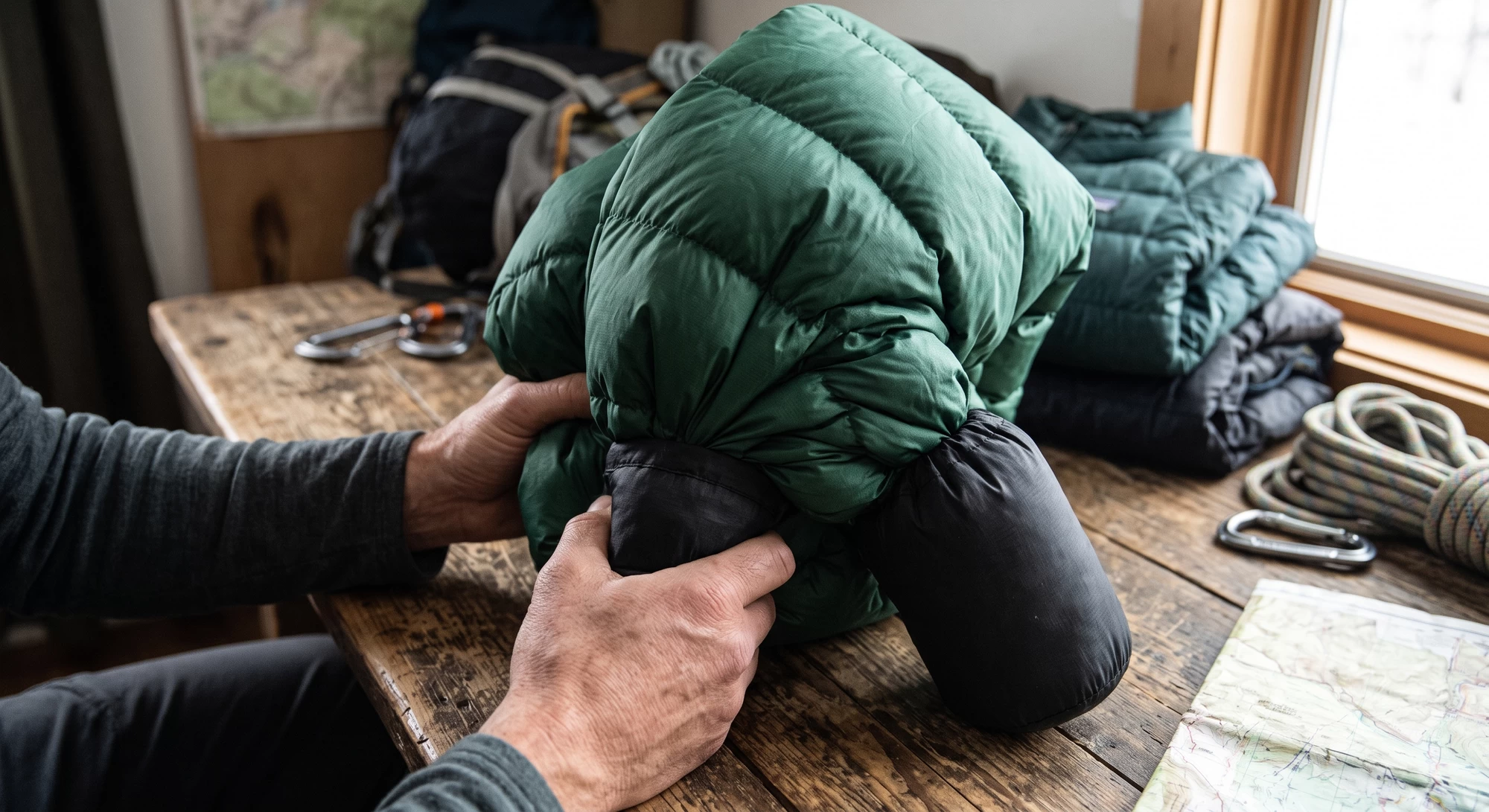
REI notes that higher-quality down is prized because it can compress into a small packable shape and then recover loft, which is valuable when weight and pack size matter.[1]
How lower denier (D) shell fabrics reduce overall garment weight for alpine activities
Reducing shell mass can lower the total weight of an insulated jacket, which is why many lightweight outdoor designs use thin nylon face fabrics.
Low denier should not be treated as universally better. Fabric construction, coatings, reinforcements, and expected abrasion all affect whether a very light shell is appropriate.
How Fill Power Dictates Cold-Weather Thermal Retention
Fill power measures the volume that one ounce of down occupies under a standardized test, indicating loft and insulation efficiency rather than assigning a universal temperature rating to a jacket.[1]
The science of loft: how trapped dead air space retains radiant body heat
The insulation does not generate heat. Its job is to create many small air spaces that slow heat loss from the body.
More stable loft creates more heat-trapping air space, which is why down quality and fill distribution both matter.[1]
Understanding Fill Power (FP): why higher-fill down can be lighter and more compressible
A higher fill-power number indicates that an ounce of that down occupies more volume. REI explains that higher fill power represents greater loft and insulating efficiency, but it does not by itself tell you how warm a finished jacket will be.[1]
An 800-fill jacket is not automatically warmer than a 500-fill jacket because total fill weight, baffle design, shell construction, fit, and coverage also affect warmth.[1][6]
The wind vulnerability: how stitched baffle seams can create colder lines
Traditional sewn-through construction compresses insulation where the shell and lining are stitched together, reducing loft along those lines compared with a box-wall chamber.
Technical cold-weather jackets often use box-wall or fully baffled construction to reduce cold spots and maintain a more continuous insulating layer.[4][5]
| Fill Power Rating | Compressibility | Typical Application | Temperature Capability |
|---|---|---|---|
| 500–600 FP | Moderate | Casual or general cold-weather use | No universal jacket temperature rating |
| 650–750 FP | High | Cold-weather outdoor use where packability matters | No universal jacket temperature rating |
| 800–900+ FP | Very High | Weight- and space-sensitive technical use | No universal jacket temperature rating |
What Are the Exact Weatherproofing Limits of a Quilted Shell?
A quilted puffer shell can resist wind and light precipitation, but a standard puffer should not be treated as a fully waterproof barrier unless it is specifically built with a waterproof shell system.
How factory DWR (Durable Water Repellent) coatings help light snow and drizzle bead off
A durable water repellent finish is applied to the face fabric to reduce the surface energy of the textile, helping water form beads and roll away instead of immediately soaking into the outer layer.[3]
DWR is not the same thing as a waterproof membrane. GORE-TEX distinguishes the water-beading treatment from the membrane that provides waterproof performance in membrane garments.[3]
The seam leakage problem: why traditional stitched baffles are not waterproof
Standard puffer construction contains many stitch lines and usually lacks the seam-taped waterproof architecture of a technical rain shell.
Some insulated jackets are engineered differently. Patagonia sells waterproof down jackets that combine a waterproof/breathable shell with taped baffle channels, showing that waterproofing requires more than ordinary quilting.[7]
The wet-out failure point: when saturated fabrics compromise comfort and insulation
Wet-out occurs when the face textile becomes saturated and loses its water-beading behavior. GORE-TEX notes that a saturated outer layer can feel cold and clammy even when an underlying waterproof membrane is still functioning.[3]
On a standard puffer without a waterproof membrane, prolonged moisture exposure is a larger problem because the insulation itself can become damp or saturated.
| Weather Condition | Puffer Capability Level | Reason |
|---|---|---|
| Dry Cold | Excellent | Loft can retain heat efficiently without moisture interference. |
| Light Snow / Drizzle | Good | A functioning DWR finish can help light moisture bead from the surface. |
| High Wind | Moderate | Shell and seam construction determine wind resistance. |
| Heavy Rain | Poor for a standard puffer | A standard quilted shell is not automatically waterproof. |
Down vs. Synthetic Fill: Which Survives Wet Weather Better?
Choosing between down and synthetic fill requires balancing down’s higher compressibility against synthetic insulation’s stronger performance in damp conditions.[2][6]
| Feature | Natural Down | Synthetic Fill |
|---|---|---|
| Wet Thermal Retention | Poorer when saturated because down can lose loft | Better performance when damp; retains useful insulation |
| Drying Time | Generally slower | Generally faster |
| Compressibility | Excellent | Moderate |
| Warmth-to-Weight | Very High | Usually lower than down for equivalent warmth |

Natural Down: exceptional warmth-to-weight ratio but severe thermal failure when wet
Down is light, compressible, and highly efficient in cold, dry conditions, but wet down can clump and lose the loft that creates heat-trapping air spaces.[2][6]
That is why a conventional down puffer is a poor substitute for a rain shell during sustained wet weather.
Synthetic Fill: heavier and bulkier, but retains insulating properties when wet
Synthetic insulation is commonly made from polyester fibers engineered to trap air. REI describes synthetic insulation as heavier and less packable than down but able to provide some warmth when wet and dry faster.[2]
This makes synthetic fill a practical choice where sweat, humidity, or repeated moisture exposure is more likely.
Hydrophobic Down: the middle-ground solution treated to resist moisture
Hydrophobic down receives a water-repellent treatment intended to help the clusters resist moisture and retain loft longer than untreated down.
Rab describes hydrophobic treatment as a way to retain loft in damp conditions, while still using water-resistant fabrics and DWR as part of the broader moisture-management system.[5][8]
The treatment improves moisture tolerance, but it does not turn a standard down puffer into a waterproof rain jacket.
Final Verdict: When Is a Puffer Jacket the Smartest Choice?
A puffer jacket is a highly effective choice for dry, cold climates and high-mobility travel, provided its insulation is protected from sustained wet weather.
Ideal scenarios for dry, sub-zero climates and high-mobility winter travel
Puffers excel where packability, low mass, and thermal retention matter. Down is particularly effective when conditions are cold and dry, while synthetic insulation trades some compressibility for better damp-weather performance.[2]
The light shell and lofted insulation structure also make puffers easy to pack compared with heavier outerwear built from dense materials.
When to bypass a standalone puffer in favor of a waterproof hardshell outer layer
Use a waterproof shell when sustained rain is the main hazard. A DWR-treated puffer can manage light moisture, but DWR alone is not a waterproof system.[3][7]
The strongest use case for a puffer is cold protection with controlled moisture exposure: choose down when weight and compressibility dominate, choose synthetic when damp performance matters more, and rely on a dedicated waterproof shell when heavy rain is expected.
Sources
- REI Expert Advice. What Is Down Fill Power?. View source.
- REI Expert Advice. How to Choose Insulated Jackets. View source.
- GORE-TEX. Durable Water Repellent (DWR) in GORE-TEX Products. View source.
- Patagonia. Men’s Down Sweater Insulated Jacket. View source.
- Rab. Men’s Positron Pro Down Jacket. View source.
- Outdoor Research. What Does Down Fill Power Mean?. View source.
- Patagonia. Men’s Jackson Glacier Waterproof Down Jacket. View source.
- Rab / Grangers. Down Repel / Hydrophobic Down Care. View source.
Evidence note: Fill power does not provide a universal jacket temperature rating. Denier examples are product-specific rather than universal benchmarks, and drying-time comparisons remain qualitative because exact times depend on garment construction and conditions.