
Do Overcoats Offer Maximum Warmth, Length, and Wind Resistance?
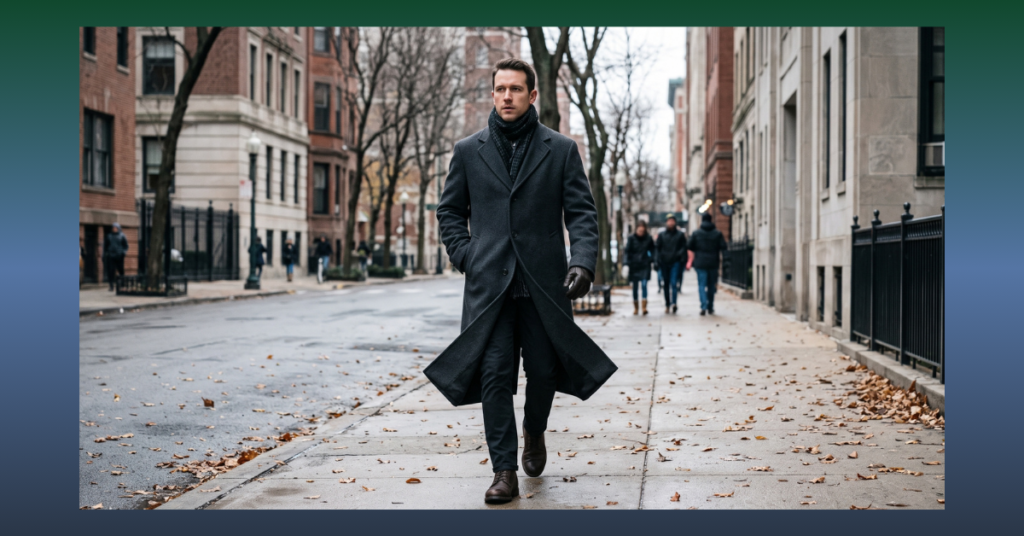
A tailored overcoat can provide high winter warmth and strong wind protection through its long body coverage, dense outer fabric, and enclosed front construction. Its knee-to-calf drape protects areas that remain exposed in shorter jackets, especially the thighs and part of the lower legs.
That protection has limits. A long heavy coat places more material around the legs when walking, climbing stairs, entering a vehicle, or sitting. Wool can also manage moisture without being waterproof. A traditional tailored overcoat therefore works best as a cold-weather outer layer rather than as a substitute for a fully waterproof technical shell.
Buyers investing in tailored winter outerwear often compare cropped jackets, mid-thigh coats, and full-length coats because coat length changes more than appearance. It changes how much of the body sits behind the outer fabric, how much material moves around the legs, how wind reaches the lower body, and how easily the wearer can sit or walk.
This guide evaluates the structural anatomy of the overcoat to validate its lower-body coverage, explain its heavy-wool thermal mechanics, analyze its double-breasted wind defense, map its mobility limits, and compare it against shorter tailored alternatives.
Evidence boundary: There is no universal fabric weight, garment weight, temperature rating, or exact hem position that defines every winter overcoat. Fabric ounce weight and GSM describe textile mass, but warmth also depends on fibre structure, fabric density, coat length, lining, interlining, fit, wind, humidity, activity, and the layers worn underneath. The unsupported fixed ranges in the source brief are therefore treated as examples rather than category rules.
How Knee-to-Calf Tailoring Defines the Overcoat’s Protective Silhouette
Extending the hemline toward or beyond the knees changes the body’s protected zone by placing more of the thighs and lower legs behind the outer shell.
Cambridge defines an overcoat as a long, thick coat worn in cold weather, while historical clothing research from the Fashion Institute of Technology documents knee-length overcoat forms such as the frock coat and long greatcoat-related designs.[1][2]
The exact hem varies. Some tailored coats stop near the knee. Others extend farther toward the calf. The functional distinction is that the garment covers substantially more of the legs than a waist-length jacket, peacoat, or mid-thigh car coat.
The Coverage Advantage: Extending Protection Down the Legs
A short jacket leaves the hips and legs outside the shell. A knee-length or calf-length coat places the thighs behind another layer of fabric and may extend protection toward the shins.
This matters in cold wind because moving air can accelerate convective heat loss from exposed clothing surfaces. A long coat does not create heat by itself. It expands the area over which dense fabric can slow airflow and retain the warmer microclimate produced by the wearer’s body and underlying clothes.
The benefit is strongest while standing or walking in exposed conditions. A longer coat shields the suit jacket, waist, seat, thighs, and part of the lower legs at the same time.
The term knee-to-calf drape should therefore describe coverage rather than promise a specific temperature. A long coat can protect more surface area than a short one, but a thin long coat may still be less insulating than a shorter garment with substantial loft.
How a Long Hem Resists Wind-Lift Through Mass and Drape
A longer overcoat uses more fabric than a cropped jacket. When that fabric is dense, its own mass helps the coat hang vertically instead of reacting as freely to every gust.
This can reduce hem flutter in ordinary winter wind, especially when the coat is buttoned and the fabric has a firm tailored drape. It should not be treated as a guarantee against strong wind. Open vents, loose fronts, wide hems, and wind direction can still move the garment.
The real aerodynamic advantage comes from combining length with fabric density and closure. Long panels extend the wind barrier lower on the body, while the front fastening controls how easily moving air can enter the torso area.
How Overcoat Proportions Accommodate Formalwear
An overcoat is worn over other clothing. That basic requirement affects its pattern. The body, sleeves, shoulders, and armholes need enough ease to fit over shirts, knitwear, waistcoats, blazers, or suit jackets without pulling excessively.
This does not mean every overcoat has oversized armscyes or extremely wide shoulders. Tailoring styles vary. The practical requirement is additional wearing ease compared with a fitted suit jacket.
If the overcoat is too tight across the shoulders or upper arms, the layers beneath can bunch and restrict reaching. If it is excessively large, gaps at the collar and front may allow more cold air inside.
Good overcoat fit therefore balances layering room with closure control. The coat should cover the formal jacket beneath it without compressing that garment’s shoulders, sleeves, or hem.
| Tailored Outerwear Cut | Hemline Drop | Lower-Body Coverage | Mobility |
|---|---|---|---|
| Hip-Length Peacoat | Around the hips | Low. Legs remain largely exposed. | High because the hem clears most leg movement. |
| Mid-Thigh Car Coat | Middle of the thigh | Moderate. Covers the seat and upper thighs. | High to moderate depending on cut and fabric weight. |
| Knee-to-Calf Overcoat | Around the knee or lower | High. Extends protection farther down the legs. | Lower because more fabric moves around the knees and lower body. |
How Heavy Wool Blends Generate High Core Warmth
Heavyweight overcoats generate warmth through a combination of fibre structure, fabric density, garment coverage, and the layers worn beneath them rather than through one universal ounce-weight threshold.
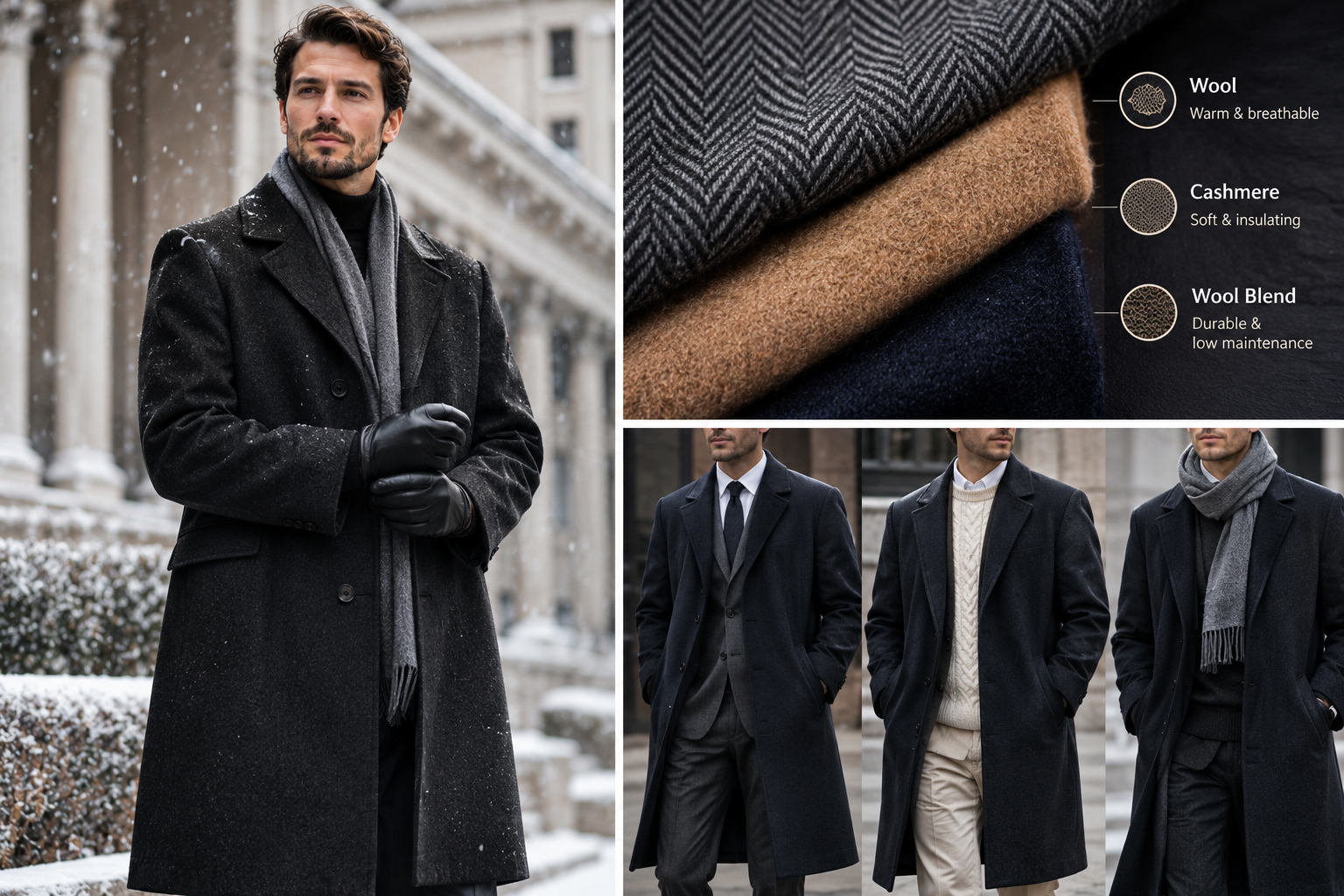
The source brief proposed fixed fabric ranges such as 24 to 32 ounces, but those values were explicitly marked as requiring evidence. Fabric weight can be expressed in ounces per yard or grams per square metre, yet no single number reliably separates every topcoat from every overcoat.
How Dense Wool Creates an Insulating Outer Barrier
Wool’s natural crimp creates small spaces that trap still air. Woolmark identifies these air pockets as an important part of wool’s insulating behavior.[3]
Fabric construction then changes how those fibres behave at garment scale. A dense outerwear fabric places more fibre between the body and moving air than a light open weave, which can improve resistance to convective windchill.
The terms worsted wool and woollen wool should not be treated as interchangeable descriptions of heaviness. The International Wool Textile Organisation explains that worsted processing uses longer fibres to create smooth yarns and can produce fine, lightweight woven fabrics, while woollen-spun fabrics are generally bulkier and are commonly used for heavier outerwear.[4]
A winter overcoat may use a heavy worsted cloth, Melton-style wool, woollen-spun cloth, or another dense blend. The relevant variables are the finished fabric’s mass, density, thickness, air permeability, and drape rather than the spinning-system name alone.
What a Cashmere Blend Changes
Cashmere is a fine animal fibre known for softness, warmth, and low mass. Educational textile references describe cashmere as a fine, soft fibre and note its use in warm but lightweight clothing.[5]
Adding cashmere to wool can change the hand, softness, drape, and warmth-to-weight character of a coat fabric. The effect depends on the fibre percentage, yarn structure, finishing, and total fabric mass.
There is no evidence-safe reason to say that every 10 or 20 percent cashmere blend will automatically outperform a specific pure-wool cloth. A dense wool fabric can be warmer than a lighter wool-cashmere blend simply because there is more insulating material and less air movement through the cloth.
Cashmere should therefore be viewed as one material variable rather than a guaranteed thermal upgrade.
What Bemberg Lining and Thermal Interlining Actually Do
Bemberg is a cupro fibre commonly used for garment linings. Asahi Kasei describes Bemberg linings as smooth, moisture-managing, anti-static, and easy to slide over other clothing.[6]
That makes Bemberg useful inside a tailored overcoat because the sleeves and body move more easily over a suit jacket, sweater, or shirt.
Bemberg should not be confused with a heavy insulating interlining. A standard lining is relatively thin. A separate quilted layer, wool interlining, flannel layer, or synthetic batting contributes much more thermal resistance because it holds additional still air.
The phrase Bemberg interlining can therefore be misleading. Bemberg commonly serves as the smooth interior lining, while an actual thermal interlining sits between the outer shell and lining when the coat is constructed for greater warmth.
Evaluating Double-Breasted vs. Single-Breasted Wind Resistance
The front closure changes how easily moving air can reach the torso. A double-breasted placket creates a substantial overlap across the chest, while a single-breasted coat generally brings two front edges together with less overlapping fabric.
Encyclopedia.com defines double-breasted construction as a jacket or coat with a substantial overlap of material at the front and two visible rows of buttons when fastened.[7]
Why Double-Breasted Overlap Can Improve Frontal Wind Protection
The main advantage is simple layer geometry. When one front panel crosses over the other, part of the chest sits behind two layers of outer fabric instead of one.
That extra overlap can reduce direct airflow through the center-front closure and gives wind another layer to pass before reaching the inner clothing.
It does not completely nullify convective windchill. Air can still enter through the neckline, cuffs, hem, vents, or gaps created by fit and movement. Strong wind can also press and lift fabric in ways that are not controlled by the front overlap alone.
The advantage is therefore localized. A double-breasted front strengthens the chest barrier, especially when buttoned correctly and made from dense fabric.
How Peak Lapels and Throat Closures Affect Neck Drafts
Peak lapels are visually associated with many formal double-breasted coats, but the lapel shape by itself does not create a sealed collar.
Some overcoats include a convertible collar, throat tab, latch, or additional button that allows the collar and lapels to close higher around the neck. When that hardware is present, raising the collar can reduce the exposed opening above the chest.
A coat without such fastening hardware may still allow substantial air around the neck even when the lapels are turned upward.
The useful buying check is therefore not simply whether the garment has peak lapels. Check whether the collar can actually close securely and whether the coat maintains that closure without creating large gaps.
The Single-Breasted Compromise
A single-breasted overcoat uses less front overlap. This reduces bulk and can create a cleaner center line across the torso.
The simpler construction may also feel less restrictive when the wearer sits or layers underneath the coat because there is less doubled fabric crossing the abdomen.
The trade-off is reduced overlapping material at the chest. Wind protection then depends more heavily on fabric density, button spacing, the position of the center-front edges, and any concealed fly or storm flap.
A well-built single-breasted coat can still provide strong winter protection. Double-breasted construction is one mechanism for improving frontal coverage, not a requirement for a warm overcoat.
What Are the Mobility, Weight, and Moisture Limits of an Overcoat?
The same long, dense construction that improves winter coverage creates the overcoat’s main disadvantages. More fabric surrounds the legs, more material rests on the shoulders, and wool remains a moisture-managing natural fibre rather than a waterproof membrane system.
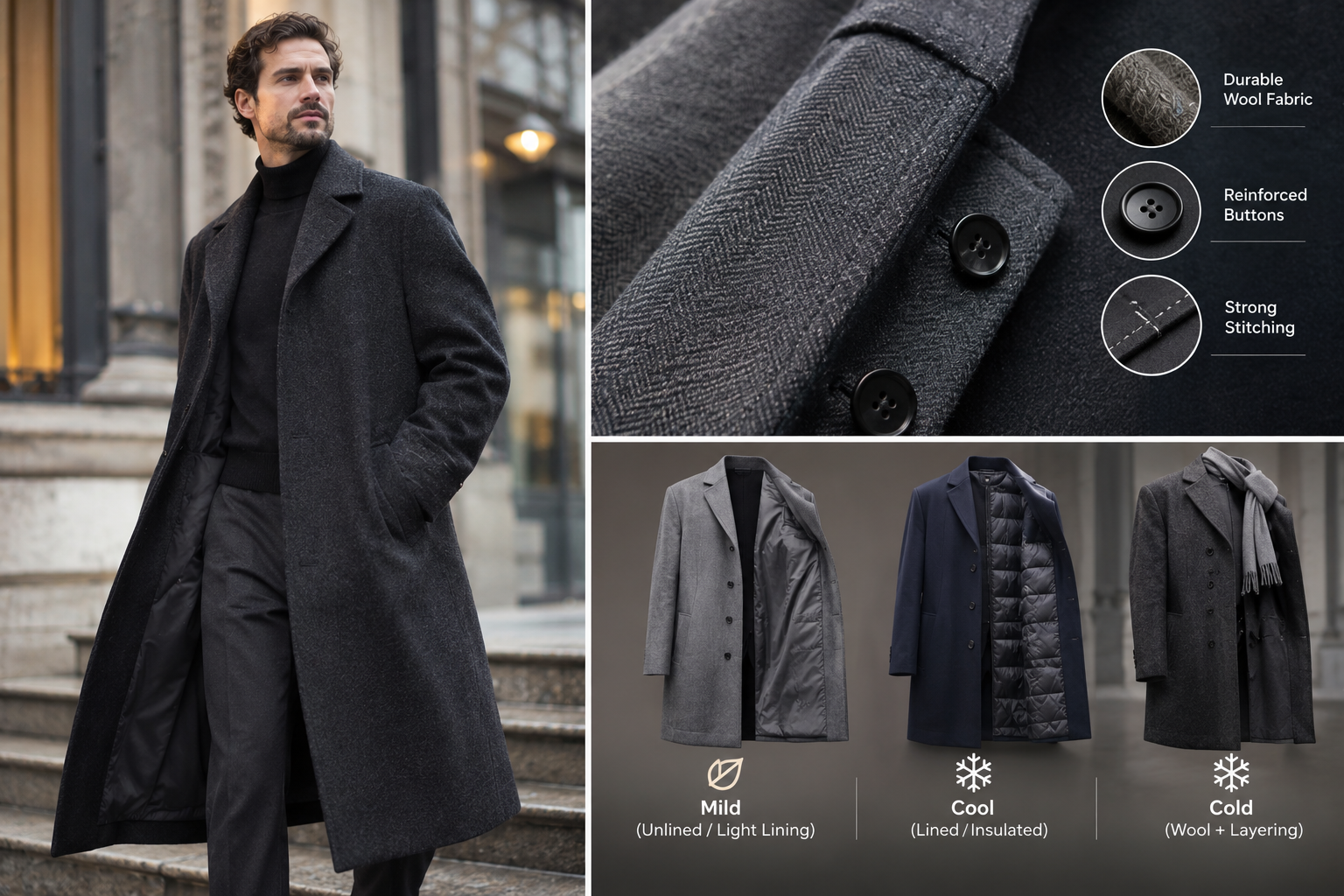
How Knee-to-Calf Length Affects Stairs and Driving
A long coat crosses the area around the hips, thighs, and knees that changes shape most when walking, climbing stairs, or sitting.
When the coat is buttoned, a narrow hem can limit stride length because each leg attempts to move against the circumference of the garment. A back vent or side vents can reduce that restriction by allowing the lower panels to separate.
Sitting creates another issue. Fabric below the hips must either fold across the seat and lap, spread around the thighs, or be moved aside.
The U.S. Navy’s historical uniform research describes the short peacoat as more practical for movement than the longer greatcoat, which supports the basic ergonomic trade-off between lower-body coverage and freedom of movement.[8]
Drivers may therefore find a mid-thigh car coat easier to manage than a knee-to-calf overcoat. Unbuttoning a long coat before sitting can also reduce tension through the front and thighs.
Why Heavy Cloth Can Increase Wearer Fatigue
The source brief proposed a universal 5-to-7-pound weight for heavy greatcoats, but no locked evidence supported that figure. Actual garment weight changes with coat size, fabric mass, lining, interlining, buttons, length, and construction.
The physical principle remains valid without a fixed number. More fabric mass increases the load hanging from the shoulders. A long coat made from dense winter cloth therefore tends to feel heavier than a shorter coat made from a lighter textile.
Whether that weight becomes tiring depends on the wearer, commute length, shoulder structure, fit, and how much time is spent carrying bags or walking.
Fabric GSM or ounce weight remains useful when comparing two known products, but it should not be converted directly into a universal garment-weight rule.
Why Wool Moisture Management Is Not Waterproofing
Wool can absorb large amounts of moisture vapor within its fibre structure. Woolmark reports that wool can take up substantial moisture before feeling wet against the skin.[3]
That property helps manage humidity inside clothing, but vapor absorption is different from resisting sustained liquid rain.
An untreated tailored wool overcoat does not automatically contain a waterproof membrane, taped seams, waterproof zipper system, or fully sealed openings. Extended heavy rain can therefore wet the face fabric and increase the amount of moisture the garment must later release.
A wet heavy coat may feel heavier, take longer to dry, and lose some of the comfort expected from a dry winter outer layer. The exact response depends on fibre treatment, fabric density, finishing, construction, and how saturated the textile becomes.
Claims that every wet wool overcoat will permanently warp its internal canvas go beyond the available evidence. The safer rule is to protect traditional tailored wool from prolonged soaking and dry it according to the manufacturer’s care instructions.
| Tailored Category | Relative Fabric Mass | Thermal Role | Primary Limitation |
|---|---|---|---|
| Transitional Topcoat | Generally lighter than dedicated heavy winter outerwear | Useful for cool transitional conditions and layering | Limited insulation in severe cold when fabric and underlayers are light |
| Winter Overcoat | Moderate to heavy depending on textile and construction | Combines long coverage with denser cold-weather fabric | Can feel warm indoors and less convenient while seated |
| Heavy Greatcoat-Style Outerwear | High because of dense fabric and extensive body coverage | Prioritizes cold and wind protection | Greater bulk, shoulder load, and lower-body movement restriction |
Full Overcoat vs. Topcoat and Peacoat: Which Length Performs Best?
Choosing between a full-length overcoat, a lighter topcoat, and a cropped peacoat requires balancing lower-body coverage against mobility, fabric mass, formalwear protection, and the weather conditions the garment must handle.
| Performance Metric | Full-Length Overcoat | Transitional Topcoat | Double-Breasted Peacoat |
|---|---|---|---|
| Lower-Body Coverage | High. Commonly extends toward the knees or lower. | Moderate to high depending on cut. | Low because the hem usually clears the hips. |
| Wind Deflection | High potential with dense fabric, long coverage, and secure closure. | Moderate when made from lighter cloth. | Strong torso protection from dense fabric and front overlap, with exposed legs. |
| Driving and Seating Comfort | Lower because more fabric occupies the seat and lap. | Moderate. | High because the short hem clears the thighs. |
| Suit-Jacket Coverage | Excellent when correctly fitted. | Usually good when designed for tailoring. | Variable because some suit jackets can extend below the peacoat hem. |
Overcoat Warmth and Leg Coverage vs. Lighter Transitional Layering
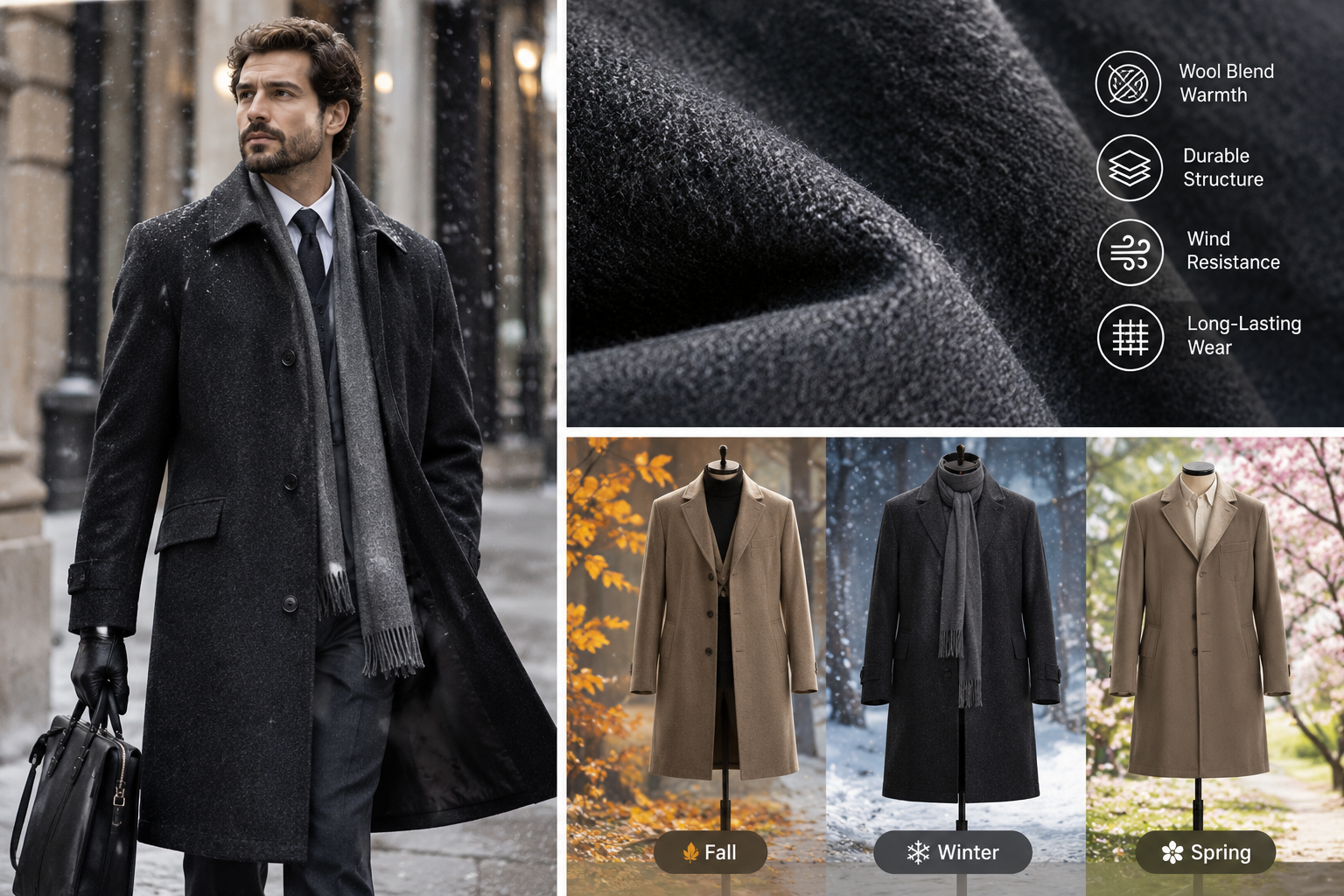
A winter overcoat is designed around substantial coverage. A long hem protects more of the legs, while dense wool can slow airflow and use the fibre’s natural crimp to support insulation.
A transitional topcoat occupies a lighter role. It can preserve the formal appearance and suit coverage of tailored outerwear without carrying the same fabric mass as a dedicated cold-weather coat.
The source brief proposed a universal 15-ounce topcoat threshold and exact mild-weather temperature range. Those numbers are not necessary to make the comparison. The practical distinction is that lighter cloth reduces bulk and insulation, which can make it more comfortable in cool rather than severe winter weather.
The buyer should compare actual fabric weight, fibre composition, lining, coat length, and intended climate instead of relying only on the words topcoat or overcoat.
Overcoat Suit Coverage vs. Peacoat Mobility
The peacoat makes the opposite trade. U.S. Navy history describes the peacoat as warm and short, with its shorter construction making movement easier than a greatcoat.[8]
That short length clears the thighs for walking, climbing, and seated movement. It also leaves substantially more of the lower body exposed.
A full overcoat is better positioned to cover a suit jacket and trousers through the upper-leg area. This is valuable for formal commuting because the clothing beneath remains behind the outer shell for more of the body.
The correct choice depends on the task. A peacoat favors agility. A full overcoat favors extended coverage. A lighter topcoat sits between heavy winter protection and minimal outerwear.
Final Verdict: When Is a Full-Length Overcoat the Right Winter Shield?
A full-length overcoat is a strong winter investment when you spend meaningful time outdoors in cold wind, need complete coverage over formal clothing, and accept the extra fabric and mobility trade-offs created by a long tailored shell.
Best Scenarios for Cold Urban Walking and Formal Dress
The overcoat performs best when lower-body coverage has practical value. A pedestrian commuter walking several city blocks in cold wind benefits more from a knee-to-calf drape than someone who moves directly from a heated home into a vehicle.
The coat also makes sense over business tailoring. Sufficient shoulder, sleeve, and body ease can accommodate a suit jacket while the longer shell protects that jacket and more of the trousers from wind and light weather exposure.
Dense wool strengthens this cold-weather role because the fibre’s crimp supports insulation and the finished fabric can slow moving air.[3]
A double-breasted placket can further increase chest overlap, while a high-closing collar or functioning throat latch can reduce drafts around the neckline.
None of these features creates a universal sub-zero rating. Comfort still depends on fabric construction, underlayers, wind speed, humidity, activity, and individual cold tolerance.
When a Car Coat or Waterproof Technical Parka Makes More Sense
A mid-thigh car coat is easier to manage for people who spend much of their commute sitting in a vehicle. It retains more leg coverage than a short jacket while placing less fabric around the knees and lap than a long overcoat.
A technical waterproof parka becomes the stronger choice when sustained heavy rain is the central environmental problem. Traditional wool can regulate moisture and resist limited weather exposure, but it does not automatically provide a waterproof membrane, sealed seams, or storm-proof closures.
The evidence supports a qualified answer to the original question. A long overcoat can deliver excellent body coverage, strong winter warmth, and useful wind resistance when dense wool, appropriate lining, secure closures, and proper fit work together. Its knee-to-calf drape also increases fabric mass and reduces seated and stair-climbing convenience. The right garment therefore depends on whether your priority is maximum tailored coverage, lower garment weight, seated mobility, or waterproof storm protection.
References
- Cambridge University Press. “Overcoat.” Academic dictionary reference defining an overcoat as a long, thick coat worn in cold weather.
- Fashion Institute of Technology, Fashion History Timeline. “Frock Coat” and historical menswear research. Educational fashion-history material documenting knee-length overcoats, long greatcoats, double-breasted outerwear, and the evolution of tailored coat silhouettes.
- The Woolmark Company. “Wool Is Naturally Breathable” and wool-fibre educational resources. Textile science material explaining wool crimp, trapped still air, moisture-vapor absorption, and temperature management.
- International Wool Textile Organisation. “Woollen & Worsted Processing.” Industry education resource explaining differences between woollen and worsted processing and the typical fabric characteristics produced by each system.
- Encyclopedia.com. “Cashmere.” Educational reference describing cashmere as a fine, soft animal fibre used for warm, lightweight clothing.
- Asahi Kasei Corporation. “Bemberg Lining” and “Guidelines for Sewing Bemberg Lining.” Technical textile education describing Bemberg cupro fibre, smoothness, moisture control, anti-static properties, and garment-lining applications.
- Encyclopedia.com, Oxford Pocket Dictionary of Current English. “Double-Breasted.” Reference defining double-breasted clothing by its substantial front overlap and two rows of buttons.
- Naval History and Heritage Command. “History of U.S. Navy Uniforms, 1776-1981.” Historical educational source explaining the peacoat’s foul-weather role and why its shorter construction was more practical for movement than a greatcoat.
- Textile School. “Wool Fiber: Properties, Characteristics, Structure and Uses.” Technical textile reference covering wool moisture regain, fibre structure, insulation, and wet-state properties.
- International Wool Textile Organisation. “About Wool.” Educational wool-science resource explaining fibre structure, crimp, fineness, elasticity, and the relationship between wool processing and end use.