
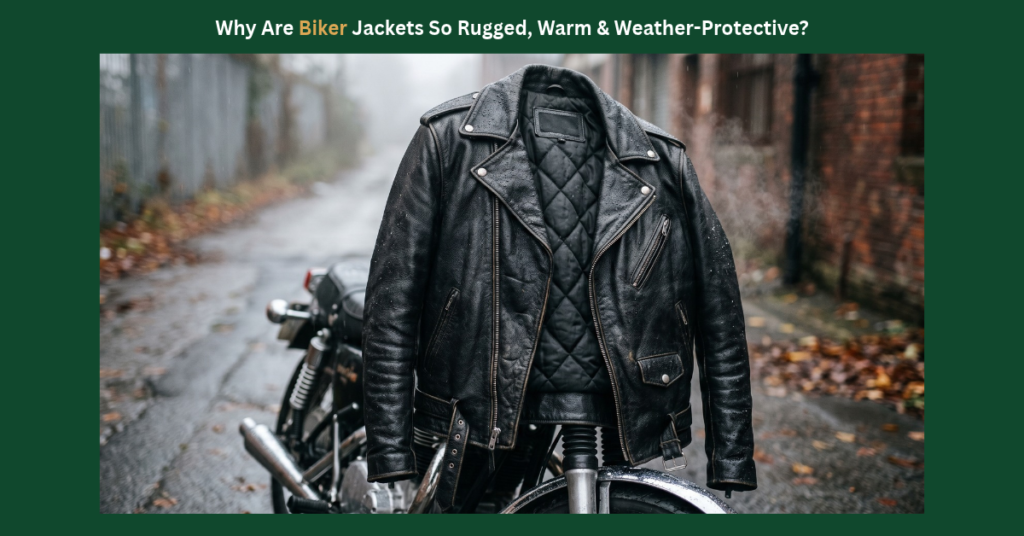
Why Are Biker Jackets So Rugged, Warm, and Weather-Protective?
A traditional biker jacket generally achieves its high durability, warmth, and weather protection through a combination of dense leather, heavy-duty hardware, and an asymmetrical rider-focused design.
Modern biker jackets are often worn as fashion pieces, but the original motorcycle blueprint was built around practical problems: abrasion exposure, moving air at road speed, repeated flexing at the shoulders and elbows, and the need to operate closures while seated.
This guide breaks down the physical material science of a biker jacket to explain its abrasion resistance, audit its specialized hardware, and map its exact weather-protective boundaries. Motorcycle protective clothing can reduce abrasion and soft-tissue injury risk, but no jacket guarantees survival or prevents every crash injury; protection varies with garment construction, certification, impact, speed, and crash mechanics.[1][2]
How Full-Grain Leather Provides High Physical Abrasion Resistance
The structural density and fibre network of leather can provide high abrasion resistance, but actual riding protection depends on the specific hide, thickness, tanning, construction, and certified garment performance.
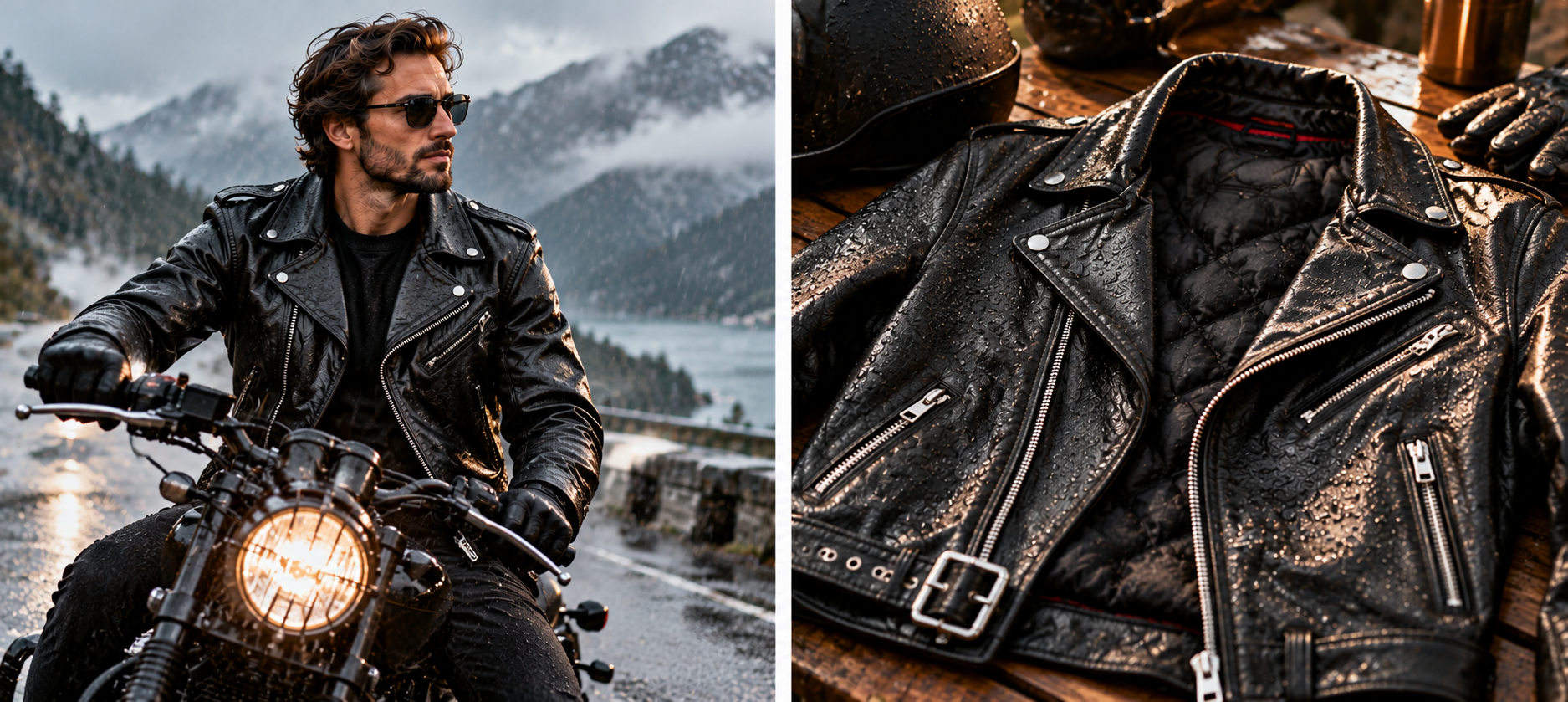
The structural density of heavy cowhide and horsehide versus standard fashion leather
Leather is a collagen-fibre material whose tear strength, abrasion behaviour, flexibility, and thickness can all be tested. Research and standards literature therefore treat leather performance as a measurable material property rather than assuming that every cowhide or horsehide performs the same.[3][4]
For motorcycle use, the practical distinction is not simply ‘full-grain equals safe.’ A purpose-built riding jacket should be judged by its actual material specification and protective-garment performance. NSW Government guidance recommends abrasion-resistant coverage and notes that leather riding gear can offer strong abrasion protection.[1]
How tanning stabilizes the collagen fibre network
Tanning converts raw hide into a more stable leather by changing and crosslinking the collagen structure. Research on chrome tanning shows that tanning agents penetrate and stabilize collagen at multiple structural levels, influencing tensile strength, tear strength, softness, and related physical properties.[5]
This does not justify a universal claim that one tanning method always produces the best motorcycle jacket. Tannage, retanning, fatliquoring, fibre dispersion, finish, thickness, and garment construction all influence the final mechanical behaviour.[5][6]
The break-in reality: why high ruggedness can require a rigid initial wear period
Dense leather can feel stiff because collagen packing, moisture content, lubricants, and processing all affect flexibility. Materials research shows that dry leather is stiffer and more brittle than appropriately hydrated and lubricated leather, while leather strength and flexibility depend on its internal fibre structure.[7]
A firm new jacket may therefore soften with repeated bending and ordinary wear, but there is no evidence-safe universal break-in period. Fit, hide type, thickness, finish, and frequency of movement determine how quickly a specific jacket becomes more compliant.
| Leather Category | Thickness Guidance | Primary Function | Abrasion Interpretation |
|---|---|---|---|
| Light garment leather | Varies by hide, tannage, finish, and garment specification | Soft drape and low bulk | Cannot be assumed to match certified riding performance |
| Purpose-built riding leather | Specified by the garment maker or certification system rather than one universal number | Abrasion protection, wind blocking, structural coverage | Must be judged by actual material and garment test performance |
The Role of Heavy-Duty Hardware in Preserving Structural Integrity
Heavy-duty hardware supports the biker jacket by securing closures and reinforcing locations that repeatedly carry tension, but the strength of the finished garment still depends on seam design, thread, leather quality, and construction.
How reinforced seams and metal hardware support vulnerable stress points
Motorcycle clothing is repeatedly loaded at the shoulders, elbows, pocket openings, cuffs, and front closure. Crash research shows that abrasion and tearing frequently occur at exposed upper-limb zones, which is why protective-clothing standards divide garments into risk areas and assign different performance requirements.[2][8]
Rivets, bar tacks, double rows of stitching, or reinforced seam structures can spread load across a larger area, but no single rivet or stitch pattern guarantees crash performance. The relevant question is whether the entire seam-and-material system resists tearing under the garment’s intended use.
Why oversized, heavy-gauge zippers are used on classic biker jackets
Museum examples of motorcycle jackets document extensive use of metal zippers at the front, pockets, and sleeve ends, reflecting the need for secure, repeatedly operated closures in a riding garment.[9]
A larger zipper may be easier to manipulate with gloves and may use more substantial components, but resistance to grit, separation, or impact depends on zipper design, slider quality, maintenance, and how the zipper is sewn into the leather. Heavy hardware is therefore a functional construction choice rather than a universal durability guarantee.
How the Asymmetrical Silhouette Helps Block Windchill and Trap Heat
The classic biker jacket uses an asymmetrical closure, cropped waist, and closeable cuffs to reduce direct wind exposure while keeping the garment workable in a seated riding position.
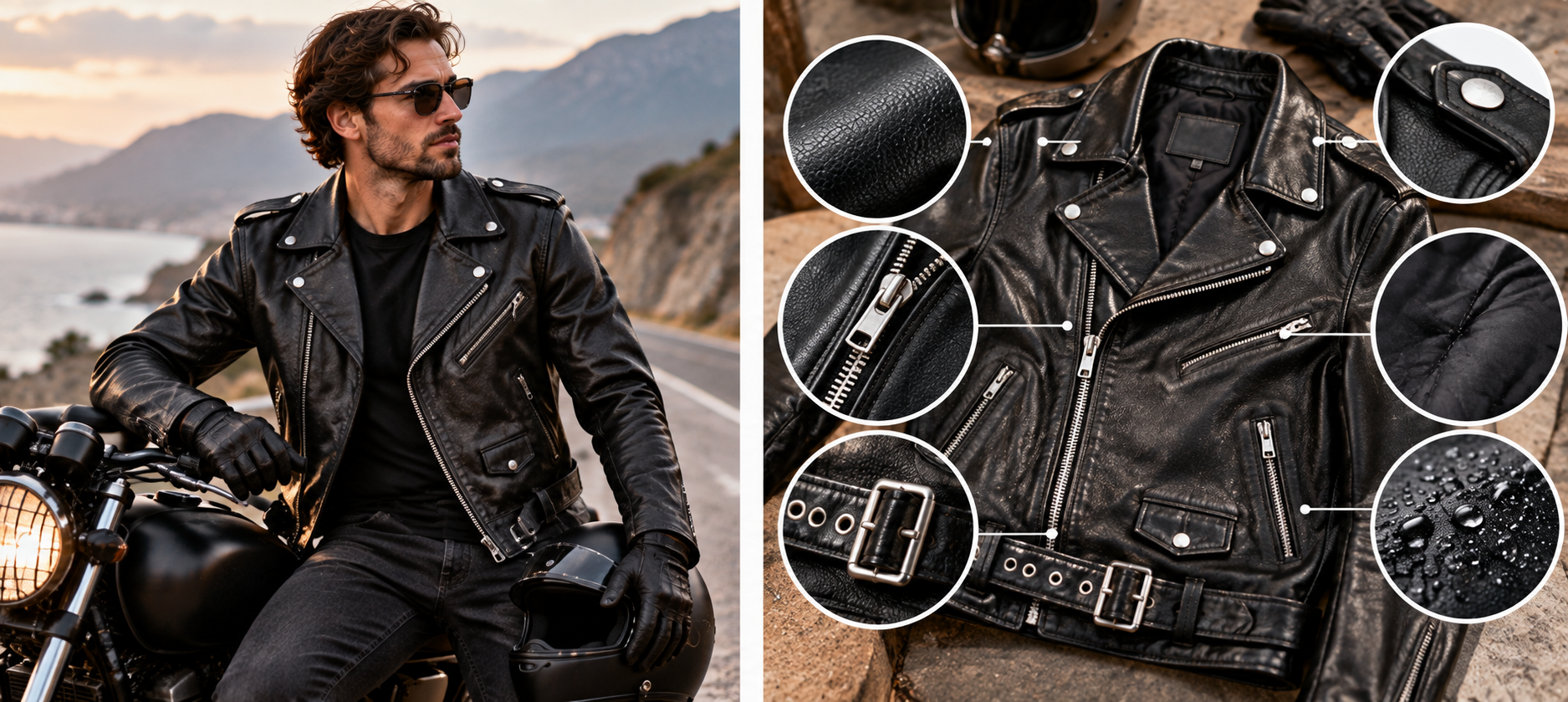
How the asymmetrical, overlapping front panel shields the chest from direct wind
The Museum at FIT describes the archetypal biker jacket as a utilitarian garment built to protect riders from wind, rain, and cold, and identifies its asymmetrical front as one of the rider-specific design elements used for wind protection.[10]
When the jacket is fully closed, the off-center zipper creates overlap across part of the chest rather than leaving only one central leather edge beside the closure. That overlap can reduce direct wind exposure at the front, although actual wind blocking also depends on collar position, zipper backing, fit, and the condition of the leather.
The aerodynamic function of the cropped waist while seated
The Museum at FIT specifically notes that the biker jacket’s waist was cropped to facilitate freedom of movement while riding.[10]
A shorter cropped waist reduces the amount of stiff leather that must fold across the hips and abdomen in a seated riding posture. It also lets a belt or waistband sit below the jacket, though a cropped cut offers less lower-torso coverage than a longer coat.
Why zippered gussets at the cuffs are used for sealing out cold air streams
A Smithsonian motorcycle-club jacket from the late 1960s to early 1970s documents zippered gores at the sleeve ends, showing that adjustable cuff openings are part of historical motorcycle-jacket construction.[9]
Opening the gusset creates room for the hand and glove; closing it narrows the sleeve opening. That mechanical reduction in open area can limit wind travelling up the arm, but the result depends on glove overlap and how tightly the cuff closes.
| Closure Style | Structural Design | Wind-Blocking Interpretation |
|---|---|---|
| Standard center zip | Single closure line at the center chest | Depends on zipper construction, backing flap, collar, and fit |
| Asymmetrical biker zip | Off-center closure creates an overlapping leather front when closed | Overlap adds a second leather layer across part of the chest and reduces direct exposure at the closure |
What Are the Exact Weatherproofing Limits of Treated Leather?
Dense leather can block wind and tolerate limited surface moisture, but traditional leather should not be treated as equivalent to a waterproof membrane shell in sustained heavy rain.
How leather finishes and dressings can improve resistance to light surface moisture
Leather’s water behaviour varies with tanning, finishing, surface coatings, lubricants, and condition. The Canadian Conservation Institute notes that processing method strongly affects water resistance and that some mineral-tanned leathers have greater resistance than more vulnerable leather types.[11]
This means light spray may bead or remain at the surface on some well-finished jackets, but ‘leather’ by itself is not a waterproof rating. Riders who need reliable rain protection should use gear designed and tested for that exposure rather than relying on appearance or thickness alone.[1]
The moisture failure point: why prolonged heavy rain is a poor match for traditional leather
The Canadian Conservation Institute states that most skins and leathers can be damaged by direct water contact, with possible stiffening, shrinkage, staining, deformation, or other changes depending on the tanning and finish.[11]
A saturated jacket also carries more water and becomes less comfortable to manage. The practical boundary is therefore clear: traditional leather can be useful in dry weather and limited spray, but sustained heavy precipitation calls for a purpose-built waterproof outer layer.
How improper drying techniques can cause leather to crack and degrade
Leather conservation guidance warns that locally elevated temperatures can accelerate deterioration through desiccation and protein denaturation, while water exposure can lead to hardening, distortion, or embrittlement in susceptible leathers.[11][12]
Wet leather should therefore be allowed to dry gradually away from radiators, tumble dryers, or other strong direct heat. Conditioning decisions should follow the specific leather and finish rather than a universal fixed schedule.
| Exposure Level | Jacket Capability | Required Care Action |
|---|---|---|
| Wind / cold dry air | Strong use case for dense leather | Routine inspection; no emergency care |
| Light rain / spray | Limited resistance depends on finish and condition | Wipe surface moisture and allow normal air drying |
| Heavy rain saturation | Poor use case for traditional leather | Air dry slowly away from direct heat; follow specialist care guidance |
| Post-saturation drying | Risk of stiffening, distortion, or deterioration | Do not use radiators or high heat; use care appropriate to the leather and finish |
Final Verdict: The Traditional Biker Jacket as a Functional Protective System
A traditional leather biker jacket is most effective when abrasion resistance, wind blocking, rider mobility, and dry-weather durability matter more than low weight or sustained waterproofing.
Ideal scenarios for high-abrasion environments, dry cold, and high-speed wind exposure
Motorcycle protective clothing has been associated with lower rates of soft-tissue injury, particularly abrasions and lacerations, although it does not eliminate the risk of fractures or more serious trauma.[1][2][13]
For a traditional leather biker jacket, the strongest functional case is dry riding or street use where dense material, secure closures, controlled sleeve openings, and reduced wind exposure are useful. Riders seeking actual crash protection should prioritize certified motorcycle PPE rather than assuming that a fashion leather jacket offers the same performance.[8][14]
When to bypass traditional leather for modern waterproof synthetic outerwear
Heavy, sustained rain is outside the strongest use case for traditional leather, and very cold conditions may require more insulation than an unlined leather shell can provide. A waterproof technical shell or insulated system is a better match when precipitation control and high thermal insulation are the primary requirements.
The biker jacket is best understood as a rugged, wind-oriented leather system with real abrasion advantages and clear moisture limits—not as an injury-proof garment or a substitute for certified waterproof cold-weather gear.
Sources
- NSW Government. Motorcyclist riding gear — abrasion-resistant coverage, leather riding gear, weather and comfort guidance. View source.
- PubMed / Accident Analysis & Prevention. Motorcycle protective clothing: protection from injury or just the weather?. View source.
- PubMed / Traffic Injury Prevention. Validation of abrasion-resistance test protocols and performance criteria for motorcycle protective clothing. View source.
- Journal of the American Leather Chemists Association. Insight into the Correlations Between Fiber Dispersion and Physical Properties of Chrome Tanned Leather. View source.
- Journal of the American Leather Chemists Association. Effect of Tanning Agents on Collagen Structure and Response to Strain in Leather. View source.
- Chemosphere / ScienceDirect. Alternative tanning technologies and their suitability in curbing environmental pollution from the leather industry: A comprehensive review. View source.
- Materials & Design / ScienceDirect. Effect of collagen packing and moisture content on leather stiffness. View source.
- PubMed / Traffic Injury Prevention. Distribution and type of crash damage to motorcyclists’ clothing: validation of the zone approach in EN13595. View source.
- Smithsonian National Museum of American History. Motorcycle-club leather jacket — zippers, sleeve-end gores, snaps and gussets. View source.
- Museum at FIT. Beyond Rebellion: Fashioning the Biker Jacket — original rider-focused asymmetrical front and cropped-waist functions. View source.
- Canadian Conservation Institute. Caring for leather, skin and fur — water damage, tanning differences, heat and deterioration. View source.
- Canadian Conservation Institute. Care of Alum, Vegetable and Mineral-tanned Leather — humidity, heat, desiccation and leather stability. View source.
- PubMed. Effectiveness of protective clothing for motorized 2-wheeler riders. View source.
- EUR-Lex. Harmonised EN 17092 standards for protective garments for motorcycle riders. View source.
- Austroads. When the Rider, not the Rubber, Hits the Road — motorcycle protective clothing mechanisms, limits and testing. View source.
Source policy: Evidence citations use government road-safety guidance, PubMed-indexed research, museum and university resources, peer-reviewed leather science, standards references, and conservation guidance. No retail product page is used as evidence. Exact universal leather-thickness thresholds, fixed break-in periods, and fixed conditioning intervals are intentionally not claimed.