
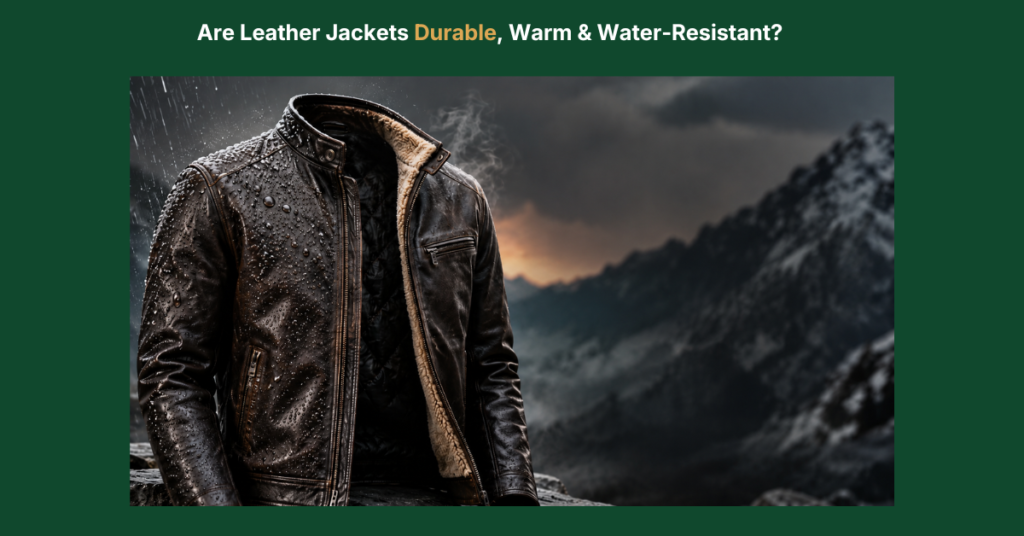
Are Leather Jackets Durable, Warm & Water-Resistant?
Leather jackets are intrinsically highly durable against physical abrasion and wind, but their absolute warmth and water resistance depend entirely upon integrated thermal linings and factory-applied surface treatments. Purchasing leather outerwear based purely on its rugged aesthetic frequently results in severe thermal failure. Unlined and untreated hides act as highly efficient thermal conductors rather than insulators, rapidly drawing heat away from your core when exposed to low temperatures. This guide provides a rigorous diagnostic framework for assessing leather outerwear capabilities, comparing hide grades against specific climates, and avoiding high-stakes jacket maintenance mistakes.
Animal hides possess remarkable structural properties engineered by nature to protect against environmental hazards. The densely woven collagen fibers found in the outermost layers of animal skin create a nearly impenetrable barrier against high-velocity wind and physical friction. However, this same biological structure contains millions of microscopic pores. Without specialized chemical interventions, these pores freely absorb moisture. Furthermore, a bare hide lacks the lofted dead air space necessary to trap human body heat. Understanding these strict material realities separates clinical garment evaluation from marketing-driven fashion purchases.
Evaluating a leather garment requires detaching from its visual appeal and auditing its physical composition. Manufacturers build technical outerwear using distinct material layers, each serving a highly specific environmental function. When a jacket fails to keep you dry or warm, it represents a failure in the material specification, not a flaw in the concept of leather itself. By breaking down the garment into its core components—the external hide, the internal baffling, and the chemical surface treatment—you guarantee maximum performance in demanding conditions.
Graphic 1: Anatomy of Hide Capabilities. The dense upper layer deflects wind and physical abrasion, while the porous inner corium acts as a sponge for moisture if left untreated by chemical finishes.
Why analyzing leather jackets dictates your long-term weather protection
Analyzing leather jackets dictates your long-term weather protection by revealing the critical distinction between the hide’s natural wind-blocking durability and its reliance on chemical finishes for waterproofing.
Leather operates as a structural membrane. The biological architecture of animal hide effectively stops convective heat loss caused by wind chill. Wind cannot penetrate the densely packed protein fibers of the corium layer. Yet, this exact same density facilitates rapid conductive heat loss. When cold air chills the exterior surface of the hide, that low temperature transfers directly through the dense material to your body unless a thermal barrier interrupts the process.
Water resistance introduces another layer of physical complexity. In a living animal, natural oils and an active biological system repel environmental moisture. Once tanned, the hide becomes a static, porous material. Water molecules easily penetrate the cellular structure of raw, unfinished leather. This absorption swells the protein fibers, significantly increasing the weight of the garment and destroying its structural integrity upon drying. Chemical interventions, such as factory-applied silicones or heavy wax treatments, alter the surface tension of the hide. This forces water to bead up and roll off rather than saturating the matrix.
How to assess leather outerwear for durability, warmth, and water resistance
Assessing leather outerwear for durability, warmth, and water resistance requires a systematic physical inspection of hide thickness, internal baffling, and factory-applied coatings.
1 Hide Thickness (Durability)
Verify if the coat utilizes full-grain cowhide or a thinner, less resilient material. Full-grain cowhide retains the complete, un-sanded outer layer of the epidermis, offering exceptionally high abrasion resistance suitable for rugged use. Conversely, thin lambskin provides excellent drape and comfort but functions strictly as a fragile fashion piece, prone to tearing under physical stress.
2 Internal Lining (Warmth)
Check the interior architecture for materials engineered to trap metabolic heat. Leather requires a dedicated insulation layer. Look for thick shearling, high-fill power down, or quilted synthetic linings. You can explore further by reading our detailed breakdown on Understanding Jacket Linings to identify which thermal barrier matches your physiology.
3 Surface Finish (Water Resistance)
Test or verify the presence of a factory-applied Durable Water Repellent (DWR) coating or a saturated waxed finish. These treatments are mandatory to repel light rain. Without a confirmed hydrophobic layer, the garment will immediately absorb precipitation. You can verify this by checking the manufacturer’s technical specifications for chemical treatments or performing a basic water-drop test on an inconspicuous area.
Graphic 2: The Technical Layer System. True weather protection requires a cohesive system: insulation traps metabolic heat (1), the hide blocks wind (2), and the surface chemical finish repels precipitation (3).
Diagnostic Decision Matrix: Hide Type vs. Weather Capabilities
| Hide Type | Durability Target | Thermal Profile (Unlined) | Base Water Resistance | Optimal Use Case |
|---|---|---|---|---|
| Full-Grain Cowhide | Extreme (High abrasion resistance, puncture resistant) | High thermal conductivity (Cold without lining) | Moderate (Requires heavy wax or DWR treatment) | Motorcycle riding, harsh physical environments, heavy wind. |
| Lambskin | Low (Susceptible to tearing and scuffing) | Moderate thermal conductivity | Poor (Highly porous, stains easily when wet) | Mild transitional weather, indoor/outdoor urban fashion. |
| Suede | Moderate (Nap catches debris and friction) | Moderate thermal conductivity | Zero (Acts as a sponge for ambient moisture) | Dry, arid climates strictly devoid of precipitation. |
This matrix establishes the baseline physiological limits of the material before human intervention. Full-grain cowhide dictates maximum durability because the dense, uppermost layer of the dermis remains entirely intact. The fibers are tightly interlocked, creating a physical shield. Suede, by definition, has this protective outer layer split away, exposing the softer, highly porous inner corium. This structural alteration drastically increases surface area, effectively turning the garment into a sponge that actively pulls moisture into the structural matrix of the coat.
Compare leather jacket grades to match your specific climate needs
Comparing leather jacket grades allows you to match specific hide properties directly to your climate needs, safely differentiating between fragile aesthetic leathers and rugged, weather-resistant armors.
Technical Performance Comparison Table
| Leather Grade | Durability Score | Water Resistance Rating |
|---|---|---|
| Full-Grain Leather | 10/10 (Maximum structural integrity) | 6/10 (With standard factory treatments) |
| Top-Grain Leather | 7/10 (Sanded surface reduces strength) | 5/10 (Requires frequent chemical maintenance) |
| Suede (Split Leather) | 3/10 (Highly vulnerable to friction) | 0/10 (Catastrophic failure in wet conditions) |
Top-grain leather undergoes a mechanical sanding process to remove visual imperfections from the animal’s skin. While this creates a remarkably smooth, uniform aesthetic, it systematically compromises the physical strength of the hide by shaving away the densest interlocking collagen fibers. This mechanical alteration reduces the garment’s overall durability score and slightly increases its porosity, demanding more frequent application of aftermarket waterproofing agents to maintain an acceptable level of water resistance.
Avoid leather jacket mistakes that ruin their natural weather defenses
Consumers frequently ruin their garments’ natural weather defenses by committing leather jacket mistakes, specifically treating porous animal hides like synthetic hardshell raincoats.
The Rainstorm Mistake
Wearing an untreated leather coat in a torrential downpour, leading to the hide soaking through, stretching, and eventually cracking as it dries.
Periodically apply a natural leather wax or a specialized chemical waterproofing spray. Reserve the jacket strictly for dry, cold environments, and immediately consult our technical procedures on leather care and moisture protection if the garment requires an aftermarket chemical barrier.
The Heat-Drying Mistake
Attempting to rapidly dry a rain-soaked leather jacket by placing it directly over a high-output radiator or using a commercial heat gun.
Allow the saturated hide to dry slowly at room temperature in a well-ventilated space. Force-drying boils the natural oils trapped within the collagen matrix, resulting in irreversible shrinkage, severe stiffness, and structural cracking.
The Insulation Mistake
Assuming a heavy jacket is automatically a warm jacket based purely on its physical weight.
Verify the interior lining. Leather alone conducts cold directly to your body, so you must have a fleece, wool, shearling, or synthetic layer built in to actively trap and retain metabolic heat.
The degradation of leather follows a predictable chemical pathway. When a hide absorbs water, the moisture displaces the conditioning oils that keep the protein fibers flexible. As the water subsequently evaporates, it leaves the internal structure entirely devoid of lubrication. The fibers grind against one another during normal movement, micro-tearing the cellular structure. This physical breakdown manifests visibly as deep surface cracks and a brittle, cardboard-like texture. Routine application of conditioning waxes restores this lost lubrication, sealing the pores and reinstating the hide’s natural hydrophobic properties.
To safely extend the life of your outerwear and prevent cracking, review our complete guide on Leather Waxing and Weatherproofing.
Graphic 3: Chemical Degradation Cycle. Left: A waxed surface blocks moisture, retaining internal conditioning oils. Right: Untreated leather absorbs water, which boils away natural oils during evaporation, causing structural cracking.
The ultimate leather jacket evaluation checklist to verify before checkout
Use this ultimate leather jacket evaluation checklist to perform a rapid, foolproof physical audit of a garment’s hide quality, thermal insulation, and surface finish before finalizing checkout.
Executing a systematic audit prevents costly procurement errors. A garment may present visually as a technical cold-weather tool while hiding fundamental material flaws. By isolating the three core pillars of performance—abrasion resistance, thermal retention, and moisture deflection—you bypass marketing rhetoric and base your purchasing decision strictly on verified physical attributes.
Ensure the garment passes this diagnostic framework:
- Is the hide quality high enough to withstand physical abrasion in my daily routine?
- Does the coat include an integrated thermal lining to trap my body heat?
- Has the exterior been treated with a water-resistant finish, or will I need to apply wax myself?
If you cannot definitively answer these queries, the garment fails the technical audit. Retail environments often obscure the exact material specifications, replacing terms like “full-grain cowhide” with ambiguous labels like “genuine leather.” The latter term legally permits the use of heavily processed, mechanically bonded hide scraps that lack structural integrity. Demand exact material classifications from the manufacturer. Verify the exact composition of the thermal baffling, ensuring it utilizes effective insulators rather than thin, un-lofted polyester sheets designed solely for aesthetic drape.
Commit to the right leather jacket construction to guarantee lifelong performance
In conclusion, committing to the right leather jacket construction guarantees lifelong performance by aligning your expectations with the strict physical realities of animal hide.