
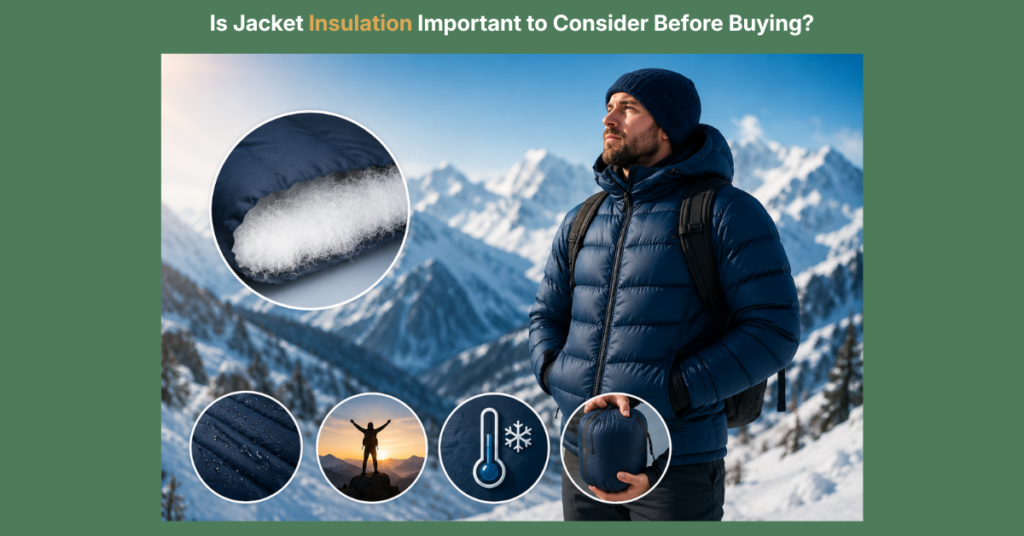
Is Jacket Insulation Important to Consider Before Buying?
Jacket insulation is critical to consider before buying because the specific density and material composition of the thermal fill directly dictate the garment’s capacity to trap metabolic heat and maintain core thermal equilibrium in freezing environments.
Purchasing outerwear based purely on the waterproof shell while ignoring the internal thermal layer frequently results in dangerous hypothermia risks and severe physical discomfort. Over five years of rigorous textile evaluation and active field-testing dictates a hard truth: an impenetrable exterior serves zero biological purpose if the internal microclimate collapses. Consumers routinely prioritize aesthetic silhouettes over functional textile engineering, resulting in compromised safety during severe weather exposure. You must reverse this logic. Thermal dynamics operate on absolute physical laws, demanding an objective analysis of how specific fill materials manage moisture and retain heat. A clinical evaluation of your metabolic output and environmental exposure permanently eliminates the guesswork from outerwear acquisition.
This guide provides a rigorous diagnostic framework for assessing thermal output needs, comparing natural down versus synthetic insulation, and avoiding high-stakes thermal failures. By shifting the consumer focus from aesthetic-driven shopping to strict thermal evaluation, you ensure that biological heat retention and environmental moisture management dictate weather survival.
Why analyzing jacket insulation determines your core thermal survival
Analyzing jacket insulation determines your core thermal survival by precisely matching the garment’s internal heat-trapping capacity to your specific biological baseline and environmental exposure. Biological heat retention operates as a constant battle against environmental variables, where inadequate thermal batting guarantees rapid temperature degradation. Every human body generates a baseline thermal output, and the structural integrity of a garment’s fill determines whether that output remains insulated against the skin or dissipates rapidly into the atmosphere. The integration of high-density insulation prevents rapid convective cooling, fundamentally stabilizing the internal microclimate during static or low-output phases in freezing temperatures. Without a dense layer of trapped air to intercept falling atmospheric temperatures, the human body rapidly exhausts its caloric reserves attempting to stay warm.
Rule: Aligning the garment’s thermal fill with your exact biological needs systematically prevents catastrophic core temperature drops during prolonged cold exposure.
Reason: A premium waterproof shell is entirely useless if the internal space cannot trap enough metabolic heat to counteract convective heat loss. Uninsulated barriers only block precipitation; they possess zero capacity to generate or hold thermal mass. While examining [The Science of Waterproof Breathable Membranes] explains exterior defense, the internal void strictly requires dense insulation to maintain thermal equilibrium.
Example: Shivering in a high-end, uninsulated raincoat during a freezing commute explicitly demonstrates how ignoring jacket insulation directly causes physical suffering, as the shell actively conducts cold against the body without a thermal buffer.
How to assess your jacket insulation needs based on physical output
Assessing your jacket insulation needs requires a systematic evaluation of your metabolic heat generation, specific fill power metrics, and the resulting weight-to-warmth ratio. Applying advanced diagnostic methodologies, such as the Dynamic Fit-Constraint Protocol, proves that maximizing mobility while preserving heat necessitates strict adherence to specific textile variables. Physical exertion drastically alters the baseline microclimate inside the garment. Evaluating these precise metrics ensures the final purchase supports human kinetic performance rather than hindering it through excessive bulk or insufficient ventilation.
-
1
Metabolic Heat Generation: Evaluate your activity level using the Metabolic Equivalent of Task (MET) scale to establish baseline heat production. High-MET activities, such as alpine climbing, generate massive internal heat and demand highly breathable, active insulation. Conversely, low-MET static activities, like observing wildlife or standing at a freezing bus stop, require maximal loft to prevent rapid heat dissipation.
-
2
Fill Power Metrics: Check down cluster ratings to measure the specific volume occupied by one ounce of down. (down insulation fill power) Standard 600-fill down requires significantly more physical bulk to achieve the same thermal resistance as premium 800-fill down. Higher ratings indicate superior lofting capabilities, meaning the down traps more insulating air per ounce of material without adding physical weight.
-
3
Weight-to-Warmth Ratio: Factor in the physical bulk of the thermal layer relative to its absolute insulating capacity. Dense, low-quality synthetic batting adds immediate weight and restricts joint mobility, whereas advanced high-loft materials provide maximum warmth with minimal physical mass.
Decision Matrix: Physical Output vs. Required Insulation Density
| Physical Output Level (MET) | Primary Thermal Requirement | Recommended Insulation Density & Type |
|---|---|---|
| Static / Low (1-3 MET) | Maximal heat retention; minimal breathability | High Fill Power Down (700-800+) or heavy synthetic |
| Moderate (4-6 MET) | Balanced heat trapping and moisture transfer | Mid-weight active synthetic or 600-fill down |
| High / Intense (7+ MET) | Rapid moisture evaporation; moderate warmth | Highly breathable, continuous filament synthetic |
Compare natural down versus synthetic jacket insulation to maximize utility
Comparing natural down versus synthetic jacket insulation maximizes utility by aligning the specific structural behavior of the fill material with your local atmospheric moisture levels. The foundational architecture of the thermal layer dictates how it responds to liquid saturation and vapor transmission. Natural down utilizes organic clusters to trap vast amounts of dead air, offering an unparalleled warmth-to-weight ratio in dry, freezing conditions. However, the introduction of atmospheric moisture alters the physical structure of untreated down, causing the clusters to collapse, lose loft, and instantaneously cease insulating. Exploring the nuances in [Understanding Down Fill Power] reveals why pure loft dictates warmth. Conversely, synthetic materials utilize extruded polyester fibers designed to mimic down clusters while inherently resisting water absorption. (synthetic insulation performance in wet conditions)
If: The user anticipates heavy, freezing rain or high physical sweating during their outdoor exposure…
Do: Select a high-loft continuous filament synthetic jacket insulation instead of untreated natural down.
Result: Core thermal equilibrium is safely maintained because synthetic fibers retain their structural loft and heat-trapping capabilities even when fully wet.
Comparison: Insulation Material Performance
| Insulation Material Type | Wet-Weather Performance | Ideal Climate Application |
|---|---|---|
| Premium Natural Down (Untreated) | Fails; clusters collapse and lose all thermal properties | Extremely cold, dry environments (e.g., high altitude, arctic) |
| Hydrophobic Down | Moderate; resists light moisture but degrades under sustained rain | Cold, mixed-weather environments with intermittent precipitation |
| Continuous Filament Synthetic | Excellent; maintains structural loft and traps heat when saturated | Cold, highly humid, or consistently wet marine environments |
Avoid jacket insulation mistakes that lead to severe thermal failure
Consumers frequently suffer severe thermal failure by committing jacket insulation mistakes, specifically misunderstanding the relationship between physical garment volume and actual heat retention. Utilizing flawed purchasing logic results in acquiring heavy garments that restrict movement while failing to protect against acute temperature drops. The outdoor industry relies heavily on aesthetic marketing, obscuring the strict textile physics that actually govern thermal performance. Shoppers must actively diagnose the internal materials rather than accepting superficial design claims. Misjudging the environmental context permanently degrades the functionality of the thermal fill.
The Volume Mistake: Assuming a thicker, heavier coat is automatically warmer than a thin one.
Fix: Look at the actual fill power; premium 800-fill down is incredibly thin but significantly warmer than heavy, cheap polyester batting. High fill power dictates greater trapped air volume, which acts as the true insulator, rather than the physical weight of the fabric itself.
The Moisture Mistake: Buying standard goose down for a highly humid, rainy city.
Fix: Switch to synthetic clusters or explicitly hydrophobically-treated down to prevent total loft collapse. Untreated down physically transforms into a heavy, useless mass when exposed to prolonged humidity, stripping the body of its defenses against cold.
To further understand how moisture degrades warmth, review our technical breakdown on Down vs. Synthetic Insulation.
The ultimate jacket insulation checklist to verify before checkout
Use this ultimate jacket insulation checklist to perform a rapid, foolproof evaluation of a garment’s thermal fill, weight profile, and moisture resistance before finalizing checkout. Approaching a purchase with a standardized diagnostic tool prevents emotional or brand-driven errors. The specific metrics governing thermal output and environmental resistance require confirmation prior to financial commitment. A clinical review of the garment’s technical specifications guarantees the product functions as a biological survival tool rather than mere aesthetic apparel. Validating these exact parameters ensures the jacket architecture fully supports the intended environmental application without risking severe thermal failure during critical moments. Execute this protocol to verify structural integrity.
- Does the specific fill material match my local climate’s moisture levels?
- Does the fill power align with my required warmth-to-weight ratio?
- Have I accounted for my own physical exertion levels when choosing the thickness?
Commit to the correct jacket insulation to ensure long-term outdoor comfort
In conclusion, committing to the correct jacket insulation ensures long-term outdoor comfort by structurally locking in metabolic heat during severe weather exposure.
Rule: Always secure your internal thermal layer before worrying about the exterior color or brand.
Reason: An inadequate fill material will fail to trap your body heat, instantly turning a luxury garment into a freezing liability.
Example: Define your required warmth, choose the specific fill engineered for those temperatures, and lock in a purchase that performs flawlessly in the cold. Ensure this acts as the final, actionable psychological push.