
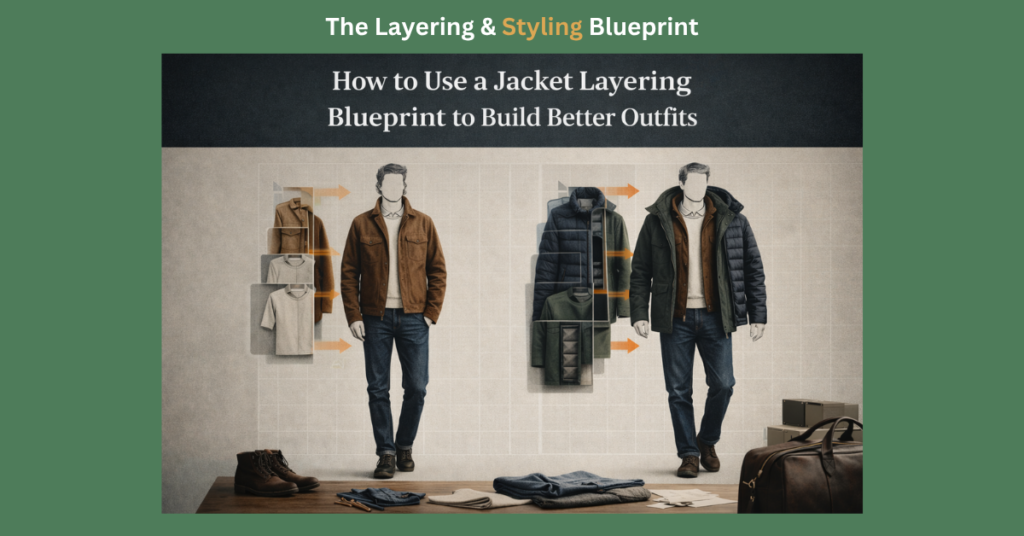
How to Use a Jacket Layering Blueprint to Build Better Outfits
Style System & Strategy
How to Use a Jacket Layering Blueprint to Build Better Outfits
Building better outfits requires moving past simple visual inspiration and adopting a structured jacket layering blueprint—a physical system that forces you to plan, coordinate, and execute your wardrobe choices before you ever open the closet door.
Most men seek style inspiration but inevitably default back to a predictable “hoodie-and-jeans” uniform. This happens because they lack a systematic method for execution and suffer from morning decision fatigue. This guide will walk you through the five distinct phases of a Jacket Layering Blueprint to effectively transform your existing closet. We will treat layering not just as a method for thermal regulation, but as a way to unlock the true architectural potential of clothing.
Why a structured jacket layering blueprint bridges the gap between inspiration and execution
A structured jacket layering blueprint bridges the gap between inspiration and execution because inspiration without a system inevitably leads to defaulting back to what is familiar and comfortable. Reading styling guides does not physically organize your closet. A 2012 study by Hajo Adam and Adam D. Galinsky, published in the Journal of Experimental Social Psychology, explored the concept of “Enclothed Cognition.” Using a white lab coat as their primary example, the researchers demonstrated that structured clothing actively alters a person’s cognitive focus. Inspiration without a system leads directly to defaulting. Using this blueprint forces you to build the outfit before you open the closet door, removing the friction of choice entirely.
Distill the core aesthetic of your jacket layering system (Phase 1)
Phase 1 requires you to distill the core aesthetic of your jacket layering system into a single, actionable sentence that defines the exact look you want to achieve. You must summarize your desired look into one sentence to avoid the maximalist error of wearing four or five disparate pieces at once. Consider the semiotics of your garments. The rugged, labor-focused history of the 1960s Levi’s Type III Trucker jacket stands in sharp contrast to the formal authority of Savile Row tailoring. Combining them creates an advanced high-low mix. This distillation must also account for local weather conditions. The extreme daily variance seen in transitional seasons across the US and EU—shifting from 50°F (10°C) mornings to 77°F (25°C) afternoons in cities like New York or London—is a perfect example of why material constraints matter.
Extract the exact complementary garments needed for your layered outfit (Phase 2)
Once the core aesthetic is established, Phase 2 dictates that you must extract the exact complementary garments needed to physically construct the layered outfit. We can examine the counterintuitive styling idea of Gorpcore, a term explored by major outdoor retailers. Gorpcore relies on the juxtaposition of using technical alpine gear, like Arc’teryx or Patagonia jackets, paired with traditional tailoring. Identify your specific items using this exact checklist format:
- 3 Complementary garments (e.g., Heavyweight white t-shirt, raw selvedge denim, brown Chelsea boots)
- 1 Counterintuitive styling idea (e.g., Pairing a highly technical Arc’teryx rain shell with traditional pleated wool trousers)
- 1 Key proportion rule (e.g., Inner jacket hem must be shorter than outer coat)
Diagram 1: The Layering Architecture
This schematic illustrates the “Thin Inside, Thick Outside” principle. The base layer acts as a fitted foundation for moisture management. The mid-layer (like your vintage denim) traps heat, while the outer topcoat serves as the primary structural and protective barrier against the elements.
Choose neglected closet items using the layering resonance matrix (Phase 3)
Phase 3 forces you to audit your current wardrobe and choose neglected closet items using a layering resonance matrix to ensure they fit your newly defined style profile. This systemic approach relies on logic rather than the emotional methodology of the KonMari system. You will utilize a 5-pile system to evaluate your garments and analyze their Cost-Per-Wear (CPW). Apply styling rules like the “Light Inside, Dark Outside” principle to break up monochromatic comfort zones.
- Question 1: Which neglected jacket fits this profile? (e.g., the suede bomber in the back of the closet).
- Question 2: How does this challenge my everyday uniform? (e.g., forcing the use of lighter earth tones).
Diagram 2: Layering Resonance Matrix
This matrix maps your existing garments based on Utility (Y-axis) and Aesthetic Resonance (X-axis). Items trapped in the bottom-left should be discarded. The goal of Phase 3 is to locate garments in the upper-right “Sweet Spot”—items like a neglected suede bomber that offer both high function and strong style integration.
Commit to a physical styling action with your outer layers (Phase 4)
To prevent this plan from remaining purely theoretical, Phase 4 requires you to commit to a physical styling action with your outer layers using a verb-based directive. Behavioral frameworks are essential here. In Atomic Habits, James Clear explains the concept of the “implementation intention.” You can use “habit stacking” by linking your outfit building to an existing evening routine to neutralize morning decision fatigue.
Rule: The commitment must start with an action verb.
Example: “I will physically lay out two outfits using my leather jacket before bed.”
Track your outfit success with a layering application log (Phase 5)
The final phase of the system is to track your outfit success in the real world using a layering application log to measure how the combination actually felt and performed. Logging tracks the thermodynamics of the wardrobe and helps you master micro-climate management. A variable environment like the transitional climates of the US and EU serves as a primary example of why testing fabric combinations is vital.
| Date Worn | Styling Plan | Result |
|---|---|---|
| 2026-03-27 | Denim-under-topcoat for casual Friday | Felt sharper, received a compliment |
Fix common execution mistakes when applying this jacket styling framework
Even with a blueprint, you must know how to fix common execution mistakes when applying this jacket styling framework to ensure the final look is polished and proportional. You must enforce the foundational principle of “Thin Inside, Thick Outside.”
-
If the inner hem peaks out at the bottom
➔ Do swap for a shorter mid-layer or a longer topcoat. -
If the colors feel too uniform
➔ Do reference your Resonance Matrix to add a contrasting earth tone. -
If the silhouette feels overwhelmingly bulky
➔ Do remove the thickest mid-layer and enforce the strict three-layer maximum.
Diagram 3: Hemline Proportion Mechanics
The single most common layering mistake is a disproportionate hemline. As shown on the left, if the mid-layer extends past the outer coat, it visually cuts the torso in half. The correct application (right) ensures the outer layer is the longest garment, maintaining a clean, uninterrupted silhouette.
Clarify frequently asked questions about jacket layering rules
Q: Does this work for warmer climates?
A: Yes, swap heavy wools for unlined cotton or linen outer layers to manage transitional climates where temperatures swing between 10°C and 25°C in a single day.
Q: How do I know if it’s too bulky?
A: If the outer coat pulls at the buttons or restricts arm movement, the mid-layer is too thick and creates an unpolished silhouette.
Sources & References
Conclusion
In conclusion, upgrading from a standard hoodie-and-jeans default is entirely achievable when you replace random inspiration with the structured, five-phase physical system of the jacket layering blueprint. You have learned to distill your aesthetic, extract garments, and audit your closet systematically. You committed to physical action through habit stacking and tracked your results to improve your Cost-Per-Wear. Applying these principles is made seamless with the structured templates provided in the Torivawear Blueprint. Ultimately, building better outfits isn’t about buying more clothes; it’s about applying a proven system to the wardrobe you already own.