
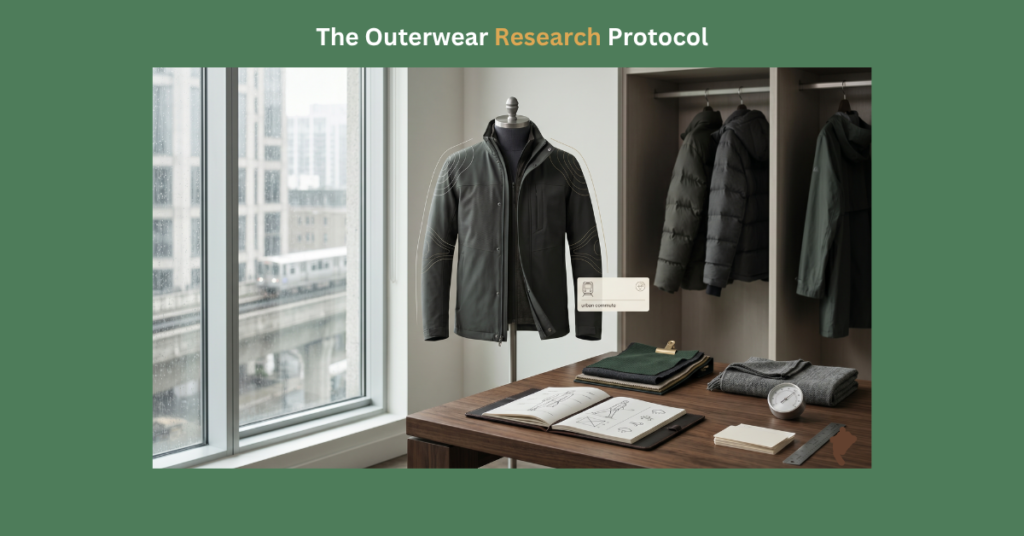
How to Execute the Outerwear Research Protocol to Find Your Core Jacket
How to Execute the Outerwear Research Protocol to Find Your Core Jacket
Within the discipline of technical apparel acquisition and personal wardrobe management, the “Outerwear Gap” is a systemic behavioral anomaly that occurs when you own multiple jackets designed for extreme, imagined scenarios, yet lack a single, functional “Core Jacket” capable of regulating your temperature during the exact micro-climates of your actual daily commute.
A diagnostic wardrobe audit of the average professional’s closet frequently reveals sub-zero Himalayan mountaineering parkas, impenetrable PVC marine shells, and structurally fragile suede garments. These items are entirely useless for the quintessential baseline example: a standard Tuesday morning multi-modal commute. Consider the physical reality of a brisk walk in 45°F/7.2°C breezy weather with a light precipitation threat, waiting on a stagnant subterranean transit platform, and arriving at a climate-controlled corporate environment.
This guide provides the definitive Outerwear Research Protocol—a data-driven, 14-day diagnostic framework designed to mathematically deduce the exact specifications of your ideal everyday Core Jacket.
Understand Why the Outerwear Gap Ruins Your Daily Wardrobe
The primary cause of the outerwear gap is a recognized cognitive bias: humans systematically overestimate the probability and impact of extreme weather events while simultaneously underestimating the persistent, low-grade friction of their actual daily commute.
Failing to mathematically diagnose your physical environment results in a wardrobe optimized for the 1% of your life. During that standard Tuesday morning commute, the expedition parka induces immediate, severe hyperthermia. The marine rain shell fails to breathe, causing rapid internal condensation. The suede garment suffers immediate material degradation from mild drizzle. Before you can mathematically deduce the Core Jacket, you must first diagnose exactly how your current inventory is failing your reality through the lens of textile physics and sociology.
Diagnose Your Current Outerwear Research Protocol Symptoms
Identifying the specific ways your current jackets fail your daily needs requires an uncompromising diagnostic audit of your physical discomfort and aesthetic mismatches using a structured symptom matrix. You must identify your exact pain points before proceeding to the data collection phase.
- The “Boil-in-a-Bag” Effect: Severe internal condensation and overheating due to a failure in textile moisture vapor transmission.
- The Style Mismatch: Sociological and aesthetic incongruence between technical garments and required professional attire.
- The Shiver Factor: High rates of convective heat loss and radiant cooling overriding the presence of internal insulation.
- The Umbrella Dependency: Failure of the textile’s hydrostatic resistance or surface tension, leading to external moisture absorption.
- The Bulk Burden: Excessive insulation volume resulting in severe kinematic restriction and spatial inefficiency.
The “Boil-in-a-Bag” Effect: The Physics of Impermeability
This phenomenon derives its etymology from food science. Flexible packaging pouches are constructed from biaxially oriented polyethylene terephthalate (PET), aluminum foil, and low-density polyethylene (LDPE) laminates designed to withstand boiling water sterilization. Apparel manufacturers utilizing low-cost non-porous polyurethane coatings or traditional polyvinyl chloride (PVC) create this exact impermeable trap. Physical exertion triggers the sudomotor response. This active metabolic engine secretes perspiration for evaporative cooling during mild exertion like walking to a train. Without a high Moisture Vapor Transmission Rate (MVTR) and adequate moisture-wicking, the relative humidity inside the jacket reaches saturation. Evaporated sweat condenses back into liquid on the interior face—a physiological trap heavily documented in the Journal of Applied Physiology and the Textile Research Journal. Breathability is a non-negotiable thermal baseline for effective thermoregulation.
The Style Mismatch: Aesthetic and Sociological Incongruence
Clothing functions as non-verbal communication and semiotics. This sartorial coding establishes professional boundaries, as documented in sociological frameworks found in the Journal of Consumer Culture. Visual friction occurs when a brightly colored, heavily logoed technical alpine shell—composed of synthetic nylon and light-reflecting materials—is paired with a worsted wool suit or classic dress trousers featuring an organic, matte finish. Technical priorities emphasize articulation, external seam taping, and high-vis hardware. Formal architectural priorities demand structured tailoring, hidden stitching, and subtle silhouettes. Ignoring your Formality Quotient disrupts the visual hierarchy of your daily environment.
The Shiver Factor: Wind Chill and Convective Heat Loss
Surface tension also governs weather resistance. Durable Water Repellent (DWR) coating alters surface tension to make water bead off the fabric. The catastrophic failure state known as “wetting out” occurs when this DWR degrades. The face fabric absorbs water, creating an unbroken solid film of moisture that drops MVTR breathability instantly to zero, a failure state extensively documented in AATCC testing standards. Precipitation will aggressively ingress through the microscopic holes created by sewing needles if seams lack waterproof tape.
The Umbrella Dependency: The Failure of Water Resistance
Weather resistance requires mathematical thresholds, evaluated primarily via the Hydrostatic Head (HH) test. This metric measures the height of a water column in millimeters before pressure forces moisture through the textile.
| Hydrostatic Head (HH) Rating | Technical Classification | Functional Environmental Application |
|---|---|---|
| <10,000 mm | Water-Resistant / Showerproof | Suitable only for light drizzle. Highly susceptible to failure under sustained precipitation. |
| 10,000 mm | Rainproof (Minimum Standard) | The entry-level threshold. Capable of handling moderate rain showers for short periods. |
| 15,000 mm | Sustained Waterproof | Capable of withstanding extended heavy rain. Ideal for long urban commutes. |
| 20,000 mm+ | Extreme Waterproof | Engineered for extreme pressure (e.g., heavy backpack straps forcing water into the membrane). |
Surface tension also governs weather resistance. Durable Water Repellent (DWR) coating alters surface tension to make water bead off the fabric. The catastrophic failure state known as “wetting out” occurs when this DWR degrades. The face fabric absorbs water, creating an unbroken solid film of moisture that drops MVTR breathability instantly to zero, a failure state extensively documented in AATCC testing standards. Precipitation will aggressively ingress through the microscopic holes created by sewing needles if seams lack waterproof tape.
The Bulk Burden: Ergonomic and Kinematic Restriction
Bulk burden operates as a strict military and tactical design constraint. Engineers must balance power density against weight and volume to prevent degraded spatial awareness and operational endurance. Massively inflated high-loft down coats cause severe kinematic restriction on crowded civilian transit vehicles. The wearer experiences an inability to articulate arms to hold an overhead railing or sit without intruding on adjacent seating, forcing them to immediately doff the coat. Solving this requires high clo-values achieved via thin-profile synthetic insulation paired with wind-blocking shells.
Define Your Precise Outerwear Gap Problem Statement
Condensing your diagnosed symptoms into a single, actionable Problem Statement provides the exact negative constraints you must aggressively avoid in your next outerwear purchase.
The strict causal logic framework dictates your analysis: If you identify specific symptoms, you must complete the diagnostic template to achieve absolute clarity on negative constraints. This logically derived statement psychologically inoculates the buyer against aggressive marketing and impulse purchasing behavior.
“My current outerwear is failing because it is too
[ Insert Flaw: e.g., heavy, casual, unbreathable ]
for my actual daily environment. As a result, I frequently feel
[ Insert Pain Point: e.g., suffocated by my own metabolic heat on the transit platform, underdressed at corporate meetings ].”
A completed statement reads exactly like this:
“My current outerwear is failing because it is entirely unbreathable and looks too aggressively athletic for my actual daily environment. As a result, I frequently feel suffocated by my own metabolic heat on the transit platform, and highly underdressed and unprofessional when walking into corporate meetings.”
Establish the 3 Core Variables for Your Outerwear Diagnostic
The foundation of the Outerwear Research Protocol relies on treating the standard macro-level weather forecast as a drastically insufficient data point; instead, you must track three precise variables over a 14-day observational period: The Elements, Exertion Level, and Formality Need.
| Variable | What it measures | Example |
|---|---|---|
| 1. The Elements | The direct weather hitting your micro-climate (not the app forecast). | Wind tunnels, unshaded radiant heat, mist, subway humidity. |
| 2. Exertion Level | The metabolic physical heat generated by your body. | Prolonged stationary standing vs. elevated heart-rate speed-walking. |
| 3. Formality Need | The strict aesthetic and sociological constraints of your destination. | Highly regulated corporate firm vs. casual creative studio. |
Variable 1: The Elements
Forecasting apps abstract data for massive geographic regions, ignoring localized conditions. Climatological research across university campuses demonstrates ambient temperatures can vary by up to 13°C at the exact same minute due to shadows, surface reflectivity, and wind tunneling. Utilizing the Physiologically Equivalent Temperature (PET) metric, an urban bus stop can record a mean PET of 49.5°C in the shade, but spike to a maximum observed 81.6°C moving just a few feet into direct sunlight on the concrete platform. Environmental data requires exact point-of-contact measurement.
Variable 2: Exertion Level
Metabolic exertion dictates non-negotiable MVTR and mechanical ventilation requirements. The body must balance thermal retention with moisture vapor exhaust. Utilizing micro-mobility options like e-bikes lowers exertion but increases convective wind-chill. Contrast this against a frantic 15-minute speed-walk with an elevated heart rate ascending three flights of subway stairs, which drastically spikes physical heat generation.
Variable 3: Formality Need
Outerwear serves as an aesthetically viable transitional bridge between chaotic exterior elements and highly regulated interior environments. A corporate law firm or financial institution requires traditional worsted wool suits, polished leather footwear, a matte finish, hidden hardware, and tailored drape. A casual creative studio accepts heavy denim, canvas, sneakers, and technical shells as standard norms. Documenting this variable establishes your strict visual boundaries.
Commit to Your 14-Day Core Jacket Tracking Contract
The transition from theoretical diagnosis to active empirical data collection requires a formalized, binding commitment to consistency to mathematically deduce the exact specifications of your ideal Core Jacket. Over the next 14 days, you must meticulously log your daily micro-climates, exertion levels, and social settings.
Diagnostic Commitment
“I commit to physically tracking my precise environmental variables, exertion states, and formality requirements for exactly 14 days prior to any outerwear acquisition.”
This psychological binding mechanism reframes the search as a strict, scientific data-gathering operation. It halts erratic, impulse-driven purchasing behavior.
Protocol Progress
Day 1 of 14 Active
Complete the 14-day tracking matrix to unlock analysis.
Frequently Asked Questions
Executing a 14-day environmental tracking phase introduces logistical questions; the answers below clarify the strict analytical guidelines for data collection.
Do I track the weather report or my actual experience?
What if my commute changes from day to day?
Why exactly 14 days?
Conclude the Protocol and Prepare for Your Core Jacket Search
The cardinal, unbreakable rule of the Outerwear Research Protocol is absolute: objective data collection must always precede the purchase.
Mathematically deducing the precise needs of the daily commute prevents the consumer from ever wasting money on the wrong outerwear again. Hard textile metrics replace guesswork.
- If data reveals frequent exposure to sustained, heavy rain combined with brisk, high-exertion walking: The specifications must demand a minimum 15,000 mm HH rating paired with an extremely high MVTR (e.g., 20,000 g/m²/24hr), strictly dictating a 3-layer laminated fabric.
- If data shows brief walks in light drizzle: An uninsulated softshell treated with a high-quality DWR coating will suffice, drastically improving comfort and eliminating the Bulk Burden.
- If the workplace dictates a formal environment: The search criteria narrows exclusively to garments that conceal their advanced laminated membranes and taped seams behind matte-finish fabrics and classic tailoring techniques, ensuring total visual harmony.
Your Core Jacket ceases to be a mere garment; it becomes a precisely engineered, mathematically deduced tool designed to seamlessly resolve the specific environmental and sociological friction of your daily reality.